Shady crypto mixing protocol eXch is merging with an offshore entity and restructuring to evade scrutiny over laundering tens of millions stolen from Bybit. Centralized crypto mixing protocol eXch revealed in an update on Bitcoin Talk that it plans to…
Cryptocurrency News
GameStop completes $1.5B sale, eyeing Bitcoin acquisition [btcmanager]
GameStop, the video game retailer, has completed a $1.5 billion offering of convertible senior notes, with plans to use the funds to buy Bitcoin for its treasury. The sale, completed on Apr. 1, 2025, raised $1.48 billion after fees, according…
7-Eleven South Korea to accept CBDC payments in national pilot program [cointelegraph]

South Korea’s 7-Eleven stores will accept payments in the country’s central bank digital currency (CBDC) until June, as the retailer participates in the test phase of its CBDC project.
The convenience store chain will reportedly provide a 10% discount on all products paid for with CBDC during the test period. According to Moon Dae-woo, head of 7-Eleven’s digital innovation division, the company is making an effort to incorporate digital technology advancements in its operations.
The executive added that the company’s participation in the CBDC test will help accelerate the firm’s digital transformation.
Many stores will participate in South Korea’s CBDC testing phase, which runs from April 1 to June 30. The project also involves 100,000 participants who will be allowed to test payments using CBDC issued by the central bank.
Central bank digital currencies are digital assets issued by government agencies. Like other digital assets, CBDCs offer faster and more modernized payment features. However, unlike Bitcoin and other privacy-focused tokens that offer certain levels of anonymity, CBDCs are controlled and monitored by governments.
Related: Over 400 South Korean officials disclose $9.8M in crypto holdings
South Korea tests CBDC from April to June
On March 24, government agencies including the Bank of Korea, the Financial Services Commission (FSC) and the Financial Supervisory Service (FSS) announced the CBDC test.
Participants can convert their bank deposits into tokens stored in a distributed ledger during the test period. The tokens hold the same value as the Korean won.
The government agencies said citizens aged 19 or older with a deposit account in a participating bank could apply to take part. Registrations were limited to 100,000 participants. KB, Koomin, Shinhan, Hana, Woori, NongHyup, IBK and Busan are among the banks participating in the CBDC tests.
Apart from 7-Eleven, participants can use their CBDCs in coffee shops, supermarkets, K-Pop merchandise stores and delivery platforms. However, users will be limited to a total conversion limit of 5 million won ($3,416) during testing.
The Bank of Korea first announced the retail CBDC testing for 100,000 users in November 2023 and was originally scheduled to begin in the fourth quarter of 2024. The FSS said the country’s CBDC test represents a step toward creating a prototype for a “future monetary system.”
Magazine: Ridiculous ‘Chinese Mint’ crypto scam, Japan dives into stablecoins: Asia Express
VanEck on track to launch first-ever BNB ETF [btcmanager]
VanEck has made a move to expand its digital asset footprint by by filing to establish a trust for the first-ever exchange-traded fund that will track the price of Binance Coin, the fifth largest cryptocurrency by market cap. On March…
Social platform 9GAG acquires Hong Kong-listed firm to buy Bitcoin, double down on AI [btcmanager]
9GAG has reportedly taken control of Hong Kong-listed Howkingtech, which may be rebranded as MemeStrategy to explore AI, cryptocurrencies, and creator economy opportunities. Ray Chan, the co-founder of 9GAG, a popular meme-sharing and news site, is said to have taken…
Nakamoto coefficient explained: Measuring decentralization in blockchain networks [cointelegraph]

Measuring decentralization in blockchain
Decentralization involves spreading control and decision-making across a network instead of a single authority.
Unlike centralized systems, where one entity controls everything, decentralized blockchains distribute data among participants (nodes). Each node holds a copy of the ledger, ensuring transparency and reducing the risk of manipulation or system failure.

In blockchain, a decentralized network provides significant advantages:
Security: Decentralization reduces vulnerabilities associated with central points of attack. Without a single controlling entity, malicious actors find it more challenging to compromise the network. Transparency: All transactions are recorded on a public ledger accessible to all participants, fostering trust through transparency. This openness ensures that no single entity can manipulate data without consensus. Fault tolerance: Decentralized networks are more resilient to failures. Data distribution across multiple nodes ensures that the system remains operational even if some nodes fail.
So, decentralization is good, but it’s not a fixed state. It’s more of a spectrum, constantly shifting as network participation, governance structures and consensus mechanisms evolve.
And yes, there’s a ruler for that. It’s called the Nakamoto coefficient.
What is the Nakamoto coefficient?
The Nakamoto coefficient is a metric used to quantify the decentralization of a blockchain network. It represents the minimum number of independent entities — such as validators, miners or node operators — that would need to collude to disrupt or compromise the network’s normal operation.
This concept was introduced in 2017 by former Coinbase chief technology officer Balaji Srinivasan and was named after Bitcoin’s creator, Satoshi Nakamoto.
A higher Nakamoto coefficient indicates greater decentralization and security within the blockchain network. In such networks, control is more widely distributed among participants, making it more challenging for any small group to manipulate or attack the system. Conversely, a lower Nakamoto coefficient suggests fewer entities hold significant control, increasing the risk of centralization and potential vulnerabilities.
For example, a blockchain with a Nakamoto coefficient of 1 would be highly centralized, as a single entity could control the network. In contrast, a network with a coefficient of 10 would require at least 10 independent entities to collude to exert control, reflecting a more decentralized and secure structure.
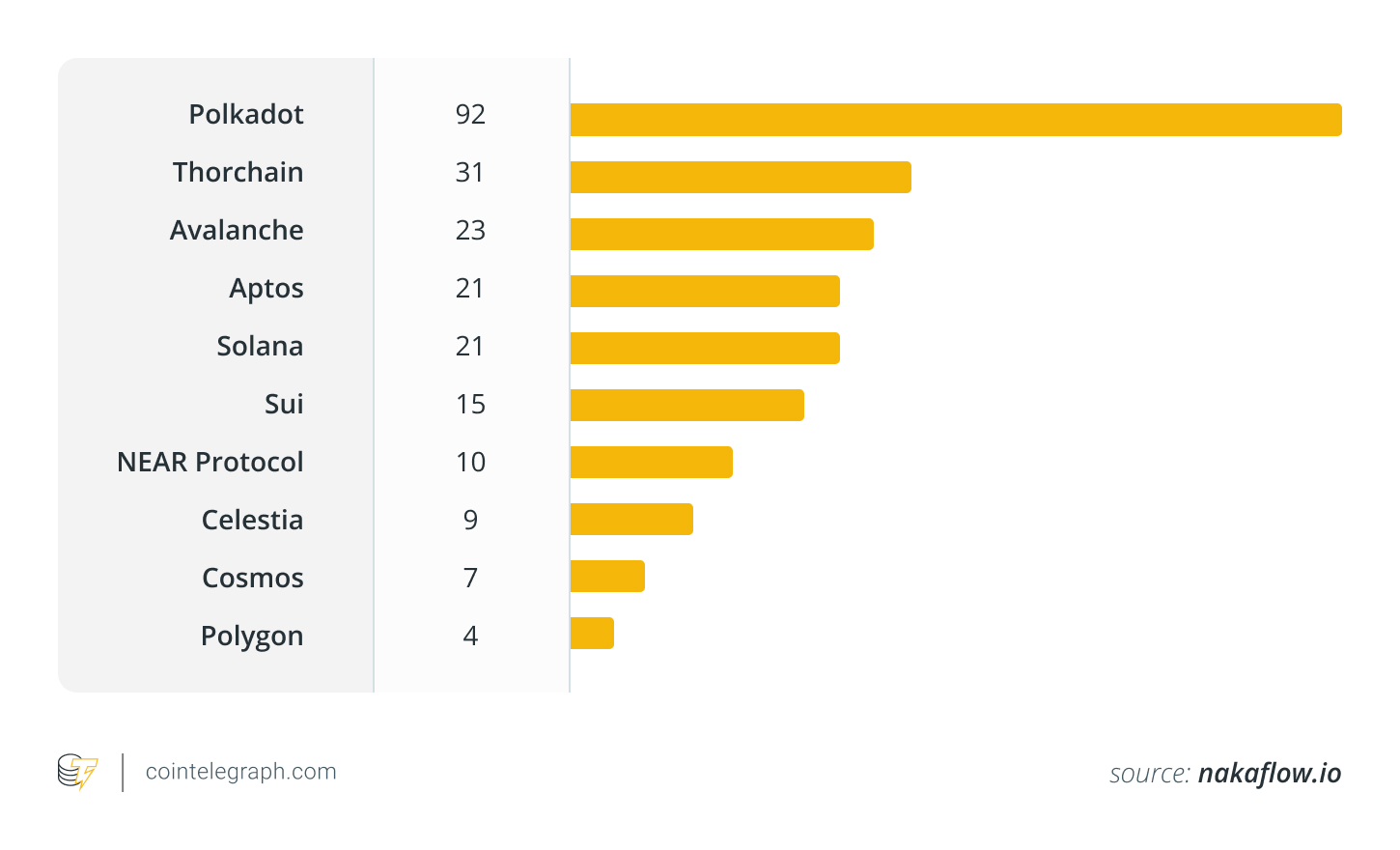
Did you know? Polkadot‘s high score on the Nakamoto coefficient is largely due to Polkadot’s nominated proof-of-stake (NPoS) consensus mechanism, which promotes an even distribution of stakes among a large number of validators.
Calculating the Nakamoto coefficient
Calculating this coefficient involves several key steps:
Identification of key entities: First, determine the primary actors within the network, such as mining pools, validators, node operators or stakeholders. These entities play significant roles in maintaining the network’s operations and security.Assessment of each entity’s control: Next, evaluate the extent of control each identified entity has over the network’s resources. For instance, in proof-of-work (PoW) blockchains like Bitcoin, this involves analyzing the hashrate distribution among mining pools. In proof-of-stake (PoS) systems it requires examining the stake distribution among validators.Summation to determine the 51% threshold: After assessing individual controls, rank the entities from highest to lowest based on their influence. Then, cumulatively add their control percentages until the combined total exceeds 51%. The number of entities required to reach this threshold represents the Nakamoto coefficient.

Consider a PoW blockchain with the following mining pool distribution:
Mining pool A: 25% (of the total hashrate)Mining pool B: 20%Mining pool C: 15%Mining pool D: 10%Others: 30%
To determine the Nakamoto coefficient:
Start with mining pool A (25%).Add mining pool B (25% 20% = 45%).Add mining pool C (45% 15% = 60%).
In this scenario, the combined hashrate of mining pools A, B and C reaches 60%, surpassing the 51% threshold. Therefore, the Nakamoto coefficient is 3, indicating that collusion among these three entities could compromise the network’s integrity.
Did you know? Despite Bitcoin’s reputation for decentralization, its mining subsystem is notably centralized. The Nakamoto coefficient is currently 2 for Bitcoin. This means that just two mining pools control most of Bitcoin’s mining power.
Limitations of the Nakamoto coefficient
While the Nakamoto coefficient serves as a valuable metric for assessing blockchain decentralization, it possesses certain limitations that warrant careful consideration.
For example:
Static snapshot
The Nakamoto coefficient provides a static snapshot of decentralization, reflecting the minimum number of entities required to compromise a network at a specific point in time.
However, blockchain networks are dynamic, with participant roles and influence evolving due to factors like staking, mining power shifts or node participation changes. Consequently, the coefficient may not accurately capture these temporal fluctuations, potentially leading to outdated or misleading assessments.
Subsystem focus
This metric typically focuses on specific subsystems, such as validators or mining pools, potentially overlooking other critical aspects of decentralization. Factors like client software diversity, geographical distribution of nodes and token ownership concentration also significantly impact a network’s decentralization and security.
Relying solely on the Nakamoto coefficient might result in an incomplete evaluation.
Consensus mechanism variations
Different blockchain networks employ various consensus mechanisms, each influencing decentralization differently. The Nakamoto coefficient may not uniformly apply across these diverse systems, necessitating tailored approaches for accurate measurement.
External Influences
External factors, including regulatory actions, technological advancements or market dynamics, can influence decentralization over time. For example, regulatory policies in specific regions might affect the operation of nodes or mining facilities, thereby altering the network’s decentralization landscape.
The Nakamoto coefficient may not account for such externalities, limiting its comprehensiveness.
To sum up, the Nakamoto coefficient is useful for assessing certain aspects of blockchain decentralization. It should be used alongside other metrics and qualitative assessments to gain a comprehensive understanding of a network’s decentralization and security.
Sony Singapore now accepts USDC payments through Crypto.com [btcmanager]
Sony Singapore has announced that it will start accepting customer payments in USDC through Crypto.com. The company also plans to accept other crypto assets in the future. Starting from April 2 11:00 SST, Singaporean users can start paying for Sony…
Bitcoin sales at $109K all-time high 'significantly below' cycle tops — Research [cointelegraph]
Bitcoin (BTC) investors who bought BTC in 2020 or later are still waiting for higher prices, new research says.
In findings published on X on April 1, onchain analytics firm Glassnode revealed that $110,000 was not high enough to make many hodlers sell.
Glassnode: 2020 Bitcoin buyers “still holding”
Bitcoiners who entered the market between three and five years ago have retained their holdings despite significant BTC price upside.
According to Glassnode, this investor cohort, with a cost basis between the 2020 lows of $3,600 and the 2021 highs of $69,000, is still hodling.
“Although the share of wealth held by investors who bought $BTC 3–5 years ago has declined by 3 percentage points since its November 2024 peak, it remains at historically elevated levels,” it said.
“This suggests that the majority of investors who entered between 2020 and 2022 are still holding.”
Bitcoin Realized Cap HODL Waves data. Source: Glassnode
An accompanying chart shows data from the Realized Cap HODL Waves metric, which splits the BTC supply into sections based on when each coin last moved onchain.
Using this, Glassnode is able to draw a distinction between the 2020-22 buyers and those who came immediately before them.
“In contrast, over two-thirds of those who had bought $BTC 5–7 years ago exited their positions by the December 2024 peak,” it reveals, reflecting their lower cost basis.
Speculators stay cool at BTC price highs
As Cointelegraph reported, more recent buyers, who form the more speculative investor cohort known as short-term holders (STHs), have proven much more sensitive to recent BTC price volatility.
Related: Bitcoin sellers ‘dry up’ as weekly exchange inflows near 2-year low
Episodes of panic selling have occurred throughout the past six months as BTC/USD hit new record highs and then fell by up to 30%.
Continuing, Glassnode said that current STH participation does not suggest a speculative frenzy — something common to previous BTC price cycle tops.
“Short-Term Holders currently hold around 40% of Bitcoin’s network wealth, after peaking near 50% earlier in 2025,” it said, alongside Realized Cap HODL Waves data on March 31.
“This remains significantly below prior cycle tops, where new investor wealth peaked at 70–90%, suggesting a more tempered and distributed bull market so far.”
Bitcoin Realized Cap HODL Waves. Source: Glassnode
This article does not contain investment advice or recommendations. Every investment and trading move involves risk, and readers should conduct their own research when making a decision.
Bitcoin sales at $109K all-time high 'significantly below' cycle tops — Glassnode [cointelegraph]
Bitcoin (BTC) investors who bought BTC in 2020 or later are still waiting for higher prices, new research says.
In findings published on X on April 1, onchain analytics firm Glassnode revealed that $110,000 was not high enough to make many hodlers sell.
Glassnode: 2020 Bitcoin buyers “still holding”
Bitcoiners who entered the market between three and five years ago have retained their holdings despite significant BTC price upside.
According to Glassnode, this investor cohort, with a cost basis between the 2020 lows of $3,600 and the 2021 highs of $69,000, is still hodling.
“Although the share of wealth held by investors who bought $BTC 3–5 years ago has declined by 3 percentage points since its November 2024 peak, it remains at historically elevated levels,” it said.
“This suggests that the majority of investors who entered between 2020 and 2022 are still holding.”
Bitcoin Realized Cap HODL Waves data. Source: Glassnode
An accompanying chart shows data from the Realized Cap HODL Waves metric, which splits the BTC supply into sections based on when each coin last moved onchain.
Using this, Glassnode is able to draw a distinction between the 2020-22 buyers and those who came immediately before them.
“In contrast, over two-thirds of those who had bought $BTC 5–7 years ago exited their positions by the December 2024 peak,” it reveals, reflecting their lower cost basis.
Speculators stay cool at BTC price highs
As Cointelegraph reported, more recent buyers, who form the more speculative investor cohort known as short-term holders (STHs), have proven much more sensitive to recent BTC price volatility.
Related: Bitcoin sellers ‘dry up’ as weekly exchange inflows near 2-year low
Episodes of panic selling have occurred throughout the past six months as BTC/USD hit new record highs and then fell by up to 30%.
Continuing, Glassnode said that current STH participation does not suggest a speculative frenzy — something common to previous BTC price cycle tops.
“Short-Term Holders currently hold around 40% of Bitcoin’s network wealth, after peaking near 50% earlier in 2025,” it said, alongside Realized Cap HODL Waves data on March 31.
“This remains significantly below prior cycle tops, where new investor wealth peaked at 70–90%, suggesting a more tempered and distributed bull market so far.”
Bitcoin Realized Cap HODL Waves. Source: Glassnode
This article does not contain investment advice or recommendations. Every investment and trading move involves risk, and readers should conduct their own research when making a decision.
Sony Electronics Singapore accepts USDC payments through Crypto.com [cointelegraph]

The online store of a Singapore-based subsidiary of Japanese tech behemoth Sony is now accepting USDC payments through Crypto.com.
According to an April 2 announcement, Sony Electronics Singapore now accepts USDC (USDC) stablecoin payments through an integration with the Crypto.com exchange. Crypto.com Singapore general manager Chin Tah Ang said:
“We’re pushing to make paying in crypto more mainstream and partnering with a well-established and forward-thinking brand like Sony Electronics Singapore further raises awareness of how simple it can be to pay for everyday goods and services using crypto.”
The Sony subsidiary is not the only high-profile partnership Crypto.com is involved in. At the end of 2024, the mobile-first crypto exchange partnered with Deutsche Bank to provide corporate banking services across Asian-Pacific markets, covering regions such as Singapore, Australia and Hong Kong.
Related: CFTC mulling probe of Crypto.com over Super Bowl contracts: Report
Singapore bets on stablecoins
Still, the Singaporean Sony subsidiary allowing stablecoin payments may be the start of a new trend in the region. Late February reports indicated that Metro, a publicly listed department store chain in Singapore, had enabled its customers to pay for products using stablecoins like Tether’s USDt.
The initiatives also follow January reports that Singapore is becoming a key destination for Web3 companies after it issued twice as many crypto licenses in 2024 as the previous year. William Croisettier, chief growth officer of ZKcandy, told Cointelegraph at the time:
“The country adopts a risk-adjusted approach to crypto regulation, focusing on the biggest digital currencies to protect investors. Singapore also makes it easy for new crypto firms to interact with local banking partners, a provision considered a luxury in other parts of the world.”
Related: Singapore Exchange to list Bitcoin futures in H2 2025: Report
An emerging crypto hub
In late November, the crypto-friendly digital bank Singapore Gulf Bank reportedly sought a fund injection of at least $50 million as it planned to acquire a stablecoin payments company in 2025. The firm was motivated to pursue the effort, with plans to sell up to 10% of its equity to fund it.
A study published at the end of 2024 revealed that its approach to regulation has made Singapore a global champion of blockchain technology. The country scored highest among all considered jurisdictions based on multiple factors.

The top blockchain jurisdictions ranked based on patents, jobs, and exchanges. Source: ApeX Protocol
Magazine: Singapore ‘not ready’ for Bitcoin ETFs, sneaky crypto mining rig importer: Asia Express