The first quarter of 2025 was a turbulent period for web3, with AI and social dApps gaining traction while decentralized finance suffered a sharp decline. The total value locked in DeFi fell 27% to $156 billion, as per DappRadar’s Q1…
Cryptocurrency News
DappRadar: DeFi TVL fell 27% in Q1 as AI and social dApps drove web3 growth [btcmanager]
The first quarter of 2025 was a turbulent period for web3, with AI and social dApps gaining traction while decentralized finance suffered a sharp decline. The total value locked in DeFi fell 27% to $156 billion, as per DappRadar’s Q1…
EU could fine Elon Musk’s X $1B over illicit content, disinformation [cointelegraph]
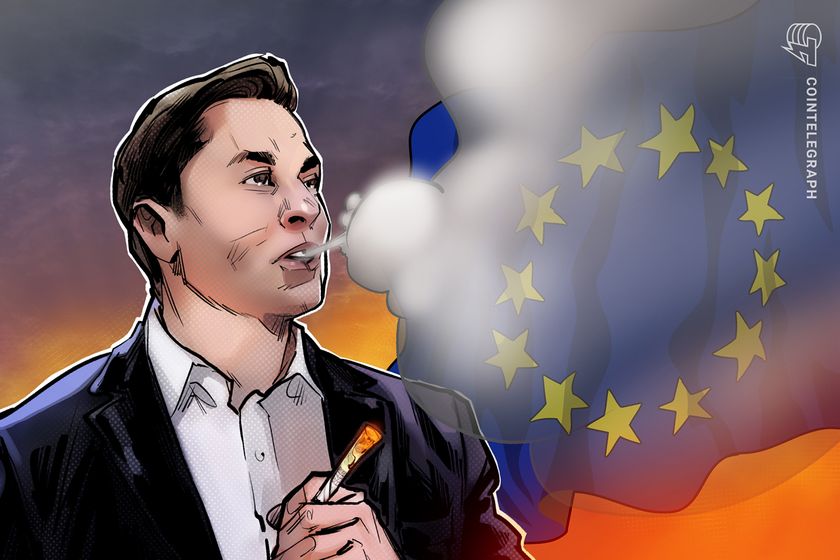
European Union regulators are reportedly mulling a $1 billion fine against Elon Musk’s X, taking into account revenue from his other ventures, including Tesla and SpaceX, according to The New York Times.
EU regulators allege that X has violated the Digital Services Act and will use a section of the act to calculate a fine based on revenue that includes other companies Musk controls, according to an April 3 report by the newspaper, which cited four people with knowledge of the plan.
Under the Digital Services Act, which came into law in October 2022 to police social media companies and “prevent illegal and harmful activities online,” companies can be fined up to 6% of global revenue for violations.
A spokesman for the European Commission, the bloc’s executive branch, declined to comment on this case to The New York Times but did say it would “continue to enforce our laws fairly and without discrimination toward all companies operating in the EU.”
In a statement, X’s Global Government Affairs team said that if the reports about the EU’s plans are accurate, it “represents an unprecedented act of political censorship and an attack on free speech.”
“X has gone above and beyond to comply with the EU’s Digital Services Act, and we will use every option at our disposal to defend our business, keep our users safe, and protect freedom of speech in Europe,” X’s global government affairs team said.

Source: Global Government Affairs
Along with the fine, the EU regulators could reportedly demand product changes at X, with the full scope of any penalties to be announced in the coming months.
Still, a settlement could be reached if the social media platform agrees to changes that satisfy regulators, according to the Times.
One of the officials who spoke to the Times also said that X is facing a second investigation alleging the platform’s approach to policing user-generated content has made it a hub of illegal hate speech and disinformation, which could result in more penalties.
X EU investigation ongoing since 2023
The EU investigation began in 2023. A preliminary ruling in July 2024 found X had violated the Digital Services Act by refusing to provide data to outside researchers, provide adequate transparency about advertisers, or verify the authenticity of users who have a verified account.
Related: Musk says he found ‘magic money computers’ printing money ‘out of thin air’
X responded to the ruling with hundreds of points of dispute, and Musk said at the time he was offered a deal, alleging that EU regulators told him if he secretly suppressed certain content, X would escape fines.
Thierry Breton, the former EU commissioner for internal market, said in a July 12 X post in 2024 that there was no secret deal and that X’s team had asked for the “Commission to explain the process for settlement and to clarify our concerns,” and its response was in line with “established regulatory procedures.”
Musk replied he was looking “forward to a very public battle in court so that the people of Europe can know the truth.”

Source: Thierry Breton
Magazine: XRP win leaves Ripple a ‘bad actor’ with no crypto legal precedent set
Coinbase Institutional files for XRP futures trading with CFTC [cointelegraph]

US crypto exchange Coinbase has filed with the US Commodity Futures Trading Commission (CFTC) to launch futures contracts for Ripple’s XRP token.
“We’re excited to announce that Coinbase Derivatives has filed with the CFTC to self-certify XRP futures — bringing a regulated, capital-efficient way to gain exposure to one of the most liquid digital assets,” stated Coinbase Institutional on April 3.
The firm added that it anticipates the contract going live on April 21.
According to the certification filing, the XRP (XRP) futures contract will be a monthly cash-settled and margined contract trading under the symbol XRL.
The contract tracks XRP’s price and is settled in US dollars. Each contract represents 10,000 XRP, currently worth about $20,000 at $2 per token.
Contracts can be traded for the current month and two months ahead, and trading will be paused as a safety measure if spot XRP prices move more than 10% in an hour.
“The exchange has spoken with FCMs (Futures Commission Merchants) and market participants who support the decision to launch a XRP contract,” the firm stated.
Coinbase is not the first to launch XRP futures in the United States. In March, Chicago-based crypto exchange Bitnomial announced the launch of the “first-ever CFTC-regulated XRP futures in the US.”
XRP futures trading is available on many of the world’s leading centralized crypto exchanges, such as Binance, OKX, Bybit and BitMEX.
Funding rates remain negative
In late March, Cointelegraph reported that XRP derivatives’ funding rates had flipped negative as investor sentiment turned bearish.
Related: XRP funding rate flips negative — Will smart traders flip long or short?
Funding rates are periodic payments between traders in perpetual futures markets that help keep the futures price aligned with the spot price. Positive funding rates mean that long traders (buyers) pay short traders, while negative funding rates mean short traders (sellers) pay long traders.
When funding rates go negative, it means short traders are willing to pay a premium to maintain their positions, indicating strong conviction from bearish derivatives traders.
XRP funding rates remained negative on major derivatives exchanges as of April 4, according to CoinGlass.

XRP OI-weighted funding rates. Source: CoinGlass
Magazine: XRP win leaves Ripple a ‘bad actor’ with no crypto legal precedent set
Justin Sun takes legal action against FDUSD issuer First Digital Trust for $500M embezzlement [btcmanager]
Tron founder Justin Sun has initiated a legal process against First Digital Trust, the issuer behind the FDUSD stablecoin, accusing it of embezzling nearly $500 million in client funds. On a Apr. 3 post in X, Sun said he had…
Cardano’s new open-source digital identity platform goes live [btcmanager]
Cardano has launched Veridian, its open-source digital identity platform which provides a decentralized solution for both individuals and businesses. Veridian, launched on Apr. 3, gives users complete control over their data by enabling them to safely manage their digital identities.…
Altcoins are set for one last big rally, but just a few will benefit — Analyst [cointelegraph]

Altcoins may have just one last rally this cycle, but only those with real utility and strong network activity will see price gains, according to an analyst.
“I think there will be one more breadth thrust from altcoins. The question is, is it a sustained rally that we will see for six to twelve months,” Real Vision chief crypto analyst Jamie Coutts told Real Vision co-founder Raoul Pal on an April 3 X livestream.
Network activity will be the ‘north star’ for how to trade crypto
“At this stage, I am not too sure, but I do believe that quality altcoins where activity returns, activity drives prices …we will definitely see a recovery in some of these more high-quality names,” Coutts said.
Cointelegraph reported in January that there were over 36 million altcoins in existence. However, Ethereum still holds the majority share of total value locked (TVL) with 55.56%, followed by Solana (6.89%), Bitcoin (5.77%), BNB Smart Chain (5.68%), and Tron (5.54%), according to CoinGecko data.
Coutts said traders should watch where the network activity “is gravitating” and use that as their “north star” for how to trade in crypto, adding he sees an altcoin market upswing within the next two months.
“I’m expecting by June to see altcoins really start to pick up again. Predicated on the fact that Bitcoin is back at all-time highs by that point.”
On March 28, Coutts told Cointelegraph that Bitcoin could reach all-time highs before the end of Q2 regardless of whether there is more clarity on US President Donald Trump’s tariffs and potential recession concerns.

The total crypto market cap is down around 8% over the past 30 days. Source: CoinMarketCap
Blockchain network activity across the board has recently experienced sharp declines amid a broader crypto market downturn. On Feb. 21, Cointelegraph reported that the number of active addresses on the Solana (SOL) network fell to a weekly average of 9.5 million in February, down nearly 40% from the 15.6 million active addresses in November 2024.
Altcoin indicators are flashing red
Meanwhile, several key indicators the crypto industry uses to determine an incoming altcoin season suggest it’s still nowhere in sight.
Capriole Investments’ Altcoin Speculation Index has dropped to 12%, down 53% since Dec. 25, the same period during which Ether fell 49% from $3,490, according to CoinMarketCap data.
Related: When will altseason arrive? Experts reveal what’s holding back altcoins
CoinMarketCap’s Altcoin Season Index, which measures the top 100 cryptocurrencies against Bitcoin’s performance over the past 90 days, is reading a score of 14 out of 100, leaning toward a more Bitcoin-dominated market, referring to it as “Bitcoin Season.”

The Altcoin Season Index Chart is sitting at 14 at the time of publication. Source: CoinMarketCap
However, while Bitcoin dominance — a level often watched for retracements that signal an altcoin season — sits at 62.84%, some analysts argue it’s no longer as relevant as a signal for altcoin season.
CryptoQuant CEO Ki Young Yu recently said that Bitcoin Dominance “no longer defines altseason — trading volume does.”
Magazine: New ‘MemeStrategy’ Bitcoin firm by 9GAG, jailed CEO’s $3.5M bonus: Asia Express
This article does not contain investment advice or recommendations. Every investment and trading move involves risk, and readers should conduct their own research when making a decision.
Genius Group says it’s been banned from buying more Bitcoin [cointelegraph]

Singapore-based artificial intelligence firm Genius Group says it’s temporarily barred from expanding its Bitcoin treasury after a US court order has banned it from selling shares, raising funds and using investor funds to buy more Bitcoin.
A New York District court issued the preliminary injunction (PI) and temporary restraining order (TRO) on March 13 in connection with a broader dispute surrounding its merger with Fatbrain AI, the Genius Group said in an April 3 statement.
Fatbrain AI and Genius Group completed a merger and purchase agreement in March 2024, but by Oct. 30, Genius initiated arbitration procedures to terminate, alleging fraud by Fatbrain AI executives connected to the deal.

Source: Roger James Hamilton
In February, Fatbrain AI executives Michael Moe and Peter Ritz filed for the TRO and permanent injunction, blocking Genius Group from selling its shares, raising funds and buying more Bitcoin pending the arbitration outcome.
The injunction has forced Genius Group to close divisions, halt marketing activities and sell 10 Bitcoin (BTC) from its stash of 440, worth over $23 million at current prices, to continue funding its operations. The firm hasn’t ruled out more sales in the future.
“Genius is taking all necessary measures to minimize Bitcoin sales but anticipates that it will need to downsize its Bitcoin Treasury in the coming months in the event the PI remains in place,” the firm said.
Fatbrain AI shareholders also filed two lawsuits against Fatbrain AI executives, including Moe and Ritz, and Genius Group, in April 2024, alleging violation of federal securities laws in connection with the merger, ASX law said in an October statement.

Two shareholder lawsuits against Fatbrain AI alleged conduct during the merger was fraudulent, which defrauded shareholders of $30 million. Source: ASX Law
Genius Group was subsequently voluntarily dismissed from the suits on Feb. 14.
Genius Group claims it’s breaking Singapore law by following order
Genius Group says the US court injunction has also forced it to break Singapore law by halting share compensation to employees as part of its employment agreements.
“We never dreamed that it was possible that a US court could block the company from being able to issue shares, raise funds or buy Bitcoin — all actions that would normally be decided by a public company’s shareholders or Board rather than a court,” said Genius Group CEO Roger James Hamilton.
Related: Rumble embraces Trump-era crypto strategy with $17M BTC purchase
He said the firm will “continue to fly the flag for Bitcoin,” even when legally banned from building out its treasury.
Fatbrain AI didn’t immediately respond to Cointelegraph’s request for comment.
Artificial intelligence firm Genius Group first announced in November 2024 that it had taken the first steps to build a Bitcoin treasury by purchasing 110 Bitcoin for $10 million.
The firm had earlier announced its overall goal of committing 90% or more of its current and future reserves to be held in Bitcoin, with an initial target of $120 million, which saw the stock price surge by 66%.
Genius Group’s share price is down 9.80% in the last trading session to $0.23, with a further 3.74% drop after the bell to $0.22, Google Finance data shows.

Genius Group’s share price went down during the last trading session and after the bell. Source: Google Finance
The stock hit an all-time high of over $96 in June 2022 but has since lost over 99% of its value.
Magazine: XRP win leaves Ripple a ‘bad actor’ with no crypto legal precedent set
Binance co-founder Changpeng Zhao to advise Kyrgyzstan on blockchain tech [cointelegraph]
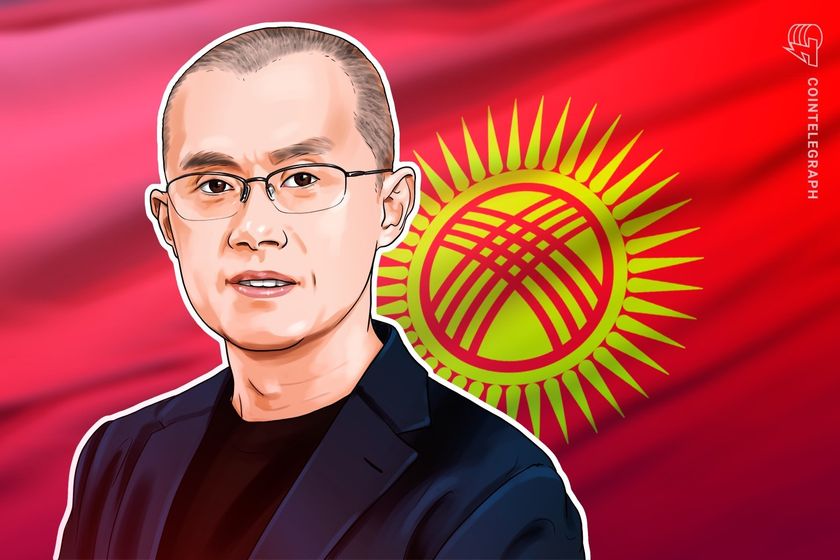
Former Binance CEO Changpeng “CZ” Zhao will begin advising the Kyrgyz Republic on blockchain and crypto-related regulation and tech after signing a memorandum of understanding with the country’s foreign investment agency.
“I officially and unofficially advise a few governments on their crypto regulatory frameworks and blockchain solutions for gov efficiency, expanding blockchain to more than trading,” the crypto entrepreneur said in an April 3 X post, adding that he finds this work “extremely meaningful.”
His comments came in response to an earlier X post from Kyrgyzstan President Sadyr Zhaparov announcing that Kyrgyzstan’s National Investment Agency (NIA) had signed a memorandum with CZ to provide technical expertise and consulting services for the Central Asian country.
The NIA is responsible for promoting foreign investments and assisting international companies in identifying business opportunities within the country.

Source: Changpeng Zhao
“This cooperation marks an important step towards strengthening technological infrastructure, implementing innovative solutions, and preparing highly qualified specialists in blockchain technologies, virtual asset management, and cybersecurity,” Zhaparov said.
The Kyrgyzstan president added: “such initiatives are crucial for the sustainable growth of the economy and the security of virtual assets, ultimately generating new opportunities for businesses and society as a whole.”
Kyrgyzstan, which officially changed its name from the Republic of Kyrgyzstan to the Kyrgyz Republic in 1993, is a mountainous, land-locked country.
It is considered well-suited for crypto mining operations due to its abundant renewable energy resources, much of which is underutilized.
Over 30% of Kyrgyzstan’s total energy supply comes from hydroelectric power plants, but only 10% of the country’s potential hydropower has been developed, according to a report by the International Energy Agency.
CZ has met with several other state officials in Asia
Malaysia also recently tapped CZ for guidance on crypto-related matters, with Prime Minister Anwar Ibrahim meeting him personally in January.
CZ has also met with officials in the UAE and Bitcoin-stacking country Bhutan — however, it isn’t clear what those meetings entailed.
Related: Is Bitcoin’s future in circular economies or national reserves?
CZ’s latest pursuits come a little over six months after he was released from a four-month prison sentence in the US for violating several anti-money laundering laws.
Since being released, CZ has made investments in blockchain tech, artificial intelligence and biotechnology companies.
CZ also recently donated 1,000 BNB (BNB) — worth almost $600,000 — to support earthquake relief efforts in Thailand and Myanmar after the natural disaster in late April.
Magazine: Financial nihilism in crypto is over — It’s time to dream big again