For US Bitcoin miners, this is more than just a policy shift, it’s the chance to become the bedrock of a new digital economic order
Cryptocurrency News
Hyperliquid’s 50x ETH whale makes a comeback with a new 20x long position worth $47.62m [btcmanager]
The notorious ‘Hyperliquid 50x whale’ is back in action with a newly formed long position of 47,253 ETH leveraged at 20x. The trader has gained a profit of nearly $2 million. After a month of inactivity, the trader took advantage…
Michael Saylor’s Strategy halts Bitcoin buys despite dip below $87K [cointelegraph]
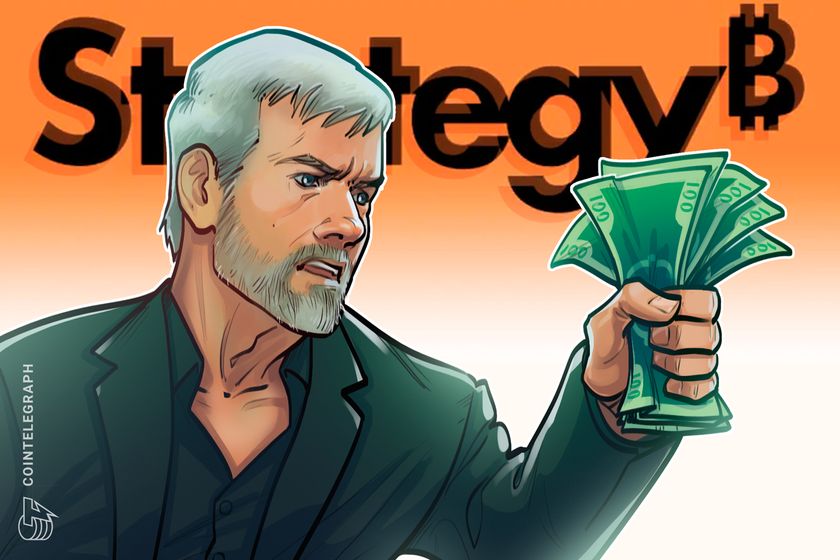
Michael Saylor’s firm Strategy, the world’s largest publicly listed corporate holder of Bitcoin, did not add to its BTC holdings last week as the cryptocurrency’s price dropped below $87,000.
In a filing with the US Securities and Exchange Commission on April 7, Strategy announced it made no Bitcoin (BTC) purchases during the week of March 31 to April 6.
The decision followed a week of heightened market volatility, with BTC surging to as high as $87,000 on April 2 after starting the week at around $82,000, according to data from CoinGecko.

Bitcoin price from March 31, 2025, to April 6, 2025. Source: CoinGecko
BTC fell below $80,000 on April 6, a significant discount from the average BTC price of Strategy’s previous 22,000 BTC purchase announced on March 31.
Strategy reports unrealized loss of $5.91 billion on digital assets in Q1
In the period from March 31 to April 6, Strategy also did not sell any shares of class A common stock, which it tends to use for financing its Bitcoin buys, the filing stated.
As of April 7, Strategy held an aggregate amount of 528,185 Bitcoin bought at $35.6 billion, or at an average price of 67,458 per BTC, it added.

An excerpt from Strategy’s Form 8-K report. Source: SEC
“Our unrealized loss on digital assets for the quarter ended March 31, 2025, was $5.91 billion, which we expect will result in a net loss for the quarter ended March 31, 2025, partially offset by a related income tax benefit of $1.69 billion,” the filing added.
“Bitcoin is most volatile because it is most useful”
While Strategy avoided buying Bitcoin last week, its co-founder and former CEO, Saylor, continued posting about the crypto asset’s superiority on social media.
“Bitcoin is most volatile because it is most useful,” Saylor wrote in an X post on April 3, soon after BTC tumbled from the intra-week high of $87,100 on April 2 below $82,000, following the tariffs announcement by US President Donald Trump.
Related: Has Michael Saylor’s Strategy built a house of cards?

Source: Michael Saylor
“Today’s market reaction to tariffs is a reminder: inflation is just the tip of the iceberg,” Saylor wrote in another X post.
“Capital faces dilution from taxes, regulation, competition, obsolescence, and unforeseen events. Bitcoin offers resilience in a world full of hidden risks,” he added.
Magazine: New ‘MemeStrategy’ Bitcoin firm by 9GAG, jailed CEO’s $3.5M bonus: Asia Express
ZKasino scammer loses $27M as Ethereum price drops [cointelegraph]

A wallet linked to the $40 million ZKasino scam lost more than $27 million after a leveraged position was liquidated, marking what some in the crypto community are calling a dose of karmic justice.
ZKasino launched in April 2024, luring investor capital by promising an airdrop of its native token to users who bridged Ether (ETH) to the platform.
However, instead of returning the funds, ZKasino transferred around $33 million in user ETH to the staking protocol Lido Finance.
Nearly a year later, the wallet behind the alleged exploit has been liquidated for $27.1 million after ETH’s price declined sharply, according to blockchain analytics platform Onchain Lens.

Source: Onchain Lens
“A scammer gets a dose of karma,” Onchain Lens wrote in an April 7 X post, adding:
“The ZkCasino scammer, who scammed $40M+, closed its $ETH (20x) position on #Hyperliquid, faced a total loss of $27.1M.”
Following the liquidation, affected users appear no closer to recovering their funds.
Related: Trump’s Liberation Day: ‘Climax of uncertainty’ before crypto market recovery
The liquidation came after record-breaking sell-offs in traditional equity markets that led to a crypto market correction; ETH’s price fell to a nearly two-year low of $1,480, last seen in May 2023.

Source: Lookonchain
Earlier on April 7, an unidentified crypto whale was forced to make a $14 million emergency deposit to avoid an over $340 million Ether liquidation.
Related: Smart money still hunting for memecoins despite end of ‘supercycle’
The ZKasino exit scam
After being accused of running an exit scam, ZKasino said it initiated a 72-hour process to return funds to investors a month after transferring the $30 million of user funds to Lido.
“We are now initiating the 2-step bridge back process in which bridgers can sign up and bridge back their ETH at a 1:1 ratio,” ZKasino said in a May 28, 2024, Medium post, adding that the team hasn’t given up on the project.
However, any investors wanting their ETH back will forfeit any allocated ZKAS tokens and the remaining 14 months of ZKAS releases, ZKasino said.
On April 29, 2024, Dutch authorities arrested one of the people suspected to be responsible for the “rug pull.” A few days later, all bridged ETH was returned to the ZKasino multisig wallet as Derivative Monke publicly denied the rug pull allegations on X.
However, ZKasino still hasn’t returned the ETH nearly a year after the incident.
“Unfortunately, everyone who sent the ZKAS back has not heard anything from them yet,” one user, who communicated on the condition that his identity not be revealed, told Cointelegraph in August 2024.
Magazine: Bitcoiner sex trap extortion? BTS firm’s blockchain disaster: Asia Express
US federal agencies to report crypto holdings to Treasury by April 7 [cointelegraph]

US federal agencies are expected to disclose their cryptocurrency holdings to the Department of the Treasury by April 7, following an executive order signed by President Donald Trump earlier this year.
Citing an unidentified White House official, journalist Eleanor Terrett reported that the deadline for federal agencies to report their crypto holdings to Treasury Secretary Scott Bessent is April 7.
The disclosures will remain confidential for now. “Unclear as of now if and when the findings could be made public,” Terrett wrote.

Source: Eleanor Terret
Crypto disclosure follows Bitcoin Reserve establishment
The reporting requirement followed an executive order signed on March 7 that directed the creation of a Strategic Bitcoin Reserve and a broader Digital Asset Stockpile. The Bitcoin (BTC) reserve will be seeded with BTC forfeited to federal agencies through civil or criminal asset seizures.
White House AI and crypto czar David Sacks described the reserve as a “digital Fort Knox for the cryptocurrency,” saying that the US will not sell any BTC held in the reserve. “It will be kept as a store of value,” Sacks added.
Sacks previously lamented the US government’s sales of 195,000 BTC for $366 million. The official said the BTC sold by the US government could’ve gone for billions if it had only held on to the assets.
The reserve will initially be seeded by the BTC kept by the Treasury, while the other federal agencies will “evaluate their legal authority” to transfer their BTC into the reserve.
Regarding the digital asset stockpile, Sacks said it would promote “responsible stewardship” of the government’s crypto assets under the Treasury. This includes potential sales from the stockpiles.
On March 2, Trump said that the crypto reserve would include assets like XRP (XRP), Solana (SOL) and Cardano (ADA). The president later added Ether (ETH) and Bitcoin (BTC) to his crypto reserves list.
Related: 10-year Treasury yield falls to 4% as DXY softens — Is it time to buy the Bitcoin price dip?
Crypto plunges as Trump tariffs shock global stocks
While Trump’s election may have positively impacted crypto markets, the US president’s next move has resulted in a market crash.
On April 5, the Trump administration hit all countries with a 10% tariff. Some countries were given higher rates, including China at 34% and Japan at 24%. The European Union was also hit with a 20% tariff.
Following Trump’s move, the overall crypto market capitalization declined by over 8%, slipping to $2.5 trillion.
Magazine: Financial nihilism in crypto is over — It’s time to dream big again
Injective price dips deep into oversold zone despite major Q1 updates [btcmanager]
Despite a series of major initiatives in the first quarter of this year, Injective has seen its price continue to trend downward, now sitting in the deep oversold zone. While this signals the possibility of a short-term bounce, the overall…
Mantra unveils $108M fund to back real-world asset tokenization, DeFi [cointelegraph]

The Mantra blockchain network has launched a $108,888,888 ecosystem fund aimed at accelerating the growth of startups focused on real-world asset (RWA) tokenization and decentralized finance (DeFi), amid rising demand for stable, asset-backed digital products.
Mantra, a layer-1 (L1) blockchain built for tokenized RWAs, launched the Mantra Ecosystem Fund (MEF) to accelerate the growth and adoption of projects and startups building on its network, according to an April 7 announcement shared with Cointelegraph.
Mantra said it will deploy the capital over the next four years among “high-potential blockchain projects” worldwide, with investment opportunities sourced through Mantra’s network of partners. The fund’s backers include a wide range of institutional partners including Laser Digital, Shorooq, Brevan Howard Digital, Valor Capital, Three Point Capital and Amber Group.
Related: 0G Foundation launches $88M fund for AI-powered DeFi agents
Mantra CEO John Patrick Mullin said the fund will operate an “open-arms policy, welcoming projects at any developmental stage globally with a particular focus on RWA’s and DeFi.” Mullin told Cointelegraph:
“The MEF thesis is to invest in top-tier teams building RWA and DeFi applications, as well as complimentary infrastructure, that will both directly and indirectly support the broader ecosystem.”
Mantra aims to become the underlying infrastructure layer for tokenized asset issues worldwide, Mullin said.

Source: Mantra
The launch of the fund comes a month after Mantra became the first DeFi platform to obtain a virtual asset service provider (VASP) license under Dubai’s Virtual Assets Regulatory Authority (VARA).
Related: Stablecoin rules needed in US before crypto tax reform, experts say
Investor demand grows for RWAs
The timing of the fund’s launch aligns with growing institutional interest in RWAs, which are seen by some as a hedge against crypto market volatility and broader economic uncertainty.
Global fears and uncertainty around US President Donald Trump’s tariffs have impacted investor sentiment across markets.
Despite a broader market slump triggered by US tariff-related concerns, the value of tokenized RWAs recently surged to a record high. According to data from RWA.xyz, total RWA market capitalization reached more than $19.6 billion as of early April, up from $17 billion in early February.

RWA global market dashboard. Source: RWA.xyz
Industry watchers previously told Cointelegraph that Bitcoin’s lack of upside momentum may drive RWAs to a $50 billion all-time high before the end of 2025.
The world’s largest asset manager, BlackRock, has also signaled support for the RWA space.

BlackRock BUIDL capital deployed by chain. Source: Token Terminal, Leon Waidmann
BlackRock’s USD Institutional Digital Liquidity Fund (BUIDL) saw an over three-fold increase in the three weeks leading up to March 26, from $615 million to $1.87 billion.
Magazine: Financial nihilism in crypto is over — It’s time to dream big again
Pepe price prediction April 2025: How high could this frog jump? [btcmanager]
Pepe Coin has quickly gained popularity in the crypto community, riding the wave of growing interest in meme coins over the past few years. Will the price of Pepe Coin (PEPE) continue to rise this month and beyond? Let’s take…
Binance integrates Apple Pay, Google Pay via deal with Worldpay [btcmanager]
Cryptocurrency exchange Binance has expanded its fiat gateway with Worldpay, allowing users to buy crypto using Apple Pay or Google Pay. Binance has teamed up with Worldpay, a public payment processing company, to allow users to purchase crypto with Apple…
Dubai land regulator teams up with crypto watchdog to drive real estate tokenization [btcmanager]
Dubai’s real estate and crypto regulators have signed a cooperation deal to explore tokenisation in property registration and management. Dubai’s land and virtual assets regulators have signed a new agreement to support real estate tokenization and improve rules around the…