Cryptocurrency News

Get these Crytpo news stories as alerts on Telegram!

Magic Eden acquires crypto trading app Slingshot to move beyond NFTs

Solana non-fungible token (NFT) marketplace Magic Eden has acquired crypto trading app Slingshot as part of a strategy to expand beyond NFTs as other marketplaces fold amid a prolonged market downturn.

The move expands Magic Eden’s support to more than 8 million tokens across almost every major blockchain, the firm said in an April 9 X post.

“No bridges. No CEXs. This is another major step towards our vision of providing the best platform to trade all assets, on all chains,” Magic Eden said.

Magic Eden acquires crypto trading app Slingshot to move beyond NFTs

Source: Jack Lu

Slingshot has amassed nearly 1 million users to date, allowing users to access any token on 10 of the largest blockchains with a universal USDC (USDC) balance.

Slingshot is one of several crypto platforms aiming to deliver full-chain abstraction — eliminating the need for users to choose the right wallet, ensure they have enough gas fees, find a trusted bridge and move funds — only then to buy the token they’re after.

Magic Eden CEO Jack Lu hopes the integration will help shift more of the 500 million users still relying on centralized exchanges toward more crypto-native, onchain platforms.

NFT marketplaces shutter as market lulls

Lu said that Magic Eden and Slingshot and Magic Eden will continue to operate independently but noted there will be “increasing connectivity” between the platforms over time.

Lu also noted that Magic Eden made $75 million from its NFT marketplace in 2024 and hopes the Slingshot acquisition will help drive those numbers up even higher.

Related: Bitcoin NFTs, layer-2 and restaking hype ‘completely gone’

Magic Eden’s expansion comes as several NFT marketplaces have shuttered in recent months.

DraftKings, GameStop and the crypto exchange Bybit all closed their NFT marketplaces, with Bybit citing falling NFT trading volumes in its April 8 announcement.

X2Y2 also recently announced that its NFT marketplace would shut down on April 30 as the firm looks to pivot into artificial intelligence.

NFT marketplaces have seen $1.6 billion worth of NFT sales across 14 million transactions so far in 2025, CryptoSlam data shows.

However, monthly sales volume has fallen every single month in 2025, and the $1.6 billion is nowhere near on track to match the $8.9 billion total from 2024, let alone the record $23.7 billion seen in 2022.

Magazine: Memecoins are ded — But Solana ‘100x better’ despite revenue plunge

Read more at cointelegraph.com

SafeMoon boss cites DOJ’s nixed crypto unit in latest bid to toss suit

Braden John Karony, the CEO of crypto firm SafeMoon, has cited the US Department of Justice’s directive to no longer pursue some crypto charges in an effort to get the case against him and his firm dismissed. 

In an April 9 letter to New York federal court judge Eric Komitee, Karony’s attorney, Nicholas Smith, said the court should consider an April 7 memo from US Deputy Attorney General Todd Blanche that disbanded the DOJ’s crypto unit.

“The Department of Justice is not a digital assets regulator,” Blanche said in the memo, which added the DOJ “will no longer pursue litigation or enforcement actions that have the effect of superimposing regulatory frameworks on digital assets.”

Blanche also directed prosecutors not to charge violations of securities and commodities laws when the case would require the DOJ to determine if a digital asset is a security or commodity when charges such as wire fraud are available.

SafeMoon boss cites DOJ’s nixed crypto unit in latest bid to toss suit

An excerpt of the letter Karony sent to Judge Komitee. Source: PACER

In the footnote of the letter, Karony’s counsel wrote an exemption to the DOJ’s new directive would be if the parties have an interest in defending that a crypto asset is a security, but added that “Karony does not have such an interest.”

The Justice Department and the Securities and Exchange Commission filed simultaneous charges of securities violations, wire fraud, and money laundering against Karony and other SafeMoon executives in November 2023.

The government alleged Karony, SafeMoon creator Kyle Nagy and chief technology officer Thomas Smith withdrew assets worth $200 million from the project and misappropriated investor funds. 

Another attempt to nix the case

The letter is Karony’s latest attempt to get the case thrown out. In February, he asked that his trial, scheduled to begin on March 31, be delayed as he argued President Donald Trump’s proposed crypto policies could potentially affect the case.

Related: OKX pleads guilty, pays $505M to settle DOJ charges

Later in February, Smith changed his plea to guilty and said he took part in the alleged $200 million crypto fraud scheme. Nagy is at large and is believed to be in Russia.

SafeMoon filed for bankruptcy in December 2023, a month after it was hit with twin cases from the SEC and DOJ. It was also hacked in March 2023, with the hacker agreeing to return 80% of the funds.

Magazine: 3 reasons Ethereum could turn a corner: Kain Warwick, X Hall of Flame

Read more at cointelegraph.com

Bitcoin inflows to Binance see ‘strong acceleration’ ahead of March CPI print

Bitcoin inflows into crypto exchange Binance have surged over the past two weeks amid uncertainty over US President Donald Trump’s tariffs and the upcoming US Consumer Price Index (CPI) results, says an analyst.

However, another analyst argued that while it could signal an impending sell-off, it might also indicate a bullish trend.

Investors are “actively moving funds to Binance”

CryptoQuant contributor Maarten Regterschot said in an April 9 post that Binance’s Bitcoin (BTC) reserve increased by 22,106 BTC, worth $1.82 billion, over the last 12 days to a total of 590,874 BTC.

“This shows a strong acceleration in BTC inflows to Binance. It’s likely that investors are actively moving funds to Binance due to the macro uncertainty and before the upcoming CPI announcement,” Regterschot said. 

CoinMarketCap shows Bitcoin is trading at $82,474 at the time of publication, up 8.8% in the past day after receiving a boost from Trump’s 90-day tariff pause on all countries but China.

Cryptocurrencies, Markets, United States, Inflation

Binance’s Bitcoin Reserve has 590,874 Bitcoin. Source: CryptoQuant

The US Bureau of Labor Statistics is scheduled to deliver the CPI results for March on April 10.

During uncertain times, traders often move their crypto onto exchanges to sell, leading to more volatility as confidence starts to decline.

However, Swyftx lead analyst Pav Hundal told Cointelegraph that this isn’t always a bearish signal. “Large inflows could be a sign of selling, but it is a very fluid market. It is plausible that Binance is shifting assets into its hot wallets to meet heavy demand.”

“The next few days are critical in understanding the appetite of the market for crypto after Trump’s climbdown on tariffs,” he said.

Earlier on April 9, Trump issued a 90-day pause on his administration’s “reciprocal tariffs,” lowering the tariff rate to 10% on all countries besides China, which he ramped up to 125%, citing the country’s counter-tariffs against the US.

“Tensions between the US and China remain a structural overhang,” Hundal said. 

Related: Bitcoin price at risk of new 5-month low near $71K if tariff war and stock market tumult continues

Meanwhile, crypto analyst Matthew Hyland said that the March CPI results “will show inflation is crashing down probably close to 2.5%.”

“Another interesting day coming,” he added. 

Crypto analyst Dyme said, “Lower than expected CPI print will send us higher.”

However, FactSet’s consensus estimates show economists expect consumer prices to have risen by 0.1% month-over-month in March. 

On March 12, the CPI came in lower than expected at 3.1%, beating expectations of 3.2%, with a corresponding 0.1% drop in headline inflation figures.

Magazine: Memecoin degeneracy is funding groundbreaking anti-aging research

This article does not contain investment advice or recommendations. Every investment and trading move involves risk, and readers should conduct their own research when making a decision.

Read more at cointelegraph.com

Ukraine floats 23% tax on some crypto income, exemptions for stablecoins

Ukraine’s financial regulator has proposed taxing certain crypto transactions as personal income at a rate of up to 23% but excluding crypto-to-crypto transactions and stablecoins.  

Crypto transactions would be taxed at 18% with a 5% military levy on top as part of the proposed framework, released on April 8 by Ukraine’s National Securities and Stock Market Commission. 

NSSMC Chairman Ruslan Magomedov said in an April 8 statement that “the issue of crypto taxes is not a hypothesis, but a reality that is fast approaching.” 

He added that the agency created the framework to help lawmakers make an “informed resolution” by considering each suggestion’s advantages and disadvantages because “these aspects can have a critical impact on the market and tax liability.”

Under the NSSMC’s proposed crypto framework, a tax will be applied when crypto is cashed out for fiat currency or exchanged for goods or services. 

Crypto-to-crypto transactions wouldn’t be taxed, bringing Ukraine in line with other European countries, including Austria and France, as well as crypto-friendly jurisdictions like Singapore, the NSSMC said. 

The regulator says it “makes sense” to exclude stablecoins backed by foreign currencies or only apply a 5% or 9% tax because Ukraine’s tax code already excludes income from transactions in “foreign exchange values.” 

Ukraine floats 23% tax on some crypto income, exemptions for stablecoins

A translated excerpt of the NSSMC’s report said stablecoins backed by foreign currencies could be exempt from taxation. Source: NSSMC

Mining, staking, hard forks and airdrops 

Other crypto-related activities, such as mining, staking and airdrops, are also addressed in the framework which floated a few options for taxation. 

The NSSMC said crypto mining is generally considered a business activity, but there might be a general tax-free limit for certain crypto transactions, including mining. 

Under the framework, staking could be considered as “business captive income” or only taxed if the crypto is cashed out for fiat currencies. While hard forks and airdrops could be taxed either as ordinary income or when the tokens are cashed. 

Related: Ukraine officials get training on crypto and virtual assets investigation

The regulator suggests a tax-free threshold could help “relieve the burden on small investors” and is common in other jurisdictions. 

Exemptions for donations, transfers between family members, and holders who keep their crypto for a set amount of time are also flagged as possibilities. However, the NSSMC says the exemption might not apply to non-custodial crypto wallets. 

Last December, Daniil Getmantsev, head of the tax committee of Ukraine’s parliament, said a draft bill to legalize cryptocurrencies was under review and expected to be finalized early this year. 

Ukrainian President Volodymyr Zelenskyy first signed a law establishing a legal framework for the country to operate a regulated crypto market in March 2022. 

Magazine: New ‘MemeStrategy’ Bitcoin firm by 9GAG, jailed CEO’s $3.5M bonus: Asia Express

Read more at cointelegraph.com

21Shares files for spot Dogecoin ETF in the US

Digital asset manager 21Shares has filed with the US Securities and Exchange Commission to launch a spot Dogecoin exchange-traded fund, following similar filings from rivals Bitwise and Grayscale.

The 21Shares Dogecoin ETF would seek to track the price of the memecoin Dogecoin (DOGE), according to the firm’s April 9 Form S-1 registration statement. The Dogecoin Foundation’s corporate arm, House of Doge, plans to assist 21Shares with marketing the fund.

21Shares said Coinbase Custody would be the proposed custodian of its Dogecoin ETF but did not specify a fee, ticker or what stock exchange it would list on.

21Shares files for spot Dogecoin ETF in the US

Source: James Seyffart

21Shares must also file a 19b-4 filing with the SEC to kickstart the regulator’s approval process for the fund. 

DOGE currently has a $24.2 billion market cap and is the eighth-largest cryptocurrency by value. It was created in 2013 as a joke and is a fork of Lucky Coin, which itself is a fork of Bitcoin.

21Shares’ proposed Dogecoin ETF is the company’s latest effort to expand its spot crypto ETF offerings, which currently includes only a spot Bitcoin (BTC) and Ether (ETH) fund.

The issuer also filed with the SEC in February to launch a spot Polkadot (DOT) ETF and last year, it filed to create a spot XRP (XRP) ETF.

Related: Dogecoin millionaires are buying dips as DOGE price eyes 30% rally

The recent surge in crypto ETF filings reflects a “spaghetti cannon approach” from issuers testing which products the new SEC leadership might approve, Bloomberg ETF analyst James Seyffart said in February.

“Issuers will try to launch many many different things and see what sticks,” Seyffart said.

Seyffart and fellow Bloomberg ETF analyst Eric Balchunas said in February that there is a 75% chance that the SEC will approve a spot Dogecoin ETF this year, while the betting platform Polymarket currently gives approval odds of 64%.

21Shares and House of Doge partner for DOGE funds in Switzerland

21Shares also said on April 9 that it partnered with House of Doge to launch a fully backed Dogecoin exchange-traded product on Switzerland’s SIX Swiss Exchange.

The 21Shares Dogecoin product will trade under the ticker “DOGE” with a 2.5% fee.

21Shares president Duncan Moir said that Dogecoin “has become more than a cryptocurrency: it represents a cultural and financial movement that continues to drive mainstream adoption, and DOGE offers investors a regulated avenue to be part of this exciting project.”

Magazine: Memecoin degeneracy is funding groundbreaking anti-aging research

Read more at cointelegraph.com

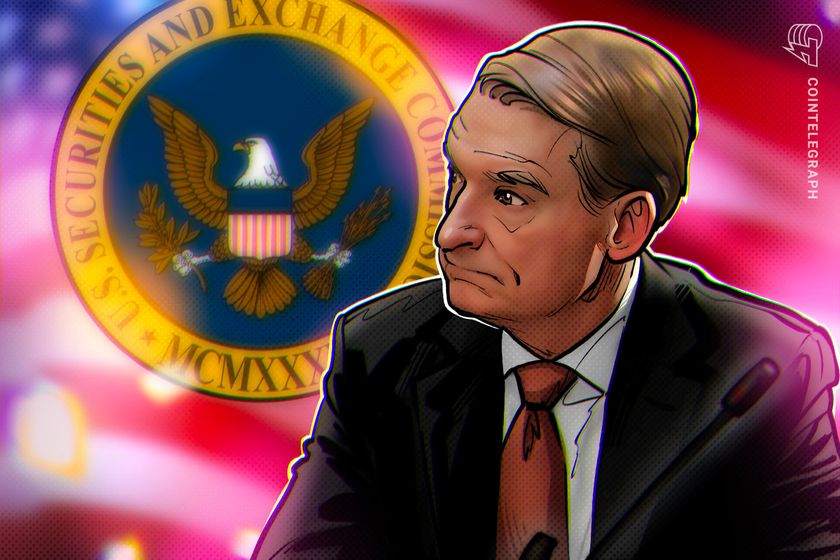
US Senate confirms Paul Atkins to lead SEC under Trump

Update April 10 at 1:41 am UTC: This article has been updated to include background on Paul Atkins and to correct the vote count.

The US Senate has confirmed US President Donald Trump’s nominee, Paul Atkins, as chair of the Securities and Exchange Commission in a 52-44 vote largely along party lines.

Atkins’ confirmation on April 9 comes after Trump named the pro-crypto former Wall Street consultant to lead the agency late last year. Atkins also served as an SEC commissioner between 2002 and 2008, during the global financial crisis.

”A veteran of our Commission, we look forward to him joining with us, along with our dedicated staff, to fulfill our mission on behalf of the investing public,” the agency’s commissioners wrote in an April 9 statement.

Atkins founded financial consulting firm Patomak Global Partners in 2009, specializing in regulatory compliance and risk management, and served as co-chair of crypto advocacy group Token Alliance between 2017 and late 2024.

After he’s sworn in, Atkins will take over from Mark Uyeda, who has been the SEC’s acting chair since Jan. 20, after former chair Gary Gensler stepped down. Gensler’s tenure saw the SEC launch multiple lawsuits and investigations against crypto firms over alleged breaches of securities laws.

US Senate confirms Paul Atkins to lead SEC under Trump

Source: Cynthia Lummis

Senate Banking Committee Chairman Tim Scott expressed confidence that Atkins would continue the SEC’s crypto-friendly approach that it has taken under the Trump administration.

“Atkins will also provide regulatory clarity for digital assets, allowing American innovation to flourish, and ensuring we remain competitive on the global stage.”

Under Trump, the SEC created a Crypto Task Force to consult with the industry on regulation and dropped several crypto-related investigations and enforcement actions undertaken by the Gensler-led SEC.

Atkins is expected to take a different approach, telling a Senate confirmation hearing in March that a top priority of his at the SEC would be “to provide a firm regulatory foundation for digital assets through a rational, coherent, and principled approach.”

Atkins’ confirmation delayed by disclosures

Atkins’ confirmation was reportedly delayed due to several financial disclosures he needed to file as a result of marrying into a billionaire family.

Related: No crypto project has registered with the SEC and ‘lived to tell the tale’ — House committee hearing

He married Sarah Humphreys Atkins in 1990 — whose family is tied to TAMKO Building Products LLC, a manufacturer of residential roofing shingles that turned over $1.2 billion in revenue in 2023, Forbes reported in December. The couple have a reported combined net worth of at least $327 million.

Some of those financial disclosures revealed that Atkins owned up to $6 million worth of crypto-related investments, including crypto custody platform Anchorage Digital and blockchain tokenization platform Securitize, Fortune reported last month.

Magazine: SEC’s U-turn on crypto leaves key questions unanswered

Read more at cointelegraph.com

Ethereum Researcher Virgil Griffith released from prison

Ethereum researcher Virgil Griffith was released from prison custody on April 9, the Bureau of Prison (BOP) officials confirmed to Cointelegraph.

According to crypto developer Brantly Millegan, Griffith will remain in a halfway house for several weeks while waiting to complete the next steps in his parole process.

Griffith was arrested in 2019 for giving a lecture about blockchain technology and its power to circumvent US sanctions to an audience in North Korea.

Law, US Government, United States, Court, Censorship

Virgil Griffith, pictured center, with his parents immediately following his release from prison on April 9. Source: Brantly Millegan

The US government claimed the researcher violated the International Emergency Economic Powers Act (IEEPA) by giving North Korea “highly technical information” despite the content of the lecture being widely available knowledge published on the internet.

Griffith’s case highlights the tension between blockchain developers and state powers as the nascent technology continues to create avenues for individuals and countries to escape financial controls, censorship, and surveillance.

Related: Crypto urges Congress to change DOJ rule used against Tornado Cash devs

Virgil Griffith’s legal battle against US prosecutors

In January 2020, a US grand jury indicted Griffith with conspiracy to violate the IEEPA, which gives the Executive Branch of government the power to restrict economic activity between US citizens and foreign powers deemed to be adversarial to the United States.

Griffith initially pleaded not guilty to the charges. The software developer’s attorneys filed a motion to dismiss the case in October 2020, arguing that Griffith did not violate the law by presenting what was already widely available public knowledge.

Law, US Government, United States, Court, Censorship

Griffith on a crypto-focused lecture in 2019 to a North Korean audience. Source: Cointelegraph/United States Department of Justice.

Following a lengthy legal battle, which took nearly two years, Griffith pleaded guilty to violating sanctions laws as part of a plea deal with the US government in September 2021.

The Ethereum researcher was sentenced to 63 months in prison and ordered to pay a $100,000 fine by the court in April 2022. However, the legal battle did not end there.

Two years later, in April 2024, the researcher’s attorneys submitted a motion to reduce the prison sentence, which US prosecutors opposed, citing Griffith’s actions as harmful to national security.

Despite the pushback from the prosecutors, New York Judge Kevin Castel issued a ruling in July 2024 reducing Griffth’s prison sentence to 56 months.

Magazine: The FBI’s takedown of Virgil Griffith for breaking sanctions, firsthand

Read more at cointelegraph.com

AAVE soars 13% as buyback proposal passes among tokenholders

Aave’s tokenholders approved a governance proposal to start buying back the decentralized finance (DeFi) protocol’s governance token, AAVE, as part of a broader tokenomics overhaul, Aave said on April 9. 

The proposal — which was approved by more than 99% of AAVE tokenholders — permits the protocol to purchase $4 million in AAVE (AAVE) tokens, enough for one month of buybacks. 

The move is a “first step” toward a broader plan to repurchase $1 million AAVE tokens weekly for six months. It is also the latest instance of DeFi protocols implementing buyback mechanisms in response to tokenholder demands.

“The goal is to sustainably increase AAVE acquisition from the open market and distribute it to the Ecosystem Reserve,” the proposal said. 

The AAVE token’s price rallied more than 13% on April 9, bringing the protocol’s market capitalization to more than $2.1 billion, according to data from CoinGecko.

AAVE soars 13% as buyback proposal passes among tokenholders

The buyback proposal passed with overwhelming support. Source: Aave

Related: Aave proposal to peg Ethena’s USDe to USDT sparks community pushback

Buybacks gain popularity

In March, the Aave Chan Initiative (ACI), a governance advisory group, proposed a tokenomics revamp that would include new revenue allocations for AAVE tokenholders, enhanced safety features for users, and the creation of an “Aave Finance Committee.”

Aave is Web3’s most popular DeFi protocol, with total value locked surpassing $17.5 billion as of April 9, according to DefiLlama. 

It is also among DeFi’s biggest fee generators, with an estimated annualized fee income of $350 million, the data shows. 

AAVE soars 13% as buyback proposal passes among tokenholders

Aave is DeFi’s most popular protocol by TVL. Source: DeFILlama

DeFi protocols are under increasing pressure to provide tokenholders with a share of protocol revenues — partly because US President Donald Trump has fostered a friendlier regulatory environment for DeFi protocols in the United States.

Projects including Ethena, Ether.fi and Maple are piloting value-accrual mechanisms for their native tokens.

In January, Maple Finance’s community floated buying back native SYRUP tokens and distributing them as rewards to stakers.

In December, Ether.fi, a liquid restaking token issuer, tipped plans to direct 5% of protocol revenues toward buying back native ETHFI tokens. 

Similarly, Ethena, a yield-bearing stablecoin issuer, agreed to share some of its approximately $200 million in protocol revenues with tokenholders in November.

Magazine: DeFi will rise again after memecoins die down: Sasha Ivanov, X Hall of Flame

Read more at cointelegraph.com