
Cryptocurrency News

Get these Crytpo news stories as alerts on Telegram!

4 reasons why Bitcoin price could rally to $90K in April

Key points: 

Monetary stimulus in China and Europe increases investors’ focus on Bitcoin price.

The US Federal Reserve is under political pressure to cut rates, as the DXY weakens.

Bitcoin’s decoupling from traditional markets continues to gain attention. 

Bitcoin (BTC) traders are somewhat puzzled by BTC price jumping to $85,000, especially since the S&P 500 index has dropped 5.7% in April, and this move came after the cryptocurrency managed a 14% rebound off its trade-war induced crash to $74,400. Investors are cautiously optimistic, but multiple events and data points to further gains above $90,000.

Several metrics and events support a “decoupling,” meaning Bitcoin’s price is not closely following traditional financial instruments. However, some skepticism emerges as BTC has not matched gold’s performance. Gold reached an all-time high of $3,358 on April 16, leading to speculation that governments and central banks are increasing their gold reserves.

Global stimulus rises as US economy shows early weakness

As central banks respond to the threat of an economic recession, the chances of an increase in monetary supply are rising. While the US Federal Reserve (Fed) has held off on lowering interest rates or expanding its balance sheet, other nations have already taken such steps. This puts more pressure on the US economy, which is starting to show signs of weakness.

4 reasons why Bitcoin price could rally to $90K in AprilUS Federal Reserve total assets, USD million. Source: St Louis Fed

In China, new bank loans in March rebounded more than expected to $500 billion, over 20% higher than analysts had predicted and a strong recovery from the previous month’s decline. According to Reuters, the PBOC has promised to increase stimulus measures to reduce the impact of the trade war with the United States.

On April 17, the European Central Bank cut interest rates for the seventh time in a year to support the eurozone economy. The ECB has lowered the cost of capital to its lowest level since late 2022. Several investment banks have also reduced their inflation forecasts for the region, as the tariff war could reduce the region’s gross domestic product by 0.5%, according to Reuters.

Weaker US dollar and Bitcoin miners’ long-term commitment

Further adding pressure on the US Federal Reserve to end its restrictive monetary policy is the weakening of the US dollar compared to major global currencies, as the DXY Index has dropped to its lowest level in three years. A weaker dollar usually helps exports, which can be positive for the current account balance, but this is unlikely to last during a trade war.

4 reasons why Bitcoin price could rally to $90K in AprilUS Dollar Index (DXY). Source: TradingView / Cointelegraph

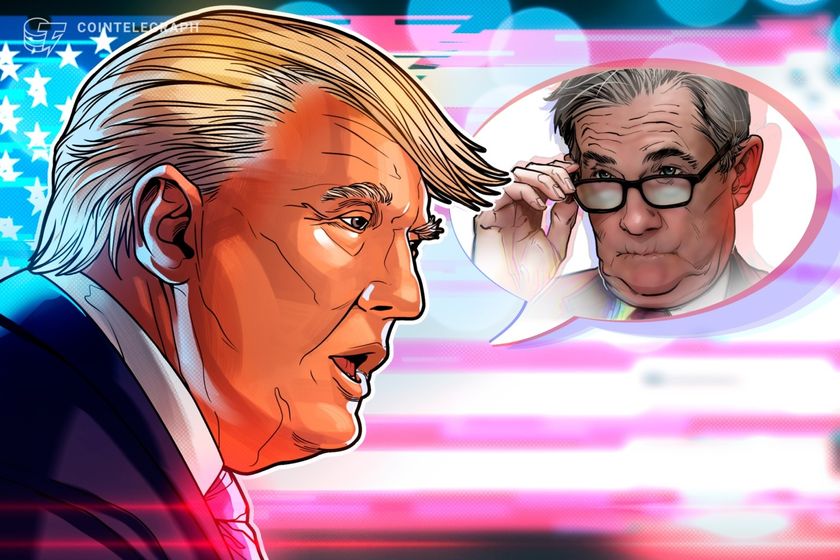
Investor confidence has also been hurt by US President Donald Trump’s public criticism of Fed Chair Jerome Powell’s administration. This situation makes it harder for the US Treasury to rely on issuing Treasurys to stay afloat, which further weakens the US dollar. President Trump even said that Powell’s removal “cannot come fast enough,” while also calling for lower interest rates.

However, when looking at the current macroeconomic data, there is little reason to support a more relaxed monetary policy from the US Fed, especially after the latest US jobless claims reported on April 17. Initial claims fell by 9,000 to 215,000 in the week ending April 12, according to the US Labor Department. Powell repeated on April 16 that the labor market is in a “solid condition,” according to Reuters.

Related: When gold price hits new highs, history shows ‘Bitcoin follows’ within 150 days — Analyst

4 reasons why Bitcoin price could rally to $90K in AprilBitcoin 7-day average estimated hashrate. Source: Blockchain.com

Bitcoin miners have also shown a strong long-term commitment, as the hashrate increased by 8% compared to the previous month. Since the Bitcoin halving in April 2024, traders were worried that lower profits would cause many miners to leave, possibly leading to a sell-off, since miners reportedly hold almost 1.8 million BTC, according to Glassnode.

This article is for general information purposes and is not intended to be and should not be taken as legal or investment advice. The views, thoughts, and opinions expressed here are the author’s alone and do not necessarily reflect or represent the views and opinions of Cointelegraph.
Read more at cointelegraph.com

Trump blasts ‘too late’ Powell for not cutting interest rates

US President Donald Trump renewed his criticism of Federal Reserve Chair Jerome Powell, accusing him of being too slow to cut interest rates and escalating a long-running conflict that risks undermining the central bank’s political independence.

With the European Central Bank (ECB) cutting interest rates again on April 17, “Too Late” Powell has failed to act appropriately in the United States, even with inflation falling, Trump said on Truth Social on April 17. 

“Powell’s termination cannot come fast enough!” Trump said.

Trump blasts ‘too late’ Powell for not cutting interest ratesSource: realDonaldTrump

Florida Senator Rick Scott agreed with the president, saying, “it’s time for new leadership at the Federal Reserve.”

Trump’s public criticism of the Fed breaks a decades-long convention in American politics that sought to safeguard the central bank from political scrutiny, which includes any executive decision to replace the chair. 

In an April 16 address at the Economic Club of Chicago, Powell said Fed independence is “a matter of law.” Powell previously signaled his intent to serve out the remainder of his tenure, which expires in May 2026. 

Related: S&P 500 briefly sees ‘Bitcoin-level’ volatility amid Trump tariff war

Crypto, risk assets look to the Fed for guidance

The Federal Reserve wields significant influence over financial markets, with its monetary policy decisions affecting US dollar liquidity and shaping investor sentiment.

Since the COVID-19 pandemic, crypto markets have increasingly come under the Fed’s sphere of influence due to the rising correlation between dollar liquidity and asset prices. 

This was further corroborated by a 2024 academic paper written by Kingston University of London professors Jinsha Zhao and J Miao, which concluded that liquidity conditions now account for more than 65% of Bitcoin’s (BTC) price movements.

As inflation moderates and market turmoil intensifies amid the trade war, Fed officials are facing mounting pressure to cut interest rates. However, Powell has reiterated the central bank’s wait-and-see approach as officials evaluate the potential impact of tariffs. 

Trump blasts ‘too late’ Powell for not cutting interest ratesA measure of real-time inflation known as “truflation” suggests that cost pressures are much weaker than the Fed’s primary indicators, which are several months out of date. Source: Truflation

The Fed is expected to maintain its wait-and-see policy approach at its next meeting in May, with Fed Fund futures prices implying a less than 10% chance of a rate cut. However, rate cut bets have increased to more than 65% for the Fed’s June policy meeting. 

Related: Weaker yuan is ‘bullish for BTC’ as Chinese capital flocks to crypto — Bybit CEO

Read more at cointelegraph.com

Wyoming commission floats whether stablecoin is 'covered' by SEC rules

The Wyoming Stable Token Commission, a body authorized by the US state to issue a stablecoin, has suggested that it may clarify its language to better comply with potential guidelines from the Securities and Exchange Commission (SEC).

In an April 17 meeting in the extension of the Wyoming Capitol building, Commissioner Joel Revill suggested the body could reduce the risk of the state’s proposed WYST stablecoin qualifying as a security under SEC rules. The discussion among the commissioners and Executive Director Anthony Apollo followed the SEC issuing guidelines that certain “covered stablecoins” were considered” non-securities” and largely not subject to reporting requirements. 

Government, SEC, Wyoming, StablecoinWyoming Stable Token Commission Executive Director Anthony Apollo with Senator Cynthia Lummis. Source: LinkedIn

“We’re looking to kind of create our own vernacular around some of this, to clarify, and then use that as a jumping off point of discussion for the commission,” said Apollo, adding there were internal discussions regarding the SEC guidance but the commission was scheduled to address the matter in a May memo. 

Related: Wyoming treasury should run on blockchain — Stable Token Commission boss

The commission, established after Wyoming passed a law to issue a state-issued stablecoin pegged to the US dollar and redeemable for fiat currency, has been exploring issues surrounding WYST. Wyoming Governor Mark Gordon said in August that the government initially planned a launch in the first quarter of 2025 for the stablecoin, later amending the timeline to potentially launch in July.

Looking to the US Congress for guidance

The commission said it would be monitoring efforts by the federal government to establish a regulatory framework for stablecoins. Among the proposed legislation was the Guiding and Establishing National Innovation for US Stablecoins, or GENIUS Act, in the Senate, and the Stablecoin Transparency and Accountability for a Better Ledger Economy, or STABLE Act, in the House of Representatives.

Though Wyoming is the least populated US state, with roughly 600,000 people, it has become home to some crypto firms likely seeking a regulatory-friendly jurisdiction. Custodia Bank, the digital asset bank established by Caitlin Long, is based in Cheyenne. US Senator Cynthia Lummis, who often advocates for crypto-friendly policies, represents Wyoming in the Senate.

Magazine: Riskiest, most ‘addictive’ crypto game of 2025, PIXEL goes multi-game: Web3 Gamer

Read more at cointelegraph.com

When gold price hits new highs, history shows ‘Bitcoin follows’ within 150 days — Analyst

The price of gold surged to a new all-time high of $3,357 per ounce on April 17, igniting speculation on whether Bitcoin (BTC) would follow. Cryptocurrencies, Bitcoin Price, Markets, Price AnalysisBitcoin-gold comparison. Source: Cointelegraph/TradingView

In 2017, Bitcoin rallied to $19,120 after gold witnessed a 30% hike a few months earlier. Similarly, gold reached a new high near $2,075 in 2020 during the COVID-19 pandemic, which preceded Bitcoin’s surge to $69,000 in 2021.

Bitcoin has historically surpassed its previous all-time highs whenever gold rallies, reflecting a dynamic relationship between the two assets during periods of economic uncertainty and when investors look for a US dollar alternative.

Further highlighting the interconnections between the assets, Joe Consorti, head of growth at Theya, pointed out that BTC follows gold’s directional bias with a lag of 100-150 days at a time. Consorti said,

“When the printer roars to life, gold sniffs it out first, then Bitcoin follows harder.”Cryptocurrencies, Bitcoin Price, Markets, Price AnalysisBitcoin vs gold price movement correlation. Source: X.com

Considering Consorti’s view, Bitcoin is expected to potentially attain new all-time highs between Q3 and Q4 of 2025. Anonymous Bitcoin proponent apsk32 expected a similar outcome or bullish period between July and November.

Looking at data from past Bitcoin price cycles and BTC’s “power curve time contours,” the analyst predicted that Bitcoin will enter a parabolic phase in the latter half of 2025, with a price target as high as $400,000. Using the power law model, the analyst normalized Bitcoin’s market cap to gold’s and plotted BTC on a logarithmic scale, measuring each Bitcoin in ounces of gold instead of dollars.

Cryptocurrencies, Bitcoin Price, Markets, Price AnalysisBitcoin price and power curve chart. Source: X.com

Related: Bitcoin gold copycat move may top $150K as BTC stays ‘impressive’

Bitcoin trading like “Mag 8” amid tariff uncertainty

In a recent interview with CNBC, Galaxy Digital CEO Mike Novogratz said that Bitcoin and gold are “key indicators of financial stewardship” amid global macroeconomic uncertainty. Highlighting it as a “Minsky Moment” for the US economy, Novogratz said that Bitcoin thrives in market turbulence, driven by a weakening US dollar and capital flowing into safe havens like gold, which has recently rallied.

Novogratz added that despite a 10% year-to-date drop in equities, markets underestimate the scale of global economic shifts, with tariffs and Trump’s policies adding uncertainty. He cautioned that rising interest rates and a weakening dollar signal the US is behaving like an emerging market, with Bitcoin and gold reflecting growing concerns over unsustainable deficits and the $35 trillion national debt.

Related: Bitcoin online chatter flips bullish as price chops at $85K: Santiment

This article does not contain investment advice or recommendations. Every investment and trading move involves risk, and readers should conduct their own research when making a decision.

Read more at cointelegraph.com

Huaxia to add staking to Ether ETF, Hong Kong’s second of its kind

Huaxia Fund is set to launch staking services on its Ether exchange-traded fund (ETF), making it the second in Hong Kong. OSL Digital Services (OSL) will provide custody and staking infrastructure for the fund.

The staking feature will be live on May 15, moving the ETF from a strictly passive investment vehicle to an “active participant” in the Ethereum ecosystem, according to the announcement from OSL. Huaxia Fund, a subsidiary of China Asset Management (ChinaAMC), first launched its Ether ETF in April 2024. 

The introduction of a staking provision comes after Hong Kong’s Securities and Futures Commission (SFC) changed its rules on April 7 to allow for entities like centralized exchanges to offer crypto staking in a bid to position the city as a leader in Web3. 

When announcing the rule change, the SFC said it “recognizes the potential benefits of staking in enhancing the security of blockchain networks and allowing investors to earn yields.”

Related: Hong Kong Bitcoin, Ether ETFs attract over $200M on day 1

Staking is the process of locking up crypto tokens to help support the operations and security of a blockchain network. In return, participants earn rewards, typically in the form of more cryptocurrency.

On April 10, Bosera HashKey was approved to be a staking provider in Hong Kong, the first under the new rule. According to a press release, staking will allow for Bosera HaskKey’s Ether ETF to take advantage of compound growth, as yield from the staked Ether can be reinvested into the financial instrument.

According to Coinbase, ETH stakers are currently earning about 2.14% of their holdings in a 365-day average.

Hong Kong, Staking, Ethereum ETF30-day ETH staking yield as of April 13. Source: Dune AnalyticsHong Kong changes rules to become Web3 hub

Staking for Ether ETFs has been a central topic in the United States. In December 2024, Bernstein Research predicted that staking would be approved for Ether ETFs under the crypto-friendly Trump administration. Since then, CBOE and the NYSE have filed for a rule change with the United States Securities and Exchange Commission (SEC) to grant permission for staking in such funds.

Asset manager BlackRock has remarked that while successful, ETH ETFs are less perfect without staking. Staking is seen as a way to attract more investors to the Ether ETFs, who may be lured by the possibility of yield, which leads to further gains.

Related: Ether shoots up 3.5% as CBOE, 21Shares seek to add ETH staking to ETF

Hong Kong’s SFC appears to understand that and is acting accordingly. Chen Wu, the CEO of Hong Kong-based crypto exchange Ex.io, told Cointelegraph. “The SFC’s announcement signals that more doors are opening — not just for staking, but for a wider range of Web3 products to take shape under a regulated and trusted framework,” she said.

Hong Kong has seen a 250% growth in its blockchain sector since 2022, with the city’s fintech market expected to reach over $600 billion by 2032. The Hong Kong government is considered to have proactive policies for cryptocurrency companies, a stark contrast to the sometimes combative tone other governments take to the emerging asset class.

Magazine: What are native rollups? Full guide to Ethereum’s latest innovation

Read more at cointelegraph.com