Omni Foundation has launched a $10 million incentive program aimed at powering the next adoption of crypto. In an announcement, the Omni Foundation said its $10 million rewards program, which goes live with support for Symbiotic, will power the future…
Cryptocurrency News
MANTRA to burn 300m $OM tokens in effort to rebuild trust [btcmanager]
DeFi protocol MANTRA has begun the process of burning 150 million OM tokens from its team and core contributor allocation. The unstaking of these tokens is now underway and expected to be completed by April 29, at which point the…
Near Protocol token flips key price as transactions and staking inflows [btcmanager]
The Near Protocol token rose for five consecutive days, crossing a crucial resistance level as its active addresses and transactions increased. Near (NEAR) rose to a high of $2.30, up by 25% from its lowest point this month. This rebound…
Here’s why altcoins like Kaspa, Fartcoin, Solana, Shiba Inu are rising [btcmanager]
Bitcoin and most altcoins rose on Monday, continuing a trajectory that started late last week. Bitcoin (BTC) rose to $87,500, while tokens like Kaspa (KAS), Fartcoin (FARTCOIN), Solana (SOL), and Shiba Inu (SHIB) jumped by double digits. Several catalysts are…
Consensys, Solana, and Uniswap CEO donated to Trump's $239M inauguration fund [cointelegraph]
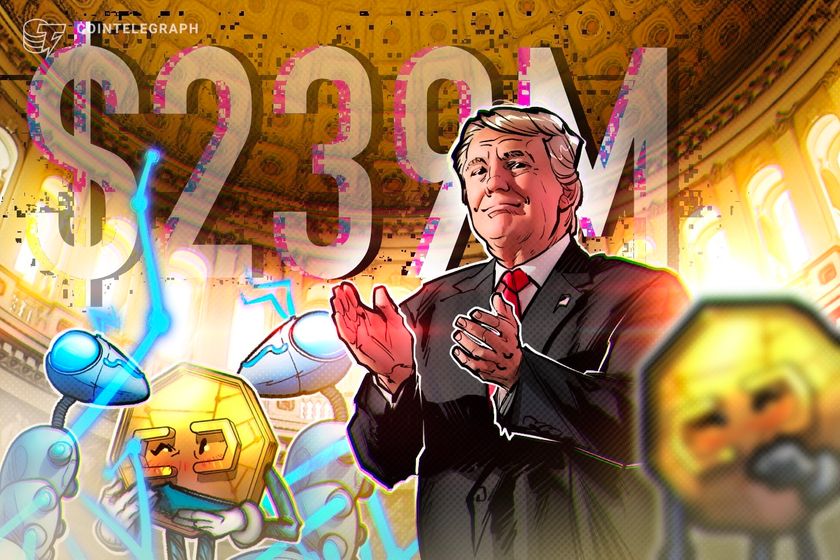
New filings from the Federal Election Commission (FEC) reveal that several cryptocurrency firms and their executives made significant contributions to US President Donald Trump’s inauguration fund after the results of the 2024 election.
According to FEC filings made public on April 20 by the Trump-Vance Inaugural Committee, Uniswap CEO Hayden Adams donated more than $245,000, Solana Labs donated $1 million, and software firm Consensys sent $100,000 in January 2025 to support the then-president-elect’s inauguration. Many major crypto firms had previously announced their support of Trump through donations to the inaugural fund, including Coinbase, Ripple Labs, Kraken, Ondo Finance, and Robinhood.
 Jan. 9 contribution from Uniswap CEO Hayden Adams to Trump-Vance inauguration fund. Source: FEC
Altogether, the fund reported more than $239 million in net donations between Nov. 15 and April 20 from companies and individuals. These included $1 million from McDonald’s, $1 million from Meta, $1 million from Apple CEO Tim Cook, $1 million from OpenAI CEO Sam Altman, and various contributions from Delta Air Lines, ExxonMobil, FedEx, Nvidia, PayPal, Target, and Coca-Cola.
Since Trump took office on Jan. 20 and appointed Mark Uyeda as acting chair of the US Securities and Exchange Commission (SEC), the agency has dropped multiple investigations and enforcement actions against crypto firms, including those that donated to the president’s 2024 campaign or inauguration fund. In February, Uniswap reported that the SEC had dropped its probe into the firm, and Consensys founder Joseph Lubin said the agency had agreed to end a separate lawsuit.
Memecoins, stablecoin issuers, and future elections
Trump’s memecoin, launched on Jan. 17 on the Solana blockchain — along with his wife Melania’s, which was available a few days later — has many in the crypto industry and the US government questioning the president about conflicts of interest by capitalizing on his position. The president’s family is also behind the launch of World Liberty Financial, a crypto firm responsible for a US dollar-pegged stablecoin at a time when lawmakers are considering legislation to regulate the technology.
In addition to the Consensys case, the SEC said it intended to drop enforcement actions or investigations into Ripple, Kraken, Robinhood and Coinbase. The three firms donated a combined $9 million to the inauguration fund.
Related: Trump’s next crypto play will be Monopoly-style game — Report
The 2024 US election cycle saw crypto-backed political action committees (PACs) spending more than $131 million to influence races in crucial congressional districts. The Fairshake PAC has already said it had more than $100 million available, in part from contributions from Coinbase and Ripple, to spend on the 2026 midterms.
Magazine: Trump’s crypto ventures raise conflict of interest, insider trading questions
Consensys, Solana, Uniswap CEO donated to Trump's $239M inauguration fund [cointelegraph]
New filings from the Federal Election Commission (FEC) reveal that several cryptocurrency firms and their executives made significant contributions to US President Donald Trump’s inauguration fund after the results of the 2024 election.
According to FEC filings made public on April 20 by the Trump-Vance Inaugural Committee, Uniswap CEO Hayden Adams donated more than $245,000, Solana Labs donated $1 million, and software firm Consensys sent $100,000 in January to support the then-president-elect’s inauguration. Many major crypto firms had previously announced their support of Trump through donations to the inaugural fund, including Coinbase, Ripple Labs, Kraken, Ondo Finance, and Robinhood.
Jan. 9 contribution from Uniswap CEO Hayden Adams to Trump-Vance inauguration fund. Source: FEC
Altogether, the fund reported more than $239 million in net donations between Nov. 15 and April 20 from companies and individuals. These included $1 million from McDonald’s, $1 million from Meta, $1 million from Apple CEO Tim Cook, $1 million from OpenAI CEO Sam Altman, and various contributions from Delta Air Lines, ExxonMobil, FedEx, Nvidia, PayPal, Target, and Coca-Cola.
Since Trump took office on Jan. 20 and appointed Mark Uyeda as acting chair of the US Securities and Exchange Commission (SEC), the agency has dropped multiple investigations and enforcement actions against crypto firms, including those that donated to the president’s 2024 campaign or inauguration fund. In February, Uniswap reported that the SEC had dropped its probe into the firm, and Consensys founder Joseph Lubin said the agency had agreed to end a separate lawsuit.
Memecoins, stablecoin issuers, and future elections
Trump’s memecoin, launched on Jan. 17 on the Solana blockchain — along with his wife Melania’s, which was available a few days later — has many in the crypto industry and members of Congress voicing concern over conflicts of interest potentially arising from the president appearing to capitalizing on his position.
Trump’s family is also behind the launch of World Liberty Financial, a crypto firm responsible for a US dollar-pegged stablecoin at a time when lawmakers are considering legislation to regulate the technology.
In addition to the Consensys case, the SEC said it intended to drop enforcement actions or investigations into Ripple, Kraken, Robinhood Crypto and Coinbase. The three firms donated a combined $9 million to the inauguration fund.
Related: Trump’s next crypto play will be Monopoly-style game — Report
The 2024 US election cycle saw crypto-backed political action committees (PACs) spending more than $131 million to influence races in crucial congressional districts. The Fairshake PAC has already said it had more than $100 million available, in part from contributions from Coinbase and Ripple, to spend on the 2026 midterms.
Magazine: Trump’s crypto ventures raise conflict of interest, insider trading questions
Upexi stock surges over 450% after investment to back Solana treasury plan [btcmanager]
Upexi Inc. surged more than 450% in trading on Monday after crypto investment firm GSR announced a $100 million private investment in the company. The funding will support Upexi’s shift toward a cryptocurrency-based treasury strategy, according to a company press…
Bitcoin price tops $88.5K as BTC doubles down on stocks decoupling [cointelegraph]

Bitcoin (BTC) doubled down on its divergence from stocks at the April 21 Wall Street open as US trade war tensions escalated.  BTC/USD 1-day chart. Source: Cointelegraph/TradingView
Trade war reactions fuel BTC price gains
Data from Cointelegraph Markets Pro and TradingView showed BTC/USD matching month-to-date highs above $88,000.
Bitcoin continued higher after the weekly close to catch up with gold as the latter set fresh all-time highs of $3,430 per ounce.
 XAU/USD 1-hour chart. Source: Cointelegraph/TradingView
By contrast, stock markets came under renewed selling pressure, with the S&P 500 and Nasdaq Composite Index both down over 2% at the time of writing.
Newfound BTC price strength thus appeared to end lockstep trading with equities as part of reactions to trade-war headlines.
These included warnings about the deterioration of relations with the US from both China and Japan, while US President Donald Trump renewed existing attacks on Federal Reserve Chair Jerome Powell over interest rates.
 Source: Donald Trump
“Technology stocks have gotten crushed again over the last week. Nvidia, NVDA, is down over -15% since last Monday while multiple other Mag 7 stocks are down 10%+,” trading resource The Kobeissi Letter wrote in part of a reaction thread on X.
“Without technology stocks, this market cannot bottom.” S&P 500 1-hour chart. Source: Cointelegraph/TradingView
Kobeissi also referenced downside pressure on the US Dollar Index (DXY), which traded at its lowest levels since March 2022.
“While the USD, DXY, falls to a new 52-week low below 99, Bitcoin and Gold are surging,” it summarized.
“Markets need trade deals ASAP.” US dollar index (DXY) vs. BTC/USD chart. Source: The Kobeissi Letter/XBitcoin “institutional confidence returning”
Continuing, trading firm QCP Capital struck an optimistic tone.
Related: US dollar goes ‘no-bid’ — 5 things to know in Bitcoin this week
Bitcoin, it argued in its latest bulletin to Telegram channel subscribers, seemed to be sharing some of gold’s limelight as a hedge against macroeconomic uncertainty after months of failure.
“With equities finishing last week in the red and extending an April drawdown, the narrative of BTC as a safe haven or inflation hedge is once again gaining traction. Should this dynamic hold, it could provide a fresh tailwind for institutional BTC allocation,” it wrote.
QCP even suggested that recent outflows from the US spot Bitcoin exchange-traded funds (ETFs) may soon recover.
“Indeed, we’re already seeing early signs of institutional confidence returning. Spot BTC ETF flows turned positive last week with net inflows of $13.4 million, a stark contrast to the previous week’s $708 million in outflows,” the bulletin noted.
“In options markets, positioning has turned more balanced. Risk reversals across tenors have flattened out, diverging from the persistent near-dated put skew that has dominated for weeks.” US spot Bitcoin ETF flows (screenshot). Source: Farside Investors
This article does not contain investment advice or recommendations. Every investment and trading move involves risk, and readers should conduct their own research when making a decision.
U.S. stocks fall as China adds to tariff jitters [btcmanager]
U.S. stocks fell on Monday as tariffs continued to dictate sentiment, with China’s threat to countries siding with the United States a new layer to the trade war environment. The Dow Jones Industrial Average, S&P 500 and Nasdaq all opened…
Unlocking the potential of dormant Bitcoin in DeFi [cointelegraph]
Opinion by: Amitej Gajjala, co-founder and CEO of KernelDAO
Bitcoin is the principal asset of the cryptocurrency world and even one of the world’s top 10 most valuable assets, recognized for its role as a store of value. Yet a huge percentage of the Bitcoin (BTC) supply remains dormant for years, meaning the crypto market only works with a fraction of the circulating supply each year.
This idle Bitcoin has an enormous amount of untapped financial potential.
Bitcoin’s principal narratives are “store of value” and “never sell.” Today’s decentralized finance (DeFi) tools, however, enable yield gain by holding Bitcoin and taking advantage of dormant Bitcoin, which just sits in investors’ wallets and does nothing.
Existing dormant Bitcoin is not being fully utilized
Dormant Bitcoin has not been used for long periods, usually one or more years. According to Glassnode, as of early 2025, the active supply that has not moved in more than one year is approximately 62%.
This Bitcoin is held in wallets that show no activity on the blockchain and remain inactive for various reasons. These could be intentional long-term holding strategies or even permanent loss as a result of negligence or the death of their users.
Let’s put aside the rest of the reasons and focus on long-term Bitcoin holding strategies. The existence of this group implies that they could enter the market at any time, producing significant volatility in the price of Bitcoin. Why aren’t we using that Bitcoin in DeFi right now?
Activating dormant Bitcoin will make waves in the market
If large quantities of dormant Bitcoin were to reactivate immediately, it could significantly affect the cryptocurrency market, creating a noticeable event. These movements could dramatically affect Bitcoin’s price in a negative way due to potential selling pressure and influence the market with a significant increase in active circulating supply.
Recent: Stablecoin presence key to blockchain legitimacy, says ZachXBT
If the reactivated Bitcoin is, however, reintegrated into productive DeFi ecosystems rather than sold en masse, it could provide liquidity without destabilizing the market. With that amount of active liquidity, Bitcoin would not only be a “store of value” but also a productive asset with utility and application.
Let’s look at the announcement of the creation of a Bitcoin strategic reserve in the United States. One of the key points of this reserve is that it will follow budget-neutral strategies without selling the estimated 198,000 BTC held by the government. Those conditions are perfect for putting this Bitcoin into restaking and using it in DeFi to obtain rewards. Just picture all the gains the US could make by using most of its Bitcoin reserves in that way, without selling.
We need to explore Bitcoin’s potential in DeFi
Integrating dormant Bitcoin into DeFi platforms offers interesting Bitcoin and decentralized finance opportunities. Bitcoin would encourage transactions and fees on the network to support miners. The total value locked (TVL) in DeFi will be tremendous compared to all the liquidity Bitcoin will add to the DeFi market.
Advances like wrapped tokens and crosschain bridges have enabled Bitcoin holders to engage in flash loans, lending, staking, restaking and yield farming on DeFi platforms. The current levels are, however, insufficient and will not be the only way to take advantage of this enormous liquidity injection.
As of March 10, Bitcoin’s TVL in DeFi stood at over $5 billion, according to DefiLlama data. This represents only 6% of the TVL of all the current blockchains on the market, with Ethereum the king at 52.56% with $48 billion. If Bitcoin became the new king of TVL in DeFi, it would only need to use some of the dormant Bitcoin mentioned above.
In this scenario, Bitcoin will provide more stability to DeFi, as its holders, including institutional and long-term investors, are not prone to selling during market downturns. In addition, activating even a small fraction of currently idle Bitcoin could unlock billions of dollars of liquidity for decentralized finance applications.
The best way to use BTC in DeFi is restaking
Today, restaking is emerging as an innovative, engaging way to integrate Bitcoin into DeFi while maintaining its appeal as a conservative, secure investment vehicle. Restaking enables holders to stake their assets in decentralized protocols and earn passive income while contributing to the economic security of the network.
This mechanism offers several benefits, including passive income with minimal risk and economic security, by supporting the development of new products. It parallels traditional finance by offering predictable returns while preserving capital, which appeals more to conventional investors.
Restaking aligns with the conservative mindset typical among many Bitcoin holders, allowing them to participate in innovations within the DeFi space. Restaking is desirable for every Bitcoiner to obtain yield with their reserves.
Dormant Bitcoin is a massive opportunity for DeFi
Dormant Bitcoin is a vast, untapped reservoir within the Web3 ecosystem. By integrating Bitcoin into DeFi platforms today, individual investors and the broader ecosystem will significantly benefit from the increased stability, liquidity and growth opportunities.
Opinion by: Amitej Gajjala, co-founder and CEO of KernelDAO.