The U.S. Federal Reserve has pulled back on rules that previously made it harder for banks to work with cryptocurrencies and stablecoins. In a press release published by the agency on Apr. 24, the Federal Reserve said it will no…
Cryptocurrency News
SEC bids to drop securities suit against Dragonchain over crypto ICO [cointelegraph]

The US Securities and Exchange Commission is looking to drop its unregistered securities lawsuit against blockchain firm Dragonchain in the agency’s latest crypto-related backdown.
In a joint stipulation filed with Dragonchain on April 24 in a Seattle federal court, the SEC said it “believes the dismissal of this case is appropriate,” citing the work of the agency’s Crypto Task Force in helping “develop the regulatory framework for crypto assets.”
“The Commission and the Defendants stipulate that this Litigation be dismissed with prejudice […] and without costs or fees to either party,” the filing reads.
The SEC sued Dragonchain, Inc.; its backer, the Dragonchain Foundation; The Dragon Company; and Dragonchain’s founder, Joseph Roets, in August 2024, claiming they raised $16.5 million through a crypto token that was an unregistered securities offering.
According to the SEC, the Dragonchain (DRGN) tokens raised $14 million in an August 2017 presale and an initial coin offering (ICO) that ran in October and November of that year. At the time, it said the company needed to register as the tokens were investment contracts under securities laws.
The SEC said a further $2.5 million worth of DRGN was sold between 2019 and 2022, which it alleged was used to cover business expenses and develop the firm’s tech.
The suit was stayed in October after Dragonchain made a settlement offer to the SEC, which was extended in January after the agency said the case should remain paused due to US President Donald Trump’s sweeping executive order earlier that month calling for the country’s “leadership in digital assets.”
Meanwhile, the DRGN token has jumped 95% over the past day to over 8.5 cents on news of the SEC’s planned dismissal, but it’s still down around 98.5% from its $5.46 peak in January 2018, according to CoinGecko.
 Dragonchain’s token jumped after the SEC filed to dismiss its lawsuit. Source: CoinGeckoSEC backs off crypto under Trump
It’s the latest case involving crypto that the SEC has abandoned under the Trump administration.
The SEC spun up a Crypto Task Force in January, the day after Trump re-entered the White House, to lead the regulator’s engagement with the crypto industry.
Related: SEC task force met with Trump-supporting firms to discuss crypto regulation
An agency memo shows its task force met with Dragonchain representatives on March 24 to discuss how the SEC should approach handling crypto.
The SEC has also dismissed some of its most high-profile lawsuits against crypto firms, including its actions against Coinbase, Ripple and Kraken.
It’s also dropped investigations into other crypto firms, including OpenSea, Crypto.com and Immutable, with no further action planned.
Magazine: SEC’s U-turn on crypto leaves key questions unanswered
Ethereum devs test a 4x increase in gas limit for Fusaka hard fork [cointelegraph]

Ethereum core developers are considering a four times increase in the layer 1 gas limit as one of the key features for the next hard fork after Pectra, known as Fusaka.
The devs are proposing to test a raise in Ethereum’s gas limit to 150 million by the Fusaka hard fork, according to Ethereum Improvement Proposal (EIP) 9678, introduced on April 23 by Sophia Gold, a developer on the protocol support team at the Ethereum Foundation.
During the last All Core Devs Execution (ACDE) meeting, there were discussions to make the gas limit increase a “key feature” of Fusaka, Ethereum core developer Tim Beiko said in an April 24 meeting summary.
“To align on client defaults and keep this as a priority, we’ve drafted an EIP. It’s a bit unconventional, but not unprecedented (see EIP-7840). We plan to get it merged early next week and formally SFI it on the next ACDE,” Beiko said.
“As we continue this work, we expect to identify changes that need to be made in-protocol to support a higher gas limit. This implies adding more EIPs to Fusaka, even though the fork scope is final.”
 Source: Tim Beiko
The next Ethereum upgrade, Pectra, is scheduled to go live on the mainnet in May. Fusaka has been flagged as possibly going online in late 2025.
Gas limit increase a priority ahead of Fusaka
As part of the motivation for increasing the gas limit, the developers said there was great interest in scaling layer 1 execution and that it could likely be done without implementing any new features.
However, the move requires guidance from execution layer developers because “we expect to find bugs in clients at higher gas limits than currently used on mainnet,” which will “require time from client developers both to test and to fix any bugs that arise, therefore it makes sense to include as an EIP in a hard fork to commit to this.”
 The developers behind the EIP say client developers will need time to test and fix any bugs that arise while increasing the gas limit. Source: GitHub
“While the gas limit is ultimately set by validators, we agreed that having an EIP to coordinate client defaults would help keep this a priority and ensure all clients update their defaults by the time Fusaka goes live,” Beiko said.
Related: Vitalik Buterin says the app layer needs ‘good social philosophy’ most
The average Ethereum gas limit was around 30 million after increasing in August 2021, according to data on Ycharts.
Validators supported raising the network’s gas limit on Feb. 4, increasing the maximum amount of gas used for transactions in a single Ethereum block. It’s just under 36 million at the moment, Ycharts data shows.
Magazine: Ethereum is destroying the competition in the $16.1T TradFi tokenization race
Bitcoin is holding above $90K, so why is ‘greed’ sentiment slipping? [cointelegraph]

Key takeaways:
Crypto market sentiment hit a two-month high with the Crypto Fear & Greed Index returning to “Greed” territory on April 23.
Despite Bitcoin’s price hold, the sentiment score is gradually declining, and analysts are expressing doubt over the rally’s sustainability.
The crypto market remains Bitcoin-heavy, with its dominance above 64%, strong ETF inflows and a low altcoin season score.
Bitcoin’s several-day surge above $90,000 pushed crypto market sentiment to its highest point in more than two months on April 23, but it’s gradually tapering off again as analysts air concerns about the sustainability of Bitcoin’s rally.
On April 23, the Crypto Fear & Greed Index clocked a score of 72 out of 100, putting it in the “Greed” zone as Bitcoin (BTC) returned above the $90,000 level. However, as of April 25, the score has fallen to 60 despite the relatively stable price.
Crypto sentiment at two-month high
The last time the index hit this score was on Feb. 4, around the same time US President Donald Trump introduced tariffs and Bitcoin fell below $100,000. Bitcoin has since reclaimed the $90,000 price level for the first time since March 6.
 Bitcoin is trading at $93,130 at the time of publication. Source: CoinMarketCap
However, despite Bitcoin trading between $91,800 and $94,304 over the past two days, sentiment within the “Greed” territory has been gradually cooling off, with the index falling to April 24 and 60 on April 25.
The slight pullback follows warnings from several crypto analysts who remain cautious about the Bitcoin rally, including 10x Research’s head of research, Markus Thielen, who isn’t yet convinced of a rally.
“Given that our stablecoin minting indicator has yet to return to high-activity levels, we remain cautious about the sustainability of the current Bitcoin rally,” Thielen said on April 23.
Meanwhile, Bitfinex analysts said on April 24 that while Bitcoin’s relative strength against US equities “appears real,” it is yet to be confirmed as structural.
However, others are more bullish. MN Trading Capital founder Michaël van de Poppe said on April 24 that “buyers are likely going to step in, and then we’ll be continuing our path toward a new [all-time high].”
Related: Bitcoin ‘short squeeze’ or $87K dip next? BTC price predictions vary
CoinMarketCap’s altcoin season index indicates that the market is still heavily favoring Bitcoin over altcoins, with the altcoin season score sitting at a lowly 17 out of 100. It comes as Bitcoin Dominance is sitting at 64.39%, according to TradingView data.
Bitcoin sentiment has gained momentum since it touched the mid-$80,000 price range. On April 17, crypto analytics firm Santiment pointed out that the tone of Bitcoin-related social media posts has flipped to bullish.
Meanwhile, crypto analyst Trader T pointed out in an April 25 X post that US-based spot Bitcoin ETFs have, so far to April 24, seen their third-best week of inflows since launching in January 2024. Over the past four trading days, the spot Bitcoin ETFs have seen $2.6 billion in net inflows.
Magazine: Pokémon on Sui rumors, Polymarket bets on Filipino Pope: Asia Express
This article does not contain investment advice or recommendations. Every investment and trading move involves risk, and readers should conduct their own research when making a decision.
Blockchain could be headed for ‘ChatGPT moment’ in adoption: Citigroup [cointelegraph]

Regulatory changes could be the catalyst to spark significant adoption of stablecoins and blockchain tech in 2025, according to investment banking giant Citigroup.
“2025 has the potential to be blockchain’s ‘ChatGPT’ moment for adoption in the financial and public sector, driven by regulatory change,” a team of Citigroup financial analysts said in an April 23 report.
A combination of growing regulatory support and adoption by financial institutions has set the stage for the stablecoin market cap to fly as high as $3.7 trillion by 2030, or in a base case, $1.6 trillion.
“The main catalyst for their greater acceptance may be regulatory clarity in the US, which could enable greater integration of stablecoins specifically, and blockchain more widely, into the existing financial system,” Citi said in its report.
“The tailwinds of regulatory support and the increased integration of digital assets into incumbent financial institutions are setting the scene for increased usage of stablecoins.”
On the heels of US President Donald Trump’s crypto-friendly administration assuming power earlier this year, lawmakers are weighing stablecoin legislation, such as the GENIUS Act, which seeks to regulate US stablecoins, ensuring their legal use for payments.
A US regulatory framework for stablecoin would also support demand for dollar risk-free assets inside and outside the US, according to the report.
“The stablecoin issuers will have to buy US Treasuries, or comparable low risk assets, against each stablecoin as a measure of having safe underlying collateral,” Citi said.
“Stablecoin issuers could hold more US Treasuries by 2030 than any single jurisdiction today.”
 Stablecoin issuers could have significant holdings of US Treasuries by 2030. Source: Citigroup US will continue to dominate stablecoins
In the future, Citi predicts the stablecoin supply will remain US dollar-denominated, with non-US countries promoting national currency or a central bank digital currency.
In April, the stablecoin market cap had crossed $230 billion, an increase of 54% since last year, with Tether (USDT) and USDC (USDC) dominating 90% of the market.
“While the dollar’s dominance may evolve over time, with the euro or other currencies being promoted by national regulations, stablecoins may be viewed by many non-US policy makers as an instrument of dollar hegemony,” Citi said.
“Geopolitics remain fluid. Should the world continue to drift into a multi-polar system it is likely that policymakers in China and Europe will be keen to promote central bank digital currencies (CBDCs) or stablecoins issued in their own currency.”
Related: Russia finance ministry official floats country making own stablecoins: Report
However, there are still some challenges ahead for the market. The stablecoin market cap could settle around $500 billion if “adoption and integration challenges persist.”
Depegging has also been flagged as a potential issue, with 1,900 instances in 2023, according to Citi, including the major USDC depeg following the collapse of Silicon Valley Bank.
“A major depegging event would likely dampen crypto market liquidity, trigger automated liquidations, impair trading platforms’ ability to meet redemptions, and potentially have broader contagion effects for the financial system,” the firm said.
Magazine: Ridiculous ‘Chinese Mint’ crypto scam, Japan dives into stablecoins: Asia Express
ARK Invest ups its 2030 Bitcoin bull case prediction to $2.4M [cointelegraph]
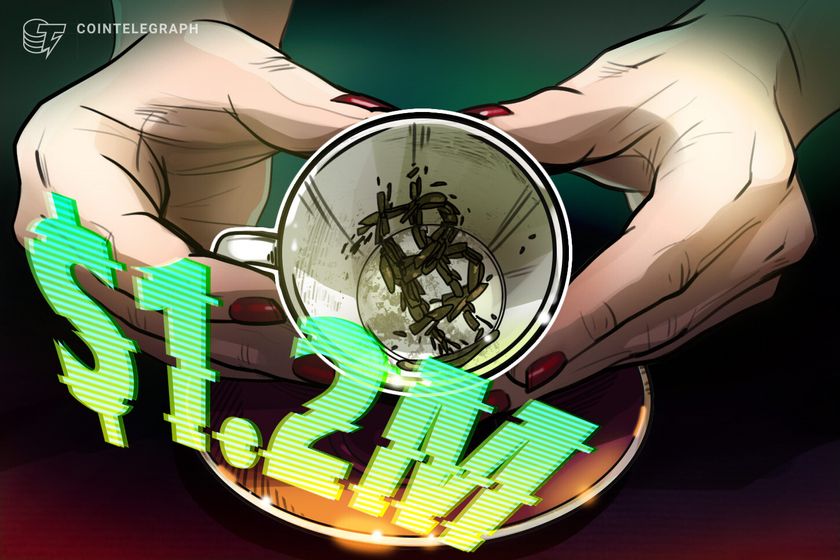
Billion-dollar asset manager ARK Invest has raised its “bull case” Bitcoin price target from $1.5 million to $2.4 million by the end of 2030, driven largely by institutional investors and Bitcoin’s increasing acceptance as “digital gold.”
ARK’s “bear” and “base” case scenarios for the price of Bitcoin (BTC) were also bumped up to $500,000 and $1.2 million, ARK research analyst David Puell said in an April 24 report.
The new bear and base targets were bumped up from ARK’s $300,000 and $710,000 Bitcoin price predictions on Feb. 11.
ARK’s price projections were modeled on Bitcoin’s total addressable market (TAM), penetration rate — the percentage of Bitcoin’s TAM that it could capture in certain cases — and Bitcoin’s supply schedule.
 ARK’s bear, base and bull case price targets for Bitcoin by Dec. 31, 2030. Source: ARK Invest
“Institutional investment contributes the most to our bull case,” said Puell, who estimated that Bitcoin would achieve a 6.5% penetration rate into the $200 trillion financial market in a best-case scenario (that figure excludes gold).
Bitcoin’s acceptance as “digital gold” was also a major contributor to the lofty estimate, with Puell estimating that it could capture up to 60% of gold’s $18 trillion market cap (2024 figures) by the end of 2030 in a bull scenario.
Bitcoin becoming a “safe haven” in emerging markets was the third-largest contributor to ARK’s $2.4 million bull case prediction at 13.5%.
“This Bitcoin use case has the greatest potential for capital accrual,” Puell said, pointing to Bitcoin’s ability to protect wealth from inflation and devaluation in developing countries.Nation-state and corporate Bitcoin treasury strategies and Bitcoin financial services were also factored into ARK’s Bitcoin price projections.
 Bitcoin use cases contributing to ARK’s Bitcoin price targets. Source: ARK InvestARK’s Bitcoin predictions are bold
A $2.4 million Bitcoin price tag would send Bitcoin’s market cap to $49.2 trillion, assuming that Bitcoin’s total supply will have reached 20.5 million by the end of 2030.
A $49.2 trillion valuation would be almost larger than the current gross domestic products of the US and China combined.
It would also put Bitcoin in a good position to overtake gold as the world’s largest asset, which currently boasts a market cap of $22.5 trillion.
Related: Cathie Wood to kick off El Salvador’s AI public education program
Even ARK’s bear and base targets of $500,000 and $1.2 million would mean Bitcoin needs to increase at a compounded annual growth rate of 32% and 53% by the end of 2030 — a return that isn’t achieved too often for assets that have already notched trillion-dollar valuations.
Since then, Bitcoin has recovered from a 2025 low of $75,160, soaring back up to the $94,000 range, while the Trump administration established a Strategic Bitcoin Reserve.
Magazine: Ethereum maxis should become ‘assholes’ to win TradFi tokenization race
POPCAT eyes breakout moment after months of pressure below major level [btcmanager]
POPCAT is showing early signs of life as it presses against a level it hasn’t cleared in over two months. But can this altcoin finally shift momentum and kickstart a fresh trend? POPCAT (POPCAT) is currently trading at a region…
Italian town to unveil locally financed Satoshi Nakamoto monument [cointelegraph]

The Italian municipality of Fornelli in the Molise region of Italy will be dedicating a monument to pseudonymous Bitcoin (BTC) creator Satoshi Nakamoto.
In an April 23 Facebook post from the municipality, Fornelli said it plans to unveil the Satoshi artwork on May 1. Details surrounding the monument were unclear in the announcement, but the municipality said it had been designed by artist Mattia Pannoni and financed by the local government.
“It is important, indeed fundamental, as an administration, to take into consideration all the new ideas that come from our young people,” said Fornelli Mayor Giovanni Tedeschi.
According to the local government, Fornelli has the “highest density of Bitcoin adoption in the world” among its roughly 1,800 residents. Other regions have attempted to use BTC or other cryptocurrencies to attract visitors, including the Bitcoin Beach area of El Salvador and the Swiss city of Zug, which accepts crypto payments for many local goods and services.
Portraying a faceless individual through art
The identity of Satoshi, whether a single individual or a group of people, remains one of the biggest mysteries in the crypto space since the publication of the Bitcoin white paper in 2008.
Related: Italy finance minister warns US stablecoins pose bigger threat than tariffs
Many artists, both crypto investors and otherwise, have released artwork attempting to represent the pseudonymous creator through statues and digital images. A common theme in these pieces is showing Satoshi without any clearly defined facial features, sometimes wearing a hoodie or working on a computer.
According to the announcement, the monument will be unveiled in the Piazza Umberto I area of Fornelli on May 1.
Magazine: Former Love Island star’s tips on how to go viral in crypto: Van00sa, X Hall of Flame
SEC delays decision on Polkadot ETF [cointelegraph]

The US Securities and Exchange Commission (SEC) has delayed a decision on whether to approve a proposed exchange-traded fund (ETF) holding Polkadot’s native token, regulatory filings show.
According to an April 24 filing, the regulator has extended its deadline for a final ruling until June 11, nearly four months after the Nasdaq sought permission to list Grayscale Polkadot Trust on Feb. 24.
Grayscale’s ETF filing adds to a roster of roughly 70 proposed ETFs awaiting SEC approval, including funds holding altcoins, memecoins, and crypto-related financial derivatives, according to Bloomberg Intelligence.
Asset managers are pitching ETFs for “[e]verything from XRP, Litecoin and Solana to Penguins, Doge and 2x Melania and everything in between,” Bloomberg analyst Eric Balchunas said in an April 21 post on the X platform. Asset manager 21Shares is also awaiting permission to list its own Polkadot ETF.
Polkadot is a layer-1 blockchain network launched in 2020. Its native token, DOT (DOT), has a market capitalization of approximately $6.6 billion as of April 24, according to CoinMarketCap.
 Polkadot’s price over time. Source: CoinMarketCap
Related: Institutions break up with Ethereum but keep ETH on the hook
Altcoin ETF pipeline
Grayscale is among multiple asset managers seeking regulatory clearance to list altcoin ETFs in the US. The company is already behind several crypto funds, including spot Bitcoin (BTC) and Ether (ETH) ETFs.
The asset manager has also asked for permission to launch ETFs holding tokens such as Solana (SOL), Litecoin (LTC), XRP (XRP), Dogecoin (DOGE), and Cardano (ADA).
 Crypto ETFs scheduled for SEC review. Source: Eric Balchunas/Bloomberg
The pipeline of proposed fund listings comes as more than 80% of institutional investors say they plan to boost allocations to crypto in 2025, according to a March report by Coinbase and EY-Parthenon.
However, analysts caution that demand for altcoin ETFs is likely to be much more limited than for funds holding core cryptocurrencies such as Bitcoin and Ether.
“Having your coin get ETF-ized is like being in a band and getting your songs added to all the music streaming services,” Balchunas said.
“Doesn’t guarantee listens but it puts your music where the vast majority of the listeners are.”
Magazine: Altcoin season to hit in Q2? Mantra’s plan to win trust: Hodler’s Digest, April 13 – 19
White House receives over 10,000 comments on AI development plan [cointelegraph]

The White House said on April 24 that it received more than 10,000 public comments on its planned artificial intelligence action plan, indicating widespread interest in the technology as the global race for AI leadership accelerates.
Among the stakeholders providing inputs were AI giants such as OpenAI, Meta, Amazon, Google, and Microsoft. In addition, organizations in academia, non-profits, and industry associations also took part in the discussion.
A preliminary review of comments from major private-sector companies highlighted several recurring themes, including the need for greater investment in US energy resources to support AI growth, foreign policy efforts to enhance the global influence of American AI firms, and improved infrastructure to advance AI development domestically.
 Excerpt from Meta’s comments. Source: NITRD
In addition, many companies lobbied for an open, innovative framework to guide the American AI industry and provide safeguards to individuals.
The White House issued a request for comments on Feb. 6. The administration says these comments “will help define the priority policy actions needed to sustain and enhance America’s AI dominance.” US President Donald Trump has pledged to make the United States the “world capital” of AI and crypto.
National security concerns
National security emerged as a key concern among companies submitting feedback. Venture capital firm Andreessen Horowitz wrote that “AI model development is an issue of national concern that should be regulated on a national level. It is critical to American national security, geopolitical objectives, and the nation’s economic and social welfare.”
OpenAI also raised the issue, explicitly naming China as a competitor with “strategic advantages,” including the capacity, as an “authoritarian state,” to rapidly mobilize resources.
In January 2025, Chinese company DeepSeek launched their R1 model, sparking alarm in the US tech sector and triggering volatility in domestic equity markets.
AI and crypto are widely viewed as two of the most transformative emerging technologies, with growing overlap of AI-powered agents and digital financial products.
Magazine: AI Eye: ‘Chernobyl’ needed to wake people to AI risks, Studio Ghibli memes