XRP has jumped above $2.30 as excitement grows ahead of the XRPFi launch, a new decentralized finance platform set to expand the token’s utility. XRPFi, built by Flare Networks, will go live on Apr. 29. It will introduce smart contract…
Cryptocurrency News
XRP price pushes past $2.30 ahead of XRPFi DeFi launch [btcmanager]
XRP has jumped above $2.30 as excitement grows ahead of the XRPFi launch, a new decentralized finance platform set to expand the token’s utility. XRPFi, built by Flare Networks, will go live on Apr. 29. It will introduce smart contract…
Crypto projects prepare to battle for privacy in Switzerland [cointelegraph]

Switzerland has long been seen as a beacon of privacy where companies, organizations and wealthy people put down roots in an effort to avoid the prying eyes of the rest of the world. Joining this cohort are many Web3 projects, which also appreciate the Swiss government’s generally positive stance toward blockchain and digital assets.
The country’s reputation as a privacy haven has resulted in Switzerland becoming a hub for privacy projects establishing their foundations or development entities there, including Nym, Session and Hopr — joining traditional privacy software companies such as Proton and Threema.
Now, a proposed change to a Swiss surveillance ordinance is worrying these same projects, as it would spell a marked increase in the government’s user monitoring requirements. But the decentralized nature of crypto may offer a solution for those wishing to preserve their privacy in a climate of increasing surveillance.
Switzerland is a privacy haven — or maybe not
Switzerland has long been considered by many to have some of the world’s strongest privacy protections. As Proton, the company behind the encrypted Proton Mail email service, argued in a 2014 blog post titled “Why Switzerland?”, the Central European country offers several advantages: Companies are outside of the jurisdiction of the US and EU, the country is politically neutral, there are strong constitutional privacy protections, and there is established infrastructure.
Kee Jeffries, technical co-founder of decentralized private messaging app Session, recently told Cointelegraph’s The Agenda podcast that it was important to establish the foundation “in a country which has a long history of preserving people’s personal privacy and freedom of speech.”
However, all governments must ultimately balance citizen privacy and national security concerns. In Switzerland, surveillance is governed by the Ordinance on the Surveillance of Correspondence by Post and Telecommunications (OSCPT).
In January, the Swiss Federal Council proposed a revision to the OSCPT that would increase user monitoring requirements for telecommunications service providers and widen the definition of who meets these requirements to include services such as VPNs, social networks and messaging apps.
In short, as they are currently written, the changes would require service providers that serve at least 5,000 users to identify all users and willfully decrypt all communications that are not end-to-end encrypted.
Privacy projects fight back against surveillance
The move has been met with widespread backlash from the privacy community. Proton CEO Andy Yen has threatened to fight the government in court and potentially pull the company out of the country. Decentralized VPN provider Nym issued a public call to action for Swiss citizens to contact their representatives and oppose the action.
 Source: Andy Yen
In a statement, Nym’s chief operating officer, Alexis Roussel, said the ordinance by the Federal Council “is destroying an entire sector,” adding:
“This ordinance directly endangers the people who use these services.”
Sebastian Bürgel, vice president of technology at Gnosis and founder of decentralized mixnet Hopr, echoed the concerns of Yen and Roussel, telling Cointelegraph the move would likely backfire.
“If the intent is to limit the privacy and anonymity that services such as Proton Mail, Proton VPN and Threema are providing, that will not change much because those entities will potentially leave Switzerland if that were to happen,” he said. “But again, the consequences will be borne by everyone out there and everyone who’s actually in Switzerland.”
Related: Keeping crypto cypherpunk protects users from censorship and corporatism — Gnosis VP
Meanwhile, Ronald Kogens, a legal partner at Swiss law firm MME who focuses on Web3 and fintech, told Cointelegraph that it’s unclear whether the Swiss Federal Council even has the authority to implement such changes.
“In an ordinance, you cannot include any heavy rights or obligations which have a strong impact on individuals in Switzerland,” he shared, saying that the Federal Council is essentially an executive body and that laws must pass through parliament.
“One question you could ask is, does the Federal Council have the power, based on the laws where it stated that they can enact an ordinance, the power to do this, what they’re doing now?”
Are Swiss crypto projects at risk?
The move by the Swiss Federal Council is damaging Switzerland’s privacy reputation, but decentralized technologies like blockchain networks may offer a lifeline. According to Kogens, truly decentralized projects should be exempt from the new surveillance requirements.
“In my opinion, most Web3 activities are not affected because […] the pure offering of software without running any infrastructure for the whole messaging or communication system is not covered by this,” he told Cointelegraph. “You have to have specific servers or clients that you operate that are an essential part of the communication or messaging service.”
Either way, the more decentralized a project is, the less any government can influence its operations. Take, for example, Tornado Cash, which has continued chugging along for years despite multiple developers being arrested and the US sanctioning its smart contracts at one point.
Nym CEO Harry Halpin told Cointelegraph in March that “in theory, we should be able to get run over with a car, and the network would keep operating.”
“Hopr, as an example of Web3 infrastructure, does not operate infrastructure, right?” said Bürgel. “Hopr Association is involved in software development and research and development, but we are not an operator of a network.”
The fact that the Hopr network is fully decentralized and anonymous means the Hopr Association could not actually give any information about its users to Switzerland, even if it were legally compelled.
“Individual node runners which are participating in it, or other third parties, cannot tell who is using the Hopr network to access any kind of web service. That is the explicit goal of what we are undertaking.”
The future of privacy in Switzerland
The Swiss Federal Council’s proposed changes to the OSCPT are still in the consultation phase, with the public encouraged to offer feedback on the proposal through May 6.
Kogens told Cointelegraph that the council will review the feedback, create a final report, and decide whether to adjust the proposal. “That happens quite a lot,” he said, “because in the end, it’s not in the interest of Switzerland to do something which harms the industry, as long as they still can fulfill their goal, which they have with this surveillance act.”
 Source: Nym
But even if the changes go through as written, there could be some positive knock-on effects for the crypto space. “It may be that the silver lining is that it will drive users to decentralized and privacy-facilitating solutions instead,” said Bürgel.
“It is clear to everyone that more surveillance is bad,” he added. “Every single individual understands that.”
“Taming the surveillance machinery is a goal of Web3. It’s not just about magic internet money. And yeah, I think we need more people working towards that.”
Magazine: UK’s Orwellian AI murder prediction system, AI will take your job
Document has no content
Crypto projects prepare to battle for privacy in Switzerland [cointelegraph]
Document has no content
What are XRP futures and how to invest in them? [cointelegraph]

If you’re following developments in the cryptocurrency market, you’ve likely noticed that Coinbase Derivatives has introduced XRP futures contracts to its US derivatives exchange. This move is part of a broader trend where regulated platforms are expanding access to futures trading, giving investors new ways to engage with digital assets like XRP (XRP).
But what exactly are XRP futures? And how do you get involved as an investor or trader?
Let’s take a closer look.
What are XRP futures?
XRP futures are standardized financial contracts that allow you to agree to buy or sell XRP at a predetermined price on a specific future date. Rather than trading the actual token, you’re trading a contract that tracks the price of XRP.
These contracts are overseen by the US Commodity Futures Trading Commission (CFTC), meaning they operate within a regulated framework. That adds a level of oversight and structure that appeals to many investors, particularly those wary of the risks tied to unregulated platforms.
On April 3, 2025, Coinbase Derivatives announced it had filed with the CFTC to self-certify XRP futures contracts, and the contracts were launched on April 21, 2025.
 Types of XRP futures contracts offered by Coinbase
Coinbase’s offering includes:
Nano XRP futures represent 500 XRP per contract, cash-settled in US dollars. These are designed for retail traders and smaller institutions, offering lower capital requirements while still providing exposure to XRP price movements.
Standard XRP futures cover 10,000 XRP per contract, are also settled in USD, and are aimed at larger institutions and active traders.
This variety lets you choose a position size that matches your risk tolerance and investment strategy.
But what do terms like “cash-settled” actually mean?
Both Nano and Standard XRP futures are contracts that let you trade based on the price of XRP — but you don’t actually own or receive XRP. You’re trading contracts that track XRP’s price.
And, when the contract closes, the difference between your entry and exit price is calculated (profit or loss) and settled in USD — this is what cash settlement means.
Did you know? Other products offered by the Coinbase Derivatives exchange include more than 20 futures contracts on assets such as Bitcoin (BTC), Ether (ETH), Dogecoin (DOGE), Solana (SOL), Chainlink (LINK) and Stellar (XLM).
Why choose XRP futures contracts over buying XRP?
You might be wondering why someone would choose futures over simply buying XRP on the spot market.
Here are a few reasons:
Leverage: Futures often allow you to control a large position with a relatively small amount of capital. While this can amplify gains, it also increases potential losses.
Hedging: If you already hold XRP and expect short-term volatility, futures can be used to protect your portfolio.
Speculation: Futures allow you to take both long (bullish) and short (bearish) positions, so you can potentially benefit from market moves in either direction.
No wallet or storage needs: Buying XRP requires a secure wallet and managing private keys, which carries risks like hacking or loss. Futures contracts are financial instruments traded on exchanges, eliminating the need for direct XRP custody.
Liquidity and accessibility: Futures markets often have high liquidity, making it easier to enter and exit positions. Some exchanges offer XRP futures with lower barriers than buying XRP on certain crypto platforms, especially in regions with regulatory restrictions.
Cash settlement: Many XRP futures are cash-settled, meaning you settle profits or losses in fiat or stablecoins without handling XRP itself, simplifying the process for traders avoiding crypto custody.
When to choose futures contracts:
You want to trade XRP price movements with leverage or flexibility to go long or short.
You prefer not to deal with crypto wallets or custody.
You’re hedging an existing XRP position or portfolio.
You’re comfortable with the risks and complexities of derivatives.
When to buy XRP:
You believe in XRP’s long-term value and want to hold it as an investment.
You plan to use XRP for transactions or in its ecosystem (e.g., Ripple’s payment network).
You want to avoid the risks of leverage and futures margin calls.
Ultimately, futures suit active traders or those seeking leveraged exposure, while buying XRP could be ideal for long-term holders or users of the asset. You must always assess your risk tolerance and goals before deciding whether to invest in XRP or XRP futures.
Did you know? The MarketVector™ Coinbase XRP Benchmark Rate provides a robust USD price reference exclusively for XRP traded on the Coinbase Exchange. It includes no other assets and no other exchanges — just XRP, just Coinbase.
Where to invest in XRP futures
If you’re looking to invest in XRP futures, there are several platforms (other than Coinbase) offering access depending on your location and trading needs.
Kraken Futures: Kraken provides XRP futures with leverage. In Australia, access is limited to wholesale clients through Beaufort Fiduciaries Pty Ltd (AFSL no. 545124). In the United Kingdom, only clients classified as Professional Clients under Financial Conduct Authority rules can trade through Crypto Facilities Limited (FRN: 757895).
Binance: Binance offers XRP/USDT perpetual futures contracts, allowing users to trade XRP without an expiry date. These contracts support leverage, giving traders flexibility in managing exposure. However, as of May 28, 2024, Binance no longer supports XRP as a margin asset under its “Multi-Assets Mode,” though XRP futures remain available in other trading modes.
OKX: OKX also provides XRP/USDT perpetual swaps, which let traders speculate on XRP price movements continuously. While OKX delisted XRP expiry futures contracts in December 2024, perpetual swaps are still supported. Traders can apply leverage and adjust positions based on their risk strategy.
Bitget: It is a globally accessible platform that offers XRP futures with options to take long or short positions. It features a user-friendly interface, making it suitable for both new and experienced traders, though availability depends on regional regulations.
KuCoin Futures: KuCoin supports XRP perpetual contracts (XRP/USDT) with leverage. The platform is known for low trading fees and offers various features for different trading strategies. It’s accessible in many countries, with some regional restrictions.
MEXC: It provides XRP futures in both USDt-margined and coin-margined formats. MEXC supports high leverage and offers educational tools, catering to traders of all levels. The platform is available in most regions, though users should check for local compliance.
Delta Exchange: It lists XRP perpetual futures with leverage up to 100x. It’s known for low fees and advanced risk management tools. The platform is available to traders in several countries, depending on local laws.
Bitfinex: Lastly, Bitfinex offers XRP futures as part of its broader derivatives portfolio. Its platform caters to advanced users with customizable strategies. Access is region-dependent, and traders must ensure eligibility based on their location.
Did you know? Coinbase crypto derivatives are not available to retail clients based in the United Kingdom or Spain due to local regulatory restrictions.
How to invest in XRP futures
If you’re interested in trading XRP futures, here are general steps to get started:
Choose a platform: Select a regulated exchange offering XRP futures, such as Coinbase’s US Derivatives Exchange. Create an account and complete identity verification, which typically involves submitting a valid ID and proof of address.
Understand the product: Research how XRP futures contracts work, including contract sizes (e.g., Coinbase offers standard contracts of 10,000 XRP or nano contracts of 500 XRP), margin requirements, leverage options and fees. Futures are complex, so review the exchange’s documentation and understand risks, such as liquidation.
Fund your account: Deposit USD or another accepted currency to use as collateral (margin) for trading. Check the platform’s minimum deposit and margin requirements. For example, Coinbase settles futures in USD, and you can fund via bank transfer or debit card.
Place your trade: Use the platform’s trading interface (e.g., Coinbase Advanced) to select XRP futures contracts (symbol: XRL for standard XRP contracts on Coinbase). Decide whether to go long (buy) or short (sell), set your position size, and apply any leverage if available. Confirm the trade after reviewing details.
Practice risk management: Futures carry high risks due to leverage and volatility. Set stop-loss orders, limit position sizes based on your risk tolerance, and avoid risking more than you can afford to lose. For instance, some exchanges pause trading if the underlying asset’s price moves over 10% in an hour to mitigate volatility risks.
Monitor the market: Track XRP’s price, market sentiment, funding rates and external factors like regulatory news or macroeconomic trends. Use tools like candlestick charts or technical indicators on the platform to inform your strategy. Stay updated to adjust positions and avoid unexpected losses.
Oregon targets Coinbase over XRP, cites securities violations
Oregon’s Attorney General has sued Coinbase, claiming the exchange offered unregistered securities, including XRP. The lawsuit argues that a wide range of digital assets traded on the platform qualify as investment contracts under state law.

State officials say the case is part of a broader effort to step in where federal enforcement has pulled back. Legal experts note that while the outcome won’t set a national precedent, it could influence how regulators and courts approach similar cases.
The timing is notable — just weeks after the SEC dropped its case against Ripple and days after Coinbase listed XRP futures on its US derivatives exchange.
Did you know? On March 25, 2025, Ripple Labs settled its long-standing legal dispute with the SEC. As part of the agreement, Ripple consented to pay a reduced fine of $50 million — down from the original $125 million — without admitting any wrongdoing.
CME’s XRP futures launch: A new era for institutional crypto trading?
CME Group, the world’s leading derivatives marketplace, is set to launch XRP futures on May 19, 2025, pending regulatory approval. This move marks a significant milestone for Ripple’s native token, as it opens the door for institutional investors to gain regulated exposure to XRP for the first time through a trusted exchange.
The futures contracts will come in two sizes:
2,500 XRP (micro)
50,000 XRP (standard)
These contracts will be cash-settled, using the CME CF XRP-Dollar Reference Rate, calculated daily at 4:00 p.m. London time. Such contracts are designed to provide traders and institutions with a capital-efficient way to hedge or speculate on XRP’s price movements.
This launch follows CME’s expanding suite of crypto derivatives, which already includes Bitcoin, Ethereum, and Solana futures. With over 80 million XRP users globally and growing interest in Ripple’s technology, the addition of XRP futures positions CME as a key player in the evolving digital asset landscape.
How risky are crypto futures?
Futures trading offers opportunities, but it comes with significant risks — especially if you’re new to derivatives. Here’s what you should keep in mind:
Leverage risk: While leverage can increase your returns, it also amplifies losses. A small price move in the wrong direction can quickly deplete your account.
Volatility: XRP is known for its sharp price swings. Futures contracts can exaggerate the impact of volatility on your position.
Funding rates: Perpetual futures contracts charge periodic funding fees, which can eat into profits if held long-term.
Liquidation: If the market moves against you and your margin falls below the required level, your position may be automatically closed — often at a loss.
Complexity: Futures are more complicated than spot trading. Understanding contract terms, funding rates and expiry dates is crucial to managing your trades effectively.
Market liquidity: While XRP is a liquid asset, futures trading depends on active participation. Thin order books can lead to slippage and unexpected price movements.
Emotional pressure: The fast-paced nature of futures trading can lead to impulsive decisions. Discipline and a clear strategy are essential.
If you’re new to this type of trading, consider starting with a demo account or using nano contracts to reduce your exposure while you learn. Trade smart — your safety’s on you!
This article does not contain investment advice or recommendations. Every investment and trading move involves risk, and readers should conduct their own research when making a decision.
If you’re following developments in the cryptocurrency market, you’ve likely noticed that Coinbase Derivatives has introduced XRP futures contracts to its US derivatives exchange. This move is part of a broader trend where regulated platforms are expanding access to futures trading, giving investors new ways to engage with digital assets like XRP (XRP).
But what exactly are XRP futures? And how do you get involved as an investor or trader?
Let’s take a closer look.
What are XRP futures?
XRP futures are standardized financial contracts that allow you to agree to buy or sell XRP at a predetermined price on a specific future date. Rather than trading the actual token, you’re trading a contract that tracks the price of XRP.
These contracts are overseen by the US Commodity Futures Trading Commission (CFTC), meaning they operate within a regulated framework. That adds a level of oversight and structure that appeals to many investors, particularly those wary of the risks tied to unregulated platforms.
On April 3, 2025, Coinbase Derivatives announced it had filed with the CFTC to self-certify XRP futures contracts, and the contracts were launched on April 21, 2025.
Types of XRP futures contracts offered by Coinbase
Coinbase’s offering includes:
Nano XRP futures represent 500 XRP per contract, cash-settled in US dollars. These are designed for retail traders and smaller institutions, offering lower capital requirements while still providing exposure to XRP price movements.
Standard XRP futures cover 10,000 XRP per contract, are also settled in USD, and are aimed at larger institutions and active traders.
This variety lets you choose a position size that matches your risk tolerance and investment strategy.
But what do terms like “cash-settled” actually mean?
Both Nano and Standard XRP futures are contracts that let you trade based on the price of XRP — but you don’t actually own or receive XRP. You’re trading contracts that track XRP’s price.
And, when the contract closes, the difference between your entry and exit price is calculated (profit or loss) and settled in USD — this is what cash settlement means.
Did you know? Other products offered by the Coinbase Derivatives exchange include more than 20 futures contracts on assets such as Bitcoin (BTC), Ether (ETH), Dogecoin (DOGE), Solana (SOL), Chainlink (LINK) and Stellar (XLM).
Why choose XRP futures contracts over buying XRP?
You might be wondering why someone would choose futures over simply buying XRP on the spot market.
Here are a few reasons:
Leverage: Futures often allow you to control a large position with a relatively small amount of capital. While this can amplify gains, it also increases potential losses.
Hedging: If you already hold XRP and expect short-term volatility, futures can be used to protect your portfolio.
Speculation: Futures allow you to take both long (bullish) and short (bearish) positions, so you can potentially benefit from market moves in either direction.
No wallet or storage needs: Buying XRP requires a secure wallet and managing private keys, which carries risks like hacking or loss. Futures contracts are financial instruments traded on exchanges, eliminating the need for direct XRP custody.
Liquidity and accessibility: Futures markets often have high liquidity, making it easier to enter and exit positions. Some exchanges offer XRP futures with lower barriers than buying XRP on certain crypto platforms, especially in regions with regulatory restrictions.
Cash settlement: Many XRP futures are cash-settled, meaning you settle profits or losses in fiat or stablecoins without handling XRP itself, simplifying the process for traders avoiding crypto custody.
When to choose futures contracts:
You want to trade XRP price movements with leverage or flexibility to go long or short.
You prefer not to deal with crypto wallets or custody.
You’re hedging an existing XRP position or portfolio.
You’re comfortable with the risks and complexities of derivatives.
When to buy XRP:
You believe in XRP’s long-term value and want to hold it as an investment.
You plan to use XRP for transactions or in its ecosystem (e.g., Ripple’s payment network).
You want to avoid the risks of leverage and futures margin calls.
Ultimately, futures suit active traders or those seeking leveraged exposure, while buying XRP could be ideal for long-term holders or users of the asset. You must always assess your risk tolerance and goals before deciding whether to invest in XRP or XRP futures.
Did you know? The MarketVector™ Coinbase XRP Benchmark Rate provides a robust USD price reference exclusively for XRP traded on the Coinbase Exchange. It includes no other assets and no other exchanges — just XRP, just Coinbase.
Where to invest in XRP futures
If you’re looking to invest in XRP futures, there are several platforms (other than Coinbase) offering access depending on your location and trading needs.
Kraken Futures: Kraken provides XRP futures with leverage. In Australia, access is limited to wholesale clients through Beaufort Fiduciaries Pty Ltd (AFSL no. 545124). In the United Kingdom, only clients classified as Professional Clients under Financial Conduct Authority rules can trade through Crypto Facilities Limited (FRN: 757895).
Binance: Binance offers XRP/USDT perpetual futures contracts, allowing users to trade XRP without an expiry date. These contracts support leverage, giving traders flexibility in managing exposure. However, as of May 28, 2024, Binance no longer supports XRP as a margin asset under its “Multi-Assets Mode,” though XRP futures remain available in other trading modes.
OKX: OKX also provides XRP/USDT perpetual swaps, which let traders speculate on XRP price movements continuously. While OKX delisted XRP expiry futures contracts in December 2024, perpetual swaps are still supported. Traders can apply leverage and adjust positions based on their risk strategy.
Bitget: It is a globally accessible platform that offers XRP futures with options to take long or short positions. It features a user-friendly interface, making it suitable for both new and experienced traders, though availability depends on regional regulations.
KuCoin Futures: KuCoin supports XRP perpetual contracts (XRP/USDT) with leverage. The platform is known for low trading fees and offers various features for different trading strategies. It’s accessible in many countries, with some regional restrictions.
MEXC: It provides XRP futures in both USDt-margined and coin-margined formats. MEXC supports high leverage and offers educational tools, catering to traders of all levels. The platform is available in most regions, though users should check for local compliance.
Delta Exchange: It lists XRP perpetual futures with leverage up to 100x. It’s known for low fees and advanced risk management tools. The platform is available to traders in several countries, depending on local laws.
Bitfinex: Lastly, Bitfinex offers XRP futures as part of its broader derivatives portfolio. Its platform caters to advanced users with customizable strategies. Access is region-dependent, and traders must ensure eligibility based on their location.
Did you know? Coinbase crypto derivatives are not available to retail clients based in the United Kingdom or Spain due to local regulatory restrictions.
How to invest in XRP futures
If you’re interested in trading XRP futures, here are general steps to get started:
Choose a platform: Select a regulated exchange offering XRP futures, such as Coinbase’s US Derivatives Exchange. Create an account and complete identity verification, which typically involves submitting a valid ID and proof of address.
Understand the product: Research how XRP futures contracts work, including contract sizes (e.g., Coinbase offers standard contracts of 10,000 XRP or nano contracts of 500 XRP), margin requirements, leverage options and fees. Futures are complex, so review the exchange’s documentation and understand risks, such as liquidation.
Fund your account: Deposit USD or another accepted currency to use as collateral (margin) for trading. Check the platform’s minimum deposit and margin requirements. For example, Coinbase settles futures in USD, and you can fund via bank transfer or debit card.
Place your trade: Use the platform’s trading interface (e.g., Coinbase Advanced) to select XRP futures contracts (symbol: XRL for standard XRP contracts on Coinbase). Decide whether to go long (buy) or short (sell), set your position size, and apply any leverage if available. Confirm the trade after reviewing details.
Practice risk management: Futures carry high risks due to leverage and volatility. Set stop-loss orders, limit position sizes based on your risk tolerance, and avoid risking more than you can afford to lose. For instance, some exchanges pause trading if the underlying asset’s price moves over 10% in an hour to mitigate volatility risks.
Monitor the market: Track XRP’s price, market sentiment, funding rates and external factors like regulatory news or macroeconomic trends. Use tools like candlestick charts or technical indicators on the platform to inform your strategy. Stay updated to adjust positions and avoid unexpected losses.
Oregon targets Coinbase over XRP, cites securities violations
Oregon’s Attorney General has sued Coinbase, claiming the exchange offered unregistered securities, including XRP. The lawsuit argues that a wide range of digital assets traded on the platform qualify as investment contracts under state law.
State officials say the case is part of a broader effort to step in where federal enforcement has pulled back. Legal experts note that while the outcome won’t set a national precedent, it could influence how regulators and courts approach similar cases.
The timing is notable — just weeks after the SEC dropped its case against Ripple and days after Coinbase listed XRP futures on its US derivatives exchange.
Did you know? On March 25, 2025, Ripple Labs settled its long-standing legal dispute with the SEC. As part of the agreement, Ripple consented to pay a reduced fine of $50 million — down from the original $125 million — without admitting any wrongdoing.
CME’s XRP futures launch: A new era for institutional crypto trading?
CME Group, the world’s leading derivatives marketplace, is set to launch XRP futures on May 19, 2025, pending regulatory approval. This move marks a significant milestone for Ripple’s native token, as it opens the door for institutional investors to gain regulated exposure to XRP for the first time through a trusted exchange.
The futures contracts will come in two sizes:
2,500 XRP (micro)
50,000 XRP (standard)
These contracts will be cash-settled, using the CME CF XRP-Dollar Reference Rate, calculated daily at 4:00 p.m. London time. Such contracts are designed to provide traders and institutions with a capital-efficient way to hedge or speculate on XRP’s price movements.
This launch follows CME’s expanding suite of crypto derivatives, which already includes Bitcoin, Ethereum, and Solana futures. With over 80 million XRP users globally and growing interest in Ripple’s technology, the addition of XRP futures positions CME as a key player in the evolving digital asset landscape.
How risky are crypto futures?
Futures trading offers opportunities, but it comes with significant risks — especially if you’re new to derivatives. Here’s what you should keep in mind:
Leverage risk: While leverage can increase your returns, it also amplifies losses. A small price move in the wrong direction can quickly deplete your account.
Volatility: XRP is known for its sharp price swings. Futures contracts can exaggerate the impact of volatility on your position.
Funding rates: Perpetual futures contracts charge periodic funding fees, which can eat into profits if held long-term.
Liquidation: If the market moves against you and your margin falls below the required level, your position may be automatically closed — often at a loss.
Complexity: Futures are more complicated than spot trading. Understanding contract terms, funding rates and expiry dates is crucial to managing your trades effectively.
Market liquidity: While XRP is a liquid asset, futures trading depends on active participation. Thin order books can lead to slippage and unexpected price movements.
Emotional pressure: The fast-paced nature of futures trading can lead to impulsive decisions. Discipline and a clear strategy are essential.
If you’re new to this type of trading, consider starting with a demo account or using nano contracts to reduce your exposure while you learn. Trade smart — your safety’s on you!
This article does not contain investment advice or recommendations. Every investment and trading move involves risk, and readers should conduct their own research when making a decision.
Bitcoin upside could stop at $100K despite $3B in ETF inflows [cointelegraph]
Key points:
High Bitcoin ETF inflows don’t always signal a price top as historical data is mixed.
Spot Bitcoin inflows often precede short-term price rises, not reversals.
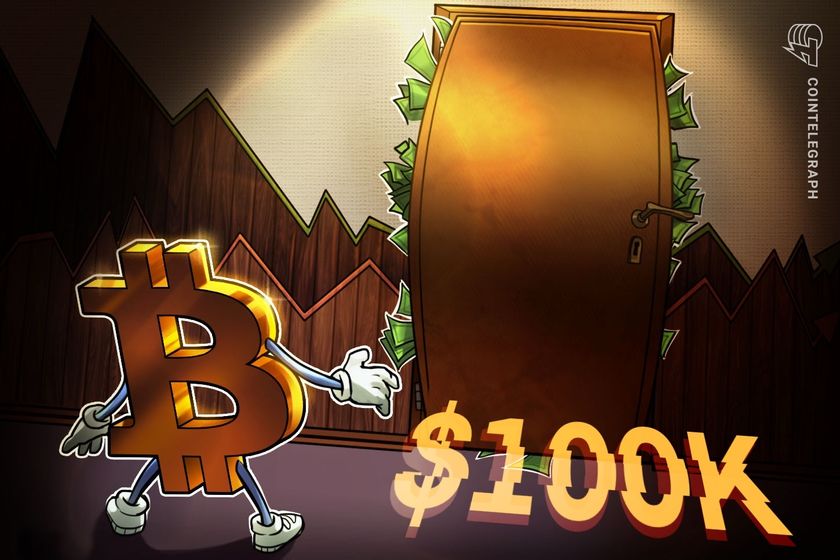
Bitcoin may hit $100K but faces resistance.
Bitcoin’s (BTC) price recovery may be stalled at $100,000 as questions emerge whether high ETF inflows have always marked the local top for the asset.
Does $1B Bitcoin ETF inflows signal a top?
Bitcoin has displayed bullish momentum after recovering from its multimonth lows of $74,400. BTC is up 8% over the last seven days, as per data from Cointelegraph Markets Pro and TradingView.
Bitcoin’s recovery was fueled by high investor appetite for spot ETFs, which recorded $3.06 billion net weekly inflows, the largest since December 2025.
Evidence of whether the high spot Bitcoin ETFs inflows could signal that the price is getting close to a local top could be determined by analyzing historical data.
While there have been instances where significant inflows coincided with or preceded Bitcoin price peaks, this has not always been the case.
 Spot Bitcoin ETF flows. Source: Glassnode
The chart above shows that in March 2024, spot Bitcoin ETFs saw record inflows of over $1 billion on March 12, with BlackRock’s IBIT alone receiving $849 million.
This preceded Bitcoin’s new all-time high of around $73,300, suggesting a potential top signal. Similarly, on June 3, 2024, daily inflows hit $917 billion, aligning with Bitcoin’s rally from $67,000 to $72,000, followed by a 25% correction to $53,000. These cases support the idea of major inflows preceding local tops.
However, in November 2024, weekly inflows hit $3.38 billion, as Bitcoin hit one all-time high after another, but this did not immediately lead to a price top. Instead, BTC showed resilience crossing the $100,000 market for the first time to its previous all-time highs of $108,000 reached on Dec. 17, 2025.
Using a Vector Autoregression model, market analytics resource FalconX demonstrated the relationship between ETF net flows and Bitcoin price, and found that inflows have short-term predictive power for price increases, not necessarily reversals.
Related: A ‘local top’ and $88K retest? 5 things to know in Bitcoin this week
How high can Bitcoin price go?
Bitcoin’s 27% rally from the $74,400 range low saw it flip key levels into support, including the 50-day ($85,100), 100-day ($90,570), and 200-day ($89,300) simple moving averages (SMA).
Bitcoin was still consolidating under the resistance at $95,000 as observed by popular analyst AlphaBTC.
“The pink box [at the $95,000 level] has held $BTC’s price for the last few days, as expected,” AlphaBTC said in an April 28 post on X, hoping to see BTC move past it as the week opens.
Cointelegraph earlier reported that the $95,000 level marks the next significant resistance for Bitcoin and that continued ETF demand and other bullish factors would be key in overcoming it.
AlphaBTC added:
“I think we push to 100K, but then likely see a bigger pullback.” BTC/USD four-hour chart. Source: AlphaBTC
Data from monitoring resource CoinGlass shows significant seller interest within the $97,000-$100,000 range over the past three months.
This suggests that Bitcoin’s price might rise further to take the liquidity at $100,000 before staging a pullback.
 BTC/USDT liquidation heatmap (screenshot). Source: CoinGlass
Keith Alan, co-founder of trading resource Material Indicators, doubted the ability of BTC/USD to sustain a trip above $95,000. While trading firm QCP Capital argued that Bitcoin lacked a “catalyst” to propel it toward $100,000 for the time being.
This article does not contain investment advice or recommendations. Every investment and trading move involves risk, and readers should conduct their own research when making a decision.
Beyond tariffs and chaos — blockchain emerges as the backbone of a parallel economy [cointelegraph]

Opinion by: Ross Shemeliak, co-founder and chief operating officer of Stobox
The Trump administration is pushing a much-revived policy trajectory, marked by tariffs and sanctions that aim to reshore production. Despite exemptions favorable to technology, this dramatic turnaround may seem like a case of the White House treating global trade as its playground. The president’s tariff agenda is fracturing supply chains overnight and disregarding long-standing economic rules.
This latent, chaotic agenda also sees the quiet emergence of a new infrastructure in which blockchain is taking on a fresh role. Insofar as it is not purely focused on decentralization, the technology is geopolitically resilient. With global businesses, especially small and medium enterprises, increasingly pushed toward blockchain, we are witnessing a global economic map redrawing into one centered on Real-World Assets tokenization and stablecoins.
Secondary markets for tokenized trade assets
There are few winners in a trade war. Sanctions and restrictions disrupt international economic rules, and liquidity is one of the first victims. Companies struggle to finance their operations, while risk management models force banks to step back. With the fragmented economic order, a new era in which secondary markets for tokenized trade assets are prevalent is being ushered in.
These tokenized real-world assets — receivables, commodities or shopping slots, for example — can be fractionalized and sold in global permissioned marketplaces. The resulting access to capital outside of sanctioned corridors grants companies liquidity. As sanctions reduce liquidity, tokenization creates it. Within the economic disruption from the US, there is a moment of opportunity for tokenization.
Onchain provenance
Another implication of sanctions relates to the existential significance of transparency and traceability. Traceability means companies importing goods must prove their origin and routing or risk secondary sanctions. Tokenization may be in a position to benefit.
Recent: US exchanges bet big on crypto derivatives amid tariff turbulence
This owes itself to tokenized assets having immutable metadata — certificates of origin, shipping routes, customs approvals. The result is real-time, tamper-proof compliance, which far outstrips outdated spreadsheets and siloed databases. Manufacturers can directly onchain verify that every component used — down to the source of its raw materials — fully complies with sanctions.
The peril of sanctions extends yet further, as trust in banks is eroded. Exiting high-risk corridors, banks leave companies without neutral payment intermediaries. DeFi Infrastructure and tokenized Escrow represent meaningful options for rebuilding trust without banks. Tokenized Escrow via smart contracts enables milestone-based payments to be enforced by code, not banks. International deals can be conducted without traditional clearing systems while maintaining trust and accountability. When sanctions gnaw away at trust in banks, code can step in as the counterparty.
Stablecoins are a new artery for sanction-neutral payments
Stablecoins do more still. The technology no longer just enables DeFi; it facilitates parallel international trade. While this may seem like the remit of the theoretical, it is happening. As fiat rails fall under geopolitical pressure, companies from Latin America to Southeast Asia adopt stablecoin-based invoicing to keep commerce alive.
While stablecoins began as something of a fintech novelty, the disruption of sanctions to SWIFT and frozen cross-border transfers means that stablecoins like USDC, USDT, and even EURC are emerging as financial lifelines. A shadow banking system has come into being for the sanctioned world. Faster, cheaper, borderless, this offers three serious advantages:
Payments are processed 24/7, without banks or FX intermediaries.
Counterparties can settle in neutral, dollar-pegged assets — outside traditional financial rails.
Smart contracts and stablecoins enable programmable, conditional payments tied to compliance checkpoints.
Neutral blockchain hubs
The deepening fractures in geopolitics are leading to further opportunities for digital infrastructure. With supply chains increasingly politicized, the door is opening to greater use of tokenization by creating “compliance-first” trade hubs.
This is significant because the trade hubs can be located in neutral countries like Singapore, the UAE and Turkey. These hubs tokenize ports, warehouses and logistics routes. As a result, they embed compliance and origin data directly into the asset lifecycle. Companies seeking a trustworthy alternative in a fraught geopolitical environment can turn to neutral blockchain hubs.
Tokenized smart contracts
Sanctions carry disadvantages for legacy contracts — these agreements are static, complex to amend, and dependent on intermediaries — and freeze when restrictions are hit. By contrast, the logic embedded in tokenized smart contracts offers more dynamic reactivity to regulatory shifts.
Let’s briefly consider an example — a European supplier tokenizes its invoice and programs the contract to release payment only if goods clear non-restricted jurisdictions. This level of programmable compliance, enabled by the technology, reduces legal risk, operational lag and cross-border tension.
Building infrastructure from uncertainty
An unprecedented, challenging economic environment is emerging from US sanctions, which has painful implications for financial institutions and trade partners. As traditional infrastructure is broken, tokenization offers the possibility to build a new one.
On the surface, tokenization and stablecoins are about efficiency and transparency. Realizing the full benefits requires us to look deeper — they are becoming foundational layers in a parallel global economy. This new order adapts faster than banks, negotiates better than lawyers, and operates beyond the reach of sanctions.
Blockchain does far more than simply record trade. It enforces geopolitical logic at the asset level. With the next economic map being drawn onchain, tokenization’s broad benefits are clear.
Opinion by: Ross Shemeliak, co-founder and chief operating officer of Stobox.
This article is for general information purposes and is not intended to be and should not be taken as legal or investment advice. The views, thoughts, and opinions expressed here are the author’s alone and do not necessarily reflect or represent the views and opinions of Cointelegraph.
Crypto lender Nexo returns to US two years after $45m settlement with SEC [btcmanager]
Crypto lender Nexo is resuming operations in the United States, two years after settling a $45 million fine with the SEC. Cryptocurrency lending firm Nexo is re-entering operations in the United States, nearly two years after settling a $45 million…
Here’s why Casper’s CSPR token spiked 130% today [btcmanager]
Casper price gained momentum on Monday as it rallied over 130%, making it one of the best-performing tokens in crypto. CSPR, the native token of the Casper Network, shot up to an intraday high of $0.023 on April 28, its…
Here’s why Casper’s CSPR token spiked 130% today [btcmanager]
Casper price gained momentum on Monday as it rallied over 130%, making it one of the best-performing tokens in crypto. CSPR, the native token of the Casper Network, shot up to an intraday high of $0.023 on April 28, its…