FTX Trading Ltd. and the FTX Recovery Trust have filed lawsuits against NFT Stars Limited and KUROSEMI INC., the company behind the gaming platform Delysium, for failing to deliver tokens owed to the FTX estate. The action was announced in…
Cryptocurrency News
Coinbase will launch a Bitcoin yield fund for institutional investors [btcmanager]
Coinbase Asset Management is preparing to launch the Coinbase Bitcoin Yield Fund on May 1, offering non-U.S. institutional investors a new way to earn yield on their Bitcoin holdings. As originally reported by Bloomberg, Coinbase Asset Management will launch a…
1inch launches on Solana with crosschain swaps in the pipeline [cointelegraph]

Decentralized exchange (DEX) aggregator 1inch has launched on Solana, marking a significant step toward its vision of a “unified multichain” decentralized finance (DeFi) ecosystem.
According to a press release shared with Cointelegraph, the integration enables users to trade over 1 million Solana-based tokens directly through the 1inch decentralized application (DApp), benefiting from maximal extractable value-protected swaps, optimized rates and open-source smart contract infrastructure.
The move brings 1inch’s Fusion protocol to Solana for the first time. Fusion enables users to define their ideal swap parameters, which are then executed by competing professional market makers, or “resolvers,” using Dutch auction mechanics.
Combined with Solana’s ultra-fast block times, the setup promises more efficient and seamless trading execution than other networks.
A 1inch representative told Cointelegraph that users could expect “minimal fees” when executing swaps on Solana. “Users may expect costs of less than one cent,” they said.
Related: Solana’s Loopscale pauses lending after $5.8M hack
1inch to launch crosschain swaps for Solana
In addition to enabling Solana-based swaps, 1inch revealed plans to roll out crosschain functionality in the coming months, aiming to allow swaps between Solana and more than 10 other blockchains already supported by 1inch.
“At this stage, there is no fixed launch date,” the 1inch representative said. “However, development is progressing well, and we expect the feature to go live in the coming months.”
 1inch’s crosschain swaps functionality. Source: 1inch
The representative said that crosschain swaps will initially support the 10 blockchains already integrated into 1inch’s crosschain swap ecosystem. The final list will be confirmed closer to launch.
1inch’s expansion into Solana comes as the blockchain has outperformed Ethereum and layer-2 networks in several key DeFi metrics.
Over the past three months, it posted a 33% higher DEX trading volume ($539 billion), handled 400% more transactions, and hosted 180% more active addresses than its rivals, according to data from Dune Analytics.
Related: Solana whale sits on $153M profit after 4-year staking play
“Both Solana and Ethereum play critical roles in the evolving DeFi landscape,” the 1inch representative said.
They said that while Ethereum’s network effects and liquidity depth continue to dominate today, Solana’s performance improvements and growing adoption make it a serious contender.
The integration also includes access to six APIs through the 1inch Developer Portal, giving builders tools to create new DApps and services on top of the 1inch-Solana infrastructure.
On Sept. 12, 2024, 1inch first revealed the details of its solution to crosschain interoperability issues when it published a white paper about the intent-based, crosschain interoperability protocol it was developing.
On Sept. 18, 2024, the DEX aggregator revealed “Fusion+” to allow users to swap their digital assets crosschain while retaining self-custody of the assets.
Magazine: Ethereum is destroying the competition in the $16.1T TradFi tokenization race
Russian ruble stablecoin: Exec lists 7 ‘Tether replica’ features [cointelegraph]
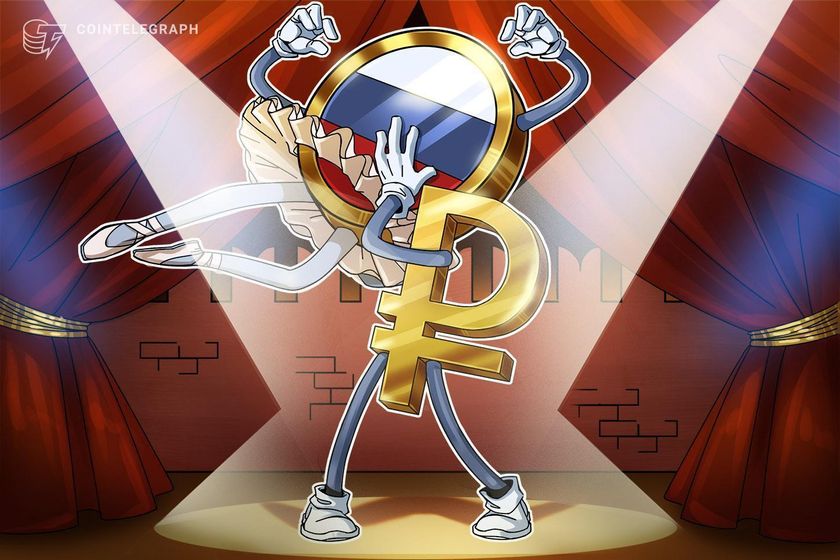
The concept of a Russian ruble stablecoin received special attention at a major local crypto event, the Blockchain Forum in Moscow, with key industry executives reflecting on some of the core features a ruble-backed stablecoin might require.
Sergey Mendeleev, founder of the digital settlement exchange Exved and inactive founder of the sanctioned Garantex exchange, put forward seven key criteria for a potential “replica of Tether” in a keynote at the Blockchain Forum on April 23.
Mendeleev said a potential ruble stablecoin must have untraceable transactions and allow transfers without Know Your Customer (KYC) checks.
However, because one of the criteria also requires the stablecoin to comply with Russian regulations, he expressed skepticism that such a product could emerge soon.
The DAI model praised
Mendeleev proposed that a potential Russian “Tether replica” must be overcollateralized similarly to the Dai (DAI) stablecoin model, a decentralized algorithmic stablecoin that maintains its one-to-one peg with the US dollar using smart contracts.
“So, any person who buys it will understand that the contract is based on the assets that super-securitize it, not somewhere on some unknown accounts, but free to be checked by simple crypto methods,” he said.
 Source: Cointelegraph
Another must-have feature should be excess liquidity on both centralized and decentralized exchanges, Mendeleev said, adding that users must be able to exchange the stablecoin at any time they need.
According to Mendeleev, a viable ruble-pegged stablecoin also needs to offer non-KYC transactions, so users are not required to pass their data to start using it.
“The Russian ruble stablecoin should have the opportunity where people use it without disclosing their data,” he stated.
Related: Russia’s central bank, finance ministry to launch crypto exchange
In the meantime, users should be able to earn interest on holding the stablecoin, Mendelev continued, adding that offering this feature is available via smart contracts.
Russia opts for centralization
Mendeleev also suggested that a potential Russian version of Tether’s USDt (USDT) would need to feature untraceable and cheap transactions, while its smart contracts should not enable blocks or freezes.
The final criterion is that a potential ruble stablecoin would have to be regulated in accordance with the Russian legislation, which currently doesn’t look promising, according to Mendeleev.
 Sergey Mendeleev at the Blockchain Forum in Moscow. Source: Bits.Media
“Once we put these seven points together […] then it would be a real alternative, which would help us at least compete with the solutions that are currently on the market,” he stated at the conference, adding:
“Unfortunately, from the point of view of regulation, we are currently going in the absolutely opposite direction […] We are going in the direction of absolute centralization, not in the direction of liberalization of laws, but consolidation of prohibitions.”Possible solutions
While the regulatory side is not looking good, a potential Russian version of USDT is technically feasible, Mendeleev told Cointelegraph.
“Except for anonymous transactions, everything is easy to implement and has already been deployed by several projects, but it’s just not unified in one project yet,” he said.
The crypto advocate specifically referred to interesting opportunities by projects like the ruble-pegged A7A5 stablecoin, unblockable contracts at DAI, and others.
Related: Russian crypto exchange Mosca raided amid cash-to-crypto ban talks
Regulation is necessary but not enough, Mendeleev said, adding that the most difficult part is the trust of users who must see the ruble stablecoin as a viable alternative to major alternatives like USDT.
Recent reports suggest that the deputy head of Russia’s Finance Ministry’s financial policy department urged the government to develop ruble stablecoins.
Elsewhere, the Bank of Russia has continued to progress its central bank digital currency project, the digital ruble. According to Finance Minister Anton Siluanov, the digital ruble is scheduled to be rolled out for commercial banks in the second half of 2025.
Magazine: Bitcoin $100K hopes on ice, SBF’s mysterious prison move: Hodler’s Digest, April 20 – 26
Ethereum Foundation restructures its leadership to sharpen focus [btcmanager]
The Ethereum Foundation has overhauled its leadership to better separate management and board responsibilities. The announcement was made in an Apr. 28 blog post. Hsiao-Wei Wang and Tomasz K. Stańczak have been named co-executive directors under the new arrangement. They…
Abu Dhabi institutional giants team up for dirham stablecoin [cointelegraph]

A trio of major Abu Dhabi institutions, including the Emirate’s sovereign wealth fund, have teamed up to launch a new dirham-pegged stablecoin.
Abu Dhabi’s sovereign wealth fund ADQ, the United Arab Emirates’ largest bank, First Abu Dhabi Bank (FAB), and the massive conglomerate the International Holding Company, have partnered to launch the stablecoin, pending regulatory approval, the three companies said on April 28.
The trio said the stablecoin would be regulated by the UAE’s central bank and backed by the country’s currency, the dirham. It will also support use cases such as machine-to-machine and artificial intelligence.
 Source: IHC
The goal is to place the UAE at the “forefront of global blockchain innovation,” while also strengthening the digital infrastructure, according to ADQ.
If it gets the nod from regulators, the new stablecoin will operate on the ADI blockchain, created by the ADI Foundation, a nonprofit organization dedicated to helping established financial systems and governments advance and adopt blockchain technology.
Established in 2018, ADQ is a sovereign wealth fund focused on critical infrastructure and global supply chains. Meanwhile, IHC is one of the UAE’s largest investment firms and conglomerates with a market value of over $243 billion that has ties to the ruling family of Abu Dhabi, the country’s capital.
FAB is the largest bank in the UAE, formed in 2017 through a merger between First Gulf Bank and National Bank of Abu Dhabi.
Countries line up to challenge US dollar stablecoins
Other countries have also announced plans to launch stablecoins backed by currencies other than the US dollar.
The market cap of US dollar-denominated stablecoins crossed $230 billion in April, an increase of 54% since last year, with Tether (USDT) and USDC (USDC) dominating 90% of the market.
Related: UAE stablecoin issuer gets nod from central bank
A Russian finance ministry official has floated a plan for the country to develop its own stablecoin after a freeze on wallets linked to the sanctioned Russian exchange Garantex by US authorities and stablecoin issuer Tether.
However, an April 23 report from investment banking giant Citigroup predicts the stablecoin supply will remain US dollar-denominated, with non-US countries promoting national or central bank digital currency.
Magazine: DeFi will rise again after memecoins die down: Sasha Ivanov, X Hall of Flame
MetaMask to launch new self-custody crypto card powered by Mastercard and Baanx [btcmanager]
Metamask is teaming up with Mastercard and crypto payments company Baanx to launch a metal payment card that will let users spend crypto straight from their wallets without giving up control. In an Apr. 28 press release, payment card manufacturer…
Coinbase launches Bitcoin Yield Fund for institutional investors, aiming for 4–8% annual returns [btcmanager]
Coinbase Asset Management is launching a new Bitcoin investment product targeting institutional investors. According to the company’s Apr. 28 official announcement, the Coinbase Bitcoin Yield Fund is designed to offer long-term exposure to Bitcoin (BTC) while providing a 4–8% net…
Arizona becomes first U.S. state to pass Strategic Bitcoin Reserve bill [btcmanager]
Arizona has made history as the first U.S. state to pass legislation establishing a Strategic Bitcoin Reserve, following a voting session by the state legislature on Apr. 28. Senate Bill 1025 was approved by the Arizona House by a vote…
Bankera founders used ICO funds on global property buys: Report [cointelegraph]

The founders of the crypto fintech firm Bankera used funds from the project’s 2018 initial coin offering to purchase luxury properties worldwide, according to a report by the Organized Crime and Corruption Reporting Project.
The OCCRP reported on April 28, citing leaked company records and bank statements, that nearly half of the funds from Bankera’s 100 million euro ($114 million) ICO were transferred to a bank in the Pacific Island country of Vanuatu that was purchased by the project’s founders, Vytautas Karalevičius, Justas Dobiliauskas and Mantas Mockevičius.
Soon after, the Vanuatu bank reportedly began issuing millions of euros in loans to companies owned by the trio to build a luxury real estate portfolio — including a villa in the French Riviera and high-end property in Lithuania, where the project was founded.
 Bankera’s three founders. Source: Bankera
The leaked records and statements reportedly show that the funds were used to underwrite loans to other companies, which were then used to purchase high-end real estate.
The Vanuatu bank also loaned millions more directly to the three founders for “personal use,” according to the OCCRP report.
Lawyers representing the founders reportedly denied that the ICO was fraudulent but declined to comment on specific transactions.
Cointelegraph contacted Bankera for comment but did not receive an immediate response.
Bankera over-promised, under-delivered
Bankera pledged to become the “bank for the blockchain era,” offering a suite of retail and institutional investment services while holding and exchanging most of the largest cryptocurrencies.
Many investors were attracted to the Bankera (BNK) token ICO by the promise of discounted rates on Bankera’s services and products, along with the opportunity to earn weekly BNK payouts.
However, an investor in Bankera’s ICO told the OCCRP that those weekly payouts began to “drop significantly below the promised amount.”
The revenue-sharing scheme was reportedly halted in 2022.
Related: Tether scales crypto payments in Eastern Europe with new investment
Bankera also reportedly promised to obtain a European Union banking license, which is yet to materialize.
Despite the 100 million euro ICO raise, the fully diluted value of the BNK token is currently at $975,710, CoinGecko data shows.
Bankera continues to provide crypto-related banking services and maintains an active social media presence on LinkedIn and, to a lesser extent, X.
Magazine: Financial nihilism in crypto is over — It’s time to dream big again