Lightchain AI presale heats up with $19.6m raised and tokens at $0.007125, drawing investors with real utility and growth. #pressrelease
Cryptocurrency News
Here’s why investors are flocking to Lightchain AI’s presale [btcmanager]
Lightchain AI presale heats up with $19.6m raised and tokens at $0.007125, drawing investors with real utility and growth. #pressrelease
Why are Bitcoin and altcoins like XRP, Pepe, VeChain going down? [btcmanager]
Bitcoin, altcoins, and the stock market are down on Wednesday after a series of weak economic data from the United States. Bitcoin (BTC) price dropped below $94,000, much lower than this month’s high of $96,000. Similarly, top altcoins like Ripple…
VC Roundup: Funding surge targets confidentiality, tokenization and Web3 infrastructure [cointelegraph]

After months of volatility and extreme fear, crypto markets turned a positive corner in the second half of April, highlighting the industry’s big sentiment shift.
For venture capital, it was business as usual, with investors continuing to pour money into promising startups across layer-1 blockchains, infrastructure, real-world asset tokenization (RWA), and Web3 social media.
This edition of VC Roundup highlights six notable funding deals from April.
Unto Labs raises $14.4M for layer-1 blockchain
Blockchain R&D company Unto Labs raised $14.4 million to continue developing its scalable layer-1 network called Thru. The pre-seed and seed funding was led by venture firms Electric Capital and Framework, with support from angel investors in the Solana engineering community.
The company is led by former Solana contributor Liam Heeger, who argues that “blockchains painted themselves into a corner by inventing custom Virtual Machines (VMs),” which he believes has prevented mainstream adoption.
Thru is built on the RISC-V standard, an open-source computer architecture not limited to blockchain and crypto-specific use cases.
An Electric Capital partner named Ren called Thru the “next logical step” in blockchain development after Ethereum pushed smart contracts and Solana raised the standard on network performance.
Related: VC Roundup: 8-figure funding deals suggest crypto bull market far from over
MIT-incubated Optimum closes seed round
Blockchain infrastructure developer Optimum closed an $11 million seed round with participation from at least 16 venture capital firms, including 1kx, Robot Ventures, Spartan, Longhash, and Animoca.
Optimum is building a high-performance memory layer for the blockchain using Random Linear Network Coding (RLNC) technology, which was developed at MIT by protocol founder Muriel Médard.
Médard, a professor at MIT, told Cointelegraph in March that RLNC is akin to “breaking a puzzle into small pieces, mixing those pieces together into equations, and sending them to your friends.”
“Even if a few pieces get lost, your friends can still put the whole puzzle together from the pieces they receive,” she said in describing how RLNC can help blockchains overcome scalability issues.
 Source: OptimumOctane launches with $6.75M in funding to bring cybersecurity to crypto
Archetype and Winklevoss Capital led a $6.75 million seed round for Octane, an AI cybersecurity startup focused on detecting vulnerabilities in blockchain systems. Additional investors included crypto exchanges Gemini and Circle.
In its announcement, Octane pointed to data from DefiLlama’s exploit tracker, which shows that crypto attacks have caused over $11.3 billion in losses, more than half of which stem from DeFi hacks.
 The monthly sum of crypto exploits. Source: DefiLlama
Octane’s platform is designed to continuously analyze smart contracts for potential vulnerabilities and offers AI-powered tools to help developers identify emerging threats.
a16z backs Inco’s $5M raise
Blockchain confidentiality protocol Inco has closed a $5 million funding round led by Andreessen Horowitz’s Crypto Startup Accelerator, also known as a16z CSX. Additional investors included Coinbase’s venture capital arm, 1kx Capital, OrangeDAO, Script Capital, and South Park Commons.
Inco leverages cryptography to develop confidential computing technology for blockchains. Its first product, Inco Lighting, is designed to bring privacy to onchain applications.
Inco founder Remi Gai said blockchains have successfully solved issues like scalability and abstraction, but “confidentiality remains the final challenge.”
The announcement referenced a Paradigm research report identifying privacy as one of the three main barriers preventing traditional finance from adopting blockchain technology.
Related: VC Roundup: Investors continue to back DePIN, Web3 gaming, layer-1 RWAs
a16z, Coinbase Ventures contribute to Towns Protocol’s $10M raise
Towns Protocol, a Web3 social media platform, raised $10 million in a Series B round led by a16z, with additional backing from Coinbase Ventures and Benchmark. The Series B brings Towns’ cumulative funding to $25.5 million since early 2023.
Shortly after announcing the fundraise, Towns revealed plans to launch 10 billion TOWNS tokens on Base and Ethereum in the second quarter of this year.
Towns is an open-source protocol that allows users to build messaging apps for their digital communities. As of April 29, it has generated $11.5 million in total revenue, with 90% paid out to the creators of individual Towns, according to developer Ryan Cooley.
 Source: Ryan CooleyRWA-focused Colb raises $7.3M to boost pre-IPO equity opportunities
Switzerland-based fintech firm Colb Asset SA raised over $7 million in an oversubscribed seed extension to advance the tokenization of pre-IPO equity in companies like SpaceX and OpenAI.
While Colb did not identify its backer, it said the round was funded by a single private investor managing over $20 billion in assets.
The new capital will support Colb’s efforts to expand its tokenization platform and cross-border payment infrastructure, potentially boosting adoption of its USC stablecoin, which it says is the first Swiss-compliant, US dollar-pegged stable asset.
Related: ‘Contrary to popular belief,’ regulation isn’t slowing tokenization — Prometheum CEO
XRP poised for another 500% surge as bullish pattern reappears, RTX, XLM may follow [btcmanager]
XRP and XLM lead 2025’s crypto rebound, but new ISO 20022 token Remittix may outshine them in cross-border payments. #partnercontent
XRP poised for another 500% surge as bullish pattern reappears, RTX, XLM may follow [btcmanager]
XRP and XLM lead 2025’s crypto rebound, but new ISO 20022 token Remittix may outshine them in cross-border payments. #partnercontent
Bitcoin price now depends on stablecoins more than retail demand, says MEXC COO [btcmanager]
Growing stablecoin demand in volatile markets presents important implications for Bitcoin, potentially driving its price up.
Ethereum Pectra upgrade goes live next week — Will ETH price rally? [cointelegraph]
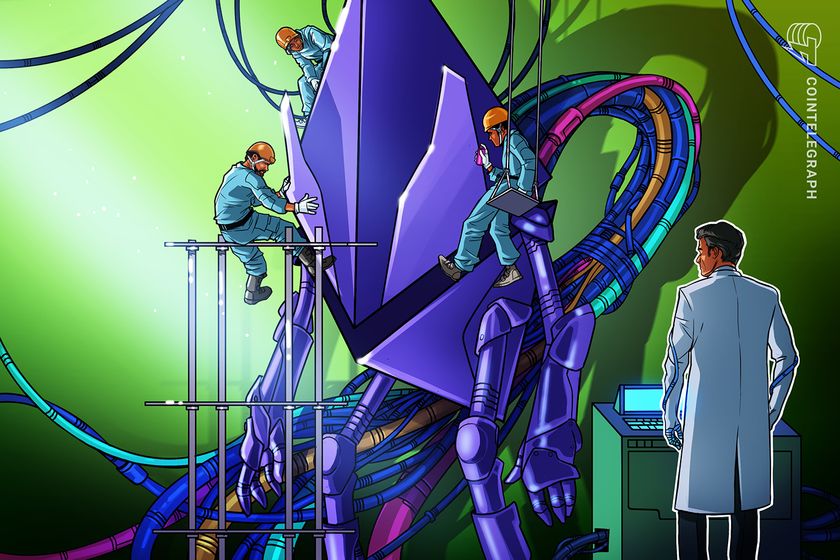
Key takeaways:
ETH price has underperformed its peers during the current bull market, but gas sponsorship could lure developers and traders back to the network.
Ethereum’s upcoming Pectra upgrade promises to improve staking efficiency, potentially increasing demand for ETH.
Data suggests ETH price bottomed. Will the Pectra narrative reignite bullish momentum?
Since 2024, Ether (ETH) has been more of a meme than a market mover. Unlike most of its rivals, ETH still hasn’t reclaimed its all-time high of $4,870 from November 2021, and it regularly underperforms even in the weak altcoin market. Currently, ETH trades at $1,813, down 56% from its local peak in December 2024.
Despite the dismal price action, dismissing Ethereum as a relic may be premature. The network continues to evolve, and the upcoming Pectra upgrade scheduled for May 7 could rekindle market interest.
By addressing long-standing user experience challenges and improving staking, Pectra may help Ethereum narrow the competitive gap with rivals like Solana and BNB. What’s more, it could potentially serve as the catalyst that brings the Ether price back into the spotlight.
What are Pectra’s key upgrades?
The Pectra upgrade introduces 11 Ethereum Improvement Proposals (EIPs) aimed at strengthening Ethereum across three dimensions: scalability through layer-2s, user experience (UX), and staking efficiency.
Scalability remains Ethereum’s most persistent challenge, and critics argue that monolithic L1s would consistently outperform modular L2-based architectures. However, the UX and staking improvements in Pectra could have truly meaningful implications for Ethereum and ETH’s market dynamics.
The standout upgrade is EIP-7702, which allows externally owned accounts (regular user wallets) to temporarily act like smart contracts. This unlocks features such as fee sponsorship and gas payments in tokens other than Ether.
These enhancements could make Ethereum significantly more user-friendly, lowering entry barriers, enabling DApps to sponsor new users’ gas fees, and improving wallet functionality with less friction. This is particularly relevant for onboarding non-technical users in gaming, payments, and mobile apps, which continue to face hurdles due to poor UX.
Another positive aspect is that the option to pay gas fees with tokens other than ETH won’t diminish ETH’s role in the network. At the protocol level, validators will continue to receive fees in ETH, while payment processors will have to convert the fee tokens into Ether.
On the staking side, EIPs 7251, 6110, and 7002 will also bring major changes. allow validators to hold up to 2,048 ETH instead of just 32, and significantly simplify validator onboarding and exits.
Validators will be able to stake up to 2,048 ETH instead of just 32, and the onboarding and exit processes will become more seamless. These changes are especially meaningful for institutional validators. As disappointed institutions are starting to sell their ETH holdings, this upgrade could stimulate renewed engagement from big players.
Will the Pectra upgrade affect ETH price?
Ether’s price reflects the market’s expectations around its future demand, driven by its use to pay gas fees, and the dynamics of its supply. The Pectra upgrade is designed to strengthen both sides of that equation: increasing demand while reducing available supply.
On the demand side, a significantly improved user experience could attract mainstream users and developers, accelerating adoption and onchain activity.
On the supply side, streamlined and institution-friendly staking mechanisms may lead to more ETH being locked in validator nodes, tightening the circulating supply and potentially exerting upward pressure on price.
Furthermore, if more innovative wallet features fulfill their promise of driving user adoption, the increased transaction throughput will also accelerate ETH burning, reducing the supply even further.
Data shows Ethereum is currently experiencing one of its lowest burning periods ever, around 70 ETH per day, compared to 2,000 to 4,000 ETH in 2024. A resurgence in activity could push the burn rate higher, adding deflationary pressure that may support the price.
 Burned ETH after EIP-1559 (daily).Source: The Block
Related: Ethereum is destroying the competition in the $16.1T TradFi tokenization race
Can Pectra spark an ETH price trend reversal?
Pectra is set to add powerful features to Ethereum, but their impact may take time to materialize. In the meantime, the upgrade could provide the narrative Ether needs to regain market momentum.
Technically, the setup looks favorable. ETH appears to have already formed a local bottom, with the weekly RSI — often a reliable reverse signal — breaking out of its downtrend on April 20. .
This marks the end of a correction that lasted since December 2024 and wiped out as much as 66% of ETH’s value. A new uptrend could be underway, but could Pectra be its trigger?
 ETH/USD 1-day. Source: Marie Poteriaieva, TradingView
Historically, Ethereum upgrades often coincided with short-lived price spikes that often failed to create momentum. In 2022, the Merge was overwhelmed by bear market sentiment. The Shapella in 2023, which enabled stake withdrawals, struggled to sustain momentum. The 2024 Dencun upgrade, which improved L2 integration, marked the end of the March rally.
However, the market cycle is now in its third year, just like in 2021, when Ethereum’s Berlin and London upgrades (improving gas pricing and introducing burning) helped fuel a major bull run. If history rhymes, Pectra could sync with the broader rally and mark Ethereum’s return to strength.
Looking ahead, the Fusaka hard fork scheduled for late 2025 could add further upside potential to Ether.
This article does not contain investment advice or recommendations. Every investment and trading move involves risk, and readers should conduct their own research when making a decision.
Ripple $4B-$5B bid to purchase Circle rejected — Report [cointelegraph]
Blockchain payments firm Ripple has reportedly bid up to $5 billion in an effort to acquire stablecoin issuer Circle, but the offer was rejected.
According to an April 30 Bloomberg report, Ripple put in a bid of $4 billion to $5 billion as part of an attempted takeover of Circle, which was rejected as being too low. Ripple hasn’t considered whether to make another bid to purchase the stablecoin issuer.
The reported acquisition attempt came less than 30 days after Circle applied for an initial public offering (IPO) in the US. Cointelegraph reached out to representatives of Circle and Ripple for comment, but had not received a response from either at the time of publication.
Related: Ripple acquisition of Hidden Road a ‘defining moment’ for XRPL — Ripple CTO
Ripple reportedly had an $11 billion valuation in 2024, an estimate CEO Brad Garlinghouse called “outdated” as of January. The blockchain company purchased prime broker Hidden Road for roughly $1.2 billion in April, claiming the move would help scale activity for XRP and XRP Ledger.
Court cases winding down
It’s unclear whether Ripple intends to pursue the Circle acquisition as the firm begins to clear some of its legal entanglements with US regulators.
In August 2024, a court found Ripple liable for $125 million in a case with the US Securities and Exchange Commission (SEC) first filed in 2020. However, Garlinghouse announced in March that the SEC planned to drop its appeal against the firm over the ruling, with Ripple later stating it would pay a net $50 million for the lower court judgment.
Both announcements followed meetings between Garlinghouse and Ripple’s chief legal officer, Stuart Alderoty, and US President Donald Trump. The blockchain firm contributed $5 million to Trump’s inauguration fund after his election victory, and both executives attended events as official guests on Jan. 20.
Magazine: XRP win leaves Ripple and industry with no crypto legal precedent set