Cryptocurrency News

Get these Crytpo news stories as alerts on Telegram!

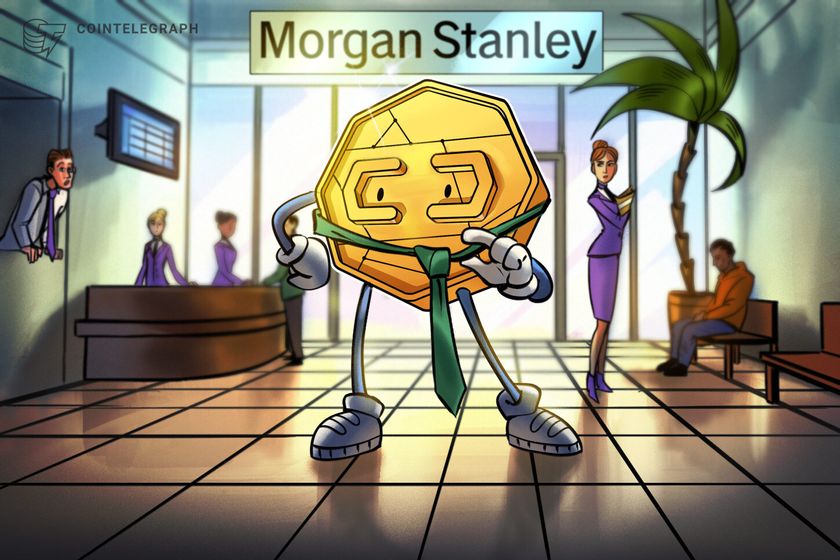
Morgan Stanley eyes crypto rollout for E*Trade platform: Bloomberg

Banking giant Morgan Stanley reportedly plans to list cryptocurrencies on its E*Trade investment brokerage and trading platform.

According to a May 1 Bloomberg report, the firm intends to list crypto assets on E*Trade in 2026. The plan is still in early development, and the bank is said to be exploring partnerships with established crypto firms to power the service. Internal discussions about cryptocurrency support reportedly began in late 2024.

Banking, Banks, Cryptocurrency Exchange, Morgan StanleyE*Trade homepage. Source: E*Trade

This would not be Morgan Stanley’s first exposure to digital assets. The bank’s wealthiest clients have had access to crypto exchange-traded funds (ETFs) and futures for some time, with the firm’s advisers allowed to pitch Bitcoin ETFs since August 2024.

Related: Morgan Stanley to explore crypto offerings for clients — CEO

Regulatory tailwinds push crypto forward

The news follows previous reports that Morgan Stanley was considering adding cryptocurrency trading to its E*Trade online brokerage platform in early January. The reports at the time cited the expectations of a friendlier crypto regulatory environment.

The move comes amid an increasingly favorable regulatory environment in the United States following the election of President Donald Trump, who campaigned on a pro-crypto platform and is personally involved in several blockchain ventures.

Morgan Stanley did not respond to Cointelegraph’s inquiry by publication.

Related: Morgan Stanley discloses $188M in BlackRock Bitcoin ETF holdings

The first 30 days of the Trump administration brought significant changes to the local crypto industry. More recently, US crypto proponents have shown optimism following the swearing-in of pro-crypto Securities and Exchange Commission Chair Paul Atkins.

The SEC had significantly changed its stance even before Atkins took office. In late February, the agency had already paused multiple cryptocurrency enforcement cases with imminent deadlines.

Trump’s own involvement with the crypto industry, paired with his pro-crypto stance, has raised concerns over potential conflicts of interest. Massachusetts Senator Elizabeth Warren recently called on government officials to address questions related to Trump’s memecoin and his media company.

Senator Jon Ossoff recently expressed support for impeaching Trump over his meeting of the top holders of his Trump Official (TRUMP) memecoin. He said that “he is granting audiences to people who buy his memecoin,” adding:

“When the sitting president of the United States is selling access for what are effectively payments directly to him. There is no question that that rises to the level of an impeachable offense.”

Magazine: ZK-proofs are bringing smart contracts to Bitcoin — BitcoinOS and Starknet

Read more at cointelegraph.com

MultiBank, MAG, Mavryk ink world’s largest $3B RWA tokenization deal

MultiBank Group, the world’s largest financial derivatives institution based in Dubai, has signed a landmark $3 billion real-world asset (RWA) tokenization agreement with United Arab Emirates (UAE)-based real estate giant MAG and blockchain infrastructure provider Mavryk.

The deal represents the largest RWA tokenization initiative globally to date and highlights the upcoming launch of MultiBank’s native utility token, MBG, according to a press release shared with Cointelegraph.

The partnership will bring MAG’s ultra-luxury real estate projects — including The Ritz-Carlton Residences, Dubai, Creekside and the Keturah Reserve — onto the blockchain via MultiBank.io’s regulated RWA marketplace.

Once tokenized, these assets will be available to global investors and will generate daily yield for holders directly on the platform.

“$3B worth of MAG’s real estate will be tokenized as individual RWA tokens on MultiBank’s platform, each represented on the Mavryk blockchain, as the underlying layer-1 infrastructure,” Talal Moafaq Al Gaddah, senior executive vice chairman of MAG, told Cointelegraph.

Al Gaddah added that “$MBG token provides ecosystem utility, including trading discounts, early access to properties, and a deflationary buyback-and-burn model.”

Related: BlackRock, five others account for 88% of all tokenized treasury issuance

MultiBank tokenizes MAG real estate

MAG, one of the UAE’s most prominent developers, will contribute its premium real estate portfolio for tokenization.

Mavryk will handle blockchain issuance and DeFi integrations, while MultiBank Group will manage regulatory compliance, liquidity and governance, with the MBG token at the core of the system.

“Tokenized assets issued by MultiBank will have dual utility. Within the MultiBank Group, they can be used as collateral for derivatives, creating a seamless bridge between traditional finance and tokenized assets,” Al Gaddah said.

He said that these tokens are fully interoperable with the broader Mavryk DeFi ecosystem.

UAE, Investments, United States, RWA, Tokenization, RWA Tokenization, CompaniesThe tokenized treasuries market is rising. Source: RWA.xyzMBG token adds platform utility

The MBG token will power staking, fee payments, VIP tiers and user rewards. It also features a buyback-and-burn mechanism tied to platform revenues, creating long-term value for both institutional and retail participants.

The platform aims to scale beyond the initial $3 billion to as much as $10 billion in tokenized assets.

“The goal is to tokenize high-value, income-generating real estate assets that have traditionally been difficult to access or trade.” 

The announcement comes amid renewed interest in RWA tokenization.

On April 30, BlackRock filed to create digital ledger technology shares from one of the firm’s money market funds, which will leverage blockchain technology to maintain a mirror record of share ownership for investors.

The DLT shares will track BlackRock’s BLF Treasury Trust Fund (TTTXX), which may only be purchased from BlackRock Advisors and The Bank of New York Mellon (BNY).

The money market fund holds over $150 million worth of assets, invested almost entirely in US Treasury bills and cash.

Magazine: TV hit Peaky Blinders to launch crypto game, FIFA Rivals on Polkadot: Web3 Gamer

Read more at cointelegraph.com

Eric Trump: USD1 will be used for $2B MGX investment in Binance

Abu Dhabi-based investment firm MGX will be tapping a US President Donald Trump-related stablecoin to settle its $2 billion investment into Binance, the world’s largest cryptocurrency exchange.

The World Liberty Financial USD (USD1) US dollar-pegged stablecoin was launched by the Trump-linked World Liberty Financial (WLFI) crypto platform in March 2025.

MGX will use the USD1 stablecoin for its $2 billion investment into Binance exchange, announced Eric Trump, the son of the US president and the executive vice president of the Trump Organization, during a panel discussion at Token 2049 Dubai.

Eric Trump: USD1 will be used for $2B MGX investment in BinanceSource: Cointelegraph

MGX announced its $2 billion stablecoin investment into Binance on March 12, marking the first institutional investment in the exchange and potentially the biggest funding deal in the entire Web3 industry.

At the time, Binance declined Cointelegraph’s request to disclose what stablecoin was used in the transaction.  

This marks the Abu Dhabi-based investment firm’s first venture into the cryptocurrency space.

Related: Trump turned crypto from ‘oppressed industry’ to ‘centerpiece’ of US strategy

Read more at cointelegraph.com

Restaking can make DeFi more secure for institutional traders

Opinion by: Amitej Gajjala, co-founder and CEO of Kernel DAO

The restaking narrative has moved fast — from side conversations in validator circles to the forefront of DeFi infrastructure discussions.

It’s not hard to see why. DefiLlama states that major liquid restaking protocols now hold over $12 billion in total value locked (TVL), with dozens of middleware services aligning their security with Ethereum’s economic base layer. What started as an idea to increase capital efficiency for validators has evolved into a serious attempt to redefine how security is provisioned across decentralized systems.

While restaking is gaining momentum among crypto-native participants, institutions — the kind with multi-year horizons and regulatory constraints — still keep DeFi at arm’s length.

Not because the rewards aren’t attractive. Risk is still poorly understood, isolated and mitigated.

Restaking can change that.

Adding friction — where it’s needed most

Restaking isn’t about reducing risk to zero; it’s about introducing friction, which deters bad actors without killing protocol composability.

Enabling validators to opt into securing new protocols using already-staked assets, restaking creates a second validation layer. This strengthens middleware like oracles, bridges and data availability layers without bootstrapping entirely new trust networks.

Unlike traditional validator sets, restaking aligns existing economic incentives with broader infrastructure needs. Instead of competing for security, protocols can now share it — with customizable slashing conditions, service-specific operator sets and dynamic risk parameters.

Recent: Unlocking the potential of dormant Bitcoin in DeFi

For institutions, this is meaningful; it signals the beginning of a modular security stack, where exposure can be configured and audited per protocol.

Slashing becomes a risk class — not a red flag

One of the main blockers for institutional staking has been slashing: the risk that validator misbehavior (or simply technical error) could lead to capital loss.

Restaking introduces slashing segmentation. On all major platforms, operators choose which services they secure. Slashing, therefore, is scoped to the context of misbehavior — not the entire validator lifecycle.

This distinction matters. It transforms slashing from an unpredictable liability into a quantifiable, bounded risk, similar to how fixed-income traders model default risk.

It also opens the door to restaking insurance markets, actuarial modeling and structured risk products.

Risk offloading through exposure diversification

DeFi’s volatility isn’t going away. Price swings, gas spikes and liquidation cascades are part of the terrain. But restaking enables cross-protocol exposure less correlated than holding multiple tokens.

A validator restaking into a curated mix of oracle, bridge and data availability layer services fundamentally builds a portfolio of security commitments — each with different risk and reward profiles. That’s diversification in the validator economy, not just in the asset layer.

It also makes network-level attacks harder. Restaking dilutes attack vectors by spreading economic security across a web of services, making DeFi’s attack surface less monolithic and more modular.

Oracles get more credible

A single point of failure in many DeFi protocols? Oracle feeds. And it’s not just flash loans — even minor price feed delays can be exploited.

ScienceDirect research shows that staking-based oracle models significantly reduce manipulation risks, especially when tied to performance-based incentives and slashing conditions.

Restaking supports this by allowing oracle operators to secure feeds with economic weight, aligning truthfulness with profit. When misreporting can cost you slashed Ether (ETH), the game theory changes.

This creates stronger guarantees for protocols relying on price data — a prerequisite for serious capital to flow in.

Restaking as the institutional wedge

Institutions won’t enter DeFi because of vibes or community incentives. They’ll enter when infrastructure risk can be scoped, quantified and mitigated when the stack looks more like a layered security model than a black box of smart contracts.

Restaking isn’t the whole answer. But it is one of the first scalable primitives to make DeFi security modular, composable and economically aligned.

As regulation matures and tokenized finance becomes more interoperable with TradFi, restaking may be the layer that bridges trust between networks and entire financial systems.

We’re not there yet. But the path looks a lot clearer than it did a year ago.

Opinion by: Amitej Gajjala, co-founder and CEO of Kernel DAO.

This article is for general information purposes and is not intended to be and should not be taken as legal or investment advice. The views, thoughts, and opinions expressed here are the author’s alone and do not necessarily reflect or represent the views and opinions of Cointelegraph.

Read more at cointelegraph.com