U.S. stocks climbed on Thursday, led by the Nasdaq, as upbeat earnings from Microsoft and Meta reassured investors who were wary of the economic impact of President Trump’s escalating trade war with China. The Nasdaq Composite index closed near session…
Cryptocurrency News
US lawmaker proposes crypto ATMs in federal buildings [cointelegraph]
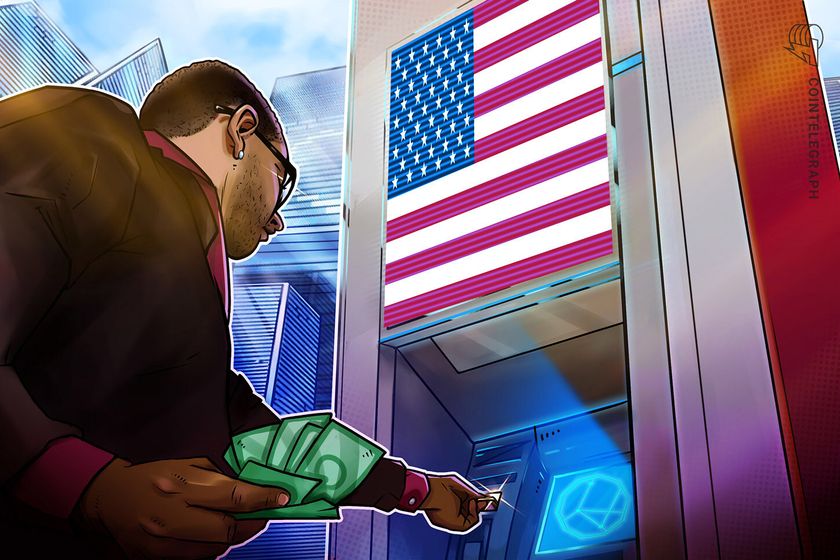
A Texas member of the US House of Representatives has proposed that government officials consider installing cryptocurrency ATMs in federal buildings across the country.
In a May 1 letter to Stephen Ehikian, the acting administrator of the General Services Administration (GSA) — the entity responsible for managing the US government’s properties — Rep. Lance Gooden claimed that introducing crypto ATMs to federal buildings would serve as an “educational resource” and reflect advances in financial technology.
He requested that the GSA begin exploring the necessary guidelines and regulations needed to install such ATMs in government-controlled properties across the US, citing alignment with President Donald Trump’s goals.
 May 1 letter pitching crypto ATMs to GSA. Source: Rep. Lance Gooden
According to financial disclosure reports filed with the US House of Representatives, Gooden had held no investments in cryptocurrency or ATM companies since taking office in 2019. He had not yet filed any financial disclosures with the government for 2025 investments.
The GSA website stated it may provide space to ATMs from federal credit unions, but it was unclear whether the acting administrator had the authority to expand the regulations to include digital asset ATMs tied to private companies like Bitcoin Depot or CoinFlip. Cointelegraph reached out to Gooden’s office for comment but did not receive a response at the time of publication.
Related: Eric Trump: USD1 will be used for $2B MGX investment in Binance
Gooden, a Republican and Trump supporter, made the proposal as lawmakers in the US Senate consider legislation to crack down on fraud through crypto ATMs. In February, Illinois Senator Dick Durbin introduced the Crypto ATM Fraud Prevention Act, aimed at placing “common sense guardrails” against fraud affecting many senior citizens.
Who would ultimately make the decision?
It’s unclear whether Ehikian, a Trump appointee, would have the authority to unilaterally — or even with the president’s approval — install the crypto ATMs without an act of Congress to authorize funding. Cointelegraph reached out to the GSA for comment but did not receive a response at the time of publication.
Trump has significant exposure to cryptocurrencies and digital asset firms through his personal holdings, presidential campaign funds, family-backed businesses, and the TRUMP memecoin. In April, the president announced a dinner in DC for top holders of his memecoin.
Magazine: Trump’s crypto ventures raise conflict of interest, insider trading questions
Bitcoin short squeeze rally meets heavy resistance: what comes next? [btcmanager]
Bitcoin has surged on the back of a textbook short squeeze, but now finds itself at a decisive resistance zone. Will it break out or roll over? Bitcoin’s (BTC) recent price action has caught many off guard, with a powerful…
Institutional Bitcoin buying may soon price out retail — LONGITUDE panel [cointelegraph]

Retail investors are running out of time to accumulate Bitcoin as institutional adoption accelerates, according to Sergej Kunz, co-founder of exchange aggregator 1inch.
Bitcoin (BTC) is evolving into an alternative reserve currency, propelling institutional demand and potentially pricing out retail investors, Kunz said during Cointelegraph’s LONGITUDE event in Dubai.
“Every retail user should be thinking about getting at least one Bitcoin — very soon they won’t be able to afford it,” Kunz said.
If the United States starts buying Bitcoin for a strategic reserve, even smaller countries may soon struggle to acquire the cryptocurrency, he added. “I’m pretty sure we’ll soon see countries battling over who owns more Bitcoin. The US will start.”
Bitcoin demand has accelerated since US President Donald Trump announced sweeping tariffs on US imports in April, setting off a global trade war.
“The only thing that still acts as a true hedge — across borders, against inflation — is Bitcoin,” Animoca Brands co-founder Yat Siu said during the panel.
 Yat Siu (middle) and Sergej Kunz (right) with Cointelegraph’s Gareth Jenkinson at LONGITUDE. Source: Cointelegraph
Related: US President Donald Trump issues 90-day pause on reciprocal tariffs
Global reserve asset?
During the week of April 21-25, Bitcoin exchange-traded funds (ETFs) attracted more than $3 billion in inflows as institutions sought safety in “digital gold” amid mounting macroeconomic uncertainty.
Analysts say demand from financial institutions could push Bitcoin’s price as high as $200,000 per coin this year. By 2029, institutional Bitcoin adoption could propel the cryptocurrency’s price past $1 million, Bitwise’s head of European research, André Dragosch, said.
 Asset managers still prefer gold for hedging against macro risk. Source: Binance Research
For Bitcoin, “[t]he silver lining is that economic uncertainty has historically accelerated institutional interest in digital assets as a diversification strategy,” David Siemer, co-founder and CEO of Wave Digital Assets, told Cointelegraph.
As of May 1, Bitcoin ETFs and other institutional funds hold upward of $128 billion worth of BTC, according to data from BitcoinTreasuries.NET. Corporate treasuries hold another roughly $73 billion, data shows.
Sovereign states — including the US, China, and the United Kingdom — collectively hold more than $130 billion worth of BTC. However, much of those holdings are from crypto assets seized by law enforcement, not outright Bitcoin buys.
Magazine: TV hit Peaky Blinders to launch crypto game, FIFA Rivals on Polkadot: Web3 Gamer
Here’s why altcoins like Jasmy, Chainlink, Dogecoin, Pi Network are rising [btcmanager]
Bitcoin and most altcoins started the month well, with the total market cap of all coins jumping to over $3 trillion. JasmyCoin (JASMY) price jumped by 6.2%, while Chainlink (LINK), Dogecoin (DOGE), and Pi Network (PI) were up by over…
PopCat decision time for bulls – pullback or breakout? [btcmanager]
PopCat has shown consistent strength in its market structure, forming higher highs and higher lows since bouncing from the $0.13 region. However, its ability to hold key support will determine what comes next. The meme coin PopCat (POPCAT) has recently…
Crypto to accelerate AI adoption — LONGITUDE panel [cointelegraph]

Cryptocurrency can accelerate artificial intelligence adoption by helping AI startups onboard users, according to Polygon’s co-founder Sandeep Nailwal.
“You can use crypto incentives and disincentives to onboard users to onboard the ecosystem players,” Nailwal said during a panel discussion at the LONGITUDE by Cointelegraph event.
He added that projects with effective onchain incentive structures might even “build a better AI because you have this incentive engine that brings in developers,” Nailwal said on May 1.
Cointelegraph’s LONGITUDE is an event series that brings together leaders and innovators from the blockchain and Web3 space for exclusive discussions.
Joining the panel, Illia Polosukhin, co-founder of the Near Protocol, expanded on crypto’s long-term synergy with AI, forecasting that crypto-native AI agents could replace traditional web application front-ends as the primary user interfaces for Web3.
“We don’t need applications or websites anymore. Your AI becomes the interface to computing and the internet,” Polosukhin said.
 Sandeep Nailwal (left) and Illia Polosukhin (middle), with Cointelegraph’s Gareth Jenkinson, speaking at Cointelegraph’s LONGITUDE event in Dubai. Source: Cointelegraph
Related: AI memecoins will become utility tokens
However, Nailwal cautioned that the rise of AI-related tokens onchain has also attracted a wave of opportunistic scams. “We know that 99% of those projects are literally token scams, but very few projects are actually trying to have some meaningful AI project,” he said.
The era of Web3 AI agents
AI agents are expected to take on a more prominent role within decentralized communities, J.D. Seraphine, co-founder of Web3 developer Raiinmaker, recently told Cointelegraph.
According to a report by VanEck, over 1 million AI agents could enter the market in 2025, with many of them tied to decentralized finance applications. Such agents are already reshaping the digital economy, building decentralized applications, launching tokens, and interacting with humans autonomously.
 AI token cumulative market cap. Source: CoinGecko
“AI is an extremely centralizing force. A few companies could become the warlords of the world,” Nailwal said.
“That’s why crypto-native, peer-to-peer AI solutions are so important—they enable privacy-preserving innovation,” Polosukhin said.
Magazine: Altcoin season to hit in Q2? Mantra’s plan to win trust: Hodler’s Digest, April 13 – 19
Enso Partners with Stargate and LayerZero: $3.5b in liquidity set to flow to Unichain [btcmanager]
Enso has partnered with Stargate and LayerZero to create a one-click liquidity migration solution for Unichain, setting the stage for up to $3.5b liquidity inflow. As Web3 advances, smooth movement across networks becomes more essential. Until now, transferring liquidity to…
Ethereum plans biggest comeback of 2025: Five burning questions and ETH price prediction [btcmanager]
Ethereum wiped out nearly half its value in 2025, price dropped over 46% year-to-date as ETFs failed to attract capital inflows and the largest altcoin lost revenue. After months of debate on the future of the Ethereum foundation and Vitalik Buterin’s new proposal for higher scalability, Ethereum eyes a comeback, likely the biggest one of the year.
Tether CEO defends decision to skip MiCA registration for USDT [cointelegraph]

Paolo Ardoino, CEO of stablecoin issuer Tether, addressed criticism over the company’s decision not to seek registration under the European Union’s Markets in Crypto-Assets (MiCA) framework, arguing that the regulations were risky for stablecoins.
Speaking to Cointelegraph at the Token2049 conference in Dubai, Ardoino reiterated that Tether had no plans to apply for its US dollar-pegged stablecoin USDt — the largest by market capitalization — to be compliant under MiCA in European countries, potentially forcing exchanges to delist the stablecoin. He added that though crypto firms had to follow regulations, there was a “fear of compliance” among companies in the EU.
“[…] MiCA license is very dangerous when it comes to stablecoins, and I believe that is even more dangerous for the small, medium banking system in Europe,” said the Tether CEO, adding that banks in the region could “go belly up” in the next few years thanks to MiCA’s requirements, such as keeping 60% of stablecoins reserves in insured cash deposits in European banks. Ardoino added:
“I decided to not apply to the MiCA license because I need to protect the 400 million+ users that we have around the world. They are not as lucky as Europeans. I love Europe, but I think that unfortunately European Central Bank is more interested [in pushing] the digital euro as a way to control people and control how they spend their money.”
Related: Paolo Ardoino: Competitors and politicians intend to ‘kill Tether’
After years of planning and research, EU officials began to implement requirements under MiCA in December 2024. Tether, which is regulated and headquartered in El Salvador, is required to comply with MiCA regulatory requirements if offering products or services in EU member states.
Since the regulations went into effect, many crypto exchanges have acted to ensure their platforms listed as MiCA-compliant tokens. Kraken delisted five stablecoins, including USDt, and Crypto.com announced plans to delist 10 stablecoins as of January.
On nations establishing crypto reserves
Speaking on its intentions for operating in the United States, Ardoino said the country “would require a different type of product,” given the competition with local stablecoin issuers. He added that the US’ and other countries’ efforts to establish a Bitcoin (BTC) stockpile were “just inevitable.”
“In the medium to long term, the more Bitcoin education, the more companies will set the example […] then everyone else will follow,” said the Tether CEO. “It’s never too late to buy Bitcoin.”
Ardoino’s statements came the same day that Tether announced roughly $120 billion in exposure to US Treasurys as of the first quarter of 2025. As of May 1, USDt had a market capitalization of roughly $149 billion.
Magazine: Crypto wanted to overthrow banks, now it’s becoming them in stablecoin fight