Bittensor price has recently broken out of a long-standing falling wedge pattern, gaining over 70% in the past month. While bullish momentum has cooled slightly, the uptrend remains intact, with the next target set around $420. Bittensor (TAO) is up…
Cryptocurrency News
Celsius founder Mashinsky slams DOJ’s 20-year request as a ‘death-in-prison’ sentence [btcmanager]
Lawyers for Celsius founder Alex Mashinsky argue that prosecutors are stripping him of his humanity to support a harsh sentence disconnected from his true actions. Alex Mashinsky‘s legal team has criticized the U.S. government’s request to sentence the former Celsius…
FARTCOIN and VIRTUAL lead in AI agent mindshare and smart money inflows [btcmanager]
FARTCOIN and VIRTUAL are dominating both smart-money inflows and AI-agent mindshare while both tokens pause to consolidate following their recent 100% breakout rallies within a broader uptrend. According to smart money reporting account Stalkchain, Fartcoin (FARTCOIN) and Virtual (VIRTUAL) are…
Ethereum holds key support ahead of Pectra upgrade – is a breakout or “sell-the-news” event coming? [btcmanager]
Ethereum is holding firmly above the $1,793 support as the highly anticipated Pectra upgrade approaches on May 7. After weeks of sideways trading, the $1,793 support has become a critical zone, and its ability to hold could dictate Ethereum’s (ETH)…
Ethereum’s stablecoin market cap jumps 1m-fold since the first time ETH reached $1,4k [btcmanager]
The total stablecoin market cap in the Ethereum ecosystem has jumped approximately 1 million-fold since the token reached $1,400 for the first time in January 2018. According to data on DeFi Llama, the ETH (ETH) stablecoin market cap has gone…
Research DAO claims paralyzed rats recover after spinal cord fix [cointelegraph]

Decentralized autonomous organization (DAO) HydraDAO claims that its researchers were able to use a novel technique to repair severed spines in rats.
In a May 5 X post, decentralized science (DeSci) project HydraDAO said that one of its research projects resulted in “rats who had their spines fully transected” being able to walk again. More notably, recovery from surgery reportedly only took five days.
 Source: HydraDAO
The post featured a video of partially shaved (presumably due to surgery) rats walking in what appeared to be a laboratory setting. The effort in question is the Dowell spinal fusogens project led by Michael Lebenstein-Gumovski, which raised 380,700 USDC (USDC) from donors. The dedicated HydraDAO page reads:
“The Dowell team submitted a project proposal to HydraDAO. After careful consideration and two peer reviews, HydraCore deems it in the interest of HydraDAO’s community.“
Related: Experts to gather in Miami to drive longevity research forward
More than smoke and mirrors?
Fusogens are chemicals capable of fusing cell membranes and have long been researched as a means to reconnect severed nerve fibers. One such chemical is polyethylene glycol (PEG), which was shown to promote membrane fusion and seal axonal membranes in other research.
The Dowell team adds a biopolymer from crustacean shells called chitosan, resulting in a PEG-chitosan compound dubbed neuro-PEG. This compound is also photopolymerizable, meaning it can be rapidly solidified using light.
This presumably allows for creating a solid scaffolding that can weld the spinal cord more permanently than liquid PEG-based solutions. Dowell also implements neuroprotection techniques such as localized hypothermia and cellular death inhibitors to prevent further damage to nerve tissue.
A 2023 research paper by Gumovski published in the peer-reviewed scientific journal Surgical Neurology International claimed that pigs treated with the compound recovered mobility in two months. The study’s conclusion read:
“Neuro-PEG affords sensorimotor recovery after complete spinal cord transection. This opens the door to human experimentation, including trials of spinal cord transplantation.“
The Dowell team also filed a patent for developed technologies, with a 2022 Russian patent describing a “method of restoring spinal cord functions after transection using a PEG-chitosan conjugate,” listing Lebenstein-Gumovski among its inventors.
The HydraDAO proposal suggests that “revenue streams include specialized surgical kits priced between $3,500 and $20,000, depending on the market and region.” Furthermore, the team would also provide “comprehensive training and certification for neurosurgeons and emergency medical services” personnel.
Related: Major scientific journal Nature features DeSci project ResearchHub
Some interesting connections
Gumovski is a neurosurgery researcher based in Russia (Stavropol State Medical University and affiliated institutes). He was a member of Sergio Canavero’s research head-transplant project, cited in at least one relevant paper.
Those articles were also published in Surgical Neurology International, while most top scientific publications shied away from the subject. The neurosurgeon from Turin, Italy, claimed to have performed a successful head transplant on a monkey back in 2016.
The team also experimented on human cadavers in preparation for a 2017 live human head transplant, which never took place. Neuroscientist Dean Burnett said at the time that head transplantation presented insurmountable challenges and that Canavero had “offered no feasible explanation or science for his claims to be able to overcome these hurdles.”
While the Dowell team’s project builds on established research and should not be dismissed outright, it is hard not to notice the similarity in making public claims not unlike those that characterized Canavero’s career. Furthermore, fusogens are well studied and less dramatic but similar results have been reported by other teams in the past (2019 example from the University of Texas).
Will the paralyzed walk again?
The evidence provided is promising, but it is advisable to exercise caution, especially until multiple third-party teams independently reproduce the results.
HydraDAO promised additional electrophysiology experiments and tracing dyes to assess connectivity between the brain and lower spine. This extra data may enhance the credibility of the research results.
Still, further research is needed to assess whether it will result in a clinically viable technique for real-world spinal injuries.
How much Bitcoin can Berkshire Hathaway buy? [cointelegraph]

Key takeaways:
Berkshire holds $347B in cash, enough to buy ~18% of Bitcoin’s supply.
Greg Abel has not signaled a shift from Warren Buffett’s anti-Bitcoin stance.
Berkshire already has indirect crypto exposure via Nu Holdings, Jefferies.
Warren Buffett announced at Berkshire Hathaway’s annual shareholder meeting on May 3 that he will step down as CEO by the end of 2025, with Greg Abel taking over. This transition raises speculation about Berkshire’s financial capacity to purchase Bitcoin (BTC) under the new leadership.
 Source: Discover CryptoBerkshire can easily surpass Strategy’s BTC stash
Berkshire ended Q4 2024 with a record $347 billion in cash and US Treasury bills, representing about 32% of its $1.1 trillion market capitalization.
The company could acquire approximately 3.52 million BTC if it purchases the cryptocurrency at May’s approximate price of $95,000. This equates to about 17.88% of Bitcoin’s circulating supply of 19.69 million coins.
If the company tapped only its estimated $295.98 billion in US Treasury, it could buy around 3.12 million BTC, or 15.85% of the circulating supply, positioning it as a dominant player in the crypto market.
Berkshire Hathaway is 20th Century Bitcoin.
— Michael Saylor (@saylor) May 3, 2025
Such a move would easily eclipse Nasdaq-listed Strategy Inc. (formerly MicroStrategy), the world’s largest corporate Bitcoin holder, which owns 553,555 BTC worth approximately $52.2 billion as of May 6.
In other words, Berkshire can theoretically match Strategy’s stash with roughly one-sixth of its cash pile if it converts it to Bitcoin.
Related: Strategy, Semler bag 2K Bitcoin as price edged toward $100K last week
 Strategy Inc. Bitcoin holdings over time. Source: BitcoinTeasuries.net
Bernstein analysts forecast roughly $330 billion in corporate treasury-driven inflows into Bitcoin by 2029, with $205 billion expected from listed companies between 2025 and 2029.
Much of this, analysts say, will come from smaller, slow-growing companies trying to copy Strategy Inc.’s Bitcoin strategy. They see it as one of the few ways to boost their value when other growth options are scarce.
 Source: X/Matthew Sigel, Head of Digital Asset Research at VanEck US
Bernstein’s bull case anticipates an additional $124 billion of Bitcoin purchases from Strategy alone, backed by the company’s recently upsized capital-raising plans, which aim to secure $84 billion by 2027, nearly double its previous target.
Is Greg Abel pro-crypto?
Whether Berkshire would buy Bitcoin under Abel’s leadership is speculative.
The new Berkshire Hathaway leader has not publicly indicated a shift from Buffett’s value-investing philosophy, prioritizing assets with tangible cash flows over speculative ones like Bitcoin, which Buffett once termed “rat poison squared.”
BTC’s price has climbed by nearly 900% since Buffett’s criticism in May 2018.
 BTC/USD two-week price chart. Source: TradingView
However, Berkshire, despite its anti-crypto stance, has indirect exposure in the sector through investments in crypto-friendly companies like Nu Holdings and Jefferies Financial Group, which holds shares in BlackRock’s iShares Bitcoin Trust (IBIT).
The strategy is similar to how Berkshire approached gold, which Buffett repeatedly ridiculed for lacking productivity. However, Berkshire surprised markets by buying Barrick Gold shares (a gold mining company) in 2020, though it later sold that position.
Under Abel, Berkshire may not dive straight into Bitcoin, but its cautious, indirect approach could expand as markets evolve. Whether that leads to full adoption or careful toe-dipping remains to be seen.
This article does not contain investment advice or recommendations. Every investment and trading move involves risk, and readers should conduct their own research when making a decision.
Is the Paws Telegram mini app legit? What you need to know [cointelegraph]
What is the Paws Telegram Mini App?
Paws is a Telegram-based Mini App created by the same team behind other projects, such as Notcoin and Dogs.
If you’ve been cruising around Telegram lately, chances are you’ve stumbled upon Paws, the viral crypto Mini App that’s got everyone tapping, clicking and inviting their friends like it’s 2010 FarmVille all over again.
Originally launched in October 2024 on The Open Network (TON) blockchain, Paws exploded in popularity with its ultra-simple tap-to-earn concept. Think of it as a gamified rewards engine embedded directly in Telegram, where users rack up points by completing tasks, referring others and interacting with mini-game elements.
Within just eight days of going live, Paws pulled in over 20 million users, and within a few months, that figure soared past 80 million.

But the real twist? Paws, in March 2025, migrated from TON to Solana, a move that brought more scalability, lower fees and deeper integration with a broader decentralized finance (DeFi) ecosystem. Alongside this shift came the launch of the PAWS token — used for governance, staking, in-game purchases and more — positioning Paws as more than just a viral hit.
The app’s core philosophy is simple: You create value every time you engage online, so why not earn for it? With no extra downloads needed, Paws is frictionless. You just activate the bot on Telegram (@PAWSOG_bot), and you’re in. From there, it’s all about interacting: tap items, read posts, join groups, complete quizzes, and get rewarded with points that convert into real tokens.
So, is it legit? Before answering that, we’ll unpack how it actually works.
How does the Paws Telegram Mini App actually work?
PAWS tracks and monitors users’ activity in Telegram and allows them to claim rewards for their engagement.
The core mechanics involves monitoring users’ activities, such as message frequency, participation in groups and interactions with other mini apps. Within the app, users can find a number of tasks to complete or allow it to perform checks on their engagements. This varies from following social channels to reading articles.
For example, you can earn 250 $PAWS for reading Cointelegraph articles like this:

The rewards are distributed on predetermined criteria and actions users take. In the long run, your earned points and referral contributions will determine your airdrop allocation when the official $PAWS crypto token launches. There are currently no specific dates for the airdrop or token exchange listing. With the project gaining such huge momentum, it is expected to finish its launch campaign in the coming months.
Why Paws migrated to Solana and why it matters
At first, Paws ran on TON, but in a move that surprised some and excited others, Paws announced a major shift to Solana in early 2025.
In early 2025, Telegram introduced a policy mandating that all Mini Apps and third-party crypto wallets on its platform exclusively operate on TON. This move forced projects like Paws to choose between remaining confined to TON or migrating to a different blockchain.
Paws opted to migrate to Solana, a decision that has had significant implications:
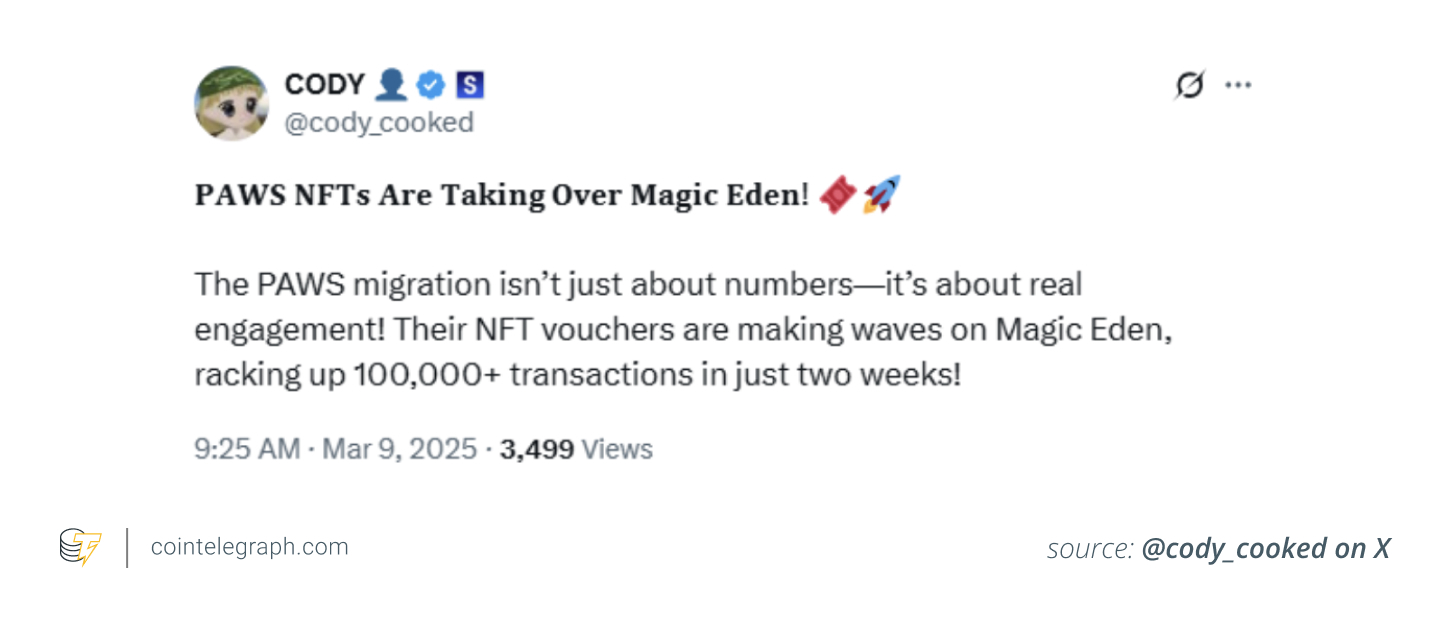
User base migration: Over 80 million Paws users transitioned to Solana, leading to more than 9 million downloads of the Phantom crypto wallet and the creation of over 1 million new Solana addresses. NFT integration: PAWS introduced non-fungible token (NFT) vouchers on the Solana-based marketplace Magic Eden, resulting in over 100,000 transactions within two weeks.Ecosystem expansion: The migration has allowed Paws to evolve from a viral Telegram application into a full-fledged Web3 brand, with plans to integrate DeFi features, gaming partnerships and social engagement tools.

This strategic move not only circumvented Telegram’s restrictive policies but also positioned Paws to leverage Solana’s scalability and active DeFi ecosystem, paving the way for broader adoption and innovation.
Did you know? The migration to Solana led to over 9 million new downloads of Phantom Wallet, with more than 1 million fresh Solana addresses created by Paws users. That’s one of the biggest onboarding waves in Solana’s history.
The PAWS airdrop: What you need to know
No viral Web3 game is complete without an airdrop, and Paws is no exception.
Users who engage with the app, tapping, referring and completing tasks earn points, which are later converted into PAWS tokens. These tokens are distributed via an airdrop, and the team has already completed early reward rounds with plans for future drops as the ecosystem expands.
The PAWS token officially launched on March 18, 2025. Here’s a breakdown of the key events that took place:
March 11-15: Withdrawals opened to exchanges.March 17: Token deposits became available on exchanges.March 18: Withdrawals to Phantom Wallet and the official PAWS listing commenced.
The airdrop distribution was as follows:
62.5% allocated to Paws app users.7.5% reserved for established Solana communities.The remaining percentage is designated for ecosystem growth, partnerships and liquidity.
Despite the successful migration and platform enhancements, the PAWS token launch faced some challenges:
Price volatility: The token experienced a significant drop in value shortly after launch.Airdrop confusion: Many users were unsure about eligibility criteria, leading to dissatisfaction.Communication gaps: Delays and a lack of clear communication regarding the token generation event (TGE) affected community trust on X.
As of April 2025, the PAWS token is listed on a few exchanges, including Bybit, MEXC and KuCoin. There’s growing speculation that listings on more centralized exchanges (CEXs) may follow, especially given the size of the community and early engagement.
Did you know? After migrating to Solana, Paws launched NFT vouchers on Magic Eden. In just two weeks, these NFTs generated over 100,000 transactions.
Is Paws legit or just another hype train?
Paws has demonstrated substantial growth and user engagement; however, users must do their own research before joining in.
Let’s get to the big question: Is Paws legit?
Paws has demonstrated substantial growth and user engagement. The following help to make a better assessment on how to approach Paws:
Pros:
Developed by a team with a track record (Notcoin and Dogs).Successful migration to Solana indicates long-term planning and future orientation.Rapid user adoption and community growth.
Cons:
Limited transparency with no public team page or comprehensive white paper.Potential for bot-driven airdrop farming, as has been seen on Telegram Mini Apps.The project is navigating regulatory uncertainty, particularly as airdrops via Telegram Mini Apps remain in a legal gray area, often lacking clear Know Your Customer (KYC) requirements.
So, what’s the verdict? While Paws appears to be a well-used platform for casual engagement, users should conduct thorough research and exercise caution, especially when considering financial investments.
What’s next for Paws?
As the platform matures and cements its place, the team behind it has hinted at a much bigger vision: one that turns Paws from a simple viral game into a dynamic Web3 super app.
Here’s what’s reportedly on the roadmap:
In-app marketplace: Users will soon be able to spend their PAWS tokens within an integrated marketplace. This could include digital goods, services and utility items tied to the app’s gaming ecosystem, such as power-ups, skins or access to exclusive features.NFT rewards and avatar customization: Paws plans to introduce customizable avatars powered by NFTs. These will not only let users personalize their experience but also function as tradable digital assets. The team has already launched early NFT vouchers on Solana’s Magic Eden, showing a clear direction toward gamified asset ownership.Social leaderboards and guild mechanics: Paws is building out more community-first features. Competitive social leaderboards will reward the most active players, while upcoming guild mechanics will allow users to team up, compete and share rewards, blending social gaming with decentralized coordination.DeFi integrations: With its migration to Solana, PAWS has opened the door to deeper DeFi utility. Upcoming features could include staking, lending pools, yield-based games or partnerships with native Solana DeFi protocols, adding more financial layers to the Paws economy.
With a user base now exceeding 80 million and growing, Paws is laying the groundwork to evolve into a full-blown Web3 social and gaming hub — though its rapid rise also warrants caution, as regulatory clarity and long-term sustainability remain key concerns.
Open-source AI isn’t the end-all game—Bringing AI onchain is | Opinion [btcmanager]
Without verifiable safeguards, open-source AI could also be vulnerable to manipulation, but blockchain can provide the trust layer it needs.
Open-source AI isn’t the end-all game—Bringing AI onchain is | Opinion [btcmanager]
Without verifiable safeguards, open-source AI could also be vulnerable to manipulation, but blockchain can provide the trust layer it needs.