Cryptocurrency News

Get these Crytpo news stories as alerts on Telegram!

Mashinsky’s 12-year sentence sets tone of enforcement in Trump era

The US federal court for the Southern District of New York has sentenced former Celsius CEO Alex Mashinsky to 12 years in prison for fraud.

Mashinsky’s legal team sought a light sentence. They highlighted his spotless record before the Celsius incident, along with his military service and willingness to plead guilty. But US prosecutors were less inclined to leniency, suggesting on April 28 that the judge deliver a 20-year sentence for his actions.

Betting markets predicted a light sentence ahead of the May 8 hearing. Polymarket showed only 11% odds for a 20-year sentence or higher.

Mashinsky’s 12-year sentence sets tone of enforcement in Trump eraSource: Polymarket

President Donald Trump began his second term with high-profile pardons of crypto executives, signalling that his administration may bring leniency to crypto fraudsters like Mashinsky. His sentencing today, however, suggests otherwise.

Trump’s DOJ wants Mashinsky sentence to serve as a warning

Crypto-related crimes have their limits, according to the current US Department of Justice. Jay Clayton, the Trump-nominated US attorney leading the prosecution, said on April 28 that the suggested 20-year sentence serves as a “critical warning to other entrepreneurs, executives, and promoters in the cryptocurrency industry and in any future industry as-yet unconceived: that fraud will be punished severely, regardless of the technology or industry in which it occurs.”

Mashinsky’s 12-year sentence sets tone of enforcement in Trump eraBitcoin advocate Jameson Lopp quotes the prosecution’s argument that Mashinsky targeted retail investors. Source: Jameson Lopp

Clayton argued that a strong sentence was warranted as the fraud targeted unsophisticated retail investors rather than institutional parties with protections and expertise. Mashinsky “preyed on ordinary individuals who relied on his promises of safety and financial security.” 

The Mashinsky defense team drew attention to Mashinsky’s character, highlighting his long career in business, devotion to family and service with the Israel Defense Forces. 

His lawyers also drew distinctions between Mashinsky’s case and that of Bankman-Fried, claiming, “There are no allegations — let alone any proof — that Alex misappropriated, embezzled or stole any customer assets or any Celsius money.”

On May 5, Mashinsky’s legal team argued that these mitigating factors should warrant a sentence of no more than 366 days.

“The government’s venom-laced submission recasts this case as one involving a predator with an intent to target victims, harm them, and steal their money,” his team said.

Mashinsky’s lawyers called the suggested 20-year term a “death-in-prison sentence.”

Mashinsky’s sentence follows high-profile Trump pardons for crypto execs

Trump started his term with the pardon of Silk Road 2.0 founder Ross Ulbricht, whose acceptance of Bitcoin (BTC) on his narcotics trading platform endeared him to the crypto community. 

The president also commuted the sentences of Arthur Hayes, Benjamin Delo and Samuel Reed, three BitMEX crypto exchange executives who pleaded guilty to violating the Bank Secrecy Act and failing to establish a proper Anti-Money Laundering program.

Sam Mangel, a consultant to white-collar convicts who advised former Trump staffer Steve Bannon and Bankman-Fried, told Politico there has been a large spike in interest in presidential pardons.

“Everybody that is in prison now is keenly aware of the environment, and it’s become a very hot topic within the low- and minimum-security inmate communities,” said Mangel.

Related: US stablecoin bill loses democrats amid Trump corruption concerns

High-profile crypto defendants seem to have taken notice, too. Roger Ver, an early Bitcoin advocate and libertarian activist, is facing federal tax evasion charges. In January, he released a video making an outright plea to Trump for a commutation. Ver claimed that he is the victim of lawfare and likened his persecution to Trump’s legal problems following the Jan. 6 scandal. 

Sam Bankman-Fried, the disgraced former CEO of now-defunct exchange FTX, likened his court experience with Trump’s defamation lawsuit in an interview with The New York Sun on Feb. 18.

He claimed his trial was politicized under the Biden administration and that he didn’t think there was “a very fair and balanced view or approach.” His parents also reportedly met with lawyers and people close to the Trump administration to explore the possibility of a presidential pardon. 

Trump’s commutation of the BitMEX executives has even led former Binance CEO Changpeng Zhao to apply for clemency. On May 6, Zhao said that his lawyers had submitted an application and were awaiting a response.

The current administration is still writing the rules of the road as regulators reshuffle personnel and priorities and new legal frameworks for crypto take shape. The picture is further muddled by Trump’s own crypto projects, which have raised concerns over corruption and conflicts of interest. Mashinsky’s sentence shows that, for the financial world, certain crimes will not go unpunished. 

Magazine: Adam Back says Bitcoin price cycle ’10x bigger’ but will still decisively break above $100K

Read more at cointelegraph.com

Bitcoin hits $101.7K as US strategic reserve bills become law and BTC mass adoption accelerates

Key takeaways:

Bitcoin rallies to $101,707 against a backdrop of strong fundamentals in the regulatory and traditional finance space.

Traders are confident that $100,000 will hold as support.

Bitcoin (BTC) price rallied above $100,000 on the heels of US President Donald Trump’s announcement of a “trade deal” with the UK, which could possibly include the removal of the blanket 10% tariff on all imports. 

Frequent social posts from Trump and public comments from White House cabinet members have hinted at a handful of trade deals in negotiation with various countries, and markets have responded positively to the messaging. In addition to the UK trade deal, the US is set to meet with Chinese officials in Switzerland on May 10.

The Dow gained 500 points following the White House announcement, while the S&P 500 rose 1.47%, and Bitcoin trades near $101,600 at the time of writing. 

In a Truth Social post, Trump wrote: 

“Many other deals, which are in serious stages of negotiation, to follow!” 

The significance of Bitcoin’s return to six-figure territory after trading below the level since February was not lost on investors:

In an X post, popular independent market analyst Macroscope said he was “watching closely now,” and stressed the importance of BTC “holding” the $100,000 level as a support, rather than a brief pop above the psychological resistance level. 

Cryptocurrencies, Bitcoin Price, Markets, White House, Donald Trump, Market Update, MicroStrategy, Bitcoin ETFX / MacroScope  

While the initial surge through the $100,000 level appears to be driven by $241 million in futures market liquidations, the political and investment environment surrounding Bitcoin has seen vast improvements since the last time BTC traded above six figures. 

In the past week, the governors of two US states have signed bills, which now make it legal for the states to establish strategic Bitcoin reserves. On May 8, the legislature in the US state of Missouri sent Bill 594, a bill which would end all capital gains taxes, to the desk of Governor Mike Kehoe. 

Related: Strive to become Bitcoin treasury company  

On May 7, the US Office of the Comptroller of the Currency (OCC) confirmed that banks within its jurisdiction can “responsibly” trade crypto on behalf of their customers, and they can also “outsource” crypto and custodial activities to trusted third parties.

In late March, the FDIC issued guidance giving banks the green light to hold crypto assets and offer various goods and services to clients. In addition to growing legislative and regulatory support for Bitcoin and other cryptocurrencies, inflows to the spot Bitcoin ETFs have soared, alongside increasing buying and BTC treasury from US-based and international publicly listed companies. 

Cryptocurrencies, Bitcoin Price, Markets, White House, Donald Trump, Market Update, MicroStrategy, Bitcoin ETFSpot Bitcoin ETF inflows (weekly). Source: SoSoValue
This article does not contain investment advice or recommendations. Every investment and trading move involves risk, and readers should conduct their own research when making a decision.

Read more at cointelegraph.com

Trump tricked into pushing XRP for crypto reserve: Report

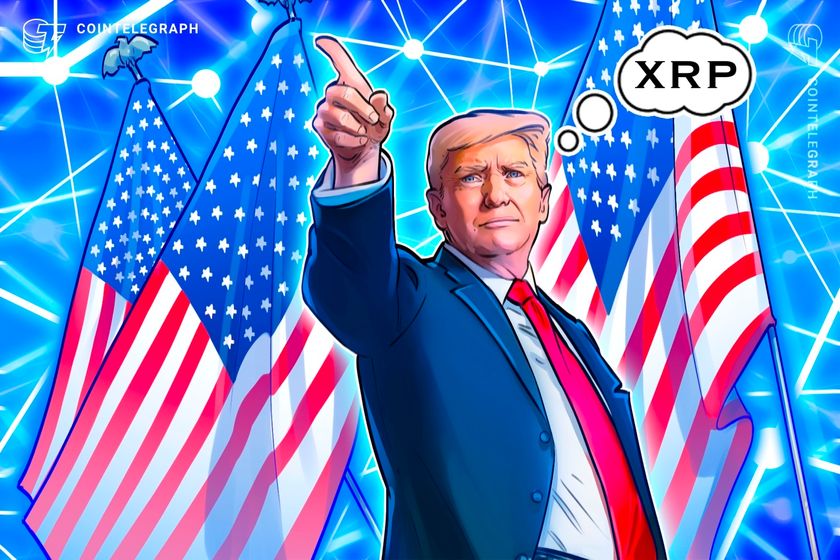
US President Donald Trump was reportedly manipulated by a lobbyist tied to Ripple Labs into announcing the XRP (XRP) token would be part of his plans for a national cryptocurrency reserve.

According to a May 8 Politico report, an employee of pro-Trump lobbyist Brian Ballard gave the president the text to a social media post she recommended he write announcing a US strategic crypto reserve that would include XRP, Solana (SOL), and Cardano (ADA).

After he posted the message to his social media platform on March 2, Trump learned Ripple was one of Ballard’s clients, infuriating the president, who felt like he’d been used, Politico reported, citing two people familiar with the incident.

“He is not welcome in anything anymore,” said Trump, referencing Ballard, according to the report.

Ripple, XRP, Donald Trump, Bitcoin ReserveMarch 2 Truth Social post announcing US crypto reserve. Source: Donald Trump
Trump had connections to Ripple long before the announcement of XRP in the proposed crypto reserve. The blockchain firm’s chief legal officer, Stuart Alderoty, donated more than $300,000 to fundraising and political action committees supporting Trump in the 2024 election, and both he and CEO Brad Garlinghouse met with the then-president-elect in January and attended inauguration events.

Related: Democrats aim at Trump’s crypto profits with a 3-prong pincer move

Ripple also donated $5 million worth of XRP to Trump’s presidential inaugural fund and has been one of the largest contributors to Fairshake, a political action committee (PAC) that supports those it considers “pro-crypto” candidates through media buys. A spokesperson for the PAC said in January that it would continue its efforts in the 2026 midterm elections.

Trump moved forward on crypto reserve days later

The president often uses his social media platform to suggest policies before any official announcement through the White House. Trump signed an executive order to create a “Digital Asset Stockpile” on March 6 — roughly four days after the post, which was still live at the time of publication.

The price of XRP did not appear to significantly react to the May 8 report. At the time of publication, it was $2.23, having risen roughly 5% in the previous 24 hours. Cointelegraph reached out to a Ripple spokesperson for comment, but did not receive a response at the time of publication.

Magazine: Trump’s crypto ventures raise conflict of interest, insider trading questions

Read more at cointelegraph.com

SEC considers new rules easing security token issuance

Updated to correct that the SEC sent a Wells notice to Uniswap but did not bring charges.

The US Securities and Exchange Commission (SEC) is considering rule changes to let companies more freely issue tokenized securities, SEC Commissioner Hester Peirce said in a speech published on May 8.

The regulator is “considering a potential exemptive order” for firms using blockchain technology to “issue, trade, and settle securities” that would release them from certain registration requirements, Peirce said in the speech.

For example, decentralized exchanges (DEXs) may no longer need to register “as a broker-dealer, clearing agency, or an exchange,” Peirce said. The SEC has previously sent numerous Wells notices to DEXs such as Uniswap for allegedly failing to register as securities exchanges.

Firms should “not have to comply with inapt regulations, which, in many cases, were developed well before the technologies being tested existed and may be obviated by attributes of that technology,” Peirce said. 

Security, SEC, Tokens, DLT, Tokenization, RWA TokenizationCommissioner Peirce described the planned changes in a May 8 speech. Source: SEC

Under such an exemption, companies would still be expected to comply with rules designed to prevent fraud and market manipulation, the commissioner said. They may also need to meet certain disclosure and recordkeeping requirements.

Related: Nasdaq urges SEC to treat certain digital assets as ‘stocks by any other name’

Sharp policy pivot

The SEC has dramatically pivoted its stance on cryptocurrency oversight since US President Donald Trump took office in January. 

Under the leadership of former SEC Chair Gary Gensler, the agency brought upward of 100 lawsuits against crypto firms for alleged securities law violations.

However, under Trump nominee Paul Atkins, who was sworn in as chair on April 21, the agency has claimed jurisdiction over a narrower segment of cryptocurrencies.

In February, the SEC issued guidance stating that memecoins — if clearly identified as purely speculative assets with no intrinsic value — do not qualify as investment contracts under US law. 

In April, the regulator said that stablecoins — digital tokens pegged to the US dollar — similarly do not qualify as securities if they are marketed solely as a means of making payments.

Magazine: Ethereum is destroying the competition in the $16.1T TradFi tokenization race

Read more at cointelegraph.com