cointelegraph.com

Eric Trump joins Metaplanet’s strategic board of advisers

Bitcoin-stacking firm Metaplanet has appointed US President Donald Trump’s son Eric to its newly established strategic board of advisers to further Metaplanet’s mission to become a “global leader in the Bitcoin economy.””His business acumen, love of the Bitcoin community and global hospitality perspective will be invaluable in accelerating Metaplanet’s vision of becoming one of the world’s leading Bitcoin Treasury Companies,” Metaplanet CEO Simon Gerovich said in a March 21 announcement on X.”As a globally recognized business leader and entrepreneur, Eric Trump brings a wealth of experience in real estate, finance, brand development, and strategic business growth and has become a leading voice and advocate of digital asset adoption worldwide,” Metaplanet added.

*Metaplanet Appoints Eric Trump to Strategic Board of Advisors* pic.twitter.com/v3CaFgLJkW

— Metaplanet Inc. (@Metaplanet_JP) March 21, 2025

The move is part of Metaplanet’s plan to establish a board of influential voices, speakers and thought leaders around the world who are committed to furthering Bitcoin adoption.Related: Bitcoin price thaws after Trump statement — Trader says ‘stay nimble and cashed up’Metaplanet shares increased 17.8% to 4,730 Japanese yen ($31.74) over the first 80 minutes of the March 21 trading day on the Tokyo Stock Exchange, Google Finance data shows.Metaplanet currently holds 3,050 Bitcoin (BTC) — worth nearly $4.1 billion — making it the 12th largest corporate Bitcoin holder, BitBo’s BitcoinTreasuries.NET data shows.The Japan-based firm has been adopting a range of financial instruments to bolster its Bitcoin reserve since it made its first purchase on April 23, 2024.Magazine: Trump’s crypto ventures raise conflict of interest, insider trading questions

Metaplanet is thrilled to welcome Eric Trump to our newly formed Strategic Board of Advisors. His business expertise and passion for BTC will help drive our mission forward as we continue building one of the world’s leading Bitcoin Treasury Companies.Welcome aboard @EricTrump! pic.twitter.com/c0bpC1ojcg

— Simon Gerovich (@gerovich) March 21, 2025

This is a developing story, and further information will be added as it becomes available.
Read more at cointelegraph.com

Bitcoin price thaws after Trump statement — Trader says ‘stay nimble and cashed up’

Bitcoin (BTC) price rallied to an intraday high of $87,453 in the early hours of the NY trading session but quickly retraced its gains to $83,655 shortly after US President Donald Trump made a video appearance at the Digital Asset Summit in New York.

Prior to the video statement, rumors circulated on X, suggesting that President Trump would announce zero capital gains taxes on certain cryptocurrencies or issue a favorable statement about the US strategic Bitcoin reserve. 

To the disappointment of some traders, neither rumor proved to be true, and Trump simply doubled down on his promise not to sell Bitcoin that has been confiscated by the government, and he called for Congress to enact clear stablecoin legislation as soon as possible.

The most positive statement made by President Trump was his restated goal of making the US the leader in all things crypto. 

“Together, we will make America the undisputed Bitcoin superpower and the crypto capital of the world.” 

As is commonplace for crypto markets, traders clearly bought into the rumor that Trump would make some sort of pro-Bitcoin executive order statements, and once this was clearly not the case, they sold on the news. 

In an X post, chartered market technician Aksel Kibar said that there is still a chance of Bitcoin price correcting to $73,700. 

Bitcoin price thaws after Trump statement — Trader says ‘stay nimble and cashed up’

BTC/USD 1-day chart. Source: Aksel Kibar / X 

Kibar said

“Long-term chart on BTC/USD. Still looks like a pullback to the broken $73.7K. What follows from here will decide on the following several month’s price action.” 

Not all of Bitcoin’s recent strength is attributed to excitement over today’s Trump statement. On March 19, BTC responded positively to the release of FOMC minutes and Federal Reserve Chair Jerome Powell’s confirmation that the Fed’s quantitative tightening regime would reduce its pace and that the possibility of two interest rate cuts in 2025 remained on the table. 

BitMEX co-founder Arthur Hayes took a victory lap at what he described as the Fed’s admission that QT would essentially end on April 1, but he cautioned that while $77,000 may have been the Bitcoin price bottom, surprise bouts of volatility could lead to more pain in stocks and BTC. 

Hayes said

“JAYPOW delivered, QT basically over Apr. 1. The next thing we need to gt bulled up for realz is either SLR exemption and or a restart of QE. Was BTC $77K the bottom, prob. But stonks prob have more pain left to fully convert Jay to team Trump so stay nimble and cashed up.” 

Related: Trump says US will be ‘Bitcoin superpower’ as BTC price breaks 4-month downtrend

As reported by Cointelegraph, a majority of Bitcoin’s recent price action has been driven by activity in the futures markets, but the reappearance of the BTC Coinbase premium could be a sign that spot demand is returning to the market. 

Bitcoin price thaws after Trump statement — Trader says ‘stay nimble and cashed up’

Bitcoin Coinbase premium index. Source: CryptoQuant

This article does not contain investment advice or recommendations. Every investment and trading move involves risk, and readers should conduct their own research when making a decision.

Read more at cointelegraph.com

Crypto campaign donations are democracy at work — former Kraken exec

Marco Santori, former chief legal officer at crypto exchange Kraken, praised the political campaign donations made by industry firms during the 2024 election as “democracy at work.”

In an exclusive interview with Cointelegraph, the former Kraken executive argued that crypto voters tilted the election in favor of Donald Trump and the Republican Party.

The executive also said that the donations from crypto firms, many of which are now having regulatory lawsuits dismissed, do not represent conflicts of interest. Santori told Cointelegraph:

“Detractors only call it a conflict of interest when it is a cause they do not believe in, otherwise, it’s just democracy at work. It is people advocating for their own benefits — people like you and me. That is what is happening, and that is what happened in the last election.”

“Look at what happened in November. Who can deny that crypto was responsible for 4%-5% of the vote,” Santori added. “It was a huge swing in an American election in every state across demographics.”

US Government, United States, Elections, Democracy, US Elections 2024

2024 US electoral map. Source: 270 To Win

In September 2024, Dr. Tonya M. Evans, a law professor at Pennsylvania State University, told Cointelegraph that the 2024 US elections would be decided by razor-thin margins and that crypto voters had the voting power to swing the elections.

Related: Rep. Mike Collins now accepting crypto donations for campaign

Crypto industry spends big on 2024 US elections

The crypto industry was responsible for nearly half of all corporate political campaign contributions during the 2024 US election cycle.

According to data from Public Citizen, a nonprofit watchdog group, digital asset firms donated over $119 million to support pro-crypto candidates and policies in the 2024 US elections.

US Government, United States, Elections, Democracy, US Elections 2024

The crypto industry’s share of corporate campaign contributions during the 2024 election cycle. Source: Public Citizen

This included money spent on the presidential and congressional elections, such as the re-election campaign of Rep. Bryan Steil, on which crypto political action committee Fairshake spent $760,000 in a last-minute media ad supporting the lawmaker.

According to former White House Chief of Staff Mick Mulvaney, the crypto industry built a professional lobbying operation during the most recent election cycle — something that was absent during 2016 and 2020.

The lobbying of the crypto industry is credited as the catalyst that allowed the GOP to secure both chambers of Congress, the popular vote, and the presidency in 2024.

Magazine: Harris’ unrealized gains tax could ‘tank markets’: Nansen’s Alex Svanevik, X Hall of Flame

Read more at cointelegraph.com

DTCC to promote ERC3643 token standard

The Depository Trust & Clearing Corporation (DTCC) — the US’s primary clearinghouse for securities transactions — has committed to promoting Ethereum’s ERC-3643 standard for permissioned securities tokens, according to a March 20 announcement. 

DTCC is joining the ERC3643 Association, a nonprofit dedicated to catalyzing the standard’s adoption with the goal of “promoting and advancing the ERC3643 token standard,” it said.

The endorsement highlights how US regulators are embracing tokenization after President Donald Trump vowed to make America the “world’s crypto capital.” 

It also suggests that the Ethereum blockchain network may play an important role in the US’s permissioned security token ecosystem. 

“DTCC will help lead the future of tokenization and support institutional adoption at scale,” Dennis O’Connell, president of the ERC3643 Association, said in a statement.

DTCC to promote ERC3643 token standard

ERC-3643 is a standard for permissioned Ethereum tokens. Source: ERC3643.org

Related: Tokenization can transform US markets if Trump clears the way

Early mover

The DTCC is a private organization closely overseen by the US Securities and Exchange Commission (SEC). It settles most US securities transactions.

In 2023, the DTCC processed transactions worth an aggregate of $3 quadrillion, according to its annual report. 

Also known as the T-REX Protocol, ERC-3643 is “an open-source suite of smart contracts that enables the issuance, management, and transfer of permissioned tokens […] even on permissionless blockchains,” according to the ERC3643 Association’s website. 

It relies on a custom-built decentralized identity protocol to ensure that only users meeting pre-specified conditions can become tokenholders. 

The DTCC has been an early mover among US financial overseers in embracing blockchain technology, piloting several initiatives related to onchain securities transactions. They include testing settling tokenized US Treasury Bills on the Canton Network and piloting private asset tokenization on an Avalanche (AVAX) subnet. 

In February, the clearinghouse launched ComposerX, a platform designed to streamline token creation and settlement for regulated US financial institutions.

In November, the Commodity Future Trading Commission (CFTC) — a top US financial regulator — tipped plans to explore similar technologies for onchain settlement in the derivatives markets.

Magazine: Terrorism and Israel-Gaza war weaponized to destroy crypto

Read more at cointelegraph.com

Clearinghouse backs Ethereum token standard for US securities

The Depository Trust & Clearing Corporation (DTCC) — the US’s primary clearinghouse for securities transactions — has committed to promoting Ethereum’s ERC-3643 standard for permissioned securities tokens, according to a March 20 announcement. 

DTCC is joining the ERC3643 Association, a nonprofit dedicated to catalyzing the standard’s adoption with the goal of “promoting and advancing the ERC3643 token standard,” it said.

The endorsement highlights how US regulators are embracing tokenization after President Donald Trump vowed to make America the “world’s crypto capital.” 

It also suggests that the Ethereum blockchain network may play an important role in the US’s permissioned security token ecosystem. 

“DTCC will help lead the future of tokenization and support institutional adoption at scale,” Dennis O’Connell, president of the ERC3643 Association, said in a statement.

Clearinghouse backs Ethereum token standard for US securities

ERC-3643 is a standard for permissioned Ethereum tokens. Source: ERC3643.org

Related: Tokenization can transform US markets if Trump clears the way

Early mover

The DTCC is a private organization closely overseen by the US Securities and Exchange Commission (SEC). It settles most US securities transactions.

In 2023, the DTCC processed transactions worth an aggregate of $3 quadrillion, according to its annual report. 

Also known as the T-REX Protocol, ERC-3643 is “an open-source suite of smart contracts that enables the issuance, management, and transfer of permissioned tokens […] even on permissionless blockchains,” according to the ERC3643 Association’s website. 

It relies on a custom-built decentralized identity protocol to ensure that only users meeting pre-specified conditions can become tokenholders. 

The DTCC has been an early mover among US financial overseers in embracing blockchain technology, piloting several initiatives related to onchain securities transactions. They include testing settling tokenized US Treasury Bills on the Canton Network and piloting private asset tokenization on an Avalanche (AVAX) subnet. 

In February, the clearinghouse launched ComposerX, a platform designed to streamline token creation and settlement for regulated US financial institutions.

In November, the Commodity Future Trading Commission (CFTC) — a top US financial regulator — tipped plans to explore similar technologies for onchain settlement in the derivatives markets.

Magazine: Terrorism and Israel-Gaza war weaponized to destroy crypto

Read more at cointelegraph.com

Bitcoin volatility hits 3.6% amid heightened market uncertainty

Bitcoin (BTC) volatility climbed to 3.6% on March 19 — the highest point since August 2024, according to data from CoinGlass.

The volatility reflects heightened market uncertainty amid structural unknowns in the US economy, according to Uldis Tearudklans, chief revenue officer at UK-based cryptocurrency exchange Paybis.

“The policy landscape is becoming more complex with the emergence of Elon Musk’s Department of Government Efficiency,” Tearudklans said. “While the initiative to reduce government spending has bipartisan backing, the broader economic effects — particularly on employment and consumer demand — remain difficult to quantify.”

The Department of Government Efficiency claims to have generated an estimated savings of $115 billion for the US government as of March 19. The claimed savings include workforce reductions, asset sales, grant cancellations, and regulatory savings.

Bitcoin volatility hits 3.6% amid heightened market uncertainty

Bitcoin volatility history from March 2013 to March 2025. Source: CoinGlass

According to Tearudklans, if fiscal tightening proceeds alongside stable or gradually declining interest rates, the resulting liquidity contraction “could create a mismatch in policy direction, limiting the intended stimulative effect of future rate cuts.”

On March 19, the Federal Open Market Committee announced that it would leave interest rates unchanged for the time being, although it left open the possibility for two more rate cuts in 2025.

Related: $77K likely the Bitcoin bottom as QT is ‘effectively dead’ — Analysts

Bitcoin volatility on display since Trump’s inauguration

Bitcoin’s volatility is well-known and has been on full display since US President Donald Trump was inaugurated in January 2025.

Since reaching a high of $109,590 on Jan. 20, BTC price suffered a 30% retracement to a low of $77,041 during the week of March 9-15. Selling pressure has increased as more short-term buyers currently find themselves down on their investments, though demand may be slightly returning. The cryptocurrency price bounced up to around $84,000 at this time of writing.

Tearudklans told Cointelegraph that the elevated volatility indicates that traders are pricing in divergent outcomes, including the possibility of fiscal contraction alongside stable or easing interest rates.

“This creates a complex feedback loop where reduced government spending could limit growth, potentially forcing the Fed to maintain a cautious stance or even delay future rate cuts.”

Bitcoin’s price action may also be tied to policy misalignment, he added. “While the Fed’s rate decision offers short-term clarity, the broader fiscal outlook introduces the risk of asymmetric market responses, reinforcing Bitcoin’s sensitivity to macroeconomic cycles and liquidity shifts.”

The volatility of Bitcoin comes as Trump has expressed overtures to the crypto community. On March 7, he signed an executive order to create a strategic Bitcoin reserve and digital asset stockpile in the United States.

On March 20, he spoke at the 2025 Digital Asset Summit, claiming the US will be a “Bitcoin superpower.”

However, Trump’s talk of tariffs and rising geopolitical tension are affecting the financial markets as a whole, including crypto.

Magazine: X Hall of Flame, Benjamin Cowen: Bitcoin dominance will fall in 2025

Read more at cointelegraph.com

Bitfinex Bitcoin longs hit 6-month high — Will BTC price follow?

Bullish Bitcoin (BTC) positions using leverage on the Bitfinex exchange surged to their highest level in nearly six months, reaching 80,333 BTC on March 20 — equivalent to $6.92 billion.

The 27.5% increase in Bitcoin margin longs since Feb. 20 has fueled speculation that the 12.5% BTC price gain from the $76,700 low on March 11 is driven by leverage and may not be sustainable.

Bitfinex Bitcoin longs hit 6-month high — Will BTC price follow?

Bitfinex BTC margin longs, BTC. Source: TradingView / Cointelegraph

However, Bitcoin’s price does not always move in tandem with bullish leveraged positions on Bitfinex. For example, in the three weeks ending July 12, 2024, large investors added 13,620 BTC in margin longs, yet Bitcoin’s price fell from $65,500 to $58,000.

Similarly, a two-week-long increase of 8,990 BTC in margin longs took place leading into Sept. 11, 2024, and this coincided with a price decline from $60,000.

Bitcoin margin traders are highly profitable but also risk-tolerant

In the long term, these savvy investors have timed the market well, as Bitcoin’s price eventually surpassed $88,000 in November 2024, while margin long positions were reduced by 30% by year-end. Essentially, these traders are highly profitable but exhibit a much higher risk tolerance and patience than the average investor. Therefore, an increase in leverage demand does not necessarily translate into upward pressure on Bitcoin’s price.

Additionally, the cost of borrowing Bitcoin remains relatively low, creating opportunities for market-neutral arbitrage as traders capitalize on cheap interest rates. Currently, borrowing BTC for 60 days on Bitfinex carries an annualized cost of 3.14%, while the funding rate for Bitcoin perpetual futures stands at 4.5%. In theory, traders can exploit this spread through ‘cash and carry’ arbitrage, profiting without direct exposure to price fluctuations.

Even if one assumes that most of the $1.48 billion in margin longs are not arbitrage trades — meaning these large investors are genuinely betting on Bitcoin’s price appreciation — other exchanges may have offset part of this move. For instance, demand for Bitcoin margin longs has declined significantly on OKX over the same 30-day period.

Bitfinex Bitcoin longs hit 6-month high — Will BTC price follow?

Bitcoin margin long-to-short ratio at OKX. Source: OKX

The Bitcoin long-to-short margin ratio on OKX currently shows longs outweighing shorts by a factor of 15, the lowest level in over three months. Historically, excessive confidence has driven this ratio above 40, most recently in late February when Bitcoin’s price surged past $105,000. Conversely, a ratio below 5 typically signals a strong bearish sentiment.

Bitcoin options price balances risks of upside and downside fluctuations in BTC price

To rule out external factors limited to margin markets, one should also analyze Bitcoin options. If traders anticipate a correction, demand for put (sell) options will rise, pushing the 25% delta skew above 6%. Conversely, during bullish periods, this metric typically falls below -6%.

Bitfinex Bitcoin longs hit 6-month high — Will BTC price follow?

Bitcoin 30-day options delta skew (put-call). Source: Laevitas.ch

Between March 10 and March 18, the Bitcoin options market showed signs of bearish sentiment but has since shifted to a neutral stance. This suggests that whales and market makers are pricing similar risks for both upward and downward price movements. Given the margin market trends on OKX and the current pricing of BTC options, a Bitcoin bull run is far from a consensus expectation.

Bitcoin’s lack of bullish momentum can partly be attributed to the higher inflation outlook and weaker economic growth projections presented by the US Federal Reserve on March 19. Concerns over a potential recession, exacerbated by a global tariff war, have made investors more risk-averse. As a result, even though whales are increasing their exposure through Bitcoin margin longs, overall market sentiment remains subdued.

This article is for general information purposes and is not intended to be and should not be taken as legal or investment advice. The views, thoughts, and opinions expressed here are the author’s alone and do not necessarily reflect or represent the views and opinions of Cointelegraph.

Read more at cointelegraph.com

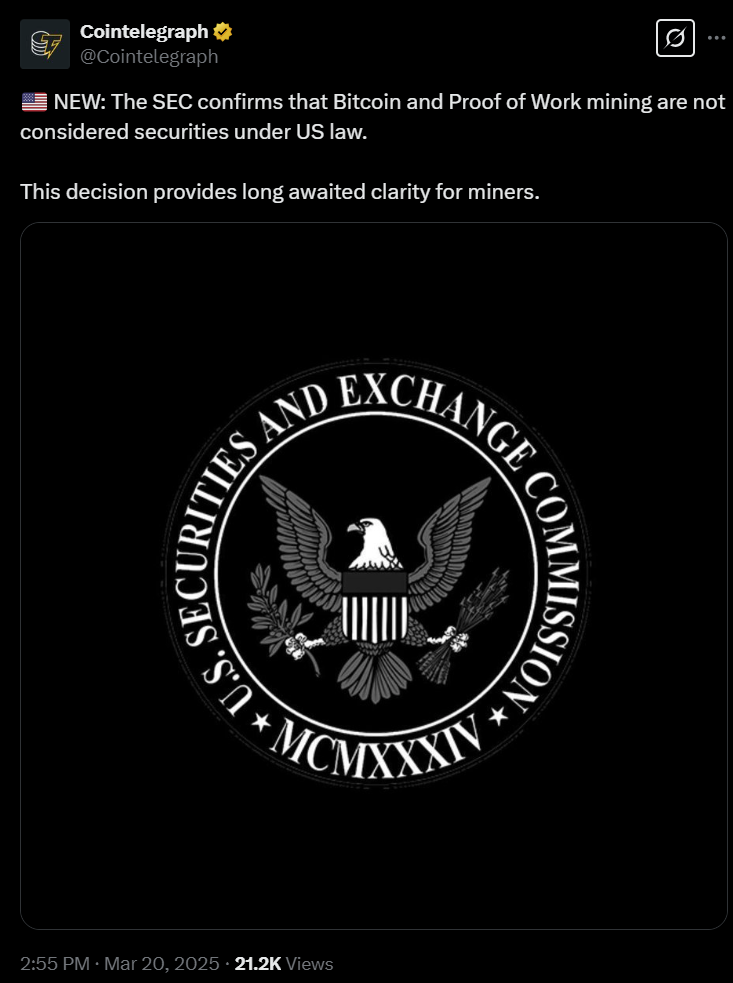
SEC says proof-of-work mining does not constitute securities dealing

The US Securities and Exchange Commission’s Division of Corporation Finance has clarified its views on proof-of-work mining, arguing that such activities do not constitute “the offer and sale of securities” as outlined in the Securities Act of 1933, so long as they meet certain criteria.

In a March 20 statement, the SEC division addressed the “mining of crypto assets that are intrinsically linked to the programmatic functioning of a public, permissionless network” and determined that decentralized PoW networks should not be treated as securities.

Although the SEC’s statement did not name any specific blockchain, its views on certain PoW activities apply to permissionless networks where mining is used to participate in the consensus mechanism. The statement applies to solo miners and mining pools participating in such networks. 

Security, SEC, Proof-of-Work

The SEC’s Division of Corporation Finance gives its view on PoW “protocol mining activities.” Source: SEC

Although Bitcoin (BTC) is by far the largest and most significant PoW chain, there are several others, including Dogecoin (DOGE), Litecoin (LTC) and Monero (XMR).

US regulators have long considered Bitcoin to be a commodity and not a security — a view that also extends to Litecoin and Dogecoin, according to the Commodity Futures Trading Commission. 

Security, SEC, Proof-of-Work

Source: Cointelegraph

Related: Trump says US will be ‘Bitcoin superpower’ as BTC price breaks 4-month downtrend

A pro-crypto policy tailwind

Digital asset markets, including PoW chains, are set to flourish under US President Donald Trump, who has vowed to make America the world’s blockchain and crypto capital. 

In addition to appointing a pro-crypto replacement to Gary Gensler at the SEC, the president has established the Council of Advisers on Digital Assets to advance common-sense regulations for the industry. 

On March 19, the council’s executive director, Bo Hines, revealed that a comprehensive stablecoin bill could land on the president’s desk in a matter of months. 

The same day, the Blockchain Association, an industry advocacy group, said a cryptocurrency market structure bill is expected by the summer. 

“I think we’re close to being able to get those done for August […] They’re doing a lot of work on that behind the scenes right now,” said Kristin Smith, the Blockchain Association’s CEO.

Magazine: Unstablecoins: Depegging, bank runs and other risks loom

Read more at cointelegraph.com

SEC says proof-of-work mining does not constitute securities dealing

The US Securities and Exchange Commission’s Division of Corporation Finance has clarified its views on proof-of-work mining, arguing that such activities do not constitute “the offer and sale of securities” as outlined in the Securities Act of 1933, so long as they meet certain criteria.

In a March 20 statement, the SEC division addressed the “mining of crypto assets that are intrinsically linked to the programmatic functioning of a public, permissionless network” and determined that decentralized PoW networks should not be treated as securities.

Although the SEC’s statement did not name any specific blockchain, its views on certain PoW activities apply to permissionless networks where mining is used to participate in the consensus mechanism. The statement applies to solo miners and mining pools participating in such networks. 

Security, SEC, Proof-of-Work

The SEC’s Division of Corporation Finance gives its view on PoW “protocol mining activities.” Source: SEC

Although Bitcoin (BTC) is by far the largest and most significant PoW chain, there are several others, including Dogecoin (DOGE), Litecoin (LTC) and Monero (XMR). US regulators have long considered Bitcoin to be a commodity and not a security — a view that also extends to Litecoin and Dogecoin, according to the Commodity Futures Trading Commission. 

Security, SEC, Proof-of-Work

Source: Cointelegraph

Related: Trump says US will be ‘Bitcoin superpower’ as BTC price breaks 4-month downtrend

A pro-crypto policy tailwind

Digital asset markets, including PoW chains, are set to flourish under US President Donald Trump, who has vowed to make America the world’s blockchain and crypto capital. 

In addition to appointing a pro-crypto replacement to Gary Gensler at the SEC, the president has established the Council of Advisers on Digital Assets to advance common-sense regulations for the industry. 

On March 19, the council’s executive director, Bo Hines, revealed that a comprehensive stablecoin bill could land on the president’s desk in a matter of months. 

The same day, the Blockchain Association, an industry advocacy group, said a cryptocurrency market structure bill is expected by the summer. 

“I think we’re close to being able to get those done for August […] They’re doing a lot of work on that behind the scenes right now,” said Kristin Smith, the Blockchain Association’s CEO.

Magazine: Unstablecoins: Depegging, bank runs and other risks loom

Read more at cointelegraph.com

Pump.fun launches own DEX, drops Raydium

Pump.fun has launched its own decentralized exchange (DEX) called PumpSwap, potentially displacing Raydium as the primary trading venue for Solana (SOL) memecoins. 

Starting on March 20, memecoins that successfully bootstrap liquidity, or “bond,” on Pump.fun will migrate directly to PumpSwap, Pump.fun said in an X post. 

Previously, bonded Pump.fun tokens migrated to Raydium, which emerged as Solana’s most popular DEX largely thanks to memecoins trading activity. 

According to Pump.fun, PumpSwap “functions similarly to Raydium V4 & Uniswap V2” and is designed “to create the most frictionless environment for trading coins.”

“[M]igrations were a major point of friction – they slow a coin’s momentum and introduce needless complexity for new users,” Pump.fun said.

“[N]ow, migrations happen instantly and for free.”

Pump.fun launches own DEX, drops Raydium

Raydium’s trading volumes surged in 2024, largely due to memecoins. Source: DeFiLlama

Related: Solana shorts spike amid memecoin scandals

Heightened competition

The launch comes just a few days after Raydium tipped plans to create its own memecoin launchpad — called LaunchLab — to directly compete with Pump.fun. 

Pump.fun and Raydium’s transition from partners to competitors stands to reshape Solana’s decentralized finance (DeFi) ecosystem at a time when memecoin trading volumes are down dramatically from January highs. 

“We welcome competition because users win at the end of the day,” Alon, one of Pump.fun’s co-founders, told Cointelegraph on March 20. 

Other upstart protocols — such as Daos.fun, GoFundMeme and Pumpkin — are also vying for a share of Solana’s memecoin market. 

PumpSwap plans to adopt one of rival GoFundMeme’s most popular features — revenue sharing with memecoin creators. 

Soon, “a percentage of protocol revenue will be shared with coin creators,” Pump.fun said.

“[I]f it succeeds, millions of dollars will go towards aligning creators with their communities and incentivizing higher quality launches.” 

Cryptocurrencies, Cryptocurrency Exchange, Decentralized Exchange, Solana, DEX, Memecoin

Pump.fun’s fee revenues are down from January. Source: DeFiLlama

Declining memecoin activity

On Feb. 27, Cointelegraph reported that successful memecoin launches on Pump.fun were down some 80% from January highs after a series of memecoin-related scandals cooled sentiment among retail traders. 

Pump.fun’s average daily fee revenue declined from more than $4 million in January to around $1 million as of mid-March, according to a Pump.fun spokesperson and data from DefiLlama.

Memecoins drove explosive growth on Solana in 2024, with the chain’s total value locked (TVL) increasing from around $1.4 billion to more than $9 billion that year, according to DefiLlama.

Raydium was among the biggest beneficiaries, with daily volumes soaring from around $245 million to more than $2 billion over the course of 2024, DefiLlama data shows.

In January, Raydium launched a leveraged perpetual futures trading platform in a bid to challenge incumbent Jupiter, another top Solana DeFi protocol.

Magazine: Trump’s crypto ventures raise conflict of interest, insider trading questions

Read more at cointelegraph.com