cointelegraph.com

North Carolina bills would add crypto to state’s retirement system

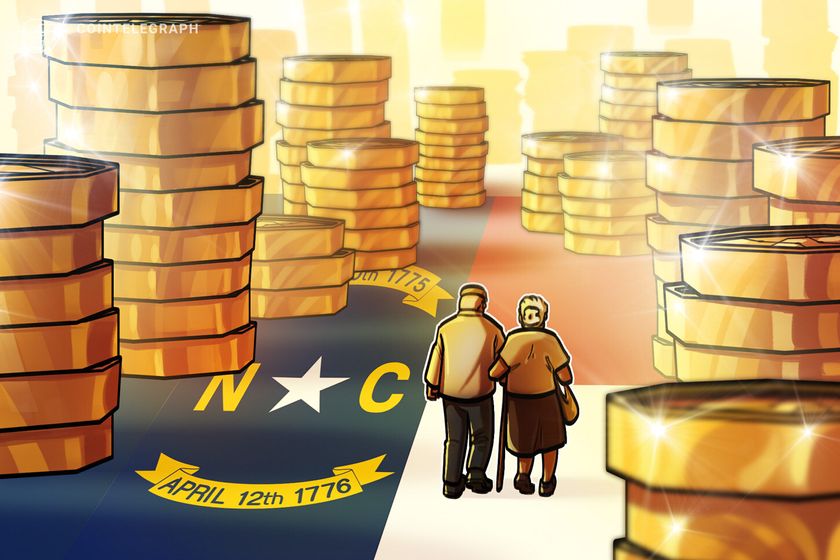
North Carolina lawmakers have introduced bills in the House and Senate that could see the state’s treasurer allocate up to 5% of various state retirement funds into cryptocurrencies such as Bitcoin.

The Investment Modernization Act (House Bill 506), introduced by Representative Brenden Jones on March 24, would create an independent investment authority under the state’s Treasury to determine which digital assets could be suitable for inclusion into the state retirement funds.

An identical bill, the State Investment Modernization Act (Senate Bill 709), was introduced into the state’s Senate on March 25.

The bills define a digital asset as a cryptocurrency, stablecoin, non-fungible token (NFT), or any other asset that is electronic in nature that confers economic, proprietary or access rights.

The North Carolina bills don’t set market cap criteria for digital assets, unlike other crypto bills that are working their way into law at the state level.

North Carolina bills would add crypto to state’s retirement system

Source: Bitcoin Laws

The newly created agency, dubbed the North Carolina Investment Authority, would, however, need to carefully weigh the risk and reward profile of each digital asset and ensure the funds are maintained in a secure custody solution.

Bitcoin legislation tracker Bitcoin Laws noted on X that House Bill 506 wasn’t drafted as a Bitcoin reserve bill as it does not mandate the investment authority to hold Bitcoin (BTC) — or any digital asset — over the long term.

North Carolina wants in on Bitcoin bill race

On March 18, North Carolina senators introduced the Bitcoin Reserve and Investment Act (Senate Bill 327), which calls for the treasurer to allocate up to 10% of public funds specifically into Bitcoin.

The bill — introduced by Republicans Todd Johnson, Brad Overcash and Timothy Moffitt — aims to leverage Bitcoin investment as a “financial innovation strategy” to strengthen North Carolina’s economic standing.

Related: GameStop hints at future Bitcoin purchases following board approval

The treasurer would need to ensure that the Bitcoin is stored in a multi-signature cold storage wallet, and the BTC could only be liquidated during a “severe financial crisis,” with approval from two-thirds of North Carolina’s General Assembly.

The bill would also create a Bitcoin Economic Advisory Board to oversee the reserve’s management.

According to Bitcoin Law, 41 Bitcoin reserve bills have been introduced at the state level in 23 states, and 35 of those 41 bills remain live.

Earlier this month, US President Donald Trump signed an executive order to create a Strategic Bitcoin Reserve and a Digital Asset Stockpile, both of which will initially use cryptocurrency forfeited in government criminal cases.

Magazine: What are native rollups? Full guide to Ethereum’s latest innovation
Read more at cointelegraph.com

North Carolina bills would add crypto to state’s retirement system

North Carolina lawmakers have introduced bills in the House and Senate that could see the state’s treasurer allocate up to 5% of various state retirement funds into cryptocurrencies such as Bitcoin.

The Investment Modernization Act (House Bill 506), introduced by Representative Brenden Jones on March 24, would create an independent investment authority under the state’s Treasury to determine which digital assets could be suitable for inclusion into the state retirement funds.

An identical bill, the State Investment Modernization Act (Senate Bill 709), was introduced into the state’s Senate on March 25.

The bills define a digital asset as a cryptocurrency, stablecoin, non-fungible token (NFT), or any other asset that is electronic in nature that confers economic, proprietary or access rights.

The North Carolina bills don’t set market cap criteria for digital assets, unlike other crypto bills that are working their way into law at the state level.

North Carolina bills would add crypto to state’s retirement system

Source: Bitcoin Laws

The newly created agency, dubbed the North Carolina Investment Authority, would, however, need to carefully weigh the risk and reward profile of each digital asset and ensure the funds are maintained in a secure custody solution.

Bitcoin legislation tracker Bitcoin Laws noted on X that House Bill 506 wasn’t drafted as a Bitcoin reserve bill as it does not mandate the investment authority to hold Bitcoin (BTC) — or any digital asset — over the long term.

North Carolina wants in on Bitcoin bill race

On March 18, North Carolina senators introduced the Bitcoin Reserve and Investment Act (Senate Bill 327), which calls for the treasurer to allocate up to 10% of public funds specifically into Bitcoin.

The bill — introduced by Republicans Todd Johnson, Brad Overcash and Timothy Moffitt — aims to leverage Bitcoin investment as a “financial innovation strategy” to strengthen North Carolina’s economic standing.

Related: GameStop hints at future Bitcoin purchases following board approval

The treasurer would need to ensure that the Bitcoin is stored in a multi-signature cold storage wallet, and the BTC could only be liquidated during a “severe financial crisis,” with approval from two-thirds of North Carolina’s General Assembly.

The bill would also create a Bitcoin Economic Advisory Board to oversee the reserve’s management.

According to Bitcoin Law, 41 Bitcoin reserve bills have been introduced at the state level in 23 states, and 35 of those 41 bills remain live.

Earlier this month, US President Donald Trump signed an executive order to create a Strategic Bitcoin Reserve and a Digital Asset Stockpile, both of which will initially use cryptocurrency forfeited in government criminal cases.

Magazine: What are native rollups? Full guide to Ethereum’s latest innovation

Read more at cointelegraph.com

SEC plans 4 more crypto roundtables on trading, custody, tokenization, DeFi

The US Securities and Exchange Commission will host four more crypto roundtables — focusing on crypto trading, custody, tokenization and decentralized finance (DeFi) — after hosting its first crypto roundtable on March 21.

The series of roundtables, organized by the SEC’s Crypto Task Force, will kick off with a discussion on tailoring regulation for crypto trading on April 11, the SEC said in a March 25 statement.

A roundtable on crypto custody will follow on April 25, with another to discuss tokenization and moving assets onchain on May 12. The fourth roundtable in the series will discuss DeFi on June 6.

SEC plans 4 more crypto roundtables on trading, custody, tokenization, DeFi

A series of four crypto roundtable discussions are scheduled from April through to June. Source: SEC

“The Crypto Task Force roundtables are an opportunity for us to hear a lively discussion among experts about what the regulatory issues are and what the Commission can do to solve them,” said SEC Commissioner Hester Peirce, the task force lead.

The specific agenda and speakers for each roundtable have yet to be disclosed, but all are open for the public to watch online or to attend at the SEC’s headquarters in Washington, DC.

SEC softens on crypto with new leadership

The agency’s Crypto Task Force was launched on Jan. 21 by acting SEC Chair Mark Uyeda. It’s tasked with establishing a workable crypto framework for the agency to use. 

The task force held its first roundtable on March 21 with a discussion titled “How We Got Here and How We Get Out — Defining Security Status.”

The SEC will also be hosting a roundtable about AI’s role in the financial industry on March 27, according to a March 25 release. 

Join us on March 27 for a roundtable discussion on artificial intelligence in the financial industry. Topics include the risks, benefits, and governance of AI. More details: https://t.co/ekX2RWp2KQ pic.twitter.com/7fH3j1tlwj

— U.S. Securities and Exchange Commission (@SECGov) March 25, 2025

The roundtable will discuss the risks, benefits, and governance of AI in the financial industry, with Uyeda, Peirce and fellow SEC Commissioner Caroline Crenshaw slated to speak.

Under the Trump administration, the SEC has slowly been walking back its hardline stance toward crypto forged under former SEC Chair Gary Gensler.

The regulator has dismissed a growing number of enforcement actions against crypto firms it launched under Gensler.

Related: Bitnomial drops SEC lawsuit ahead of XRP futures launch in the US

Uyeda, who took the reins after Gensler resigned on Jan. 20, flagged plans on March 17 to scrap a rule proposed under the Biden administration that would tighten crypto custody standards for investment advisers.

Uyeda also said in a March 10 speech that he had asked SEC staff for options to abandon part of proposed changes that would expand regulation of alternative trading systems to include crypto firms, requiring them to register as exchanges. 

Magazine: SEC’s U-turn on crypto leaves key questions unanswered 

Read more at cointelegraph.com

Bitcoin, Ethereum to end Q1 in the red, ‘vertical swing up’ unlikely

Bitcoin and Ethereum are poised to suffer their worst first quarter in years unless they can pull off a huge rally in the next few days.

Ether (ETH) has dropped 37.98% so far over the first quarter of 2025, its worst Q1 decline since 2018, when it plunged 46.61%, according to CoinGlass data. Meanwhile, Bitcoin (BTC) is down 6.49% so far over the quarter, which is slated to end on March 31 — marking its worst Q1 performance since 2020, when it saw a 10.83% decline. 

Crypto market unlikely to flash green before end quarter

Swyftx lead analyst Pav Hundal told Cointelegraph that a “vertical swing up into the end of the quarter looks unlikely.” 

Cryptocurrencies, Markets

Ether has posted an average return of 78.23% in the first quarter of every year since 2017. Source: CoinGlass

Hundal said that the crypto market will be “flying a little blind” until the middle of April when the broader market should have better clarity on US President Donald Trump’s tariff plans.

“The economic data shows a global economy in decent shape,” he said. 

Some analysts say it may only be a matter of weeks after that before Bitcoin sees its next significant rally.

Crypto commentator Colin Talks Crypto said in a March 19 X post that Bitcoin may begin its “next major blast-off” around April 30. Meanwhile, Swan Bitcoin CEO Cory Klippsten said earlier this month that there’s more than a 50% chance Bitcoin will hit all-time highs before the end of June.

The first quarter has historically been Ether’s strongest and Bitcoin’s second-best. Since 2017, Ether has averaged a 78.23% gain in Q1, while Bitcoin has seen an average return of 51.62% since 2013.

At the time of publication, Bitcoin is trading at $87,558, while Ether is trading at $2,059, up 5.08% and 5.88% over the past 24 hours, respectively.

Meanwhile, the ETH/BTC ratio — showing Ether’s relative strength to Bitcoin — is at its lowest point since May 2020, sitting at 0.2348, according to TradingView data.

Cryptocurrencies, Markets

The ETH/BTC ratio is sitting at 0.02348 at the time of publication. Source: TradingView

The rest of the crypto market has followed the downtrend of the two largest cryptocurrencies by market cap, with the entire crypto market capitalization declining 11.65% since Jan. 1, sitting at $2.88 trillion at the time of publication, according to CoinMarketCap data.

Related: Bitcoin price has 75% chance of hitting new highs in 2025 — Analyst

While many in the crypto industry were highly optimistic going into Q1 2025 following a strong end to 2024 after Bitcoin tapped $100,000 for the first time after Trump’s November election win, unexpected macroeconomic conditions were largely to blame for the crypto market’s downturn at the beginning of February.

After Bitcoin retraced below $100,000 in February, amid Trump’s imposed tariffs and uncertainty around the future of the US federal interest rate, the broader market sentiment turned fearful. The sentiment-tracking Crypto Fear & Greed Index was reading a “Neutral” score of 47 as of March 26.

Magazine: What are native rollups? Full guide to Ethereum’s latest innovation

This article does not contain investment advice or recommendations. Every investment and trading move involves risk, and readers should conduct their own research when making a decision.

Read more at cointelegraph.com

Bitcoin, Ethereum to end Q1 in the red, ‘vertical swing up’ unlikely

Bitcoin and Ethereum are poised to suffer their worst first quarter in years unless they can pull off a huge rally in the next few days.

Ether (ETH) has dropped 37.98% so far over the first quarter of 2025, its worst Q1 decline since 2018, when it plunged 46.61%, according to CoinGlass data. Meanwhile, Bitcoin (BTC) is down 6.49% so far over the quarter, which is slated to end on March 31 — marking its worst Q1 performance since 2020, when it saw a 10.83% decline. 

Crypto market unlikely to flash green before end quarter

Swyftx lead analyst Pav Hundal told Cointelegraph that a “vertical swing up into the end of the quarter looks unlikely.” 

Cryptocurrencies, Markets

Ether has posted an average return of 78.23% in the first quarter of every year since 2017. Source: CoinGlass

Hundal said that the crypto market will be “flying a little blind” until the middle of April, when the broader market should have better clarity on US President Donald Trump’s tariff plans.

“The economic data shows a global economy in decent shape,” he said. 

Some analysts say it may only be a matter of weeks after that before Bitcoin sees its next significant rally.

Crypto commentator Colin Talks Crypto said in a March 19 X post that Bitcoin may begin its “next major blast-off” around April 30. Meanwhile, Swan Bitcoin CEO Cory Klippsten said earlier this month that there’s more than a 50% chance Bitcoin will hit all-time highs before the end of June.

The first quarter has historically been Ether’s strongest and Bitcoin’s second-best. Since 2017, Ether has averaged a 78.23% gain in Q1, while Bitcoin has seen an average return of 51.62% since 2013.

At the time of publication, Bitcoin is trading at $87,558, while Ether is trading at $2,059, up 5.08% and 5.88% over the past 24 hours, respectively.

Meanwhile, the ETH/BTC ratio — showing Ether’s relative strength to Bitcoin — is at its lowest point since May 2020, sitting at 0.2348, according to TradingView data.

Cryptocurrencies, Markets

The ETH/BTC ratio is sitting at 0.02348 at the time of publication. Source: TradingView

The rest of the crypto market has followed the downtrend of the two largest cryptocurrencies by market cap, with the entire crypto market capitalization declining 11.65% since Jan. 1, sitting at $2.88 trillion at the time of publication, according to CoinMarketCap data.

Related: Bitcoin price has 75% chance of hitting new highs in 2025 — Analyst

While many in the crypto industry were highly optimistic going into Q1 2025 following a strong end to 2024 after Bitcoin tapped $100,000 for the first time after Trump’s November election win, unexpected macroeconomic conditions were largely to blame for the crypto market’s downturn at the beginning of February.

After Bitcoin retraced below $100,000 in February, amid Trump’s imposed tariffs and uncertainty around the future of the US federal interest rate, the broader market sentiment turned fearful. The sentiment-tracking Crypto Fear & Greed Index was reading a “Neutral” score of 47 as of March 26.

Magazine: What are native rollups? Full guide to Ethereum’s latest innovation

This article does not contain investment advice or recommendations. Every investment and trading move involves risk, and readers should conduct their own research when making a decision.

Read more at cointelegraph.com

Bitcoin, Ethereum to end Q1 in the red, ‘vertical swing up’ unlikely

Bitcoin and Ethereum are poised to suffer their worst first quarter in years unless they can pull off a huge rally in the next few days.

Ether (ETH) has dropped 37.98% so far over the first quarter of 2025, its worst Q1 decline since 2018, when it plunged 46.61%, according to CoinGlass data. Meanwhile, Bitcoin (BTC) is down 6.49% so far over the quarter, which is slated to end on March 31 — marking its worst Q1 performance since 2020, when it saw a 10.83% decline. 

Crypto market unlikely to flash green before end quarter

Swyftx lead analyst Pav Hundal told Cointelegraph that a “vertical swing up into the end of the quarter looks unlikely.” 

Cryptocurrencies, Markets

Ether has posted an average return of 78.23% in the first quarter of every year since 2017. Source: CoinGlass

Hundal said that the crypto market will be “flying a little blind” until the middle of April, when the broader market should have better clarity on US President Donald Trump’s tariff plans.

“The economic data shows a global economy in decent shape,” he said. 

Some analysts say it may only be a matter of weeks after that before Bitcoin sees its next significant rally.

Crypto commentator Colin Talks Crypto said in a March 19 X post that Bitcoin may begin its “next major blast-off” around April 30. Meanwhile, Swan Bitcoin CEO Cory Klippsten said earlier this month that there’s more than a 50% chance Bitcoin will hit all-time highs before the end of June.

The first quarter has historically been Ether’s strongest and Bitcoin’s second-best. Since 2017, Ether has averaged a 78.23% gain in Q1, while Bitcoin has seen an average return of 51.62% since 2013.

At the time of publication, Bitcoin is trading at $87,558, while Ether is trading at $2,059, up 5.08% and 5.88% over the past 24 hours, respectively.

Meanwhile, the ETH/BTC ratio — showing Ether’s relative strength to Bitcoin — is at its lowest point since May 2020, sitting at 0.2348, according to TradingView data.

Cryptocurrencies, Markets

The ETH/BTC ratio is sitting at 0.02348 at the time of publication. Source: TradingView

The rest of the crypto market has followed the downtrend of the two largest cryptocurrencies by market cap, with the entire crypto market capitalization declining 11.65% since Jan. 1, sitting at $2.88 trillion at the time of publication, according to CoinMarketCap data.

Related: Bitcoin price has 75% chance of hitting new highs in 2025 — Analyst

While many in the crypto industry were highly optimistic going into Q1 2025 following a strong end to 2024 after Bitcoin tapped $100,000 for the first time after Trump’s November election win, unexpected macroeconomic conditions were largely to blame for the crypto market’s downturn at the beginning of February.

After Bitcoin retraced below $100,000 in February, amid Trump’s imposed tariffs and uncertainty around the future of the US federal interest rate, the broader market sentiment turned fearful. The sentiment-tracking Crypto Fear & Greed Index was reading a “Neutral” score of 47 as of March 26.

Magazine: What are native rollups? Full guide to Ethereum’s latest innovation

This article does not contain investment advice or recommendations. Every investment and trading move involves risk, and readers should conduct their own research when making a decision.

Read more at cointelegraph.com

Crusoe to sell Bitcoin mining business to NYDIG to focus on AI

Crusoe Energy, a company that captures waste gas from oil to power high-performance compute, is selling its Bitcoin mining business to New York Digital Investment Group (NYDIG) to focus on artificial intelligence. 

In a March 25 announcement, Crusoe said it plans to sell its Bitcoin (BTC) mining operation,  including its digital flare mitigation business, to NYDIG, subject to regulatory approvals and other consents. 

The deal includes Crusoe’s 270 megawatts of power generation technology from more than 425 modular data centers across the United States and Argentina, along with 135 Crusoe employees who will join NYDIG, as no roles will be eliminated as a result of the transaction. 

Crusoe was founded in 2018 and pioneered technology that captures waste gas created during oil extraction and refinement that would be normally burned off in a process called gas flaring in order to power Bitcoin miners.

Crusoe to sell Bitcoin mining business to NYDIG to focus on AI

Photo of gas flaring in action. Source: Crusoe Energy

It converts the gas or “stranded energy” into electricity used to power the high-performance compute required for Bitcoin mining and AI data centers. Some reports suggest that Crusoe’s Bitcoin mining operation accounts for 1% of the world’s Bitcoin mining. 

Crusoe’s AI expansion plans

However, Crusoe says it now wants to focus its tech on building out AI infrastructure. 

“The AI business — it’s become the majority of our revenue,” Cully Cavness, the co-founder, president and chief operating officer of Crusoe, told CNBC. 

The company recently expanded its AI data center in Abilene, Texas, to 1.2 gigawatts around the same time it announced a joint venture with investment firm Engine No. 1 to develop large-scale data center campuses across the US to build out AI capabilities.

Crusoe to sell Bitcoin mining business to NYDIG to focus on AI

Source: Matthew Sigel

Last December, it closed $600 million in a Series D round at a $2.8 billion valuation to power AI. 

“We see a huge opportunity in front of us, and we have a big advantage and a big head start with what we’ve already announced — and more coming soon,” added Cavness. 

Related: Tokenized US gold could ultimately benefit Bitcoin: NYDIG

NYDIG said that the acquisition of Crusoe’s Bitcoin mining business will help expand its role in supporting Bitcoin’s proof-of-work security. 

NYDIG founder and executive chairman Ross Stevens said that “it is critically important to keep the Bitcoin network secure, and at the lowest possible cost,” claiming that fiat currencies are “collapsing against Bitcoin around the world.” 

Magazine: Ex-Alameda hire on ‘pressure’ to not blow up Backpack exchange: Armani Ferrante, X Hall of Flame

Read more at cointelegraph.com

Crypto influencer Ben ‘BitBoy’ Armstrong arrested in Florida

Update (March 26, 6:12 am UTC): This article has been updated to add information on Ben Armstrong’s prior arrest and background.

Crypto influencer Ben Armstrong, also known as “BitBoy,” has been arrested in Florida after disclosing on social media just days ago that a warrant was out for his arrest.

Florida’s Volusia County Division of Corrections listed Armstrong as a fugitive from justice who was taken in custody on March 25 at 7:18 pm local time.

Days prior, Armstrong said in a March 21 X post that he could “confirm that the warrants for my arrest” were due to sending emails to Cobb County, Georgia Superior Court Judge Kimberly Childs while acting as his own attorney.

Police, United States, Court, Social Media

Source: Ben Armstrong

He also claimed that Judge Childs had deleted her social media accounts due to the emails.

Information on Armstrong’s lawyers was not immediately available. Armstrong could not immediately be contacted for comment.

Police, United States, Court, Social Media

A screenshot of the Volusia Country Corrections website showing details of Ben Armstrong’s arrest. Source: Volusia County Division of Corrections

BitBoy’s previous arrest

Armstrong was previously arrested in September 2023 while livestreaming outside the house of a former business associate whom he alleged had possession of his Lamborghini.

Armstrong has faced other legal woes as well. He was named in a class-action lawsuit launched in March 2023 claiming he promoted Binance, which the suit also claimed had sold unregistered securities. 

The case was later settled in August 2024, with Armstrong and his co-defendant, NBA star Jimmy Butler, agreeing to pay a combined $340,000 with no admission of wrongdoing. 

Related: ZachXBT rug pull drama reveals extent of unpaid detective work 

In early 2024, Armstrong fought pseudonymous memecoin developer “More Light” at a fight night hosted by combat sports company Karate Combat in Mexico on Feb. 24. 

Armstrong managed to come out on top in the encounter and was declared the victor by unanimous decision after three two-minute rounds. More Light said that after the fight, there was no bad blood between them in real life and that Armstrong was a “good guy” in person.

Meanwhile, the parent of Hit Network, which controls the BitBoy Crypto brand, cut ties with Armstrong in August 2023, citing alleged substance abuse and unprofessional behavior toward employees. Armstrong denied the allegations, claiming the move was an attempted coup. 

Magazine: Crypto fans are obsessed with longevity and biohacking: Here’s why

Read more at cointelegraph.com

Pirating pioneer Napster sells for $207M with plans for music metaverse

Artificial intelligence startup Infinite Reality has acquired the music-pirating app turned music streaming service Napster in a $207 million deal and plans to add a music-focused metaverse. 

Infinite Reality said in a March 25 statement that Napster would offer “branded 3D virtual spaces” to allow virtual concerts and “social listening parties” along with the ability to offer virtual merchandise.

“Imagine stepping into a virtual venue to watch an exclusive show with friends, chat with your favorite artist in their own virtual hangout as they drop their new single, and be able to directly buy their exclusive digital and physical merch,” said Napster CEO Jon Vlassopulos, who will continue in his role amid the acquisition.

“The internet has evolved from desktop to mobile, from mobile to social, and now we are entering the immersive era,” he added.

“The most legendary collab?! Infinite Reality has acquired iconic online music brand @Napster.With this acquisition, we’re expanding and reimagining Napster, empowering artists with new audience monetization and engagement capabilities, underpinned by iR’s #immersivepic.twitter.com/L4Fig7QFct

— Infinite Reality (@Infinite_iR) March 25, 2025

Infinite Reality added that it also plans for Napster to allow musicians to use AI customer and community management agents and analytics dashboards to track fan behavior and cross-promotion with its other entertainment properties, such as Esports teams.

Napster’s latest repurposing

Napster was a pioneer in piracy, launching in 1999 as a peer-to-peer (P2P) filing-sharing service mostly for music. It shuttered in 2001, buried by a court order after a wave of copyright infringement lawsuits.

The now-bankrupt company sold its brand, which was relaunched as a music-streaming service before bouncing between owners for the next 20 years. The blockchain firm Algorand and crypto investment firm Hivemind most recently bought it in 2022.

Related: Here’s what musicians actually think of tokenizing content in Web3

Napster had made several moves in the Web3 space, announcing plans in June 2022 to launch its own Napster token on the Algorand blockchain that could be used to buy music subscriptions and other content. The brand also bought Web3 music startup Mint Songs in February 2023.

Pirating pioneer Napster sells for $207M with plans for music metaverse

Source: Napster

John Acunto, co-founder and CEO of Infinite Reality, said the team hopes to lead an “internet industry shift from a flat 2D clickable web to a 3D conversational one.” 

Infinite Reality says the acquisition of Napster is slated to close in a few weeks. According to the firm, it hopes to evolve the Napster brand to become the leading immersive music platform for artists, fans and curators through audience monetization and engagement capabilities.

Magazine: Memecoins are ded — But Solana ‘100x better’ despite revenue plunge

Read more at cointelegraph.com

Pirating pioneer Napster sells for $207M with plans for music metaverse

Artificial intelligence startup Infinite Reality has acquired the music-pirating app turned music streaming service Napster in a $207 million deal and plans to add a music-focused metaverse. 

Infinite Reality said in a March 25 statement that Napster would offer “branded 3D virtual spaces” to allow virtual concerts and “social listening parties” along with the ability to offer virtual merchandise.

“Imagine stepping into a virtual venue to watch an exclusive show with friends, chat with your favorite artist in their own virtual hangout as they drop their new single, and be able to directly buy their exclusive digital and physical merch,” said Napster CEO Jon Vlassopulos, who will continue in his role amid the acquisition.

“The internet has evolved from desktop to mobile, from mobile to social, and now we are entering the immersive era,” he added.

“The most legendary collab?! Infinite Reality has acquired iconic online music brand @Napster.With this acquisition, we’re expanding and reimagining Napster, empowering artists with new audience monetization and engagement capabilities, underpinned by iR’s #immersivepic.twitter.com/L4Fig7QFct

— Infinite Reality (@Infinite_iR) March 25, 2025

Infinite Reality added that it also plans for Napster to allow musicians to use AI customer and community management agents and analytics dashboards to track fan behavior and cross-promotion with its other entertainment properties, such as Esports teams.

Napster’s latest repurposing

Napster was a pioneer in piracy, launching in 1999 as a peer-to-peer (P2P) filing-sharing service mostly for music. It shuttered in 2001, buried by a court order after a wave of copyright infringement lawsuits.

The now-bankrupt company sold its brand, which was relaunched as a music-streaming service before bouncing between owners for the next 20 years. The blockchain firm Algorand and crypto investment firm Hivemind most recently bought it in 2022.

Related: Here’s what musicians actually think of tokenizing content in Web3

Napster had made several moves in the Web3 space, announcing plans in June 2022 to launch its own Napster token on the Algorand blockchain that could be used to buy music subscriptions and other content. The brand also bought Web3 music startup Mint Songs in February 2023.

Pirating pioneer Napster sells for $207M with plans for music metaverse

Source: Napster

John Acunto, co-founder and CEO of Infinite Reality, said the team hopes to lead an “internet industry shift from a flat 2D clickable web to a 3D conversational one.” 

Infinite Reality says the acquisition of Napster is slated to close in a few weeks. According to the firm, it hopes to evolve the Napster brand to become the leading immersive music platform for artists, fans and curators through audience monetization and engagement capabilities.

Magazine: Memecoins are ded — But Solana ‘100x better’ despite revenue plunge

Read more at cointelegraph.com