
cointelegraph.com

Nakamoto coefficient explained: Measuring decentralization in blockchain networks

Measuring decentralization in blockchain

Decentralization involves spreading control and decision-making across a network instead of a single authority. 

Unlike centralized systems, where one entity controls everything, decentralized blockchains distribute data among participants (nodes). Each node holds a copy of the ledger, ensuring transparency and reducing the risk of manipulation or system failure.

Centralization vs decentralization

In blockchain, a decentralized network provides significant advantages:

Security: Decentralization reduces vulnerabilities associated with central points of attack. Without a single controlling entity, malicious actors find it more challenging to compromise the network. ​Transparency: All transactions are recorded on a public ledger accessible to all participants, fostering trust through transparency. This openness ensures that no single entity can manipulate data without consensus. ​Fault tolerance: Decentralized networks are more resilient to failures. Data distribution across multiple nodes ensures that the system remains operational even if some nodes fail. ​

So, decentralization is good, but it’s not a fixed state. It’s more of a spectrum, constantly shifting as network participation, governance structures and consensus mechanisms evolve.

And yes, there’s a ruler for that. It’s called the Nakamoto coefficient.

What is the Nakamoto coefficient?

The Nakamoto coefficient is a metric used to quantify the decentralization of a blockchain network. It represents the minimum number of independent entities — such as validators, miners or node operators — that would need to collude to disrupt or compromise the network’s normal operation. 

This concept was introduced in 2017 by former Coinbase chief technology officer Balaji Srinivasan and was named after Bitcoin’s creator, Satoshi Nakamoto

A higher Nakamoto coefficient indicates greater decentralization and security within the blockchain network. In such networks, control is more widely distributed among participants, making it more challenging for any small group to manipulate or attack the system. Conversely, a lower Nakamoto coefficient suggests fewer entities hold significant control, increasing the risk of centralization and potential vulnerabilities. ​

For example, a blockchain with a Nakamoto coefficient of 1 would be highly centralized, as a single entity could control the network. In contrast, a network with a coefficient of 10 would require at least 10 independent entities to collude to exert control, reflecting a more decentralized and secure structure.
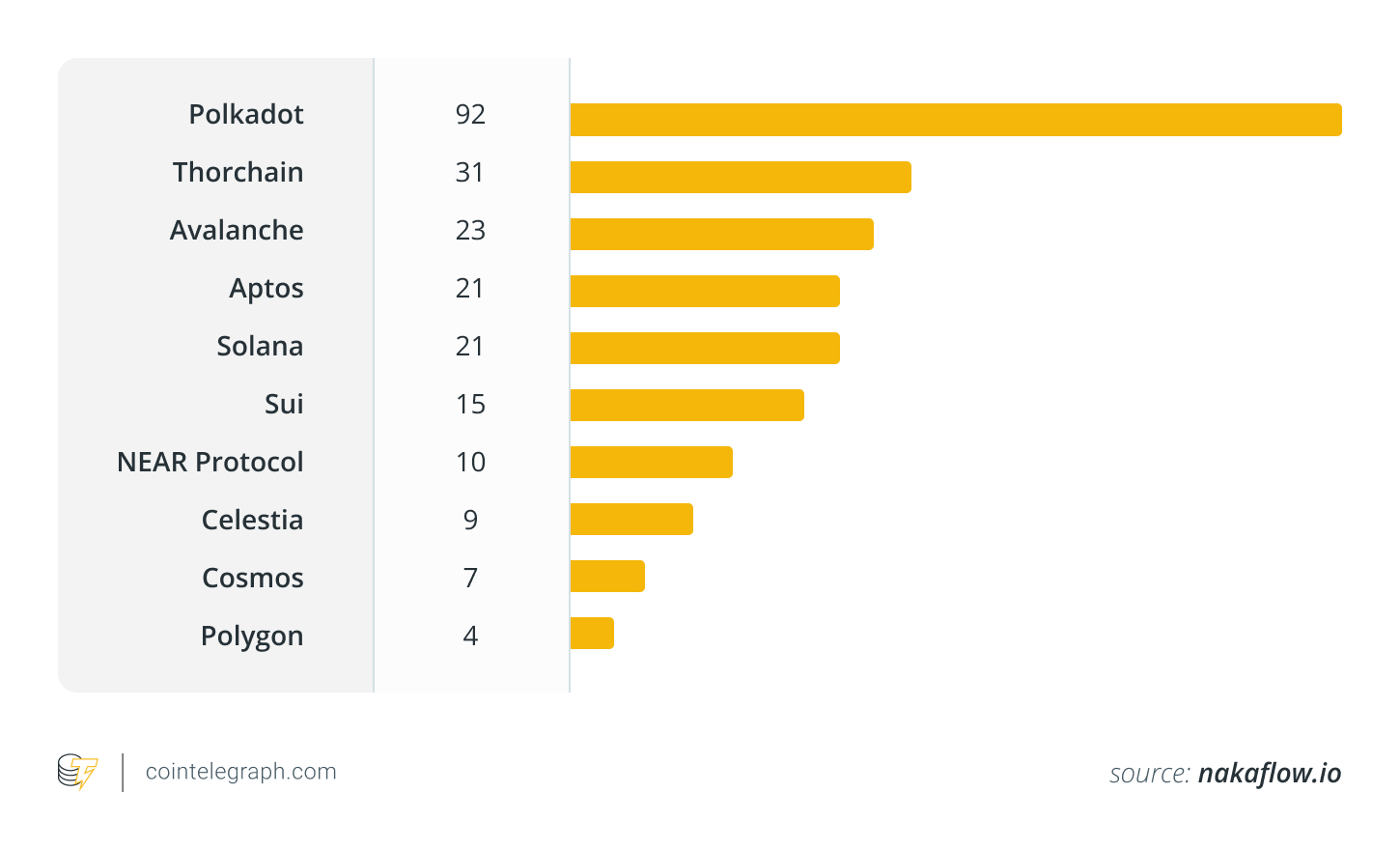
Top 10 blockchains by the average Nakamoto coefficients as of May 29th, 2024

​Did you know? Polkadot‘s high score on the Nakamoto coefficient is largely due to Polkadot’s nominated proof-of-stake (NPoS) consensus mechanism, which promotes an even distribution of stakes among a large number of validators. 

Calculating the Nakamoto coefficient

Calculating this coefficient involves several key steps:​

Identification of key entities: First, determine the primary actors within the network, such as mining pools, validators, node operators or stakeholders. These entities play significant roles in maintaining the network’s operations and security.Assessment of each entity’s control: Next, evaluate the extent of control each identified entity has over the network’s resources. For instance, in proof-of-work (PoW) blockchains like Bitcoin, this involves analyzing the hashrate distribution among mining pools. In proof-of-stake (PoS) systems it requires examining the stake distribution among validators.Summation to determine the 51% threshold: After assessing individual controls, rank the entities from highest to lowest based on their influence. Then, cumulatively add their control percentages until the combined total exceeds 51%. The number of entities required to reach this threshold represents the Nakamoto coefficient.

How to calculate the Nakamoto coefficient

Consider a PoW blockchain with the following mining pool distribution:

Mining pool A: 25% (of the total hashrate)​Mining pool B: 20%​Mining pool C: 15%​Mining pool D: 10%​Others: 30%​

To determine the Nakamoto coefficient:​

Start with mining pool A (25%).​Add mining pool B (25% 20% = 45%).​Add mining pool C (45% 15% = 60%).​

In this scenario, the combined hashrate of mining pools A, B and C reaches 60%, surpassing the 51% threshold. Therefore, the Nakamoto coefficient is 3, indicating that collusion among these three entities could compromise the network’s integrity. 

Did you know? ​Despite Bitcoin’s reputation for decentralization, its mining subsystem is notably centralized. The Nakamoto coefficient is currently 2 for Bitcoin. This means that just two mining pools control most of Bitcoin’s mining power.

Limitations of the Nakamoto coefficient

While the Nakamoto coefficient serves as a valuable metric for assessing blockchain decentralization, it possesses certain limitations that warrant careful consideration.​ 

For example: 

Static snapshot

The Nakamoto coefficient provides a static snapshot of decentralization, reflecting the minimum number of entities required to compromise a network at a specific point in time. 

However, blockchain networks are dynamic, with participant roles and influence evolving due to factors like staking, mining power shifts or node participation changes. Consequently, the coefficient may not accurately capture these temporal fluctuations, potentially leading to outdated or misleading assessments. ​

Subsystem focus

This metric typically focuses on specific subsystems, such as validators or mining pools, potentially overlooking other critical aspects of decentralization. Factors like client software diversity, geographical distribution of nodes and token ownership concentration also significantly impact a network’s decentralization and security. 

Relying solely on the Nakamoto coefficient might result in an incomplete evaluation.

Consensus mechanism variations

Different blockchain networks employ various consensus mechanisms, each influencing decentralization differently. The Nakamoto coefficient may not uniformly apply across these diverse systems, necessitating tailored approaches for accurate measurement. ​

External Influences

External factors, including regulatory actions, technological advancements or market dynamics, can influence decentralization over time. For example, regulatory policies in specific regions might affect the operation of nodes or mining facilities, thereby altering the network’s decentralization landscape. 

The Nakamoto coefficient may not account for such externalities, limiting its comprehensiveness.

To sum up, the Nakamoto coefficient is useful for assessing certain aspects of blockchain decentralization. It should be used alongside other metrics and qualitative assessments to gain a comprehensive understanding of a network’s decentralization and security. 

Read more at cointelegraph.com

Bitcoin sales at $109K all-time high 'significantly below' cycle tops — Research

Bitcoin (BTC) investors who bought BTC in 2020 or later are still waiting for higher prices, new research says.

In findings published on X on April 1, onchain analytics firm Glassnode revealed that $110,000 was not high enough to make many hodlers sell.

Glassnode: 2020 Bitcoin buyers “still holding”

Bitcoiners who entered the market between three and five years ago have retained their holdings despite significant BTC price upside.

According to Glassnode, this investor cohort, with a cost basis between the 2020 lows of $3,600 and the 2021 highs of $69,000, is still hodling.

“Although the share of wealth held by investors who bought $BTC 3–5 years ago has declined by 3 percentage points since its November 2024 peak, it remains at historically elevated levels,” it said.

“This suggests that the majority of investors who entered between 2020 and 2022 are still holding.”Bitcoin sales at $109K all-time high 'significantly below' cycle tops — Research

Bitcoin Realized Cap HODL Waves data. Source: Glassnode

An accompanying chart shows data from the Realized Cap HODL Waves metric, which splits the BTC supply into sections based on when each coin last moved onchain.

Using this, Glassnode is able to draw a distinction between the 2020-22 buyers and those who came immediately before them.

“In contrast, over two-thirds of those who had bought $BTC 5–7 years ago exited their positions by the December 2024 peak,” it reveals, reflecting their lower cost basis.

Speculators stay cool at BTC price highs

As Cointelegraph reported, more recent buyers, who form the more speculative investor cohort known as short-term holders (STHs), have proven much more sensitive to recent BTC price volatility.

Related: Bitcoin sellers ‘dry up’ as weekly exchange inflows near 2-year low

Episodes of panic selling have occurred throughout the past six months as BTC/USD hit new record highs and then fell by up to 30%.

Continuing, Glassnode said that current STH participation does not suggest a speculative frenzy — something common to previous BTC price cycle tops.

“Short-Term Holders currently hold around 40% of Bitcoin’s network wealth, after peaking near 50% earlier in 2025,” it said, alongside Realized Cap HODL Waves data on March 31. 

“This remains significantly below prior cycle tops, where new investor wealth peaked at 70–90%, suggesting a more tempered and distributed bull market so far.”Bitcoin sales at $109K all-time high 'significantly below' cycle tops — Research

Bitcoin Realized Cap HODL Waves. Source: Glassnode

This article does not contain investment advice or recommendations. Every investment and trading move involves risk, and readers should conduct their own research when making a decision.

Read more at cointelegraph.com

Bitcoin sales at $109K all-time high 'significantly below' cycle tops — Glassnode

Bitcoin (BTC) investors who bought BTC in 2020 or later are still waiting for higher prices, new research says.

In findings published on X on April 1, onchain analytics firm Glassnode revealed that $110,000 was not high enough to make many hodlers sell.

Glassnode: 2020 Bitcoin buyers “still holding”

Bitcoiners who entered the market between three and five years ago have retained their holdings despite significant BTC price upside.

According to Glassnode, this investor cohort, with a cost basis between the 2020 lows of $3,600 and the 2021 highs of $69,000, is still hodling.

“Although the share of wealth held by investors who bought $BTC 3–5 years ago has declined by 3 percentage points since its November 2024 peak, it remains at historically elevated levels,” it said.

“This suggests that the majority of investors who entered between 2020 and 2022 are still holding.”Bitcoin sales at $109K all-time high 'significantly below' cycle tops — Glassnode

Bitcoin Realized Cap HODL Waves data. Source: Glassnode

An accompanying chart shows data from the Realized Cap HODL Waves metric, which splits the BTC supply into sections based on when each coin last moved onchain.

Using this, Glassnode is able to draw a distinction between the 2020-22 buyers and those who came immediately before them.

“In contrast, over two-thirds of those who had bought $BTC 5–7 years ago exited their positions by the December 2024 peak,” it reveals, reflecting their lower cost basis.

Speculators stay cool at BTC price highs

As Cointelegraph reported, more recent buyers, who form the more speculative investor cohort known as short-term holders (STHs), have proven much more sensitive to recent BTC price volatility.

Related: Bitcoin sellers ‘dry up’ as weekly exchange inflows near 2-year low

Episodes of panic selling have occurred throughout the past six months as BTC/USD hit new record highs and then fell by up to 30%.

Continuing, Glassnode said that current STH participation does not suggest a speculative frenzy — something common to previous BTC price cycle tops.

“Short-Term Holders currently hold around 40% of Bitcoin’s network wealth, after peaking near 50% earlier in 2025,” it said, alongside Realized Cap HODL Waves data on March 31. 

“This remains significantly below prior cycle tops, where new investor wealth peaked at 70–90%, suggesting a more tempered and distributed bull market so far.”Bitcoin sales at $109K all-time high 'significantly below' cycle tops — Glassnode

Bitcoin Realized Cap HODL Waves. Source: Glassnode

This article does not contain investment advice or recommendations. Every investment and trading move involves risk, and readers should conduct their own research when making a decision.

Read more at cointelegraph.com

Sony Electronics Singapore accepts USDC payments through Crypto.com

The online store of a Singapore-based subsidiary of Japanese tech behemoth Sony is now accepting USDC payments through Crypto.com.

According to an April 2 announcement, Sony Electronics Singapore now accepts USDC (USDC) stablecoin payments through an integration with the Crypto.com exchange. Crypto.com Singapore general manager Chin Tah Ang said:

“We’re pushing to make paying in crypto more mainstream and partnering with a well-established and forward-thinking brand like Sony Electronics Singapore further raises awareness of how simple it can be to pay for everyday goods and services using crypto.”

The Sony subsidiary is not the only high-profile partnership Crypto.com is involved in. At the end of 2024, the mobile-first crypto exchange partnered with Deutsche Bank to provide corporate banking services across Asian-Pacific markets, covering regions such as Singapore, Australia and Hong Kong.

Related: CFTC mulling probe of Crypto.com over Super Bowl contracts: Report

Singapore bets on stablecoins

Still, the Singaporean Sony subsidiary allowing stablecoin payments may be the start of a new trend in the region. Late February reports indicated that Metro, a publicly listed department store chain in Singapore, had enabled its customers to pay for products using stablecoins like Tether’s USDt.

The initiatives also follow January reports that Singapore is becoming a key destination for Web3 companies after it issued twice as many crypto licenses in 2024 as the previous year. William Croisettier, chief growth officer of ZKcandy, told Cointelegraph at the time:

“The country adopts a risk-adjusted approach to crypto regulation, focusing on the biggest digital currencies to protect investors. Singapore also makes it easy for new crypto firms to interact with local banking partners, a provision considered a luxury in other parts of the world.”

Related: Singapore Exchange to list Bitcoin futures in H2 2025: Report

An emerging crypto hub

In late November, the crypto-friendly digital bank Singapore Gulf Bank reportedly sought a fund injection of at least $50 million as it planned to acquire a stablecoin payments company in 2025. The firm was motivated to pursue the effort, with plans to sell up to 10% of its equity to fund it.

A study published at the end of 2024 revealed that its approach to regulation has made Singapore a global champion of blockchain technology. The country scored highest among all considered jurisdictions based on multiple factors.

Circle, Sony, Stablecoin, Crypto.com

The top blockchain jurisdictions ranked based on patents, jobs, and exchanges. Source: ApeX Protocol

Magazine: Singapore ‘not ready’ for Bitcoin ETFs, sneaky crypto mining rig importer: Asia Express

Read more at cointelegraph.com

GameStop finishes $1.5B raise to add Bitcoin to its balance sheet

Video game retailer GameStop Corporation (GME) has finished a convertible debt offering that raised $1.5 billion, with some proceeds earmarked for buying Bitcoin.

The offering was initially set to raise at least $1.3 billion, but purchasers opted for an additional $200 million aggregate principal amount of notes, GameStop said in an April 1 filing with the Securities and Exchange Commission.

“The company expects to use the net proceeds from the offering for general corporate purposes, including the acquisition of Bitcoin in a manner consistent with the Company’s Investment Policy,” GameStop added.

The convertible notes are debt that can later be converted into equity and are scheduled to mature on April 1, 2030, unless earlier converted, redeemed or repurchased.

The conversion rate for the notes will initially be 33 shares of Common Stock per $1,000 principal amount of notes, according to the filing. 

GameStop shares didn’t see a significant move following the close of the convertible debt offering. GME closed the April 1 trading day up 1.34% at $22.61 and only saw an extra 0.5% bump after the bell, Google Finance data shows.

Cryptocurrencies, United States, Stocks, Companies

GameStop’s share price barely moved after sharing it closed the convertible debt offering. Source: Google Finance

Positive shareholder sentiment saw the stock jump nearly 12% to $28.36 on March 26, the day after GameStop announced its Bitcoin (BTC) plan, but its fortunes reversed the next day, with GME shares dropping nearly 24% to $21.68.

Analysts at the time suggested the chilly reception reflected shareholders’ fear of GameStop’s deeper problems with its business model. 

GameStop joins growing Bitcoin move 

On March 25, GameStop confirmed that it had received board approval to invest in Bitcoin and US-dollar-pegged stablecoins using the notes and its cash reserves. Those reserves stood at $4.77 billion as of Feb. 1, compared with $921.7 million a year earlier, according to its 2024 fourth-quarter financial statements. 

GameStop is a relative latecomer among public companies creating Bitcoin treasuries. A slew of others have already added Bitcoin to their balance sheets in a playbook popularized by Micheal Saylor’s Strategy.

Related: Metaplanet adds $67M in Bitcoin following 10-to-1 stock split

The video game retailer previously made forays into the crypto space with a crypto wallet for its users, which it eventually shut down in November 2023 due to regulatory uncertainty.

GameStop is also considered the first example of meme stock success after a short squeeze in 2021 that sent the stock surging over 1,000% in a month as traders flipped the table on hedge funds that had been making money shorting on the company.

Magazine: SEC’s U-turn on crypto leaves key questions unanswered

Read more at cointelegraph.com

SEC and Gemini ask to pause lawsuit to explore ‘potential resolution’

The US Securities and Exchange Commission and crypto exchange Gemini have asked to pause the regulator’s suit over the exchange’s Gemini Earn program, saying they want to discuss a potential resolution. 

In an April 1 letter to New York federal court judge Edgardo Ramos, lawyers representing the SEC and Genesis requested a 60-day hold on the case and that all deadlines be pulled “to allow the parties to explore a potential resolution.” 

“In this case, the parties submit that it is in each of their interests to stay this matter while they consider a potential resolution and agree that no party or non-party would be prejudiced by a stay,” the letter states.

The lawyers added that a stay was in the court’s interest as “a resolution would conserve judicial resources” and proposed that a joint status report be submitted within 60 days after the entry of the stay.

The SEC sued Gemini and crypto lending firm Genesis Global Capital in January 2023, alleging they offered unregistered securities through the Gemini Earn program.

In March 2024, Genesis agreed to pay $21 million to settle charges related to the lending program, but the enforcement case against Gemini remains outstanding.

SEC and Gemini ask to pause lawsuit to explore ‘potential resolution’

Letter from SEC and Genesis Global requesting extension of stay. Source: CourtListener

The letter did not specify what a possible resolution would entail, but the SEC has dropped several lawsuits it launched against crypto companies under the Biden administration, including against Coinbase, Ripple and Kraken.

Related: Will new US SEC rules bring crypto companies onshore?

In February, Gemini said the SEC closed a separate investigation into the firm as the regulator winds back its crypto enforcement under President Donald Trump. 

“The SEC cost us tens of millions of dollars in legal bills alone and hundreds of millions in lost productivity, creativity, and innovation. Of course, Gemini is not alone,” Gemini co-founder Cameron Winklevoss said at the time.

OpenSea, Crypto.com and Uniswap, among others, have also recently reported that the SEC had closed similar probes into their companies that were investigating alleged breaches of securities laws.

Magazine: Bitcoin ATH sooner than expected? XRP may drop 40%, and more: Hodler’s Digest, March 23 – 29

Read more at cointelegraph.com

Crypto PAC-backed Republicans win US House seats in Florida special elections

Two Republicans who received a combined $1.5 million from the crypto-backed political action committee (PAC) Fairshake will enter the US House after winning special elections in Florida.

Republican Jimmy Patronis won the vacant seat in Florida’s 1st Congressional District to replace Matt Gaetz, taking 57% of the vote to defeat Democrat Gay Valimont, according to AP News data.

Randy Fine also took Florida’s 6th Congressional District with 56.7% of the vote to beat his Democratic rival, public school teacher Josh Weil, and fill a seat left vacant by Mike Waltz, who took a job as White House national security adviser.

Florida’s 1st and 6th Congressional Districts — located in Florida’s western panhandle and along the state’s northeast coast — have been controlled by Republicans for roughly 30 years, but their lead has narrowed in recent years.

Fairshake, a PAC backed by crypto industry giants including Coinbase, Ripple and Andreessen Horowitz, gave Fine around $1.16 million in advertising spending and funneled $347,000 to Patronis to support his campaign.

Both Republicans have expressed support for the crypto industry, with Fine stating in a Jan. 14 X post that “Floridians want crypto innovation!”

Crypto PAC-backed Republicans win US House seats in Florida special elections

Source: Randy Fine

Fairshake and its affiliates poured around $170 million into the 2024 US presidential and congressional elections to back candidates who committed to supporting the crypto industry.

The wins by Patronis and Fine increased Republican representation in the House to 220 seats, with the Democrats holding 213 seats.

There are two vacant seats to be filled after Texas and Arizona Democrats Sylvester Turner and Raúl Grijalva died on March 5 and March 13, respectively.

Florida can expect to see a crypto-friendly regulatory environment 

The victories for Patronis and Fine likely mean that crypto legislation will continue to see support in the US capital.

The Republican Party would have maintained its House majority even if it lost both seats in Florida, but it would have made it more difficult for some of the recently introduced Republican-backed crypto bills to pass through the House and Senate.

Related: Florida bill proposes strict rules against online gambling

At the Digital Assets Summit on March 18, Democratic Congressman Ro Khanna said he believes Congress “should be able to get” both a stablecoin and crypto market structure bill done this year.

Bills that could eventually make their way to the House include the Guiding and Establishing National Innovation for US Stablecoins (GENIUS) Act, which passed the Senate Banking Committee in an 18-6 vote on March 13.

Senator Cynthia Lummis also reintroduced a Bitcoin reserve bill about a week after the Trump administration announced the establishment of a Strategic Bitcoin Reserve on March 6, with the legislation referred to the Senate Banking Committee on March 11.

Magazine: Trump’s crypto ventures raise conflict of interest, insider trading questions

Read more at cointelegraph.com

UK trade bodies ask government to make crypto a ‘strategic priority’

Several British trade associations have asked Prime Minister Keir Starmer’s office to appoint a special envoy dedicated to crypto and for a dedicated action plan for digital assets and blockchain technology.

In a March 31 letter, the coalition of six UK digital economy trade bodies urged Starmer’s special adviser on business and investment, Varun Chandra, for a “greater strategic focus and alignment to deliver investment, growth and jobs” for the crypto industry. 

The group, which consisted of the UK Cryptoasset Business Council, Global Digital Finance, The Payments Association, Digital Currencies Governance Group, the Crypto Council for Innovation and techUK, noted the US policy shift on crypto under President Donald Trump and his appointment of a crypto czar.

Britain’s commitment to an economic trade deal focused on technological cooperation with the US “presents a significant opportunity to mirror the United States’ ambition in fostering leadership in blockchain, digital assets, and other emerging financial technologies,” the letter stated. 

The group recommended that the UK appoint a blockchain special envoy, similar to the US, to coordinate policy, foster innovation, and position the country competitively in global markets.

The trade bodies also called for the development of a dedicated government action plan for crypto and blockchain technology, including a concierge service to attract high-potential firms.

They added that the government should acknowledge and leverage the commonalities between blockchain, quantum computing and artificial intelligence technologies, including potential applications for government services.

Another recommendation was to create a high-level industry-government-regulator engagement forum to ensure informed decision-making and cross-sector collaboration.

UK trade bodies ask government to make crypto a ‘strategic priority’

The UK crypto and tech associations lobbying the government for a policy shift. Source: LinkedIn

“With deep pools of talent, access to capital, world-class academic institutions, and sophisticated regulators, the UK provides an environment where digital assets and blockchain innovation can thrive,” they stated. 

Related: UK should tax crypto buyers to boost stock investing, economy, says banker

Crypto a $74 billion opportunity, industry group says

The coalition argues that crypto and blockchain technology could boost the UK economy by 57 billion British pounds ($73.6 billion) over the next decade, with the sector potentially increasing global gross domestic product by 1.39 trillion pounds ($1.8 trillion) by 2030.

Tom Griffiths, the co-founder and managing partner of crypto compliance advisory firm BitCompli, said in response to the letter on LinkedIn that the Financial Conduct Authority “has a lot of talent and a good sight of future plans, but the UK is definitely losing pace with Dubai, Singapore, and other EU jurisdictions.”

“Now is the time for the FCA to act, or the UK will lose out on this huge opportunity, which is digital assets and all the benefits this sector can bring, not only now but over the next 20 years,” he added.

Magazine: Bitcoin ATH sooner than expected? XRP may drop 40%, and more: Hodler’s Digest, March 23 – 29

Read more at cointelegraph.com

Kentucky joins Vermont and South Carolina in dropping Coinbase staking suit

Kentucky’s finance watchdog has dismissed its lawsuit against Coinbase over the exchange’s staking rewards program, following its peers in Vermont and South Carolina.

Kentucky’s Department of Financial Institutions filed the stipulation to dismiss jointly with Coinbase on April 1, ending the state’s legal action against the exchange first filed along with 10 other state regulators in June 2023.

Coinbase chief legal officer Paul Grewal posted to X on April 1, calling for Congress “to end this litigation-driven, state-by-state approach with a federal market structure law.”

Kentucky joins Vermont and South Carolina in dropping Coinbase staking suit

Source: Paul Grewal

Financial regulators from 10 states launched similar suits against Coinbase in June 2023, on the same day the Securities and Exchange Commission sued the exchange — a lawsuit the SEC dropped last month.

Seven suits against Coinbase still active

Alabama, California, Illinois, Maryland, New Jersey, Washington and Wisconsin are the seven states that are still continuing with their lawsuits, which all allege Coinbase breached securities laws with its staking rewards program.

Vermont was the first state to end its suit against Coinbase, with its Department of Financial Regulation filing an order to rescind the action on March 13, noting the SEC’s Feb. 27 decision to drop its action against the exchange and the likelihood of changes in the federal regulator’s guidance.

The South Carolina Attorney General’s securities division followed Vermont days later, dismissing its lawsuit in a joint stipulation with Coinbase on March 27.

Related: South Carolina dismisses its staking lawsuit against Coinbase, joining Vermont

Kentucky’s decision to drop its case against Coinbase follows just days after the state’s governor, Andy Beshear, signed a “Bitcoin Rights” bill into law on March 24 that establishes protections for crypto self-custody and exempts crypto mining from money transmitting and securities laws.

The axed state-level lawsuits come amid a stark policy change at the SEC, which has dropped or delayed multiple lawsuits against crypto companies that it filed under the Biden administration.

The federal securities watchdog has also created a Crypto Task Force that is engaging with the industry on how it should approach cryptocurrencies.

Magazine: SEC’s U-turn on crypto leaves key questions unanswered

Read more at cointelegraph.com

Bitcoin traders are overstating the impact of the US-led tariff war on BTC price

Despite Bitcoin’s 2.2% gains on April 1, BTC (BTC) hasn’t traded above $89,000 since March 7. Even though the recent price weakness is often linked to the escalating US-led global trade war, several factors had already been weighing on investor sentiment long before President Donald Trump announced the tariffs.

Some market participants claimed that Strategy’s $5.25 billion worth of Bitcoin purchases since February is the primary reason BTC has held above the $80,000 support. But, regardless of who has been buying, the reality is that Bitcoin was already showing limited upside before President Trump announced the 10% Chinese import tariffs on Jan. 21.

Bitcoin traders are overstating the impact of the US-led tariff war on BTC price

Gold/USD (left) vs. Bitcoin/USD (right). Source: TradingView / Cointelegraph

The S&P 500 index hit an all-time high on Feb. 19, exactly 30 days after the trade war began, while Bitcoin had repeatedly failed to hold above $100,000 for the previous three months. Although the trade war certainly affected investor risk appetite, strong evidence suggests Bitcoin’s price weakness started well before President Trump took office on Jan. 20.

Spot Bitcoin ETFs inflows, strategic Bitcoin reserve expectations and inflationary trends

Another data point that weakens the relation with tariffs is the spot Bitcoin exchange-traded funds (ETFs), which saw $2.75 billion in net inflows during the three weeks following Jan. 21. By Feb. 18, the US had announced plans to impose tariffs on imports from Canada and Mexico, while the European Union and China had already retaliated. In essence, institutional demand for Bitcoin persisted even as the trade war escalated.

Part of Bitcoin traders’ disappointment after Jan. 21 stems from excessive expectations surrounding President Trump’s campaign promise of a “strategic national Bitcoin stockpile,” mentioned at the Bitcoin Conference in July 2024. As investors grew impatient, their frustration peaked when the actual executive order was issued on March 6.

A key factor behind Bitcoin’s struggle to break above $89,000 is an inflationary trend, reflecting a relatively successful strategy by global central banks. In February, the US Personal Consumption Expenditures (PCE) Price Index rose 2.5% year-over-year, while the eurozone Consumer Price Index (CPI) increased by 2.2% in March.

Investors turn more risk-averse following weak job market data

In the second half of 2022, Bitcoin’s gains were driven by inflation soaring above 5%, suggesting that businesses and families turned to cryptocurrency as a hedge against monetary debasement. However, if inflation remains relatively under control in 2025, lower interest rates would favor real estate and stock markets more directly than Bitcoin, as reduced financing costs boost those sectors.

Bitcoin traders are overstating the impact of the US-led tariff war on BTC price

US CPI inflation (left) vs. US 2-year Treasury yield (right). Source: TradingView

Related: Coinbase sees worst quarter since FTX collapse amid industry bloodbath

The weakening job market also dampens traders’ demand for risk-on assets, including Bitcoin. In February, the US Labor Department reported job openings near a four-year low. Similarly, yields on the US 2-year Treasury fell to a six-month low, with investors accepting a modest 3.88% return for the safety of government-backed instruments. This data suggests a rising choice for risk aversion, which is unfavorable for Bitcoin.

Ultimately, Bitcoin’s price weakness stems from investors’ unrealistic expectations of BTC acquisitions by the US Treasury, declining inflation supporting potential interest rate cuts, and a more risk-averse macroeconomic environment as investors turn to short-term government bonds. While the trade war has had negative effects, Bitcoin was already showing signs of weakness before it began.

This article is for general information purposes and is not intended to be and should not be taken as legal or investment advice. The views, thoughts, and opinions expressed here are the author’s alone and do not necessarily reflect or represent the views and opinions of Cointelegraph.

Read more at cointelegraph.com