cointelegraph.com

Stablecoins are the best way to ensure US dollar dominance — Web3 CEO

Stablecoins are the single best tool for the United States government to maintain the US dollar’s hegemony in global financial markets, according to LayerZero Labs CEO and founder Bryan Pellegrino.

In an interview with Cointelegraph, the CEO of LayerZero Labs, which created the LayerZero interoperability protocol recently chosen by Wyoming to be the distribution partner for the Wyoming stablecoin, said that the cross-border accessibility of dollar-pegged tokens makes them an obvious choice to drive US dollar demand. Pellegrino added:

“Stablecoins for the US dollar are the single best tool — the last Trojan Horse or vampire attack on every single other currency in the world — whether it is Argentina, whether it is Venezuela, whether it is all of the countries that have massive inflation.”

The CEO said he expects support for stablecoins on both the federal and state levels to grow because of the obvious boost stablecoins give to the US dollar in foreign exchange markets and the financial moat stablecoin-driven demand will create around the US dollar’s global reserve currency status.

Dollar, US Government, Stablecoin

Stablecoin market overview. Source: RWA.XYZ

Related: Certain stablecoins aren’t securities, SEC says in new guidance

US government looks to stablecoins to protect US dollar

Pellegrino cited Tether’s emerging role as one of the largest buyers of US Treasury bills in the world as evidence of the demand for US debt instruments from stablecoin issuers.

Tether recently became the seventh-largest holder of US Treasuries, beating Canada, Germany, Norway, Hong Kong, and Saudi Arabia.

Speaking at the White House Crypto Summit on March 7, US Treasury Secretary Scott Bessent said the Trump administration would leverage stablecoins to extend US dollar hegemony and indicated this would be a top priority for officials in 2025.

According to a 2023 report by Chainalysis, over 50% of all the digital asset value transferred to countries in the Latin American region, including Argentina, Brazil, Columbia, Mexico, and Venezuela was denominated in stablecoins.

The low transaction fees, relative stability, and near-instant settlement times for dollar-pegged stablecoins make these real-world tokenized assets ideal for remittances and stores of value for residents in developing countries suffering from high inflation and capital controls.

Magazine: Bitcoin payments are being undermined by centralized stablecoins

Read more at cointelegraph.com

CFPB likely to step back from crypto regulation — Attorney

The Consumer Financial Protection Bureau (CFPB) will likely see a reduced role in crypto regulations as other federal agencies like the Securities and Exchange Commission (SEC) and state-level regulators assume a bigger role in crypto policy, according to Ethan Ostroff, partner at the Troutman Pepper Locke law firm.

“I think with the current administration, my sense is, we are highly likely to see a significant pullback by the CFPB in the context of the activity by other regulators,” Ostroff told Cointelegraph in an interview.

State regulators also have the authority under the Consumer Financial Protection Act (CFPA) to assume some of the regulatory roles of the CFPB, the attorney said, but he also added that some regulatory functions will continue to fall within the purview of the CFPB as a matter of established law.

Ostroff cited the New York Department of Financial Services (NYDFS) and the California Department of Financial Protection and Innovation (DFPI) as regulators to keep an eye on as potential leaders of crypto regulations at the state level.

However, the attorney clarified that while the CFPB may see a diminished role during the Trump administration, the agency would not be outright dismantled during the current regime due to “statutorily mandated obligations and requirements” that require acts of Congress to change.

Related: Elon Musk’s ‘government efficiency’ team turns its sights to SEC — Report

Trump administration targets CFPB in efficiency push

The Trump administration targeted the CFPB as part of a broader push by the Department of Government Efficiency (DOGE) to slash government spending and reduce the federal debt.

Russell Vought, the recently appointed head of the CFPB, announced major funding cuts to the agency and scaled back operations within days of assuming the helm at the CFPB in February 2025.

Bitcoin Regulation, US Government, United States, Donald Trump

Source: Russell Vought

Massachusetts Senator Elizabeth Warren criticized Elon Musk for dismantling the CFPB, which the US senator co-founded back in 2007.

Warren characterized Musk as a “bank robber” and claimed that the Trump administration dismantled the CFPB to undo consumer protection rules and have greater control over the financial system.

In a Feb. 12 interview with Mother Jones, the senator stressed that the Executive Branch of government does not have the statutory authority to fully dismantle the CFPB, which can only be done through Congressional approval.

Magazine: SEC’s U-turn on crypto leaves key questions unanswered

Read more at cointelegraph.com

As gaming giants crumble, onchain gaming promises remain unfulfilled

Opinion by: Daryl Xu, co-founder and CEO, NPC Labs

While gaming has been on a steady decline since the end of COVID-19 lockdowns, 2024 hit the industry especially hard, with layoffs and studio closures hitting even the most prominent studios. 

While unsustainable development costs and an innovation crisis seem to be the main culprits behind the collapse, Web3 gaming emerged as a potential solution promising to return power to developers — and it raised billions of dollars in investment to do so. 

Yet, despite a continued rise in crypto adoption, Web3 gaming has failed to capture mainstream players’ attention or solve any of gaming’s fundamental problems. Why? Early blockchains were designed for financial applications. Game developers were forced to either build on blockchains that weren’t designed for their use or create their own chains that isolated themselves from the blockchain ecosystem. Either choice led to poor player experience and an overemphasis on tokenomics. 

Many developers choose the latter, picking control over connectivity. Inadvertently, this resulted in walled gardens that were not dissimilar to the ones that contributed to traditional gaming’s collapse.

A solution that created more problems

A recent article in The New York Times revealed that over the last 30 or 40 years, video game industry executives have bet on better graphics to bring in players and profits rather than leaning on creativity. Traditional gaming development is costly, regularly exceeding $100 million per title. Indie developers often struggle to compete against large publishers who ultimately control funding and distribution.

Blockchain seemed to be a promising solution for indie studios, providing them with new avenues to raise funds and giving them control over distribution. Early Web3 gaming platforms, however, ended up recreating the same enclosed systems that blockchain was trying to fix. With high player acquisition costs and limited Web3 gamers, Web3 gaming platforms deepened their moats to prevent users from moving away. As it continued developing, Web3 gaming introduced its own problems. 

An impossible choice for game developers

The technological infrastructures of layer-1 blockchains like Ethereum and Solana were created for finance and not aligned with gaming’s requirements. Beyond transaction speed, layer-2 solutions were not designed to handle gaming’s unique needs either.

Game developers — attracted to Web3’s funding model, promises of ownership and user engagement, are forced to either build on existing blockchains and compromise gameplay or launch their own chain — which diverts attention and resources away from what they want to do: make better games. 

Recent: Web3 gaming investors no longer throwing money at ‘Axie killers’

While crypto native players may feel this is a worthwhile tradeoff, mainstream gamers want engaging experiences. A January DappRadar report showed that Web3 gaming had reached 7.3 million unique active wallets, but  in speaking with the community anecdotally, approximately 10,000 of those represent the actual gaming cohort who aren’t in games just to farm rewards. This number may be higher but is not more than 50,000 to 100,000 at the most.

A misalignment with gaming culture

The thing that converts mainstream users onchain isn’t non-fungible tokens (NFTs) or decentralized finance, its meaningful ownership of in-asset games. Mainstream gamers have spent decades on arcade games, Nintendo or mobile games. If combined with true ownership of in-game assets, that familiarity is powerful enough to create a compelling experience for developers and gamers.

While Web3 games claim to be revolutionizing gaming, most projects aren’t listening to actual gamers. In actuality, they end up competing for the same crypto-native users. Rather than focusing on fun and engaging gameplay, most Web3 games are led by crypto technology and tokenomics. Within this bubble, success in Web3 gaming meant taking crypto users from each other rather than bringing new players onchain. 

With rare exceptions, the industry lost sight of what’s important: making fun games that people want to play.

This misalignment also extends to game developers who want to enter Web3 to create better player experiences and sustainable revenue models. Game studios understand the potentials of Web3 but are hesitant to navigate crypto’s complex systems, which require technical skills to build protocols with sufficient liquidity and user bases while delivering seamless gameplay simultaneously.

Make games fun again

As major studios continue to struggle, Web3 has a second chance to deliver on its promise. But this time, we must rethink how games interact. We must focus on creating access for creators and players instead of building new walled gardens. This requires Web3 gaming-specific infrastructure that provides both developer control and cross-ecosystem collaboration. 

The path forward is clear. We need to restore economic freedom to creators and put control back in players’ hands. That means revenue models that reward collaboration instead of isolation. Most importantly, it means returning to gaming’s roots — making games fun again. 

The future of gaming isn’t about better graphics or token incentives. It’s about creating an industry where creativity and collaboration can thrive. When developers can focus on making engaging experiences instead of building moats, everyone wins.

Opinion by: Daryl Xu, co-founder and CEO, NPC Labs.

This article is for general information purposes and is not intended to be and should not be taken as legal or investment advice. The views, thoughts, and opinions expressed here are the author’s alone and do not necessarily reflect or represent the views and opinions of Cointelegraph.
Read more at cointelegraph.com

Trump’s Liberation Day: ‘Climax of uncertainty’ before crypto market recovery

Cryptocurrency markets could be on track for recovery as investor sentiment begins to stabilize following US President Donald Trump’s sweeping tariff announcement — what some analysts are calling the peak of recent market uncertainty.

Trump announced his reciprocal import tariffs on April 2, which sent tremors across global markets. The S&P 500 lost more than $5 trillion, its largest drop on record, surpassing the pandemic-induced crash in March 2020, according to Reuters.

Still, some analysts see a silver lining to the tariff announcement.

“In my opinion, the tariffs are the representation of the uncertainty in the markets,” Michaël van de Poppe, founder of MN Consultancy, told Cointelegraph. “Liberation Day is basically the peak of that period, the climax of uncertainty. Now it’s out in the open. Everybody knows the new playing field.”

Van de Poppe added that he believes Trump is using tariffs as a strategic move to stimulate domestic growth and reduce yields. “Tariffs are literally the only way to do that,” he said. “I wouldn’t be surprised if they’re reversed within the next six to 12 months.”

Trump’s Liberation Day: ‘Climax of uncertainty’ before crypto market recovery

Average tariff rate on US goods and imports. Source: JPMorgan, Ayesha Tariq

President Trump’s plan imposes a 10% baseline tariff on all US imports from April 5 and a higher “reciprocal tariff” of up to 54% on select countries with larger trade deficits from April 9.

Related: Michael Saylor’s Strategy buys Bitcoin dip with $1.9B purchase

Import tariffs could trigger Fed easing

Still, the end of the uncertainty could bring renewed investment into crypto markets, leading to a recovery, Van de Poppe said:

“We’ll start to see the rotation toward the crypto markets in the coming period where there’s more calm and peace in the markets where investors start to buy the dip and understand that some things have been undervalued.”

He noted that the economic impact of the tariffs may ultimately lead the US Federal Reserve to lower interest rates and begin a new round of quantitative easing (QE), a monetary policy that involves the Fed buying bonds to inject liquidity into the economy.

Arthur Hayes, co-founder of BitMEX and chief investment officer at Maelstrom, has predicted Bitcoin could climb to $250,000 if the Fed formally enters a QE cycle.

Related: Satoshi Nakamoto turns 50 as Bitcoin becomes US reserve asset

Trump tariff uncertainty still weighing on sentiment

On the downside, the tariff-related uncertainty may continue pressuring risk asset appetite for weeks, according to Noelle Acheson, author of the Crypto is Macro Now newsletter.

“We can count on President Trump changing his mind a few times within the first couple of weeks,” Acheson told Cointelegraph. She added:

“With heightened uncertainty a given in these markets, we can expect more risk-off behavior, even though some short-term bounces may bring some relief.”

“For crypto, BTC continues to act like a risk asset short-term while its analog counterpart gold breaks through one all-time high after another,” a development that may impact crypto investor sentiment in the short term, Acheson said.

Meanwhile, crypto intelligence firm Nansen estimated a 70% probability that the market could bottom by June, depending on how the tariff negotiations evolve.

Magazine: Bitcoin ATH sooner than expected? XRP may drop 40%, and more: Hodler’s Digest, March 23 – 29

Read more at cointelegraph.com

Decentralized exchanges gain ground despite $6M Hyperliquid exploit

Decentralized cryptocurrency exchanges (DEXs) continue to challenge the dominance of centralized platforms, even as a recent $6.2 million exploit on Hyperliquid highlights risks in DEX infrastructure.

A cryptocurrency whale made at least $6.26 million profit on the Jelly my Jelly (JELLY) memecoin by exploiting the liquidation parameters on Hyperliquid, Cointelegraph reported on March 27. 

The exploit was the second major incident on the platform in March, noted CoinGecko co-founder Bobby Ong.

“$JELLYJELLY was the more notable attack where we saw Binance and OKX listing perps, drawing accusations of coordinating an attack against Hyperliquid,” Ong said in an April 3 X post, adding:

“It’s clear that CEXes are feeling threatened by DEXes, and are not going to see their market share erode without putting on a fight.”DEX growth reshapes derivatives market

Hyperliquid is the eighth-largest perpetual futures exchange by volume across both centralized and decentralized exchanges. This puts it “ahead of some notable OGs such as HTX, Kraken and BitMEX,” Ong noted, citing an April 4 research report.

Related: Bitcoin to $110K next, Hyperliquid whale bags $6.2M ‘short’ exploit: Finance Redefined

Hyperliquid’s growing trading volume is starting to cut into the market share of other centralized exchanges.

Decentralized exchanges gain ground despite $6M Hyperliquid exploit

Top derivative exchanges by open interest. Source: CoinGecko 

Hyperliquid is the 12th-largest derivatives exchange, with an over $3 billion 24-hour open interest — though it still trails Binance’s $19.5 billion by a wide margin, CoinGecko data shows.

According to Bitget Research analyst Ryan Lee, the incident may harm user confidence in emerging decentralized platforms, especially if actions taken post-exploit appear overly centralized.

“Hyperliquid’s intervention — criticized as centralized despite its decentralized ethos — may make investors wary of similar platforms,” Lee said.

Whale exploits Hyperliquid’s trading logic

The unknown Hyperliquid whale managed to exploit Hyperliquid’s liquidation parameters by deploying millions of dollars worth of trading positions.

The whale opened two long positions of $2.15 million and $1.9 million and a $4.1 million short position that effectively offset the longs, according to a postmortem by blockchain analytics firm Arkham.

Decentralized exchanges gain ground despite $6M Hyperliquid exploit

Hyperliquid exploiter, transactions. Source: Arkham

When the price of JELLY rose by 400%, the $4 million short position wasn’t immediately liquidated due to its size. Instead, it was absorbed into the Hyperliquidity Provider Vault (HLP), which is designed to liquidate large positions.

Related: Polymarket faces scrutiny over $7M Ukraine mineral deal bet

As of March 27, the unknown whale still held 10% of the memecoin’s total supply, worth nearly $2 million, despite Hyperliquid freezing and delisting the memecoin, citing “evidence of suspicious market activity” involving trading instruments.

The Hyperliquid exploit occurred two weeks after a Wolf of Wall Street-inspired memecoin — launched by the Official Melania Meme (MELANIA) and Libra (LIBRA) token co-creator Hayden Davis — crashed over 99% after launching with an 80% insider supply.

Magazine: Memecoins are ded — But Solana ‘100x better’ despite revenue plunge

Read more at cointelegraph.com

Nearly 400,000 FTX users risk losing $2.5 billion in repayments

Nearly 400,000 creditors of the bankrupt cryptocurrency exchange FTX risk missing out on $2.5 billion in repayments after failing to begin the mandatory Know Your Customer (KYC) verification process.

Roughly 392,000 FTX creditors have failed to complete or at least take the first steps of the mandatory Know Your Customer verification, according to an April 2 court filing in the US Bankruptcy Court for the District of Delaware.

FTX users originally had until March 3 to begin the verification process to collect their claims.

“If a holder of a claim listed on Schedule 1 attached thereto did not commence the KYC submission process with respect to such claim on or prior to March 3, 2025, at 4:00 pm (ET) (the “KYC Commencing Deadline”), 2 such claim shall be disallowed and expunged in its entirety,” the filing states.

Nearly 400,000 FTX users risk losing $2.5 billion in repayments

FTX court filing. Source: Bloomberglaw.com

The KYC deadline has been extended to June 1, 2025, giving users another chance to verify their identity and claim eligibility. Those who fail to meet the new deadline may have their claims permanently disqualified.

According to the court documents, claims under $50,000 could account for roughly $655 million in disallowed repayments, while claims over $50,000 could amount to $1.9 billion — bringing the total at-risk funds to more than $2.5 billion.

Nearly 400,000 FTX users risk losing $2.5 billion in repayments

FTX court filing, estimated claims. Source: Sunil

The next round of FTX creditor repayments is set for May 30, 2025, with over $11 billion expected to be repaid to creditors with claims of over $50,000.

Under FTX’s recovery plan, 98% of creditors are expected to receive at least 118% of their original claim value in cash.

Related: FTX liquidated $1.5B in 3AC assets 2 weeks before hedge fund’s collapse

How FTX users can complete KYC

Many FTX users have reported problems with the KYC process.

However, users who were unable to submit their KYC documentation can resubmit their application and restart the verification process, according to an April 5 X post from Sunil, FTX creditor and Customer Ad-Hoc Committee member.

Nearly 400,000 FTX users risk losing $2.5 billion in repayments

FTX KYC portal. Source: Sunil

Impacted users should email FTX support ([email protected]) to receive a ticket number, then log in to the support portal, create an account, and re-upload the necessary KYC documents.

Related: Crypto trader turns $2K PEPE into $43M, sells for $10M profit

FTX’s Bahamian subsidiary, FTX Digital Markets, processed the first round of repayments in February, distributing $1.2 billion to creditors.

The crypto industry is still recovering from the collapse of FTX and more than 130 subsidiaries launched a series of insolvencies that led to the industry’s longest-ever crypto winter, which saw Bitcoin’s (BTC) price bottom out at around $16,000.

While not a “market-moving catalyst” in itself, the beginning of the FTX repayments is a positive sign for the maturation of the crypto industry, which may see a “significant portion” reinvested into cryptocurrencies, Alvin Kan, chief operating officer at Bitget Wallet, told Cointelegraph.

Magazine: XRP win leaves Ripple a ‘bad actor’ with no crypto legal precedent set

Read more at cointelegraph.com

Billionaire investor would ‘not be surprised’ if Trump postpones tariffs

Crypto-friendly billionaire investor Bill Ackman is considering the possibility that US President Donald Trump may pause the implementation of his controversial proposed tariffs on April 7.

“One would have to imagine that President Donald Trump’s phone has been ringing off the hook. The practical reality is that there is insufficient time for him to make deals before the tariffs are scheduled to take effect,” Ackman, founder of Pershing Square Capital Management, said in an April 5 X post.

Trump may postpone tariffs to make more deals, says Ackman

“I would, therefore, not be surprised to wake up Monday with an announcement from the President that he was postponing the implementation of the tariffs to give him time to make deals,” Ackman added.

On April 2, Trump signed an executive order establishing a 10% baseline tariff on all imports from all countries, which took effect on April 5. Harsher reciprocal tariffs on trading partners with which the US has the largest trade deficits are scheduled to kick in on April 9.

Ackman — who famously said “crypto is here to stay” after the FTX collapse in November 2022 — said Trump captured the attention of the world and US trading partners, backing the tariffs as necessary after what he called an “unfair tariff regime” that hurt US workers and economy “over many decades.” 

Following Trump’s announcement on April 2, the US stock market shed more value during the April 4 trading session than the entire crypto market is currently worth. The fact that crypto held up better than the US stock market caught the attention of both crypto industry supporters and skeptics.

United States, Donald Trump

Source: Cameron Winklevoss

Prominent crypto voices such as BitMEX co-founder Arthur Hayes and Gemini co-founder Cameron Winklevoss also recently showed their support for Trump’s tariffs.

Related: Trump tariffs squeeze already struggling Bitcoin miners — Braiins exec

Ackman said a pause would be a logical move by Trump — not just to allow time for closing potential deals but also to give companies of all sizes “time to prepare for changes.” He added:

“The risk of not doing so is that the massive increase in uncertainty drives the economy into a recession, potentially a severe one.”

Ackman said April 7 will be “one of the more interesting days” in US economic history.

Magazine: New ‘MemeStrategy’ Bitcoin firm by 9GAG, jailed CEO’s $3.5M bonus: Asia Express

Read more at cointelegraph.com

Meta's Llama 4 puts US back in lead to ‘win the AI race’ — David Sacks

The White House AI and crypto czar David Sacks says Meta’s release of its latest AI model, Llama 4, has pushed the United States into the lead in the global artificial intelligence race.

“For the US to win the AI race, we have to win in open source too, and Llama 4 puts us back in the lead,” Sacks said in an April 5 X post, as speculation continues to mount over the US and China competing for the top spot in the global AI race.

Sacks has been vocal about the AI race since taking on his role following US President Donald Trump’s inauguration on Jan. 20. Just over a week into the job, Sacks said he is “confident in the US, but we can’t be complacent.”

Llama 4 “best in their class for multimodality,” says Meta

Sack’s latest comment came after Meta’s AI division said in an X post on the same day that it is introducing the fourth generation of its Llama models, Llama 4 Scout and Llama 4 Maverick.

Meta

Source: David Sacks

“Our most advanced models yet and the best in their class for multimodality,” Meta said.

Meta said its Llama 4 Scout model has 17 billion active parameters and uses 16 experts. 

The company claims it outperforms rival large language models — Gemma 3, Gemini 2.0 Flash-lite, and Mistral 3.1 — “across a broad range of widely accepted benchmarks.”

Meanwhile, Llama 4 Maverick also has 17 billion active parameters but is configured with 128 experts. Meta claimed the Maverick model can outperform GPT-4o and Gemini 2.0 Flash “across a broad range of widely accepted benchmarks.” 

Meta

Llama 4 Maverick instruction-tuned benchmarks. Source: Meta

It also said Maverick can perform similarly to DeepSeek v3 on “reasoning and coding tasks” despite using only half the active parameters.

Related: NFT marketplace X2Y2 shuts down after 3 years, pivots to AI

Less than a year ago, in July 2024, Meta CEO Mark Zuckerberg said that in 2025, he expects Llama models to become “the most advanced in the industry.” It has been just over two years since Meta first released the limited version of Llama 1 in February 2023.

At the time, Meta said it was “blown away” by the demand, receiving over 100,000 requests for access. 

Magazine: XRP win leaves Ripple a ‘bad actor’ with no crypto legal precedent set

Read more at cointelegraph.com

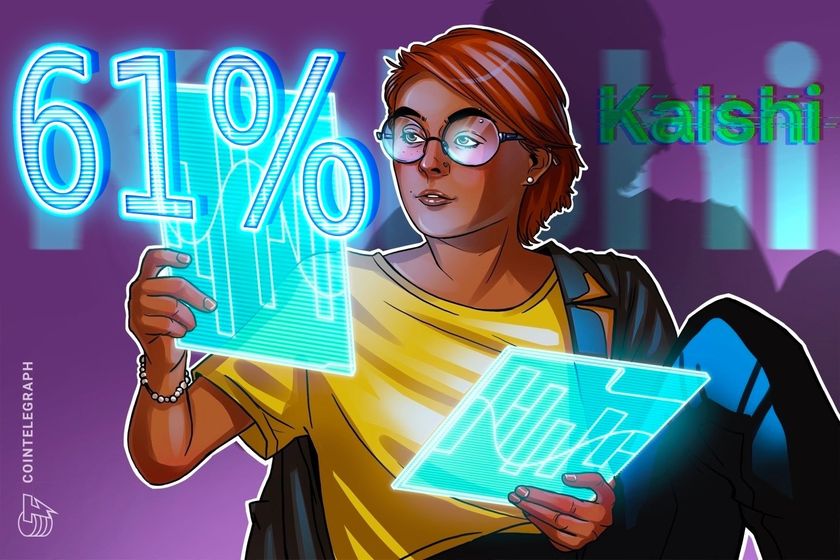
Kalshi traders place the odds of US recession in 2025 at over 61%

Traders on the Kalshi prediction market place the odds of a US recession in 2025 at 61%, following the sweeping tariff order signed by President Donald Trump on April 2.

Kalshi uses the standard criteria of a recession, two business quarters of negative gross domestic product (GDP) growth, as reported by the United States Department of Commerce.

Odds of a US recession on the prediction platform have nearly doubled since March 20 and mirror the current 2025 US recession odds on Polymarket, which traders on the platform currently place at 60%.

The macroeconomic outlook for 2025 deteriorated rapidly following US President Donald Trump’s sweeping tariff order and the ensuing sell-off in capital markets, sparking fears of a prolonged bear market.

Economy, United States

Odds of US recession in 2025 top 60% on the Kalshi prediction market. Source: Kalshi

Related: Bitcoin bulls defend $80K support as ‘World War 3 of trade wars’ crushes US stocks

Trump’s executive order throws markets in disarray

The US President’s executive order established a 10% baseline tariff rate for all countries and different “reciprocal” tariff rates on trading partners with existing tariffs on US import goods.

Trump’s announcement triggered an immediate stock market sell-off, wiping away over $5 trillion in shareholder value in a matter of days.

Fears of a recession continue to grow as market analysts warn of a potentially protracted trade war that negatively impacts global markets and suppresses risk asset prices, including cryptocurrencies.

Meanwhile, President Trump has expressed confidence that the tariffs will strengthen the US economy long-term and correct any trade imbalances.

“The markets are going to boom,” the President said on April 3, describing the current market sell-off as an expected part of the process.

Economy, United States

The stock market sell-off continues as stocks shed trillions in shareholder value. Source: TradingView

Asset manager Anthony Pompliano recently speculated that President Trump deliberately crashed markets to bring down interest rates.

Pompliano cited the reduction in 10-year US Treasury bonds as evidence that the President’s strategy of forcing a recession to impact rates is working.

Interest rates on 10-year US Treasury bonds declined from approximately 4.66% in January 2025 to just 4.00% on April 5. President Trump is also pressuring Federal Reserve Chair Jerome Powell to lower short-term interest rates.

“This would be a perfect time for Fed chairman Jerome Powell to cut interest rates,” Trump wrote in an April 4 Truth Social post.

Magazine: Financial nihilism in crypto is over — It’s time to dream big again

Read more at cointelegraph.com

Solana TVL hits new high in SOL terms, DEX volumes show strength — Will SOL price react?

Solana’s native token SOL (SOL) dropped by 9% between March 28 and April 4, but several key metrics grew during the same period. Despite SOL’s price downturn, the Solana network continues to outpace competitors, maintaining its second-place position in deposits and trading volume. Traders now wonder how long it will take for SOL’s price to reflect this onchain strength.

Solana outperforms rivals in TVL deposits and DEX volumes

Investor’s declining interest in SOL could be linked to the April 4 staking unlock of 1.79 million SOL, worth over $200 million. The selling pressure is clear, as these tokens were staked in April 2021, when SOL traded near $23. Another factor is the decline in interest for memecoins, which had been a major driver of new user adoption on Solana. With fewer speculative inflows, growth in activity may not translate to immediate price gains.

Several meme-themed cryptocurrencies, including WIF, PENGU, POPCAT, AI16Z, BOME, and ACT, saw declines of 20% or more over the past seven days. Yet, despite worsening market conditions, the Solana network outperformed some competitors. Its total value locked (TVL) rose to the highest level since June 2022, while decentralized exchange (DEX) volumes showed notable resilience.

Solana TVL hits new high in SOL terms, DEX volumes show strength — Will SOL price react?

Solana Total Vale Locked (TVL), SOL. Source: DefiLlama

Deposits in Solana network’s DApps rose to 53.8 million SOL on April 2, marking a 14% increase from the previous month. In US dollar terms, the $6.5 billion total stands $780 million ahead of its closest competitor, BNB Chain. Solana’s top DApps by TVL include Jito (liquid staking), Jupiter (leading DEX), and Kamino (lending and liquidity platform).

Solana gains support for scalability and Web3 focus despite MEV concerns

While not yet a direct threat to Ethereum’s $50 billion TVL, Solana’s onchain data shows greater resilience compared to BNB Chain, Tron, and Ethereum layer-2 networks like Base and Arbitrum. In decentralized exchange (DEX) volumes, Solana holds a 24% market share, while BNB Chain accounts for 12% and Base captures 10%, according to data from DefiLlama.

Solana TVL hits new high in SOL terms, DEX volumes show strength — Will SOL price react?

DEX volumes monthly market share. Source: DefiLlama

While Ethereum has regained the lead in DEX volumes, Solana has shown strong resilience following the memecoin bubble burst. For context, Raydium’s weekly volumes dropped 95% from the $42.9 billion all-time high reached in mid-January. Still, Solana has demonstrated that traders appreciate its focus on base layer scalability and integrated Web3 user experience despite ongoing criticism related to maximum extractable value (MEV).

Solana TVL hits new high in SOL terms, DEX volumes show strength — Will SOL price react?

Source: Cbb0fe

In short, MEV occurs when validators reorder transactions for profit. This practice is not unique to Solana, but some market participants—such as user Cbb0fe, a self-proclaimed decentralized finance (DeFi) liquidity provider—have raised concerns about insider gatekeeping. While not stated directly, the criticism likely refers to incentives provided by Solana Labs to offset the high investment and maintenance costs required by certain validators.

Supporters of changing Solana’s token emissions argue that rewards earned through MEV already provide sufficient incentives for validators to secure the network, eliminating the need for further inflationary pressure on SOL. Meanwhile, Loring Harkness, a core contributor to Shutter Network, advocates for encrypting transactions before they enter the mempool as a way to prevent validators from manipulating their order.

Solana’s growth in TVL and resilience in DEX market share may not be enough for SOL to retest the $200 level seen in mid-February. However, it has firmly secured its second-place position behind Ethereum as a leading platform for decentralized applications, supported by consistent activity, infrastructure development, and growing interest from both developers and users.

This article is for general information purposes and is not intended to be and should not be taken as legal or investment advice. The views, thoughts, and opinions expressed here are the author’s alone and do not necessarily reflect or represent the views and opinions of Cointelegraph.

Read more at cointelegraph.com