cointelegraph.com

Standard Chartered and OKX pilot crypto, money market fund collateral program

Standard Chartered and cryptocurrency exchange OKX are piloting a new program allowing institutions to use crypto assets and tokenized money market funds (MMFs) as collateral.

Announced on April 10, the collateral mirroring program enables off-exchange collateral usage while enhancing security by placing custody with a globally systemically important bank, according to a joint statement from the companies.

The pilot has been launched under the regulatory oversight of the Dubai Virtual Asset Regulatory Authority, with Standard Chartered acting as a regulated custodian in the Dubai International Financial Centre (DIFC).

The program launched in collaboration with crypto-friendly asset manager Franklin Templeton and features Brevan Howard Digital among the first institutions to trial the new capability.

OKX clients to gain access to assets by Franklin Templeton

As part of the collaboration, OKX clients will have access to onchain assets developed by Franklin Templeton’s digital assets team.

“We take an authentic approach, from directly investing in blockchain assets to developing innovative solutions with our in-house team,” Franklin Templeton’s head of digital assets, Roger Bayston, said, adding:

“By ensuring assets are minted onchain, we enable true ownership, allowing them to move and settle at blockchain speed — eliminating the need for traditional infrastructure.”

According to the announcement, Franklin Templeton will be one of the first in a “series of MMFs” that are expected to be offered under the program by Standard Chartered and OKX.

Standard Chartered backs tokenized funds

In the crypto lending industry, collateral is any blockchain-based asset used to secure loans from a lender as a security measure when taking out a loan. By allowing borrowers to pledge those assets, the lender guarantees that the loan is going to be repaid.

Despite the high volatility of digital assets, Standard Chartered’s Margaret Harwood-Jones, global head of financing and securities services, is bullish on crypto collaterals as a major step in the evolution of institutional crypto services.

Standard Chartered and OKX pilot crypto, money market fund collateral program

A visual of the crypto lending process with collaterals and deposits. Source: CoinRabbit

Related: Xapo Bank launches Bitcoin-backed USD loans targeting hodlers

“Our collaboration with OKX to enable the use of cryptocurrencies and tokenized MMFs as collateral represents a significant step forward in providing institutional clients with the confidence and efficiency they need,” Harwood-Jones said, adding:

“By leveraging our established custody infrastructure, we are ensuring the highest standards of security and regulatory compliance, fostering greater trust in the digital asset ecosystem.”

According to Ryan Taylor, group head of compliance at Brevan Howard, the program is another example of the ongoing innovation and institutionalization in the crypto industry.

“As a significant investor in the digital assets space, we are thrilled to partner with industry leaders to further grow and evolve the crypto ecosystem globally,” he noted.

Magazine: Memecoin degeneracy is funding groundbreaking anti-aging research

Read more at cointelegraph.com

Standard Chartered and OKX pilot crypto, tokenized fund collaterals

Standard Chartered and cryptocurrency exchange OKX are piloting a new program allowing institutions to use crypto assets and tokenized money market funds (MMFs) as collateral.

Announced on April 10, the collateral mirroring program enables off-exchange collateral usage while enhancing security by placing custody with a globally systemically important bank, according to a joint statement from the companies.

The pilot has been launched under the regulatory oversight of the Dubai Virtual Asset Regulatory Authority, with Standard Chartered acting as a regulated custodian in the Dubai International Financial Centre (DIFC).

The program launched in collaboration with crypto-friendly asset manager Franklin Templeton and features Brevan Howard Digital among the first institutions to trial the new capability.

OKX clients to gain access to assets by Franklin Templeton

As part of the collaboration, OKX clients will have access to onchain assets developed by Franklin Templeton’s digital assets team.

“We take an authentic approach, from directly investing in blockchain assets to developing innovative solutions with our in-house team,” Franklin Templeton’s head of digital assets, Roger Bayston, said, adding:

“By ensuring assets are minted onchain, we enable true ownership, allowing them to move and settle at blockchain speed — eliminating the need for traditional infrastructure.”

According to the announcement, Franklin Templeton will be one of the first in a “series of MMFs” that are expected to be offered under the program by Standard Chartered and OKX.

Standard Chartered backs tokenized funds

In the crypto lending industry, collateral is any blockchain-based asset used to secure loans from a lender as a security measure when taking out a loan. By allowing borrowers to pledge those assets, the lender guarantees that the loan is going to be repaid.

Despite the high volatility of digital assets, Standard Chartered’s Margaret Harwood-Jones, global head of financing and securities services, is bullish on crypto collaterals as a major step in the evolution of institutional crypto services.

Standard Chartered and OKX pilot crypto, tokenized fund collaterals

A visual of the crypto lending process with collaterals and deposits. Source: CoinRabbit

Related: Xapo Bank launches Bitcoin-backed USD loans targeting hodlers

“Our collaboration with OKX to enable the use of cryptocurrencies and tokenized MMFs as collateral represents a significant step forward in providing institutional clients with the confidence and efficiency they need,” Harwood-Jones said, adding:

“By leveraging our established custody infrastructure, we are ensuring the highest standards of security and regulatory compliance, fostering greater trust in the digital asset ecosystem.”

According to Ryan Taylor, group head of compliance at Brevan Howard, the program is another example of the ongoing innovation and institutionalization in the crypto industry.

“As a significant investor in the digital assets space, we are thrilled to partner with industry leaders to further grow and evolve the crypto ecosystem globally,” he noted.

Magazine: Memecoin degeneracy is funding groundbreaking anti-aging research

Read more at cointelegraph.com

Trump’s tariff escalation exposes ‘deeper fractures’ in global financial system

Escalating trade tensions and renewed uncertainty in global markets are driving investors toward alternative assets, including Bitcoin and tokenized real-world assets (RWAs), as concerns mount over the long-term stability of the financial system.

Global trade tensions continue pressuring investor sentiment despite US President Donald Trump announcing a 90-day pause on higher reciprocal tariffs on April 9, reverting the tariffs to the 10% baseline for most countries.

At the same time, Trump escalated his tariffs on Chinese goods from 104% to 125%, the Financial Times reported on April 9.

“President Trump’s tariff escalation marks a significant inflection point for global markets,” a move that signals “more than a trade disagreement,” said Teddy Pornprinya, co-founder of Plume — a layer-1 blockchain focused on tokenized real-world assets. He added:

“It exposes deeper fractures in the global monetary system.”

With both the US and China facing what he described as unsustainable debt levels, Pornprinya warned of increased reliance on inflationary tools, including the potential depreciation of the Chinese yuan.

“These dynamics will test the resilience of every asset class” and inspire greater adoption for tokenized credit and private yield products that “aren’t exposed to sovereign devaluation games,” he said.

Related: Bitcoin ETFs lose $326M amid ‘evolving’ dynamic with TradFi markets

The tariff fears led tokenized gold trading volume to surge to a two-year high this week, topping $1 billion for the first time since the US banking crisis in 2023, Cointelegraph reported on April 10.

Trump’s tariff escalation exposes ‘deeper fractures’ in global financial system

Top tokenized gold assets, trading volume. Source: CoinGecko, Cex.io

Onchain real-world assets (RWAs) also surpassed the $20-billion all-time high on April 9, with tokenized private credit representing the lion’s share, or $12.7 billion of total RWA value, according to data from RWA.xyz.

Trump’s tariff escalation exposes ‘deeper fractures’ in global financial system

RWA global market dashboard. Source: RWA.xyz

Some industry watchers said that Bitcoin’s lack of upside momentum may drive RWAs to a $50-billion all-time high before the end of 2025, as their increased liquidity will help RWAs attract a significant share of the $450-trillion global asset market.

Related: Bitcoin’s safe-haven appeal grows during trade war uncertainty

Tariffs are “US bargaining tool,” not lasting policy shift

Despite investor concerns, analysts at crypto exchange Bitfinex said the tariff hike may not represent a long-term policy shift.

“We believe, however, that the threat of tariffs by the current US administration is a negotiating tool to be used to persuade other countries to lower tariffs on American manufactured goods and services and are unlikely to become permanent policy,” they told Cointelegraph.

Trump’s tariff escalation exposes ‘deeper fractures’ in global financial system

Source: Raoul Pal

Raoul Pal, founder and CEO of Global Macro Investor, also said that the tariff negotiations may only be “posturing” for the US to reach an agreement with China.

The tone of the negotiations may dictate the recovery of global risk assets, including the crypto market, which has a 70% chance to bottom by June 2025 before recovering, Nansen analysts predicted.

Magazine: Bitcoin ATH sooner than expected? XRP may drop 40%, and more: Hodler’s Digest, March 23–29

Read more at cointelegraph.com

Top Bitcoin miners produced nearly $800M of BTC in Q1 2025

The largest publicly traded Bitcoin mining companies produced nearly $800 million worth of Bitcoin in the first quarter of 2025, reflecting continued growth across the sector as Bitcoin prices held near record highs.

According to publicly available data compiled by Cointelegraph, the top Bitcoin mining companies produced over 9,700 Bitcoin (BTC) in the first quarter. With Bitcoin trading at around $81,600 at the time of writing, the total production was valued at around $800 million. 

Mara, the biggest Bitcoin mining company by market capitalization, led the pack with 2,285 Bitcoin (worth roughly $186 million) mined in Q1. 

On April 3, Mara announced that it produced 829 BTC in March, up 17.4% from February and 10.5% higher than January.

Mining, Bitcoin Price, Data, Companies

Related: Bitcoin miner Bitfarms secures up to $300M loan from Macquarie

Bitcoin miners produce 9,746 BTC in Q1 2025

CleanSpark followed with 1,950 BTC mined in Q1, valued near $160 million. CleanSpark’s March performance also saw a 13.4% increase month-on-month. 

Iren, formerly Iris Energy, produced the third-highest amount for the quarter. The mining firm reported a total of 1,513 BTC, worth almost $124 million.

Its 533 BTC produced in March was a 16.1% increase from its February performance. CompaniesMarketCap places Iren as the sixth-largest Bitcoin miner by market capitalization. 

Riot Blockchain, which ranks second only to Mara by market capitalization, had the fourth-largest BTC production during the quarter.

The company reported production of 1,428 BTC (about $117 million) during the quarter. Like Iren, Riot produced 533 BTC in March, a 13.4% increase from February. 

Top Bitcoin miners produced nearly $800M of BTC in Q1 2025

Top Bitcoin miners by market cap. Source: CompaniesMarketCap

Hut8 shows 91% growth in Bitcoin production

Hut 8 Mining, despite producing the least amount of Bitcoin among the top miners reviewed, showed the highest growth rate. The company mined 199 BTC in Q1 valued at about $16 million, including 88 BTC in March. That represents a 91% increase from the 46 BTC it produced in February.

On March 31, Hut8 partnered with US President Donald Trump’s sons, Donald Trump Jr. and Eric Trump, to launch a new mining venture called American Bitcoin. The project aims to be the “world’s largest, most efficient pure-play Bitcoin miner.”

In a previous Cointelegraph interview, Hut 8 CEO Asher Genoot said the company aims to dominate US Bitcoin mining. Genoot said the company plans to build one of the largest and most efficient Bitcoin mining platforms rooted in American soil. 

Magazine: Memecoin degeneracy is funding groundbreaking anti-aging research

Read more at cointelegraph.com

Anti-Elon Musk protests 2025: Everything you need to know

Why are people protesting against Elon Musk?

Elon Musk, once celebrated as a tech visionary behind Tesla and SpaceX, has faced growing backlash due to his political ties, controversial corporate decisions and provocative public statements.

Born in 1971 in Pretoria, South Africa, Elon Musk co-founded Zip2 in 1995, which was sold to Compaq in 1999. He then launched X.com, which merged with Confinity to form PayPal, acquired by eBay in 2002. 

His later ventures, SpaceX (2002) and Tesla (2004), solidified his status as a leading innovator in aerospace and electric vehicles. In 2022, Musk acquired Twitter for $44 billion and later rebranded the platform as X, integrating it into his broader vision for an “everything app.”

Initially celebrated for his technological contributions, Musk’s public image began to shift in the late 2010s for several reasons:

Political involvement: Musk’s association with conservative politics, notably his support for US President Donald Trump and his role as head of the Department of Government Efficiency (DOGE), drew criticism. His advocacy for significant federal spending cuts and program eliminations fueled discontent.Corporate practices: Decisions like relocating Tesla’s headquarters from California to Texas and implementing controversial labor practices contributed to negative perceptions. These actions were seen as prioritizing profit over employee welfare and regulatory compliance.Public statements: Musk’s public communications, especially on social media, often sparked controversy. Critics accused him of spreading misinformation and promoting conspiracy theories, which eroded trust among certain groups.

Elon's 'peculiar' gesture at an early 2025 Trump rally

Did you know? Despite popular narratives of Elon Musk as a self-made entrepreneur, he came from a wealthy South African family. His father, Errol Musk, is suspected of owning an emerald mine in Zambia, and Elon has acknowledged receiving financial support from his family during his early ventures.

Anti-Elon Musk protests in 2025

By 2025, the aforementioned factors culminated in widespread protests targeting Musk and his business interests. 

The demonstrations were driven by core grievances:

Wealth disparity: Musk’s net worth, which reached $400 billion in December 2024, had declined to $298 billion by April 2025 due to stock market fluctuations and political controversies. His accumulation of wealth highlighted growing economic inequalities, with protesters viewing it as emblematic of systemic issues favoring the ultra-wealthy.Political influence: Musk’s significant political engagement, particularly his advisory role to Trump and influence over DOGE policies, has raised concerns about the concentration of power among wealthy elites. Critics feared this influence undermined democratic processes and prioritized corporate interests over public welfare.Corporate practices: Actions such as aggressive cost-cutting measures, perceived labor exploitation and controversial business decisions led to dissatisfaction among employees and consumers. The “Tesla Takedown” movement, for example, targeted Tesla showrooms, criticizing Musk’s leadership and corporate strategies.Social and environmental concerns: Musk’s business decisions were also scrutinized for their social and environmental impact. Protesters questioned Tesla’s labor practices and the environmental implications of some of his ventures, calling for more ethical and sustainable corporate behaviors.Did you know? A March 2025 Brookings op-ed called DOGE’s naming choice a “branding blunder,” while a CNN/ORC poll found 62% of respondents viewed it as “inappropriate” for a government agency and 44% felt it damaged confidence in the administration’s reform efforts.

Tesla protest events in 2025

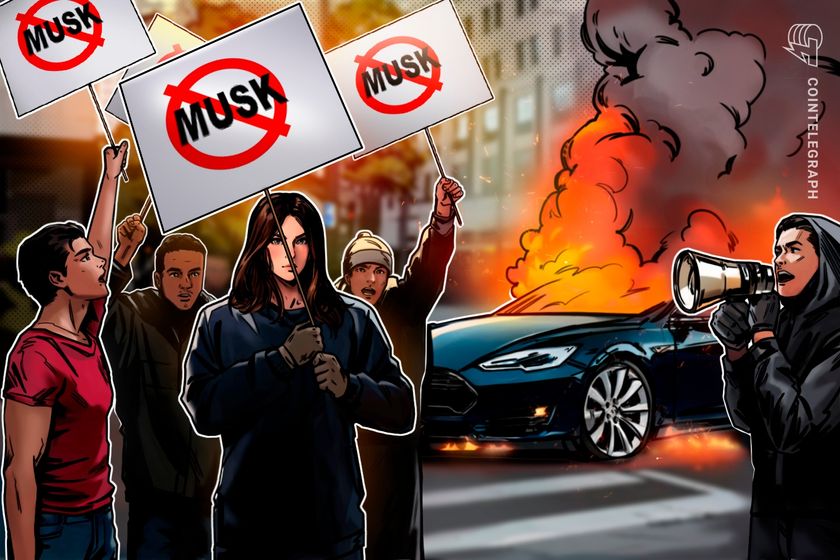
The “Tesla Takedown” movement, with demonstrations in over 250 cities worldwide, aimed to challenge Musk’s influence. 

Originating in early 2025, this grassroots initiative organized nonviolent protests at Tesla locations across the US, Canada, Europe and Australia.

Tesla Takedown protests at Tesla stores

Protesters called for boycotts and urged the public to divest from Tesla by selling their vehicles and shares, intending to economically impact Musk and question his political influence.

Two key factors fueled the protests:

Labor practices: Tesla faced allegations of labor rights violations, including reports of employees being fired for expressing dissenting opinions. The National Labor Relations Board had 24 open investigations into Musk’s companies, including allegations of illegal firings at SpaceX.Environmental concerns: Protesters criticized Tesla’s environmental record, highlighting issues such as alleged negligence in the installation and maintenance of solar panels, which led to roof fires at Walmart stores. Walmart filed a multimillion-dollar lawsuit against Tesla, claiming negligent installation and maintenance of solar panels caused roof fires at seven Walmart stores dating back to 2012.

Declining sales figures underscored consumer discontent. In the first quarter of 2025, Tesla’s global vehicle deliveries dropped 13% year-over-year to 336,681 units, marking the company’s lowest quarterly performance since mid-2022.

Did you know? While intended to be peaceful, some protests escalated into acts of vandalism. For example, on March 24, 2025, incendiary devices were discovered at a Tesla dealership in Austin, Texas.

SpaceX controversy 2025

SpaceX’s activities also attracted scrutiny, particularly regarding safety and regulatory compliance. 

The 2025 Starship explosion served as a stark reminder of the risks associated with private space exploration. The largest and most powerful rocket ever built disintegrated minutes after liftoff, scattering debris across protected areas and reigniting debates about safety, environmental responsibility and regulatory oversight in the private spaceflight industry.

Tesla Takedown protests at Tesla stores

Musk’s political involvement further complicated matters. Serving as the head of DOGE, he oversaw significant federal spending cuts and deregulation efforts. This role led to conflicts of interest, especially concerning agencies that regulate his businesses. 

For example, SpaceX faced fines from the Federal Aviation Administration for safety violations, including operating an unapproved launch control room and using non-approved rocket fuel, totaling $633,009.

What does the future hold for Elon Musk amid growing backlash?

Musk’s entanglement in political affairs, particularly his advisory role to President Trump and leadership of DOGE, has led to significant public disapproval. 

A February 2025 poll indicated that 52% of Americans held an unfavorable view of Musk, with only 29% expressing approval.

In response to the mounting criticism, reports suggest that Musk is considering stepping back from his governmental advisory role to focus on his business ventures. Such a move could be aimed at mitigating public perception that his political activities are adversely affecting Tesla’s performance.

However, given Musk’s history of unconventional decisions and resilience, it’s uncertain whether distancing himself from politics will fully quell public dissent or restore consumer confidence in Tesla.
Read more at cointelegraph.com

Anti-Elon Musk protests 2025: Everything you need to know

Why are people protesting against Elon Musk?

Elon Musk, once celebrated as a tech visionary behind Tesla and SpaceX, has faced growing backlash due to his political ties, controversial corporate decisions and provocative public statements.

Born in 1971 in Pretoria, South Africa, Elon Musk co-founded Zip2 in 1995, which was sold to Compaq in 1999. He then launched X.com, which merged with Confinity to form PayPal, acquired by eBay in 2002. 

His later ventures, SpaceX (2002) and Tesla (2004), solidified his status as a leading innovator in aerospace and electric vehicles. In 2022, Musk acquired Twitter for $44 billion and later rebranded the platform as X, integrating it into his broader vision for an “everything app.”

Initially celebrated for his technological contributions, Musk’s public image began to shift in the late 2010s for several reasons:

Political involvement: Musk’s association with conservative politics, notably his support for US President Donald Trump and his role as head of the Department of Government Efficiency (DOGE), drew criticism. His advocacy for significant federal spending cuts and program eliminations fueled discontent.Corporate practices: Decisions like relocating Tesla’s headquarters from California to Texas and implementing controversial labor practices contributed to negative perceptions. These actions were seen as prioritizing profit over employee welfare and regulatory compliance.Public statements: Musk’s public communications, especially on social media, often sparked controversy. Critics accused him of spreading misinformation and promoting conspiracy theories, which eroded trust among certain groups.

Elon's 'peculiar' gesture at an early 2025 Trump rally

Did you know? Despite popular narratives of Elon Musk as a self-made entrepreneur, he came from a wealthy South African family. His father, Errol Musk, is suspected of owning an emerald mine in Zambia, and Elon has acknowledged receiving financial support from his family during his early ventures.

Anti-Elon Musk protests in 2025

By 2025, the aforementioned factors culminated in widespread protests targeting Musk and his business interests. 

The demonstrations were driven by core grievances:

Wealth disparity: Musk’s net worth, which reached $400 billion in December 2024, had declined to $298 billion by April 2025 due to stock market fluctuations and political controversies. His accumulation of wealth highlighted growing economic inequalities, with protesters viewing it as emblematic of systemic issues favoring the ultra-wealthy.Political influence: Musk’s significant political engagement, particularly his advisory role to Trump and influence over DOGE policies, has raised concerns about the concentration of power among wealthy elites. Critics feared this influence undermined democratic processes and prioritized corporate interests over public welfare.Corporate practices: Actions such as aggressive cost-cutting measures, perceived labor exploitation and controversial business decisions led to dissatisfaction among employees and consumers. The “Tesla Takedown” movement, for example, targeted Tesla showrooms, criticizing Musk’s leadership and corporate strategies.Social and environmental concerns: Musk’s business decisions were also scrutinized for their social and environmental impact. Protesters questioned Tesla’s labor practices and the environmental implications of some of his ventures, calling for more ethical and sustainable corporate behaviors.Did you know? A March 2025 Brookings op-ed called DOGE’s naming choice a “branding blunder,” while a CNN/ORC poll found 62% of respondents viewed it as “inappropriate” for a government agency and 44% felt it damaged confidence in the administration’s reform efforts.

Tesla protest events in 2025

The “Tesla Takedown” movement, with demonstrations in over 250 cities worldwide, aimed to challenge Musk’s influence. 

Originating in early 2025, this grassroots initiative organized nonviolent protests at Tesla locations across the US, Canada, Europe and Australia.

Tesla Takedown protests at Tesla stores

Protesters called for boycotts and urged the public to divest from Tesla by selling their vehicles and shares, intending to economically impact Musk and question his political influence.

Two key factors fueled the protests:

Labor practices: Tesla faced allegations of labor rights violations, including reports of employees being fired for expressing dissenting opinions. The National Labor Relations Board had 24 open investigations into Musk’s companies, including allegations of illegal firings at SpaceX.Environmental concerns: Protesters criticized Tesla’s environmental record, highlighting issues such as alleged negligence in the installation and maintenance of solar panels, which led to roof fires at Walmart stores. Walmart filed a multimillion-dollar lawsuit against Tesla, claiming negligent installation and maintenance of solar panels caused roof fires at seven Walmart stores dating back to 2012.

Declining sales figures underscored consumer discontent. In the first quarter of 2025, Tesla’s global vehicle deliveries dropped 13% year-over-year to 336,681 units, marking the company’s lowest quarterly performance since mid-2022.

Did you know? While intended to be peaceful, some protests escalated into acts of vandalism. For example, on March 24, 2025, incendiary devices were discovered at a Tesla dealership in Austin, Texas.

SpaceX controversy 2025

SpaceX’s activities also attracted scrutiny, particularly regarding safety and regulatory compliance. 

The 2025 Starship explosion served as a stark reminder of the risks associated with private space exploration. The largest and most powerful rocket ever built disintegrated minutes after liftoff, scattering debris across protected areas and reigniting debates about safety, environmental responsibility and regulatory oversight in the private spaceflight industry.

Tesla Takedown protests at Tesla stores

Musk’s political involvement further complicated matters. Serving as the head of DOGE, he oversaw significant federal spending cuts and deregulation efforts. This role led to conflicts of interest, especially concerning agencies that regulate his businesses. 

For example, SpaceX faced fines from the Federal Aviation Administration for safety violations, including operating an unapproved launch control room and using non-approved rocket fuel, totaling $633,009.

What does the future hold for Elon Musk amid growing backlash?

Musk’s entanglement in political affairs, particularly his advisory role to President Trump and leadership of DOGE, has led to significant public disapproval. 

A February 2025 poll indicated that 52% of Americans held an unfavorable view of Musk, with only 29% expressing approval.

In response to the mounting criticism, reports suggest that Musk is considering stepping back from his governmental advisory role to focus on his business ventures. Such a move could be aimed at mitigating public perception that his political activities are adversely affecting Tesla’s performance.

However, given Musk’s history of unconventional decisions and resilience, it’s uncertain whether distancing himself from politics will fully quell public dissent or restore consumer confidence in Tesla.

Read more at cointelegraph.com

Cosmos launches Eureka to connect Ethereum and IBC networks

Cosmos, a blockchain network aiming to become the “internet of blockchains,” has launched Eureka, an interoperability layer designed to link its inter-blockchain communication (IBC) protocol with Ethereum.

According to an April 10 announcement, Eureka has expanded the Cosmos IBC protocol, changing IBC from an ecosystem standard “to a universal interoperability protocol,” setting the hub on a course to become the home of multichain apps.

Cosmos launches Eureka to connect Ethereum and IBC networks

Cosmos projects are integrating into IBC Eureka. Source: Cosmos

With the introduction of Eureka, many Cosmos-based applications and blockchains are now accessible to more users by expanding IBC to the Ethereum network. With the new protocol, developers can reportedly build multichain apps across multiple ecosystems without fragmenting the user base.

Related: Cosmos co-founder proposes peer-to-peer clearing system in white paper

The announcement said that most projects rely on bridges for interoperability, resulting in the introduction of intermediaries as well as user and liquidity fragmentation. With bridges, users can simply move assets between blockchains, while with Eureka, developers promise to deliver native interoperability.

Cosmos launches Eureka to connect Ethereum and IBC networks

Cosmos Hub Integration Image. Source: Cosmos

Cointelegraph reached out to the Interchain Foundation, the organization behind Cosmos, but did not receive a response by publication.

How IBC Eureka works

Eureka relies on a distribution zone allowing developers to access all IBC connections, users, liquidity and services without additional infrastructure. The Cosmos Hub also allows users to access apps, services and assets across the included ecosystems.

Related: Cosmos ecosystem rocked by North Korean developer allegations

Some early use cases include Bitcoin staking protocol Babylon, whose users will now be able to transfer Bitcoin liquid staking tokens from Ethereum to Babylon’s Cosmos-based chain. Similarly, decentralized finance (DeFi) protocol Elys will enable trading with Wrapped Ether (WETH), Wrapped Bitcoin (WBTC) and USDt (USDT) from Ethereum.

More integrations coming

In the future, developers promise that users will be able to leverage Eureka-powered multichain features in major decentralized exchange (DEX) dYdX. Real-world asset tokenization platform Mantra will also reportedly bridge capital from Ethereum into Cosmos-based real-estate markets, staking infrastructure and permissioned DeFi applications.

According to the announcement, IBC — which Eureka upgrades — has facilitated an average of up to $3 billion in transaction volume among more than 115 blockchains every month since its launch. Still, the integration was far from seamless for blockchains that were not part of the Cosmos ecosystem.

Magazine: Arbitrum co-founder skeptical of move to based and native rollups: Steven Goldfeder

Read more at cointelegraph.com

Cosmos launches Eureka to connect Ethereum and IBC networks

Cosmos, a blockchain network aiming to become the “internet of blockchains,” has launched Eureka, an interoperability layer designed to link its inter-blockchain communication (IBC) protocol with Ethereum.

According to an April 10 announcement, Eureka has expanded the Cosmos IBC protocol, changing IBC from an ecosystem standard “to a universal interoperability protocol,” setting the hub on a course to become the home of multichain apps.

Cosmos launches Eureka to connect Ethereum and IBC networks

Cosmos projects are integrating into IBC Eureka. Source: Cosmos

With the introduction of Eureka, many Cosmos-based applications and blockchains are now accessible to more users by expanding IBC to the Ethereum network. With the new protocol, developers can reportedly build multichain apps across multiple ecosystems without fragmenting the user base.

Related: Cosmos co-founder proposes peer-to-peer clearing system in white paper

The announcement said that most projects rely on bridges for interoperability, resulting in the introduction of intermediaries as well as user and liquidity fragmentation. With bridges, users can simply move assets between blockchains, while with Eureka, developers promise to deliver native interoperability.

Cosmos launches Eureka to connect Ethereum and IBC networks

Cosmos Hub Integration Image. Source: Cosmos

Cointelegraph reached out to the Interchain Foundation, the organization behind Cosmos, but did not receive a response by publication.

How IBC Eureka works

Eureka relies on a distribution zone allowing developers to access all IBC connections, users, liquidity and services without additional infrastructure. The Cosmos Hub also allows users to access apps, services and assets across the included ecosystems.

Related: Cosmos ecosystem rocked by North Korean developer allegations

Some early use cases include Bitcoin staking protocol Babylon, whose users will now be able to transfer Bitcoin liquid staking tokens from Ethereum to Babylon’s Cosmos-based chain. Similarly, decentralized finance (DeFi) protocol Elys will enable trading with Wrapped Ether (WETH), Wrapped Bitcoin (WBTC) and USDt (USDT) from Ethereum.

More integrations coming

In the future, developers promise that users will be able to leverage Eureka-powered multichain features in major decentralized exchange (DEX) dYdX. Real-world asset tokenization platform Mantra will also reportedly bridge capital from Ethereum into Cosmos-based real-estate markets, staking infrastructure and permissioned DeFi applications.

According to the announcement, IBC — which Eureka upgrades — has facilitated an average of up to $3 billion in transaction volume among more than 115 blockchains every month since its launch. Still, the integration was far from seamless for blockchains that were not part of the Cosmos ecosystem.

Magazine: Arbitrum co-founder skeptical of move to based and native rollups: Steven Goldfeder

Read more at cointelegraph.com

Nasdaq files to list VanEck spot Avalanche ETF

American stock exchange Nasdaq has filed an application with the United States Securities and Exchange Commission (SEC) to list and trade shares of the VanEck Avalanche Trust, a proposed exchange-traded fund (ETF) designed to offer indirect exposure to the AVAX token.

The filing, signed by Nasdaq’s executive vice president and chief legal officer John Zecca, requests approval to list and trade shares of the VanEck Avalanche ETF under the company’s Rule 5711(d), which governs the trading of commodity-based trust shares. 

If approved, the VanEck Avalanche ETF would allow investors to gain exposure to the Avalanche (AVAX) price without directly holding them. The ETF would hold the tokens and track their price, allowing investors to profit from the token’s performance without needing crypto wallets or using digital asset trading platforms. 

According to the filing, asset manager VanEck Digital Assets will sponsor the trust, while a third-party custodian will hold all the Avalanche tokens on the trust’s behalf. 

Nasdaq files to list VanEck spot Avalanche ETF

Excerpt of Nasdaq’s Avalanche ETF listing application. Source: Nasdaq

Related: XRP ETF: Here are the funds awaiting SEC approval so far

VanEck joins Avalanche ETF race

The filing follows VanEck’s efforts to register a spot Avalanche ETF in the US. On March 10, the asset manager registered the crypto investment product as a trust corporate service company in Delaware. 

The application marks the fourth standalone crypto ETF product submitted by VanEck, alongside its Bitcoin (BTC), Ether (ETH) and Solana (SOL) ETF products. In 2024, VanEck filed for a spot Solana ETF, becoming one of the first issuers to file for a SOL-based ETF. 

On March 14, VanEck’s formal application for the Avalanche ETF was shared publicly via social media, signaling the firm’s commitment to the product.

Grayscale Investments is also pursuing an AVAX-backed ETF. On March 28, Nasdaq applied to list Grayscale’s Avalanche ETF. The product would be a conversion of a close-ended AVAX fund launched by the asset manager in August 2024.  

Despite the interest in exchange-traded products based on AVAX, the token suffered massive losses in 2025 as the broader crypto markets saw a downturn. On April 10, the AVAX token traded at $18, which is 56% less than its January high of $41. 

Magazine: XRP win leaves Ripple and industry with no crypto legal precedent set

Read more at cointelegraph.com

How Bitcoin’s three pillars are about to fix money — StarkWare CEO

Bitcoin wasn’t supposed to just sit still.

When Satoshi Nakamoto released the white paper in 2008, it wasn’t a blueprint for digital gold; it was a peer-to-peer cash system. But fast-forward to today, and Bitcoin’s biggest critics and supporters alike often agree on one thing: It doesn’t really work like money, at least not yet.

In the latest episode of The Clear Crypto Podcast, hosts Nathan Jeffay and Gareth Jenkinson speak with Eli Ben-Sasson, the co-founder of StarkWare and one of the leading minds in cryptographic scaling. His message? That might be about to change.

Bitcoin’s three pillars

Ben-Sasson lays out a compelling framework for how Bitcoin can evolve — not by abandoning its principles, but by scaling them. He describes three core pillars that need to align in order for Bitcoin to fulfill its promise. 

Broadness, integrity and verifiability, according to Ben-Sasson, are concrete, technical targets for Bitcoin’s widespread adoption and useability. Not only that, but the tools to hit these targets already exist. 

The reintroduction of a long-dormant opcode, OP_CAT, could be the first domino. “Nine lines of code,” he said, “that would make Bitcoin programmable again.”

Store of value or economic backbone

Right now, Bitcoin is often described as digital gold, a pristine, untouchable store of value. But Ben-Sasson wants to see it function more like a digital economy: permissionless, inclusive and usable in everyday transactions. That means rethinking what Bitcoin is for and upgrading how it works.

“If we don’t make Bitcoin more useful, we risk making it irrelevant.”

The conversation touches on everything from the politics of Bitcoin governance to the role of zero-knowledge proofs and layer-2s in building scalable, decentralized systems.

Related: Jack Dorsey pushes Signal to adopt Bitcoin payments

It also explores what it would take to build money that works for everyone, not just the technically elite or financially privileged.

“We are not in a situation where Bitcoin is a system that today can allow any two parties to transact without any trusted intermediary. We’re simply not there. To me, that’s the start, middle and end of of the reason why things need to change.”

To hear the full conversation on The Clear Crypto Podcast,  listen to the full episode on Cointelegraph’s Podcasts page, Apple Podcasts or Spotify. And don’t forget to check out Cointelegraph’s full lineup of other shows! 

Magazine: SEC’s U-turn on crypto leaves key questions unanswered

Read more at cointelegraph.com