cointelegraph.com

North Carolina lawmaker introduces Digital Asset Freedom Act

North Carolina (NC) representative Neal Jackson introduced the North Carolina Digital Asset Freedom Act on April 10. The bill proposes that qualifying “digital assets” be accepted as a legally recognized form of payment and for taxes.

Although the language of the bill does not specifically mention Bitcoin (BTC), there are several provisions laid out that make BTC uniquely qualified under the bill’s definition of a “digital asset.”

These stipulations include a minimum market capitalization of $750 billion and a daily trading volume of over $10 billion, a market history of 10 years or more, proven censorship resistance, proof-of-work consensus, lack of a central authority, 99.98% or more network uptime, and a maximum supply cap. The bill read:

“The General Assembly further finds that decentralized digital assets, which are not governed by any central entity or foundation, align with the economic principles of limited, noninflationary money and are capable of ensuring the security and integrity of transactions.”

Jackson’s bill is merely the latest in state-led Bitcoin strategic reserve legislation in the United States amid inflation concerns, high US federal debt and a depreciating currency.

Bitcoin Regulation, United States, North Carolina

NC Digital Asset Freedom Act. Source: North Carolina Legislature

Related: North Carolina bills would add crypto to state’s retirement system

North Carolina takes a firm stance against CBDCs

Former North Carolina Governor Roy Cooper vetoed a bill banning a central bank digital currency (CBDC) in July 2024. At the time, Cooper characterized the bill as “premature, vague, and reactionary” to threats that have not yet materialized.

In August 2024, the North Carolina House of Representatives overrode Cooper’s veto in a definitive and bipartisan 73-41 vote.

The North Carolina Senate followed suit by overriding Cooper’s veto in a 27-17 vote and passed the anti-CBDC legislation into law in September 2024.

Bitcoin Regulation, United States, North Carolina

North Carolina’s anti-CBDC legislation. Source: North Carolina Legislature

Dan Spuller, the head of industry affairs at crypto advocacy organization the Blockchain Association, applauded the action taken by NC lawmakers to push back against the tide of CBDCs.

“This bill should have never been vetoed, and Governor Cooper blew an opportunity to send a strong message to the Federal Reserve that NC stands united against CBDCs,” Spuller wrote in a Sept. 9 X post.

Magazine: Bitcoiner sex trap extortion? BTS firm’s blockchain disaster: Asia Express

Read more at cointelegraph.com

Tariffs, capital controls could fragment blockchain networks — Execs

Escalating geopolitical tensions threaten to balkanize blockchain networks and restrict users’ access, crypto executives told Cointelegraph. 

On April 9, US President Donald Trump announced a pause in the rollout of tariffs imposed on certain countries — but the prospect of a global trade war still looms, especially because Trump still wants to charge a 125% levy on Chinese imports. 

Industry executives said they fear a litany of potential consequences if tensions worsen, including disruptions to blockchain networks’ physical infrastructure, regulatory fragmentation, and censorship. 

“Aggressive tariffs and retaliatory trade policies could create obstacles for node operators, validators, and other core participants in blockchain networks,” Nicholas Roberts-Huntley, CEO of Concrete & Glow Finance, told Cointelegraph. 

“In moments of global uncertainty, the infrastructure supporting crypto, not just the assets themselves, can become collateral damage.”

According to data from CoinMarketCap, cryptocurrency’s total market capitalization dropped approximately 4% on April 10 as traders weighed conflicting messages from the White House on tariffs amid a backdrop of macroeconomic unease. 

Tariffs, capital controls could fragment blockchain networks — Execs

Crypto’s market cap retraced on April 10. Source: CoinMarketCap

Related: Trade tensions to speed institutional crypto adoption — Execs

Bitcoin’s vulnerabilities

Bitcoin (BTC) is especially vulnerable to a trade war since the network depends on specialized hardware for Bitcoin mining, such as the ASIC chips used to solve the network’s cryptographic proofs. 

“Tariffs disrupt established ASIC supply chains,” David Siemer, CEO of Wave Digital Assets, told Cointelegraph. Chinese manufacturers such as Bitmain are key suppliers for miners.

However, “the greater threat is the erosion of blockchain’s core value proposition—its global, permissionless infrastructure,” Siemer said. This could be especially problematic for everyday crypto holders. 

“If global trade breaks down and capital controls tighten, it may become harder for citizens in restrictive countries to acquire bitcoin,” said Joe Kelly, CEO of Unchained. “Governments could crack down on exchanges and on-ramps, making accumulation and usage more difficult,” Kelly added.

Tariffs, capital controls could fragment blockchain networks — Execs

Bitcoin’s performance versus stocks. Source: 21Shares

Ironically, these types of fears also underscore the importance of cryptocurrencies and decentralized blockchain networks, the executives said. 

Bitcoin has already shown “signs of resilience” amid the market turbulence, highlighting the coin’s role in hedging against geopolitical risks

“While the environment is challenging, it also creates an opening for crypto to prove its long-term value and utility on the global stage,” noted Fireblocks’ executive Neil Chopra.

Magazine: Memecoin degeneracy is funding groundbreaking anti-aging research

Read more at cointelegraph.com

Bitcoin traders’ sentiment shift points to next step in BTC halving cycle

Bitcoin’s (BTC) four-year cycle, anchored around its halving events, is widely recognized as a key factor in BTC’s year-over-year price growth. Within this larger framework, traders have come to expect distinct phases: accumulation, parabolic rallies, and eventual crashes.

Throughout the four-year period, shorter-duration cycles also emerge, often driven by shifts in market sentiment and the behavior of long- and short-term holders. These cycles, shaped by the psychological patterns of market participants, can provide insights into Bitcoin’s next moves.

Bitcoin whales eat as markets retreat

Long-term Bitcoin holders — those holding for three to five years — are often considered the most seasoned participants. Typically wealthier and more experienced, they can weather extended bear markets and tend to sell near local tops. 

According to recent data from Glassnode, long-term holders distributed over 2 million BTC in two distinct waves during the current cycle. Both waves were followed by strong reaccumulation, which helped absorb sell-side pressure and contributed to a more stable price structure. Currently, long-term Bitcoin holders are in the new accumulation period. Since mid-February, this cohort’s wealth increased sharply by almost 363,000 BTC.

Bitcoin traders’ sentiment shift points to next step in BTC halving cycle

Total BTC supply held by long-term holders. Source: Glassnode

Another cohort of Bitcoin holders often seen as more seasoned than the average market participant are whales—addresses holding over 1,000 BTC. Many of them are also long-term holders. At the top of this group are the mega-whales holding more than 10,000 BTC. Currently, there are 93 such addresses, according to BitInfoCharts, and their recent activity points to ongoing accumulation.

Glassnode data shows that large whales briefly reached a perfect accumulation score (~1.0) in early April, indicating intense buying over a 15-day period. The score has since eased to ~0.65 but still reflects consistent accumulation. These large holders appear to be buying from smaller cohorts—specifically wallets with less than 1 BTC and those with under 100 BTC—whose accumulation scores have dipped toward 0.1–0.2. 

This divergence signals growing distribution from retail to large holders and marks potential for future price support (whales tend to hold long-time). Oftentimes, it also precedes bullish periods.

The last time mega-whales hit a perfect accumulation score was in August 2024, when Bitcoin was trading near $60,000. Two months later, BTC raced to $108,000.

Bitcoin traders’ sentiment shift points to next step in BTC halving cycle

BTC trend accumulation score by cohort. Source: Glassnode

Short-term holders are heavily impacted by market sentiment

Short-term holders, usually defined as those holding BTC for 3 to 6 months, behave differently. They’re more prone to selling during corrections or periods of uncertainty. 

This behavior also follows a pattern. Glassnode data shows that spending levels tend to rise and fall approximately every 8 to 12 months. 

Currently, short-term holders’ spending activity is at a historically low point despite the turbulent macro environment. This suggests that so far, many newer Bitcoin buyers are choosing to hold rather than panic-sell. However, if the Bitcoin price drops further, short-term holders may be the first to sell, potentially accelerating the decline.

Bitcoin traders’ sentiment shift points to next step in BTC halving cycle

BTC short-term holders’ spending activity. Source: Glassnode

Markets are driven by people. Emotions like fear, greed, denial, and euphoria don’t just influence individual decisions — they shape entire market moves. This is why we often see familiar patterns: bubbles inflate as greed takes hold, then collapse under the weight of panic selling. 

CoinMarketCap’s Fear & Greed Index illustrates this rhythm well. This metric, based on several market indicators, typically cycles every 3 to 5 months, swinging from neutral to either greed or fear.

Since February, market sentiment has remained in the fear and extreme fear territory, now worsened by US President Donald Trump’s trade war and the collapse in global stock market prices. However, human psychology is cyclical, and the market might see a potential return to a “neutral” sentiment within the next 1-3 months.

Bitcoin traders’ sentiment shift points to next step in BTC halving cycle

Fear & Greed Index chart. Source: CoinMarketCap

Perhaps the most fascinating aspect of market cycles is how they can become self-fulfilling. When enough people believe in a pattern, they start acting on it, taking profits at expected peaks and buying dips at expected bottoms. This collective behavior reinforces the cycle and adds to its persistence.

Bitcoin is a prime example. Its cycles may not run on precise schedules, but they rhyme consistently enough to shape expectations — and, in turn, influence reality.

This article does not contain investment advice or recommendations. Every investment and trading move involves risk, and readers should conduct their own research when making a decision.

Read more at cointelegraph.com

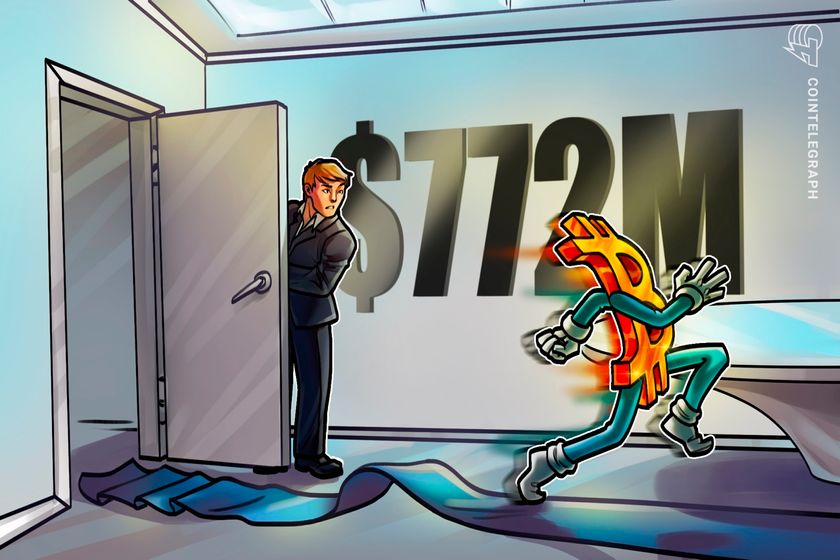
Spot Bitcoin ETFs see $772M outflow as investors prepare for tariff-driven inflation

Bitcoin (BTC) spot exchange-traded funds (ETFs) faced significant pressure amid uncertainty caused by the ongoing global trade war. Between March 28 and April 8, these ETFs experienced net outflows totaling $595 million, according to Farside Investors data. Notably, even after most US import tariffs were temporarily lifted on April 9, the funds still recorded an additional $127 million in net outflows.

This situation has left traders questioning the reasons behind the continued outflows and why Bitcoin’s rally to $82,000 on April 9 failed to boost confidence among ETF investors.

Spot Bitcoin ETFs see $772M outflow as investors prepare for tariff-driven inflation

Spot Bitcoin ETF net flows. Source: Farside Investors

Corporate credit risk could be driving investors away from BTC

One factor contributing to diminished interest is the rising likelihood of an economic recession. “What you can clearly observe is that liquidity on the credit side has dried up,” Lazard Asset Management global fixed income co-head Michael Weidner told Reuters. Essentially, investors are shifting toward safer assets like government bonds and cash holdings, a trend that could ultimately lead to a credit crunch.

A credit crunch is a sharp decline in loan availability, leading to reduced business investment and consumer spending. It can happen regardless of US Treasury yields because heightened borrower risk perceptions may independently restrict credit supply.

RW Baird strategist Ross Mayfield noted that even if the US Federal Reserve decides to cut interest rates in an effort to stabilize turbulent markets, any relief for companies might be short-lived.

Mayfield reportedly stated: “In a stagflationary environment from tariffs, you’ll see both investment grade and high yield corporate borrowers struggle as their costs of debt rise.” Despite the 10-year US Treasury yield remaining flat compared to the previous month, investor appetite for corporate debt remains weak.

Spot Bitcoin ETFs see $772M outflow as investors prepare for tariff-driven inflation

ICE Bank of America Corporate Index option-adjusted spread. Source: TradingView / Cointelegraph

Dan Krieter, director of fixed income strategy at BMO Capital Markets, told Reuters that corporate bond spreads have experienced their largest one-week widening since the regional banking crisis in March 2023. Corporate bond spreads measure the difference in interest rates between corporate bonds and government bonds, reflecting the additional risk investors take when lending to companies.

Related: Bitwise doubles down on $200K Bitcoin price prediction amid trade tension

Trade war takes center stage, limiting investor interest in BTC

Investors remain concerned that even if the US Federal Reserve cuts interest rates, it may not be enough to restore confidence in the economy. This sentiment also explains why the US Consumer Price Index (CPI) for March—at 2.8%, its slowest annual increase in four years — failed to positively impact stock markets.

“This is the last clean print we’re going to see before we get those tariff-induced inflation increases,” Joe Brusuelas, RSM chief economist, told Yahoo Finance.

Traders appear to be waiting for stabilization in the corporate bond market before regaining confidence in Bitcoin ETF inflows. As long as recession risks remain elevated, investors will likely favor safer assets such as government bonds and cash holdings.

Breaking this correlation would require a shift in perception toward Bitcoin’s fixed monetary policy and censorship resistance. However, potential catalysts for such a change remain unclear and could take months or even years.

This article is for general information purposes and is not intended to be and should not be taken as legal or investment advice. The views, thoughts, and opinions expressed here are the author’s alone and do not necessarily reflect or represent the views and opinions of Cointelegraph.

Read more at cointelegraph.com

Jack Dorsey's Block fined $40M for alleged crypto compliance, AML failures

Digital payments company Block Inc. has reached a $40 million settlement with New York regulators over alleged compliance misconducts tied to its Cash App platform, Bloomberg reported on April 10.

Block was fined by the New York Department of Financial Services (NYDFS) following an investigation into Cash App’s Anti-Money Laundering (AML) and cryptocurrency compliance operations, Bloomberg said after reviewing the government agency’s consent order. 

NYDFS determined that Block allegedly violated consumer protection laws and didn’t conduct proper due diligence on its customers. The company was allegedly too slow in reporting suspicious transactions to regulators and failed to adequately screen so-called “high-risk” Bitcoin (BTC) transactions. 

Block confirmed that it had worked with NYDFS to “resolve the matter principally related to Cash App’s past compliance program.” However, it did not admit to any wrongdoing, according to Bloomberg. 

Block, which was founded by internet entrepreneur and Bitcoin advocate Jack Dorsey in 2009, had been negotiating a settlement with the NYDFS since last year, based on filings submitted with the US Securities and Exchange Commission (SEC).

Jack Dorsey's Block fined $40M for alleged crypto compliance, AML failures

Excerpts of Block Inc.’s February Form 10K filing with the SEC. Source: SEC

The NYDFS settlement isn’t the first monetary penalty Block has agreed to pay this year. As Cointelegraph reported, the company paid $80 million in fines to several state regulators over alleged violations tied to its AML program.

Related: NYDFS chief’s advice for crypto firms: ‘Never surprise your regulator’

Block remains in growth mode

Despite getting caught in regulatory crosshairs, Block’s underlying business remained strong at the end of 2024. Companywide revenues increased by roughly 4.5% year-over-year to $6.03 billion as per-share earnings climbed 51% to $0.71. 

The other positive takeaway was that Block’s merchant gross payment volume, or the total amount of money processed through its systems, increased by 10% to $61.95 billion. 

Cash App continues to be a source of growth, with the unit recording $1.38 billion in gross profit in the fourth quarter. 

The mobile payment service had more than 57 million monthly transacting users in early 2024. 

Jack Dorsey's Block fined $40M for alleged crypto compliance, AML failures

Despite reporting strong growth, Block Inc.’s (XYZ) share price has fallen more than 37% this year as part of a marketwide sell-off. Source: Yahoo Finance

Cash App users have been able to buy Bitcoin through the platform since at least 2018. In 2023, Cash App integrated crypto accounting software TaxBit, giving users an easier way to track and report their crypto-related taxes. 

Magazine: Bitcoin heading to $70K soon? Crypto baller funds SpaceX flight: Hodler’s Digest, March 30 – April 5

Read more at cointelegraph.com

Ether ETF staking could come as soon as May — Bloomberg analyst

Ether exchange-traded funds (ETFs) in the United States may be able to start staking a portion of their tokens as soon as May, according to Bloomberg Intelligence analyst James Seyffart. 

On April 9, the US Securities and Exchange Commission (SEC) authorized exchanges to begin listing options contracts tied to spot Ether (ETH) ETFs after greenlighting Bitcoin (BTC) ETF options in September. However, issuers are still waiting for the regulator to allow Ether ETFs to offer staking after filing numerous requests for permission earlier this year.

Ether ETF staking could come as soon as May — Bloomberg analyst

Source: James Seyffart

The approval of options contracts could represent a key step toward regulatory approval for staking services in the United States. Bloomberg Intelligence analyst James Seyffart said on April 9 that clearance for staking on ETH funds could come as early as May but would likely take until the end of 2025.

“It’s possible they could be approved for staking early, but the final deadline is at the end of October,” Seyffart said in a post on the X platform. “Potential intermediate deadlines before the final approval (or denial) are in late May & late August.”

Options are financial derivatives that give investors the right, but not the obligation, to buy or sell an asset at a predetermined price before a certain date. Staking, on the other hand, involves locking up a cryptocurrency, like ETH, to support network operations — such as validating transactions — in exchange for rewards.

In ETH funds, options contracts allow investors to hedge or speculate on the tokens’ prices, while staking offers a way to earn rewards by participating in Ethereum’s proof-of-stake network.

Ether ETF staking could come as soon as May — Bloomberg analyst

Ether ETF inflows. Source: Farside Investors

Related: SEC approves options on spot Ether ETFs

Progress toward adoption

Ether ETFs launched in June 2024 but struggled to attract significant investor interest. According to data from Farside Investors, the funds have seen net inflows of $2.4 billion as of April 10, compared to $35 billion for Bitcoin ETFs introduced in January. Analysts say the SEC’s approval of Ether ETF options could help spur adoption.

Asset managers are also waiting on the SEC to greenlight requests to allow in-kind creations and redemptions for Bitcoin and Ether ETFs.

The emergence of options markets tied to spot crypto ETFs is a “monumental advancement” in crypto markets and creates “extremely compelling opportunities” for investors,” Jeff Park, Bitwise Invest’s head of alpha strategies, said in a Sept. 20 X post

But staking could be the most significant step forward for Ether funds. 

In March, Robbie Mitchnick, BlackRock’s head of digital assets, said Ether ETFs are “less perfect” without staking. “A staking yield is a meaningful part of how you can generate investment return in this space.”

Magazine: Memecoin degeneracy is funding groundbreaking anti-aging research

Read more at cointelegraph.com

Meanwhile raises $40M to bring BTC life insurance to inflation-prone economies

Crypto startup Meanwhile has raised $40 million to scale its Bitcoin-denominated life insurance business, targeting so-called “inflation-prone economies” where policyholders may seek alternatives to traditional fiat-based payouts.

The Series A investment round was led by Framework Ventures and Fulgur Ventures, with additional participation from Xapo founder Wences Casares, the company disclosed on April 10. 

Meanwhile previously secured $20.5 million in seed funding backed by OpenAI CEO Sam Altman and others.

Funding, Venture Capital, Insurance, Bermuda

Source: Meanwhilelife

Regulated by the Bermuda Monetary Authority, Meanwhile offers a whole life insurance policy denominated in Bitcoin (BTC), giving policyholders the ability to safeguard the value of their life insurance against currency debasement. 

Policyholders can access the value of their life insurance anytime through loans and tax-free partial withdrawals. 

Meanwhile co-founder Zac Townsend told Fortune that the company’s life insurance policies operate similarly to typical life insurance policies, but monthly premiums are paid in Bitcoin. When a policyholder passes away, their family receives the value of the claim entirely in BTC. 

The company’s policies are geared toward clients living in regions with high inflation or currency instability, Townsend said. Given the inflationary tendencies of Western economies and the extreme currency fluctuations in emerging markets, Meanwhile has cast a very wide net on its addressable market. 

Related: Bitcoin price could rally even as global trade war rages on — Here’s why

Bitcoin and the inflation problem

Bitcoin’s deflationary design has made it a popular store of value for early cryptocurrency adopters, but its role as an inflation hedge in the traditional sense is subject to debate. 

A 2025 study that appeared in the Journal of Economics and Business determined that Bitcoin’s inflation-hedging abilities have weakened in recent years due to rising institutional adoption. The study referenced Bitcoin’s 60% drop in 2022 when US inflation surged to a 40-year high above 9%.

However, some analysts may counter that claim by arguing that investors purchased Bitcoin during the pandemic on expectations that inflation would rise due to massive government stimulus.

During this period, “Investors saw that inflation was coming, so they began buying bitcoin hand-over-fist,” said investor and analyst Anthony Pompliano.

Regardless of whether Bitcoin meets the technical definition of an inflation hedge, the asset has significantly outperformed inflation, or the debasement of currency, since its inception. 

The Bitcoin price dipped below $80,000 on April 10 after the latest US inflation data triggered renewed volatility in the market. Nevertheless, the report showed a sharp deceleration in annual inflation in March, with the Consumer Price Index falling to 2.4% from 2.8% in February.

Funding, Venture Capital, Insurance, Bermuda

The Bitcoin price experienced heavy intraday volatility following the latest US CPI data. Source: Cointelegraph

Related: As Trump tanks Bitcoin, PMI offers a roadmap of what comes next

Read more at cointelegraph.com

Bitcoin, stocks shun CPI print win and give up tariff relief gains — Will BTC whales save the day?

Bitcoin (BTC) price failed to hold its weekly open gains on April 10 as US stocks ignored positive inflation data.Bitcoin, stocks shun CPI print win and give up tariff relief gains — Will BTC whales save the day?

BTC/USD 1-hour chart. Source: Cointelegraph/TradingView

Data from Cointelegraph Markets Pro and TradingView showed BTC price volatility ticking higher around the release of the March Consumer Price Index (CPI) numbers.

These numbers came in broadly below expectations, revealing slowing inflationary forces despite mass-market disruption due to US trade tariffs.

An official press release from the US Bureau of Labor Statistics (BLS) stated:

“The all items index rose 2.4 percent for the 12 months ending March, after rising 2.8 percent over the 12 months ending February. The all items less food and energy index rose 2.8 percent over the last 12 months, the smallest 12-month increase since March 2021.”Bitcoin, stocks shun CPI print win and give up tariff relief gains — Will BTC whales save the day?

US CPI 12-month % change. Source: BLS

While notionally a tailwind for risk assets, US stocks were in no mood for relief at the open. The S&P 500 and Nasdaq Composite Index were down 3% and 3.7%, respectively, at the time of writing.

“Markets think the recently strong jobs report and cool inflation data gives Trump the ‘green light’ to continue the trade war,” trading resource The Kobeissi Letter suggested in part of a response on X.

Kobeissi nonetheless acknowledged the implications of rapidly declining inflation — something which tariffs had yet to influence.

“This marks the lowest Core CPI inflation rate in 4 years,” it continued in a separate X thread. 

“It also puts Headline CPI inflation just 40 basis points above the Fed’s 2% target. Inflation is down 60 basis points over the last 3 months alone.”BTC price rebound may rest with ”Spoofy the Whale”

Turning to BTC price action, market participants were in a wait-and-see mode after the US paused the majority of its tariff implementations for 90 days.

Related: Crypto trading firm warns of ‘classic bull trap’ as Bitcoin tags $82.7K

For popular trader Daan Crypto Trades, a reclaim of at least $83,000 was necessary as an initial step for bulls.

“$BTC Saw a strong move after the tariff pause was announced,” he told X followers.

“Where BTC was more resilient on the downside, we saw equities pump more on the back of this pause (which makes sense as those are directly influenced by the tariffs).”

An accompanying chart showed nearby key trend lines around the spot price.

“BTC traded right back into the 4H 200MA (Purple) which has capped price over the past couple of weeks. That $83-85K is a key level to overtake for the bulls,” he continued.

“Right below we can see the ~$81.1K horizontal being a key level that sees quite a lot of action. I think it’s a good one to watch in the short term. Trading below that area could turn this into a nasty deviation/stop hunt.”Bitcoin, stocks shun CPI print win and give up tariff relief gains — Will BTC whales save the day?

BTC/USDT perpetual swaps 4-hour chart. Source: Daan Crypto Trades/X

Analyzing order book liquidity, Keith Alan, co-founder of trading resource Material Indicators, drew attention to both the 21-day and 50-day simple moving averages (SMA) on the daily chart.

“First attempt at breaking resistance at the 21-Day MA was rejected, however BTC bid liquidity is moving higher so I think we’ll see another attempt,” he summarized earlier on the day. 

“If bulls can R/S Flip the 21-Day, there is even stronger resistance where liquidity is stacked around the trend line and the 50-Day MA.”Bitcoin, stocks shun CPI print win and give up tariff relief gains — Will BTC whales save the day?

BTC/USD 1-day chart with 21, 50 SMA. Source: Cointelegraph/TradingView

Alan reiterated the role of large-volume traders shifting liquidity above and below Bitcoin’s spot price to influence price action. The actions of one entity in particular, which he previously dubbed “Spoofy the Whale,” remained a point of consideration.

“If ‘Spoofy’ will give us a roof pull, we’ll get a shot at the 100-Day and the 2025 open at $93.3k, which is the gateway back to 6-figure Bitcoin,” he concluded.

Bitcoin, stocks shun CPI print win and give up tariff relief gains — Will BTC whales save the day?

BTC/USDT order book liquidity data. Source: Keith Alan/X

This article does not contain investment advice or recommendations. Every investment and trading move involves risk, and readers should conduct their own research when making a decision.

Read more at cointelegraph.com

AI-generated content needs blockchain before trust in digital media collapses

Opinion by: Roman Cyganov, founder and CEO of Antix

In the fall of 2023, Hollywood writers took a stand against AI’s encroachment on their craft. The fear: AI would churn out scripts and erode authentic storytelling. Fast forward a year later, and a public service ad featuring deepfake versions of celebrities like Taylor Swift and Tom Hanks surfaced, warning against election disinformation. 

We are a few months into 2025. Still, AI’s intended outcome in democratizing access to the future of entertainment illustrates a rapid evolution — of a broader societal reckoning with distorted reality and massive misinformation.

Despite this being the “AI era,” nearly 52% of Americans are more concerned than excited about its growing role in daily life. Add to this the findings of another recent survey that 68% of consumers globally hover between “somewhat” and “very” concerned about online privacy, driven by fears of deceptive media. 

It’s no longer about memes or deepfakes. AI-generated media fundamentally alters how digital content is produced, distributed and consumed. AI models can now generate hyper-realistic images, videos and voices, raising urgent concerns about ownership, authenticity and ethical use. The ability to create synthetic content with minimal effort has profound implications for industries reliant on media integrity. This indicates that the unchecked spread of deepfakes and unauthorized reproductions without a secure verification method threatens to erode trust in digital content altogether. This, in turn, affects the core base of users: content creators and businesses, who face mounting risks of legal disputes and reputational harm. 

While blockchain technology has often been touted as a reliable solution for content ownership and decentralized control, it’s only now, with the advent of generative AI, that its prominence as a safeguard has risen, especially in matters of scalability and consumer trust. Consider decentralized verification networks. These enable AI-generated content to be authenticated across multiple platforms without any single authority dictating algorithms related to user behavior.

Getting GenAI onchain

Current intellectual property laws are not designed to address AI-generated media, leaving critical gaps in regulation. If an AI model produces a piece of content, who legally owns it? The person providing the input, the company behind the model or no one at all? Without clear ownership records, disputes over digital assets will continue to escalate. This creates a volatile digital environment where manipulated media can erode trust in journalism, financial markets and even geopolitical stability. The crypto world is not immune from this. Deepfakes and sophisticated AI-built attacks are causing insurmountable losses, with reports highlighting how AI-driven scams targeting crypto wallets have surged in recent months. 

Blockchain can authenticate digital assets and ensure transparent ownership tracking. Every piece of AI-generated media can be recorded onchain, providing a tamper-proof history of its creation and modification. 

Akin to a digital fingerprint for AI-generated content, permanently linking it to its source, allowing creators to prove ownership, companies to track content usage, and consumers to validate authenticity. For example, a game developer could register an AI-crafted asset on the blockchain, ensuring its origin is traceable and protected against theft. Studios could use blockchain in film production to certify AI-generated scenes, preventing unauthorized distribution or manipulation. In metaverse applications, users could maintain complete control over their AI-generated avatars and digital identities, with blockchain acting as an immutable ledger for authentication.

End-to-end use of blockchain will eventually prevent the unauthorized use of AI-generated avatars and synthetic media by implementing onchain identity verification. This would ensure that digital representations are tied to verified entities, reducing the risk of fraud and impersonation. With the generative AI market projected to reach $1.3 trillion by 2032, securing and verifying digital content, particularly AI-generated media, is more pressing than ever through such decentralized verification frameworks.

Recent: AI-powered romance scams: The new frontier in crypto fraud

Such frameworks would further help combat misinformation and content fraud while enabling cross-industry adoption. This open, transparent and secure foundation benefits creative sectors like advertising, media and virtual environments.

Aiming for mass adoption amid existing tools

Some argue that centralized platforms should handle AI verification, as they control most content distribution channels. Others believe watermarking techniques or government-led databases provide sufficient oversight. It’s already been proven that watermarks can be easily removed or manipulated, and centralized databases remain vulnerable to hacking, data breaches or control by single entities with conflicting interests.

It’s quite visible that AI-generated media is evolving faster than existing safeguards, leaving businesses, content creators and platforms exposed to growing risks of fraud and reputational damage.

For AI to be a tool for progress rather than deception, authentication mechanisms must advance simultaneously. The biggest proponent for blockchain’s mass adoption in this sector is that it provides a scalable solution that matches the pace of AI progress with the infrastructural support required to maintain transparency and legitimacy of IP rights. 

The next phase of the AI revolution will be defined not only by its ability to generate hyper-realistic content but also by the mechanisms to get these systems in place on time, significantly, as crypto-related scams fueled by AI-generated deception are projected to hit an all-time high in 2025. 

Without a decentralized verification system, it’s only a matter of time before industries relying on AI-generated content lose credibility and face increased regulatory scrutiny. It’s not too late for the industry to consider this aspect of decentralized authentication frameworks more seriously before digital trust crumbles under unchecked deception.

Opinion by: Roman Cyganov, founder and CEO of Antix.

This article is for general information purposes and is not intended to be and should not be taken as legal or investment advice. The views, thoughts, and opinions expressed here are the author’s alone and do not necessarily reflect or represent the views and opinions of Cointelegraph.

Read more at cointelegraph.com

AI-generated content needs blockchain before trust in digital media collapses

Opinion by: Roman Cyganov, founder and CEO of Antix

In the fall of 2023, Hollywood writers took a stand against AI’s encroachment on their craft. The fear: AI would churn out scripts and erode authentic storytelling. Fast forward a year later, and a public service ad featuring deepfake versions of celebrities like Taylor Swift and Tom Hanks surfaced, warning against election disinformation. 

We are a few months into 2025. Still, AI’s intended outcome in democratizing access to the future of entertainment illustrates a rapid evolution — of a broader societal reckoning with distorted reality and massive misinformation.

Despite this being the “AI era,” nearly 52% of Americans are more concerned than excited about its growing role in daily life. Add to this the findings of another recent survey that 68% of consumers globally hover between “somewhat” and “very” concerned about online privacy, driven by fears of deceptive media. 

It’s no longer about memes or deepfakes. AI-generated media fundamentally alters how digital content is produced, distributed and consumed. AI models can now generate hyper-realistic images, videos and voices, raising urgent concerns about ownership, authenticity and ethical use. The ability to create synthetic content with minimal effort has profound implications for industries reliant on media integrity. This indicates that the unchecked spread of deepfakes and unauthorized reproductions without a secure verification method threatens to erode trust in digital content altogether. This, in turn, affects the core base of users: content creators and businesses, who face mounting risks of legal disputes and reputational harm. 

While blockchain technology has often been touted as a reliable solution for content ownership and decentralized control, it’s only now, with the advent of generative AI, that its prominence as a safeguard has risen, especially in matters of scalability and consumer trust. Consider decentralized verification networks. These enable AI-generated content to be authenticated across multiple platforms without any single authority dictating algorithms related to user behavior.

Getting GenAI onchain

Current intellectual property laws are not designed to address AI-generated media, leaving critical gaps in regulation. If an AI model produces a piece of content, who legally owns it? The person providing the input, the company behind the model or no one at all? Without clear ownership records, disputes over digital assets will continue to escalate. This creates a volatile digital environment where manipulated media can erode trust in journalism, financial markets and even geopolitical stability. The crypto world is not immune from this. Deepfakes and sophisticated AI-built attacks are causing insurmountable losses, with reports highlighting how AI-driven scams targeting crypto wallets have surged in recent months. 

Blockchain can authenticate digital assets and ensure transparent ownership tracking. Every piece of AI-generated media can be recorded onchain, providing a tamper-proof history of its creation and modification. 

Akin to a digital fingerprint for AI-generated content, permanently linking it to its source, allowing creators to prove ownership, companies to track content usage, and consumers to validate authenticity. For example, a game developer could register an AI-crafted asset on the blockchain, ensuring its origin is traceable and protected against theft. Studios could use blockchain in film production to certify AI-generated scenes, preventing unauthorized distribution or manipulation. In metaverse applications, users could maintain complete control over their AI-generated avatars and digital identities, with blockchain acting as an immutable ledger for authentication.

End-to-end use of blockchain will eventually prevent the unauthorized use of AI-generated avatars and synthetic media by implementing onchain identity verification. This would ensure that digital representations are tied to verified entities, reducing the risk of fraud and impersonation. With the generative AI market projected to reach $1.3 trillion by 2032, securing and verifying digital content, particularly AI-generated media, is more pressing than ever through such decentralized verification frameworks.

Recent: AI-powered romance scams: The new frontier in crypto fraud

Such frameworks would further help combat misinformation and content fraud while enabling cross-industry adoption. This open, transparent and secure foundation benefits creative sectors like advertising, media and virtual environments.

Aiming for mass adoption amid existing tools

Some argue that centralized platforms should handle AI verification, as they control most content distribution channels. Others believe watermarking techniques or government-led databases provide sufficient oversight. It’s already been proven that watermarks can be easily removed or manipulated, and centralized databases remain vulnerable to hacking, data breaches or control by single entities with conflicting interests.

It’s quite visible that AI-generated media is evolving faster than existing safeguards, leaving businesses, content creators and platforms exposed to growing risks of fraud and reputational damage.

For AI to be a tool for progress rather than deception, authentication mechanisms must advance simultaneously. The biggest proponent for blockchain’s mass adoption in this sector is that it provides a scalable solution that matches the pace of AI progress with the infrastructural support required to maintain transparency and legitimacy of IP rights. 

The next phase of the AI revolution will be defined not only by its ability to generate hyper-realistic content but also by the mechanisms to get these systems in place on time, significantly, as crypto-related scams fueled by AI-generated deception are projected to hit an all-time high in 2025. 

Without a decentralized verification system, it’s only a matter of time before industries relying on AI-generated content lose credibility and face increased regulatory scrutiny. It’s not too late for the industry to consider this aspect of decentralized authentication frameworks more seriously before digital trust crumbles under unchecked deception.

Opinion by: Roman Cyganov, founder and CEO of Antix.

This article is for general information purposes and is not intended to be and should not be taken as legal or investment advice. The views, thoughts, and opinions expressed here are the author’s alone and do not necessarily reflect or represent the views and opinions of Cointelegraph.

Read more at cointelegraph.com