cointelegraph.com

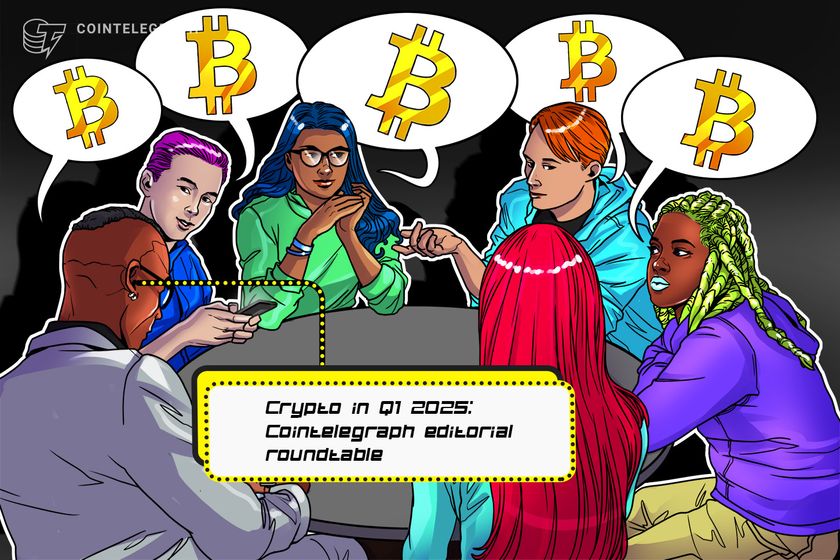
Memecoins, markets and Trump: Cointelegraph’s Q1 crypto editorial roundtable

The year 2025 kicked off with a bang and a meme. Just weeks into the New Year, a frenzy of politically fueled memecoins sent Crypto Twitter into overdrive, while lawmakers on both sides of the Atlantic turned up the heat on stablecoins, securities laws and tokenized assets, usually with different approaches.

It was a whirlwind first quarter, shaped by Bitcoin’s dominance in the crypto market and a US political climate that put digital assets back in the spotlight. Q1 delivered no shortage of storylines.

Who better to break it all down than the journalists tracking it in real time? In the latest episode of Decentralize with Cointelegraph, editorial team members sit down for an unfiltered newsroom roundtable.

Savannah Fortis, head of podcasts and EU reporter, is joined by Gareth Jenkinson, chief of multimedia; Zoltan Vardai, breaking news reporter on the EU news team; and Vince Quill, US news reporter, to reflect on Q1’s biggest stories and what they signal for the months ahead.

Memecoins, power and perception

As memecoins surged in early 2025, questions regarding their legitimacy and political entanglement intensified. For Cointelegraph’s editorial team, the frenzy wasn’t just a market quirk, it revealed deep tensions among innovation, opportunism and influence.

Jenkinson was first to comment on what the impact of US President Donald Trump and greater political memecoin frenzies may mean for the industry in the long term, saying, “I struggle to still trust what the Trump administration and his group of advisers are doing, when they are launching things like memecoins…”

“Yes, we’ve seen a much more favorable approach to the wider crypto industry, and that’s been really great. But a lot of the lobbying, from Ripple, Circle and others, was about making sure their cryptocurrencies were included in this bundle of assets the US wants to hold.”

Related: Bitcoin may hit a wall at $84K if bullish conditions don’t pick up: CryptoQuant

The team acknowledged that while regulatory clarity and institutional support have created a more stable environment for crypto companies in general since the new administration took office, that progress risks being overshadowed by spectacle.

More memes…

Trump’s big moves seem to domino into other political figures, namely Argentina’s President Javier Milei, to become entangled in a high-profile memecoin controversy that rippled far beyond national politics.

For an industry seeking legitimacy, this kind of involvement by world leaders sends a mixed message. “It’s terrible for the industry,” Jenkinson added. “Milei was supposed to be a savior for Argentina after years of hyperinflation. And now he’s launching a memecoin with a known rug puller.”

Still, the roundtable remained hopeful. “I’m an eternal optimist,” he continued. “At least we got the affirmation for Bitcoin. People now understand what it is, governments are starting to hold it. That’s how good the fundamentals are.”

Stablecoins and the altcoin fallout

While much attention has centered on Bitcoin’s institutional glow-up and the memecoin spectacle, several members of the Cointelegraph team voiced deeper concerns around emerging stablecoin legislation and the quiet moves behind it.

“One thing that I think kind of flew under the radar is that the Trump-linked World Liberty Forum actually launched a US dollar-backed stablecoin in March,” Vardai pointed out. 

“These stablecoins would fall completely in line with both requirements in the Genius Act and Stable Act… but it could really be interpreted as Trump trying to pass stablecoin legislation while having a vested interest. His World Liberty Financial is launching a lot of crypto-related products.”

The fallout from politically aligned memecoins has also weighed heavily on the broader crypto markets, particularly altcoins. “Altcoins aren’t really winning at all this quarter,” Vardai also noted.

“Memecoins have had this premature rally, and they’ve been rallying independently from other cryptocurrencies. A lot of people are concerned whether Bitcoin’s rise is going to come before Ether’s, and before any altcoin rise.”

So what defined Q1 of 2025? Tune in to the full episode to hear all of the insights! 

Memecoins, markets and Trump: Cointelegraph’s Q1 crypto editorial roundtable

Listen to the full episode of Decentralize with Cointelegraph on Cointelegraph’s podcast page, Spotify, Apple Podcasts or your podcast platform of choice. And don’t forget to check out Cointelegraph’s full lineup of other shows!

Magazine: Memecoin degeneracy is funding groundbreaking anti-aging research
Read more at cointelegraph.com

Trump memecoins worth $321M to hit the market next week

United States President Donald Trump’s official memecoin is set to unlock $321 million worth of vested tokens on April 18.

Token vesting tracker Tokenomist data shows that 40 million Trump tokens will be released in a cliff unlock, meaning the tokens will be available all at once. With the tokens currently trading at about $8, the unlock represents about $321 million in supply entering the market at once.

Token vesting is a common practice in the crypto space to incentivize long-term holding and prevent early investors or team members from dumping tokens during the start of the project. Instead, projects impose a vesting period that allows individuals or entities to gradually get access to the tokens. 

Trump memecoin down 89% since its peak

While the token’s creators reportedly profited by more than $350 million, retail investors have not fared as well. Blockchain analytics firm Chainalysis estimates that at least 813,000 wallets suffered losses totaling roughly $2 billion following the memecoin’s rapid rise and fall.

Trump’s official token has seen a sharp decrease in value since its peak. On Jan. 19, the token reached an all-time high (ATH) of $73.43. This happened a day before the then-incoming US president was inaugurated. The hype surrounding the token has died down since. Its current value of $8 represents an 89% drop since its ATH. 

The forthcoming token unlock might also cause a further price drop for the Trump memecoin. Massive token unlocks are often followed by sharp declines in crypto prices as holders who previously couldn’t sell will be allowed to offload their crypto. 

In March 2024, Arbitrum unlocked $2.32 billion in vested crypto tokens. At the time, its ARB token was worth $1.89. However, the event was followed by a decline in the crypto asset’s value, with the token trading at $0.29 at the time of writing, an 84% drop since the unlock. 

The Trump token is the largest single crypto unlock scheduled for the week of April 14–20. It accounts for roughly 61% of the total $519 million in tokens set to be released across several projects, according to Tokenomist.

Donald Trump, Data, Memecoin

$519 million in locked crypto tokens will be released next week. Source: Tokenomist

Related: Trump administration reportedly shutters DOJ’s crypto enforcement team

Tokens worth $519 million due to be unlocked next week

In addition to Trump’s memecoin, projects including Arbitrum, Fasttoken and Starknet will release vested tokens next week. 

FTN’s unlock is the second-biggest release after Trump’s memecoin. Tokenomist data shows the project will release 20 million FTN worth $80 million. The crypto assets are allocated to the team and its founders. 

Arbitrum will release ARB (ARB) tokens worth over $27 million next week, which will be unlocked for its founders, team members and private investors. Meanwhile, Starknet will release 127 million STRK (STRK) tokens worth $16 million. 

Magazine: Memecoin degeneracy is funding groundbreaking anti-aging research

Read more at cointelegraph.com

Trump memecoins worth $321M to hit the market next week

United States President Donald Trump’s official memecoin is set to unlock $321 million worth of vested tokens on April 18.

Token vesting tracker Tokenomist data shows that 40 million Trump tokens will be released in a cliff unlock, meaning the tokens will be available all at once. With the tokens currently trading at about $8, the unlock represents about $321 million in supply entering the market at once.

Token vesting is a common practice in the crypto space to incentivize long-term holding and prevent early investors or team members from dumping tokens during the start of the project. Instead, projects impose a vesting period that allows individuals or entities to gradually get access to the tokens. 

Trump memecoin down 89% since its peak

While the token’s creators reportedly profited by more than $350 million, retail investors have not fared as well. Blockchain analytics firm Chainalysis estimates that at least 813,000 wallets suffered losses totaling roughly $2 billion following the memecoin’s rapid rise and fall.

Trump’s official token has seen a sharp decrease in value since its peak. On Jan. 19, the token reached an all-time high (ATH) of $73.43. This happened a day before the then-incoming US president was inaugurated. The hype surrounding the token has died down since. Its current value of $8 represents an 89% drop since its ATH. 

The forthcoming token unlock might also cause a further price drop for the Trump memecoin. Massive token unlocks are often followed by sharp declines in crypto prices as holders who previously couldn’t sell will be allowed to offload their crypto. 

In March 2024, Arbitrum unlocked $2.32 billion in vested crypto tokens. At the time, its ARB token was worth $1.89. However, the event was followed by a decline in the crypto asset’s value, with the token trading at $0.29 at the time of writing, an 84% drop since the unlock. 

The Trump token is the largest single crypto unlock scheduled for the week of April 14–20. It accounts for roughly 61% of the total $519 million in tokens set to be released across several projects, according to Tokenomist.

Donald Trump, Data, Memecoin

$519 million in locked crypto tokens will be released next week. Source: Tokenomist

Related: Trump administration reportedly shutters DOJ’s crypto enforcement team

Tokens worth $519 million are to be unlocked next week

In addition to Trump’s memecoin, projects including Arbitrum, Fasttoken and Starknet will release vested tokens next week. 

FTN’s unlock is the second-biggest release after Trump’s memecoin. Tokenomist data shows the project will release 20 million FTN worth $80 million. The crypto assets are allocated to the team and its founders. 

Arbitrum will release ARB tokens worth over $27 million next week, which will be unlocked for its founders, team members and private investors. Meanwhile, Starknet will release 127 million STRK tokens worth $16 million. 

Magazine: Memecoin degeneracy is funding groundbreaking anti-aging research

Read more at cointelegraph.com

New York bill proposes legalizing Bitcoin, crypto for state payments

A New York lawmaker has introduced legislation that would allow state agencies to accept cryptocurrency payments, signaling growing political momentum for digital asset integration in public services.

Assembly Bill A7788, introduced by Assemblyman Clyde Vanel, seeks to amend state financial law to allow New York state agencies to accept cryptocurrencies as a form of payment.

It would permit state agencies to accept payments in Bitcoin (BTC), Ether (ETH), Litecoin (LTC) and Bitcoin Cash (BCH), according to the bill’s text.

New York bill proposes legalizing Bitcoin, crypto for state payments

Source: Nysenate.gov

According to the bill, state offices could authorize crypto payments for “fines, civil penalties, rent, rates, taxes, fees, charges, revenue, financial obligations or other amounts,” as well as penalties, special assessments and interest.

Related: Trump’s tariff escalation exposes ‘deeper fractures’ in global financial system

Cryptocurrency legislation is becoming a focal point in New York, with Bill A7788 marking the state’s second crypto-focused legislation in a little over a month.

In March, New York introduced Bill A06515, aiming to establish criminal penalties to prevent cryptocurrency fraud and protect investors from rug pulls.

Crypto-focused legislation has gathered momentum since President Donald Trump took office on Jan. 20, with Trump signaling during his campaign that his administration intends to make crypto policy a national priority, as well as making the US a global hub for blockchain innovation.

Related: Illinois Senate passes crypto bill to fight fraud and rug pulls

New York may mandate state “service fee” on crypto payments

If passed, the bill would mark a significant shift in how New York handles digital assets. It would allow state entities to integrate cryptocurrency into the payment infrastructure used for collecting public funds.

The proposal also includes a clause allowing the state to impose a service fee on those choosing to pay with crypto. According to the text, the state may require “a service fee not exceeding costs incurred by the state in connection with the cryptocurrency payment transaction.” This could include transaction costs or fees owed to crypto issuers.

Assembly Bill A7788 has been referred to the Assembly Committee for review and may advance to the state Senate as the next step.

New York’s legislation comes shortly after the state of Illinois passed a crypto bill to fight fraud and rug pulls after the recent wave of insider schemes related to memecoins, Cointelegraph reported on April 11.

Magazine: XRP win leaves Ripple and industry with no crypto legal precedent set

Read more at cointelegraph.com

BlackRock reports $3B in digital asset inflows during Q1

BlackRock, the world’s largest asset manager with $11.6 trillion in assets under management, reported $84 billion in total net inflows in the first quarter of 2025, marking a 3% annualized growth in assets under management.

The firm’s strong performance was led by a record first quarter for iShares exchange-traded funds (ETFs) alongside continued strength in private markets and net inflows, according to BlackRock’s Q1 earnings released on April 11.

Of the $107 billion in net inflows to iShares ETFs, $3 billion, or 2.8% of the total ETF inflows, was directed to digital asset products in Q1, BlackRock said.

Bitcoin ETF, BlackRock, ETF, Companies

BlackRock’s net flow data in Q1 2025 (in billions of US dollars). Source: BlackRock

Alternative investments also played a significant role in Q1, with private market inflows totaling $9.3 billion.

Digital assets remain small segment

As of March 31, digital assets accounted for $34 million in base fees or less than 1% of BlackRock’s long-term revenue.

By the end of the first quarter, BlackRock’s total digital assets under management amounted to $50.3 billion, which represents about 0.5% of the firm’s $11.6 trillion in total assets under management.

BlackRock reports $3B in digital asset inflows during Q1

BlackRock’s business results in Q1 2025 (in millions of US dollars). Source: BlackRock

BlackRock’s financial results suggest that digital assets still make up a modest share of the company’s business.

Despite that, BlackRock’s $3 billion in digital asset inflows is notable given widespread liquidations in the Bitcoin ETF market earlier this year. The company’s figures suggest that investor interest in crypto-backed ETFs remains steady.

Base fee growth shows “best start to a year since 2021,” CEO says

Despite BlackRock recording a 70% drop in net inflows in the first quarter of 2025 compared to the previous quarter, with inflows falling from $281 billion in Q4 2024 to $84 billion, BlackRock CEO Larry Fink pointed to the company’s solid fee growth as a major indicator of success.

“We delivered 6% organic base fee growth in the first quarter, representing our best start to a year since 2021 and secular strength against a complex market backdrop,” Fink said in the report.

Related: Bitcoin could reduce dominance of US dollar — BlackRock

Fink also mentioned that the company is focused on helping clients navigate market and policy changes while also providing insights on “long-term structural growth opportunities,” adding:

“The goal for us is to keep our clients focused on the long-term, and help them achieve any near-term allocation or liquidity changes they need within the BlackRock platform.”

While BlackRock saw $3 billion in crypto asset inflows in Q1 2025, some other Bitcoin ETF issuers have suffered massive outflows.

Bitcoin ETF, BlackRock, ETF, Companies

Flows by issuer (in millions of US dollars). Source: CoinShares

According to CoinShares data, Grayscale saw roughly $1.4 billion in outflows from its crypto ETFs year-to-date as of April 4.

Magazine: Bitcoin heading to $70K soon? Crypto baller funds SpaceX flight: Hodler’s Digest, March 30 – April 5

Read more at cointelegraph.com

The whale, the hack and the psychological earthquake that hit HEX

An elderly crypto whale known as “HEX 19” lost nearly $4.5 million in a slow-moving hack that drained his staked HEX (HEX) over multiple years. 

At first, it looked like a HEX whale was cashing out. But it wasn’t long before the community realized he didn’t voluntarily unstake his tokens — he had become a victim of a major exploit.

The cyberattack started in November 2021, touched multiple phishing wallets, and was traced back to an online entity known as “Konpyl,” a threat actor familiar to crypto investigators.

The breach not only shook the token’s price but also exposed a web of fraudulent operations tied to Inferno Drainer and the $1.6-million fake Rabby wallet scam of February 2024.

The whale, the hack and the psychological earthquake that hit HEX

HEX token price sinks following the HEX19 hack. Source: CoinGecko

HEX hackers and the web of connections

A blockchain investigator who spoke to Cointelegraph on condition of anonymity said, “There’s direct counterparty exposure with wallets used in the fake Rabby app scam as well as the HEX19 victim’s funds flowing directly into wallets used to launder illicit Inferno Drainer phishing scam proceeds.”

The first major batch of outflows from the victim’s wallet occurred in November 2021 and has continued over the years as assets locked away in decade-long stakes continued to unlock, some prematurely closed by the hacker with penalties. 

The whale, the hack and the psychological earthquake that hit HEX

HEX19 wallet loses almost $4 million on Nov. 21. Source: Arkham Intelligence

Related: THORChain at crossroads: Decentralization clashes with illicit activity

The deeper investigators dug into the wallets tied to the HEX19 hack, the more it became clear that this wasn’t a one-off for the hacker. The same addresses appeared again and again across phishing campaigns, wallet drainers and laundering trails.

Wallets used by the HEX19 hacker, the fake Rabby wallet scam and several schemes related to Inferno Drainer share a common address: Konpyl.

In an October 2024 investigation, Cointelegraph’s Magazine analyzed on- and offchain evidence gathered by an investigator and a US government agency that links Konpyl to Konstantin Pylinskiy, an executive of a Dubai-based investment firm who uses the nickname in his online activities. Pylinskiy has denied any involvement with scams.

The investigator said the attack on HEX19 was possible because the victim had stored his seed phrases in the cloud. Transaction records show that the hackers use victim funds for initial transfers to their illicit accounts, a common trait of Konpyl-linked schemes. 

“The HEX19 hacker follows similar patterns from other scams by ‘Konpyl,’” they said.

In a November 2024 report, Cointelegraph learned that Konpyl-linked wallets had a high number of interactions with scams connected to Inferno Drainer, a scam-as-a-service threat actor.

Fantasy, a forensics specialist and investigations lead at crypto insurance firm Fairside Network, told Cointelegraph that Konpyl may possibly function less as a direct attacker and more as a laundering proxy.

Inside the HEX hack

The first batch of funds started moving out from the wallet on Nov. 21, 2021, but blockchain records show that the wallet may have been compromised as early as Nov. 3, as the victim wallet (0x97E…7a7df) had an outflow to one of the hacker’s wallets.

The whale, the hack and the psychological earthquake that hit HEX

On Nov. 21, HEX19 was drained of nearly $4 million across nine separate transactions. The majority of the losses were in HEX tokens. The primary destination was address 0xcfe…8A11D, which we will call HEX Hacker 1 (HH1).

That same day, HH1 began splitting the stolen funds. They sent $2.64 million (12.33 million HEX) to a second wallet, 0xA30…2EA17, or HEX Hacker 2 (HH2).

A follow-up transaction on Dec. 10, 2021, sent another 616,700 HEX (worth around $86,700 at the time) from HH1 to HH2.

On Feb. 18, 2022, HH1 transferred 5.2 million HEX (worth about $1 million at the time) and some Ether (ETH) to yet another address, 0x719a…4Bd0c, where the funds remain parked to this day.

The whale, the hack and the psychological earthquake that hit HEX

The HH2 wallet appears central to laundering efforts.

From December 2021 to March 2022, HH2 sent over $1 million to Tornado Cash, Ethereum’s best-known anonymizing protocol.

HH2 also transferred $106,758 in Dai (DAI) to an intermediary wallet, 0x837…2Ba9B, which was used to interact with decentralized finance (DeFi) platforms like 1inch to further obscure or swap funds.

The intermediary interacted with 0x7BF…C4eAa, a wallet that received direct inflows from Konpyl (an online persona that has appeared in numerous phishing and draining operations).

HH2’s laundering chain also intersects with a high-risk wallet — 0x909…e4371 — flagged for over 70 suspicious transactions.

The whale, the hack and the psychological earthquake that hit HEX

On May 16, 2024, a third wallet, Hex Hacker (HH3) — 0xdCe…4f0d8 — began withdrawing funds from the compromised HEX19 address.

HH3 has received around $108,000 in HEX from the victim’s account. 

HH3 connected to 0x87B…53d92, an address Cointelegraph previously identified in a November investigation as part of an Inferno Drainer-linked scam. That same wallet shares a commingling address (0xF2F…6a608) with Konpyl, which connects a March 2024 Inferno-linked scam and the Rabby wallet phishing incident.

Finally, a fourth wallet, 0x7cc…59ee2 — HEX Hacker 4 (HH4) — entered the picture. Beginning on Jan. 12, 2024, HH4 began siphoning funds from the HEX19 wallet through March.

Related: From Sony to Bybit: How Lazarus Group became crypto’s supervillain

This wallet interacted with 0x4E9…c71C2, which is a known address used by the fake Rabby wallet scammer.

Lessons from the HEX19 Hack

HEX19, the retired tech veteran, has been through booms and busts before — just not ones that emptied millions of dollars from his digital wallet in a single day.

He filed police reports, and exchanges couldn’t do much to help, he said. The remaining staked funds, including 10-year HEX locks, became ticking time bombs. He knew the hackers had access and were just waiting to extract more.

Cointelegraph has found at least 180 suspicious transactions from November 2021 to October 2024, totaling over $4.5 million. The victim’s wallet still has nine active stakes remaining, though their values aren’t as significant as those prematurely closed and withdrawn by the thieves.

The whale, the hack and the psychological earthquake that hit HEX

The active stakes are not as valuable as those closed by hackers. Source: HEXscout

“You have this feeling in the pit of your stomach and you say, ‘Oh my God.’ And then you say, ‘Oh, geez, I gotta tell my family that I’ve screwed up again,’” HEX19, purportedly a retiree in his 80s, said in an interview with HEX community member Mati Allin soon after the exploit. Cointelegraph attempted to get in touch with HEX19 but did not receive a response.

Despite the loss, HEX19 maintains a surprising sense of calm: “We’re retired. We live without debt. We live very simply. We have a great family, awesome daughters, granddaughters,” he said in the 2021 community interview. “There’s more to life than money.”

While he doesn’t expect to recover the funds, he does hope his experience helps others think twice before storing their seed phrases online.

Magazine: Financial nihilism in crypto is over — It’s time to dream big again

Read more at cointelegraph.com

Swedish MP proposes Bitcoin reserve to finance minister

A member of Sweden’s parliament proposed adding Bitcoin to the country’s foreign exchange reserves, suggesting increased openness to cryptocurrency adoption in Europe following recent moves by the United States.

Swedish MP Rickard Nordin issued an open letter urging Finance Minister Elisabeth Svantesson to consider adopting Bitcoin (BTC) as a national reserve asset.

“Sweden has a tradition of a conservative and carefully managed foreign exchange reserve, mainly consisting of foreign currencies and gold,” Nordin wrote in a letter registered on April 8, adding:

“At the same time, there is a rapid development in digital assets, and several international players regard bitcoin as a custodian and a hedge against inflation. In many parts of the world, bitcoin is used as a means of payment and as security against rising inflation.”

“It is also an important way for freedom fighters to handle payments when under the oppression of authoritarian regimes,” he added.

Swedish MP proposes Bitcoin reserve to finance minister

Open letter from MP Rickard Nordin. Source: Riksdagen.se

Related: US Bitcoin reserve marks’ real step’ toward global financial integration

The Swedish proposal echoes a recent move by the United States. In March, President Donald Trump signed an executive order to create a national Bitcoin reserve funded by cryptocurrency seized in criminal investigations rather than purchased through market channels.

The order authorized the Treasury and Commerce secretaries to develop “budget-neutral strategies” to buy more Bitcoin for the reserve, provided there were no additional costs to taxpayers.

The governor of the Czech National Bank has also considered Bitcoin as part of a potential diversification strategy for the country’s foreign reserves, Cointelegraph reported on Jan. 7.

Related: Bitcoin reserve backlash signals unrealistic industry expectations

European lawmakers silent on Bitcoin legislation amid CBDC push

European lawmakers have remained mostly silent on Bitcoin legislation despite Trump’s historic executive order and Bitcoin’s economic model favoring the early adopters.

The lack of Bitcoin-related statements may stem from Europe’s focus on the launch of the digital euro, a central bank digital currency (CBDC), James Wo, the founder and CEO of venture capital firm DFG, told Cointelegraph, adding:

“This highlights the EU’s greater emphasis on the digital euro, though the recent outage in the ECB’s Target 2 (T2) payment system, which caused significant transaction delays, raised concerns about its ability to oversee a digital currency when it struggles with daily operations.”

ECB President Christine Lagarde is pushing ahead with the digital euro’s rollout, expected in October. Lagarde has emphasized that the CBDC will coexist with cash and offer privacy protections to address concerns about government overreach.

“The European Union is looking to launch the digital euro, our central bank digital currency, by October this year,” Lagarde said during a news conference, adding:

“We are working to ensure that the digital euro coexists with cash, addressing privacy concerns by making it pseudonymous and cash-like in nature.”Swedish MP proposes Bitcoin reserve to finance minister

Source: Cointelegraph

This is in stark contrast to the approach of the US, where Trump has taken a firm stance against CBDCs, prohibiting “the establishment, issuance, circulation, and use” of a US dollar-based CBDC.

Magazine: SCB tips $500K BTC, SEC delays Ether ETF options, and more: Hodler’s Digest, Feb. 23 –March. 1

Read more at cointelegraph.com

Ethical hacker intercepts $2.6M in Morpho Labs exploit

A known maximal extractable value (MEV) white hat actor intercepted about $2.6 million in crypto assets stolen from Morpho Labs’ decentralized finance (DeFi) protocol. 

On April 10, Morpho Labs implemented a front-end update on its Morpho Blue application. A day later, a hacker breached an address through a vulnerability caused by the update. Blockchain security firm PeckShield reported that an address lost $2.6 million due to the vulnerability. 

However, the security firm noted that “c0ffeebabe.eth,” a known white hat MEV operator, had front-run the transaction, effectively intercepting the stolen funds.

At the time of writing, the funds had been transferred to a different wallet address. It’s unclear whether the funds have yet been returned to their original owner.

Morpho Labs reverts front-end update

Responding to the incident, Morpho Labs reversed its front-end update. In a post on X on April 11, the team confirmed it had been alerted to the issue and rolled back the changes. The team also said that normal operations had resumed:

“All funds in the Morpho Protocol are safe and unaffected. The Morpho team will provide a detailed update later today in this thread.”

After further investigation, the team confirmed that its front-end was safe and that users don’t need to perform additional actions to secure their assets. 

The team said the update was pushed to enhance the transaction flow. However, specific transactions on the front-end were incorrectly crafted. The Morpho Labs team said they’ve identified the issue and applied a fix. They added that they would publish a more detailed explanation of the incident next week. 

Cointelegraph reached out to the Morpho Labs team on X but did not receive a response by publication. 

Related: MEV bot loses $180K in ETH from access control exploit

White hat MEV operator c0ffeebabe.eth

C0ffeebabe.eth is known to have contributed to the recovery of funds during DeFi hacks. In 2023, the white hat MEV operator retrieved around $5.4 million in Ether (ETH) from the Curve Finance exploit in July 2023.  

During the incident, c0ffeebabe.eth used a bot to front-run a malicious hacker to secure 3,000 ETH. The funds were then returned to the Curve deployer address. 

In 2024, the mysterious white hat actor also recovered funds stolen during the Blueberry exploit. In an update, the DeFi protocol said all drained funds had been front-run by c0ffeebabe.eth and returned. 

Magazine: Illegal arcade disguised as … a fake Bitcoin mine? Soldier scams in China: Asia Express

Read more at cointelegraph.com

Bollinger Bands creator says Bitcoin forming 'classic' floor near $80K

Bitcoin (BTC) is exhibiting familiar “bottom” behavior at current prices, according to one of its best-known leading indicators. 

In an X post on April 10, John Bollinger, creator of the Bollinger Bands volatility metric, offered potentially good news to Bitcoin bulls.

Bollinger bands %b metric teases BTC price comeback

Bitcoin may already be establishing a long-term bottom, the latest Bollinger Bands data suggests.

Analyzing weekly timeframes, Bollinger drew attention to one of his proprietary indicators, known as “%b,” which offers further clues about market trend reversals.

The indicator %b measures an asset’s closing price relative to Bollinger Band position, employing standard deviation around a 20-period simple moving average (SMA). 

Among its insights is the “W” bottom formation, where a first low beneath zero is followed by a higher low retest later, something that could now be in play for BTC/USD.

Bollinger confirmed to X followers:

“Classic Bollinger Band W bottom setting up in $BTCUSD. Sill needs confirmation.”Bollinger Bands creator says Bitcoin forming 'classic' floor near $80K

BTC/USD 1-week chart with Bollinger Bands data. Source: John Bollinger/X

On both weekly and daily timeframes, Bollinger Bands show no trend shift has yet taken place.

Data from Cointelegraph Markets Pro and TradingView shows that the daily chart continues to walk down the lower band, with the middle SMA acting as resistance.

Bollinger Bands creator says Bitcoin forming 'classic' floor near $80K

BTC/USD 1-day chart with Bollinger Bands data. Source: Cointelegraph/TradingView

Turning to stocks, with which BTC/USD has become increasingly correlated, Jurrien Timmer, director of global macro at Fidelity Investments, drew similar conclusions.

“Revisiting the Bollinger Bands, we have gone from 2 standard deviations above-trend to on-trend to now almost 2 standard deviations below-trend,” he said in reference to the S&P 500 on April 9. 

“Again, oversold but not at an historic extreme.”Bitcoin bounce may follow 10% Nasdaq plunge

As Cointelegraph continues to report, BTC price bottom targets increasingly center around the $70,000 mark.

Related: Bitcoin, stocks shun CPI print win and give up tariff relief gains — Will BTC whales save the day?

That level is significant for several reasons, including as a psychological barrier and its status as a liquidity magnet.

Network economist Timothy Peterson, whose Lowest Price Forward metric previously offered 95% odds that $69,000 would stay intact as support, now sees Bitcoin reversing only after stocks find their own floor.

“Bitcoin led NASDAQ on this decline As the asset perceived to be at the top of the risk pyramid, I would expect NASDAQ to rally first, and then Bitcoin Just something to look for,” he revealed this week. 

“But I think NASDAQ has another -10% to fall.”Bollinger Bands creator says Bitcoin forming 'classic' floor near $80K

Bitcoin vs Nasdaq comparison. Source: Timothy Peterson/X

This article does not contain investment advice or recommendations. Every investment and trading move involves risk, and readers should conduct their own research when making a decision.

Read more at cointelegraph.com

Bollinger bands creator says Bitcoin forming 'classic' floor near $80K

Bitcoin (BTC) is exhibiting familiar “bottom” behavior at current prices, according to one of its best-known leading indicators. 

In an X post on April 10, John Bollinger, creator of the Bollinger bands volatility metric, revealed good news in progress for Bitcoin bulls.

Bollinger bands %b metric teases BTC price comeback

Bitcoin may already be establishing a long-term bottom, the latest Bollinger bands data suggests.

Analyzing weekly timeframes, Bollinger himself drew attention to one of his proprietary indicators, known as “%b,” which offers further clues about market trend reversals.

%b measures an asset’s closing price relative to Bollinger band position, employing standard deviation around a 20-period simple moving average (SMA). 

Among its insights is the “W” bottom formation, where a first low beneath zero is followed by a higher low retest later — something that could now be in play for BTC/USD.

Bollinger confirmed to X followers:

“Classic Bollinger Band W bottom setting up in $BTCUSD. Sill needs confirmation.”Bollinger bands creator says Bitcoin forming 'classic' floor near $80K

BTC/USD 1-week chart with Bollinger bands data. Source: John Bollinger/X

On both weekly and daily timeframes, Bollinger bands show no trend shift has taken place yet.

Data from Cointelegraph Markets Pro and TradingView shows that the daily chart continues to walk down the lower band, with the middle SMA acting as resistance.

Bollinger bands creator says Bitcoin forming 'classic' floor near $80K

BTC/USD 1-day chart with Bollinger bands data. Source: Cointelegraph/TradingView

Turning to stocks, with which BTC/USD has become increasing correlated, Jurrien Timmer, director of global macro at Fidelity Investments, drew similar conclusions.

“Revisiting the Bollinger Bands, we have gone from 2 standard deviations above-trend to on-trend to now almost 2 standard deviations below-trend,” he noted about the S&P 500 on April 9. 

“Again, oversold but not at an historic extreme.”Bitcoin bounce may follow 10% Nasdaq plunge

As Cointelegraph continues to report, BTC price bottom targets increasingly center around the $70,000 mark.

Related: Bitcoin, stocks shun CPI print win and give up tariff relief gains — Will BTC whales save the day?

That level is significant for several reasons, including as a psychological barrier and its status as a liquidity magnet.

Network economist Timothy Peterson, whose Lowest Price Forward metric previously offered 95% odds that $69,000 would stay intact as support, now sees Bitcoin reversing only after stocks find their own floor.

“Bitcoin led NASDAQ on this decline.  As the asset perceived to be at the top of the risk pyramid, I would expect NASDAQ to rally first, and then Bitcoin.  Just something to look for,” he revealed this week. 

“But I think NASDAQ has another -10% to fall.”Bollinger bands creator says Bitcoin forming 'classic' floor near $80K

Bitcoin vs. Nasdaq comparison. Source: Timothy Peterson/X

This article does not contain investment advice or recommendations. Every investment and trading move involves risk, and readers should conduct their own research when making a decision.

Read more at cointelegraph.com