cointelegraph.com

Crypto rug pulls have slowed, but are now more devastating: DappRadar

There has been a 66% year-on-year decrease in the number of crypto rug pulls this year compared to 2024, but recent data shows the size of each rug pull has been increasing.

Rug pulls have dropped in frequency year-over-year, with early 2024 recording 21 separate incidents, compared to only seven so far in 2025, according to an April 16 report from blockchain analytics platform DappRadar.

However, since the beginning of 2025, the Web3 ecosystem has lost nearly $6 billion to rug pulls, according to DappRadar’s report. However, the report attributes 92% of that to Mantra’s OM token collapse, which the founders have strongly denied was a rug pull.

In comparison, during the same period in early 2024, three months into the year, total losses from rug pulls hit $90 million.

“This shift suggests that rug pulls are becoming less frequent, but far more devastating when they do occur,” DappRadar analyst Sara Gherghelas said. 

“The scams are increasingly sophisticated, often orchestrated by teams with polished branding and well-planned narratives.”Memecoins main culprit for rug pulls 

Gherghelas says the nature of rug pulls is evolving. In the first quarter of 2024, most originated in DeFi protocols, NFT projects, and memecoins. In the same time frame for 2025, most rug pulls occurred in memecoins.

Libertad project’s native Solana token, Libra (LIBRA), is one of the more recent high-profile cases of a rug pull; it rallied to a market capitalization of $4.56 billion on Feb. 14 after Argentina’s president, Javier Milei, posted about it on X.

The token then fell by over 94% after he deleted the post, prompting accusations of a pump-and-dump scheme

“Rug pulls and exit scams remain a persistent threat, especially in ecosystems where projects can rapidly gain traction through hype, only to disappear with user funds overnight,” Gherghelas said.

“Despite increasing awareness and more tools to detect suspicious behavior, rug pulls remain a recurring issue, particularly in DeFi and newly launched token ecosystems.”

Gherghelas says red flags for rug pulls can include a sudden spike in unique active wallets without an apparent reason or unusually high volume paired with low user activity.

Cryptocurrencies, Scams, Memecoin, Rug PullsDappRadar analyst Sara Gherghelas says several red flags could signal a project is a rug pull. Source: DappRadar

At the same time, projects with unverified smart contracts, limited GitHub activity, or anonymous developer teams or DApps that spike overnight can also be a red flag.

Related: Savvy memecoin trader makes $988K in 3 hours despite rug pull

“As the industry matures, so do the tactics used by bad actors. But the tools available to users are also getting stronger,” Gherghelas said.

“While rug pulls may never be fully eradicated, their impact can be drastically reduced when users are equipped with the right information.”  

Magazine: Mystery celeb memecoin scam factory, HK firm dumps Bitcoin: Asia Express
Read more at cointelegraph.com

Manta founder details attempted Zoom hack by Lazarus that used very real ‘legit faces’

Manta Network co-founder Kenny Li says he was targeted by a highly sophisticated phishing attack on Zoom that used live recordings of familiar people in an attempt to have him download malware. 

The meeting seemed real with the impersonated person’s camera on, but the lack of sound and a suspicious prompt to download a script raised red flags, Li said in an April 17 X post.

“I could see their legit faces. Everything looked very real. But I couldn’t hear them. It said my Zoom needs an update. But it asked me to download a script file. I immediately left.”

Li then asked the impersonator to verify themselves over a Telegram call, however, they didn’t comply and proceeded to erase all messages and block him soon after.

Manta founder details attempted Zoom hack by Lazarus that used very real ‘legit faces’Source: Kenny Li

Li believes the North Korean state-backed Lazarus Group was behind the attack.

The Manta Network co-founder managed to screenshot his conversation with the attacker before the messages were deleted, where Li initially suggested moving the call over to Google Meet instead.

Manta founder details attempted Zoom hack by Lazarus that used very real ‘legit faces’Source: Kenny Li

Speaking with Cointelegraph, Li said he believes the live shots used in the video call were taken from past recordings of real team members.

“It didn’t seem AI-generated. The quality looked like what a typical webcam quality looks like.”

Manta founder details attempted Zoom hack by Lazarus that used very real ‘legit faces’Source: Kenny Li

Li confirmed that the real person’s accounts had been compromised by the Lazarus Group.

Beware of being asked to download anything, says Li

Li advised other members of the crypto community to always be aware of anything they’re asked to download out of the blue.

“The biggest red flag will always be a downloadable. Whether it’s in the form of an update, an attachment, app, or anything else, if you need to download something in order to continue something with the person on the other side, don’t do it.”

The Manta executive acknowledged that it could easily fool a crypto executive accustomed to being bombarded with messages and accepting sudden meeting requests.

“These are hacks that play to your emotional connection and potentially mental fatigue.”

Other members of the crypto community share similar stories

Li wasn’t the only to be targeted by the hackers in recent days.

“They also asked me to download Zoom via their link, and said that it’s only for their business. Even though I actually have Zoom on my computer, I couldn’t use it,” a member of ContributionDAO said.

Related: Lazarus Group’s 2024 pause was repositioning for $1.4B Bybit hack

“They claimed it had to be a business version that they had registered. When I requested to switch to Google Meet instead, they refused.”

Crypto researcher and X user “Meekdonald” said a friend of theirs fell victim to the exact same strategy that Li avoided.

Magazine: Meet the hackers who can help get your crypto life savings back

Read more at cointelegraph.com

Manta founder details attempted Zoom hack by Lazarus that used very real ‘legit faces’

Manta Network co-founder Kenny Li says he was targeted by a highly sophisticated phishing attack on Zoom that used live recordings of familiar people in an attempt to have him download malware. 

The meeting seemed real with the impersonated person’s camera on, but the lack of sound and a suspicious prompt to download a script raised red flags, Li said in an April 17 X post.

“I could see their legit faces. Everything looked very real. But I couldn’t hear them. It said my Zoom needs an update. But it asked me to download a script file. I immediately left.”

Li then asked the impersonator to verify themselves over a Telegram call, however, they didn’t comply and proceeded to erase all messages and block him soon after.

Manta founder details attempted Zoom hack by Lazarus that used very real ‘legit faces’Source: Kenny Li

Li believes the North Korean state-backed Lazarus Group was behind the attack.

The Manta Network co-founder managed to screenshot his conversation with the attacker before the messages were deleted, where Li initially suggested moving the call over to Google Meet instead.

Manta founder details attempted Zoom hack by Lazarus that used very real ‘legit faces’Source: Kenny Li

Speaking with Cointelegraph, Li said he believes the live shots used in the video call were taken from past recordings of real team members.

“It didn’t seem AI-generated. The quality looked like what a typical webcam quality looks like.”

Manta founder details attempted Zoom hack by Lazarus that used very real ‘legit faces’Source: Kenny Li

Li confirmed that the real person’s accounts had been compromised by the Lazarus Group.

Beware of being asked to download anything, says Li

Li advised other members of the crypto community to always be aware of anything they’re asked to download out of the blue.

“The biggest red flag will always be a downloadable. Whether it’s in the form of an update, an attachment, app, or anything else, if you need to download something in order to continue something with the person on the other side, don’t do it.”

The Manta executive acknowledged that it could easily fool a crypto executive accustomed to being bombarded with messages and accepting sudden meeting requests.

“These are hacks that play to your emotional connection and potentially mental fatigue.”

Other members of the crypto community share similar stories

Li wasn’t the only to be targeted by the hackers in recent days.

“They also asked me to download Zoom via their link, and said that it’s only for their business. Even though I actually have Zoom on my computer, I couldn’t use it,” a member of ContributionDAO said.

Related: Lazarus Group’s 2024 pause was repositioning for $1.4B Bybit hack

“They claimed it had to be a business version that they had registered. When I requested to switch to Google Meet instead, they refused.”

Crypto researcher and X user “Meekdonald” said a friend of theirs fell victim to the exact same strategy that Li avoided.

Magazine: Meet the hackers who can help get your crypto life savings back

Read more at cointelegraph.com

Media mogul hits Justin Sun with countersuit in $78M sculpture dispute

American film producer, record executive and art collector David Geffen has hit back at crypto entrepreneur Justin Sun in a countersuit disputing ownership claims over a multimillion-dollar sculpture.

The billionaire American media mogul filed a counterclaim against Sun on April 16, calling the Tron founder’s suit a “sham” and adding claims of “unethical and/or illegal business activities.”

Sun sued Geffen in February, claiming that the statue was stolen from him by a former employee who then sold the artwork to Geffen in a deal worth around $65 million in artwork and cash.

Sun purchased the Alberto Giacometti sculpture titled “Le Nez” at a Sotheby’s auction in 2021 for $78 million, working with the assistance of his former art adviser, Xiong Zihan Sydney.

In the 100-page countersuit, Geffen claims that Sun and Xiong “contrived this fraudulent lawsuit” after they couldn’t profitably sell two paintings that Geffen had exchanged for the sculpture, along with $10.5 million in cash.

“Sun’s claims concerning Le Nez, a sculpture by the artist Alberto Giacometti, are utterly without merit and constitute a bad-faith, tortious attempt to interfere with Geffen’s ownership of Le Nez,” the counterclaim read. 

Geffen also claims that Sun was eager to sell the sculpture because crypto markets were crashing throughout 2022 and 2023 and his crypto platforms Poloniex and HTX were repeatedly hacked for hundreds of millions of dollars in 2023.  

Media mogul hits Justin Sun with countersuit in $78M sculpture disputeAlberto Giacometti’s Le Nez. Source: Fondation Giacomett

Key disputes include whether Xiong confessed to stealing the sculpture, inconsistencies in Sun’s claims about how much money Xiong allegedly stole, and Geffen’s claim that Sun still has the money and the paintings, which are being held by art dealers.

Fraudulent behavior allegations 

Geffen takes things further by alleging Sun has a history of fraudulent behavior, such as being sued by former employees for punishing them for refusing to engage in “unethical and/or illegal business activities,” and making false statements in other lawsuits. 

Related: Justin Sun ‘not aware’ of circulating reports about CZ plea deal

On April 17, Sun’s lawyer, William Charron, refuted essential aspects of Geffen’s countersuit, according to ArtNet. 

Ms. Xiong confessed to her theft, was arrested in China, and is in detention in China today, he said before adding: 

“In spite of these facts, Mr. Geffen goes all-in on the idea that Ms. Xiong was not a thief; that she supposedly spoke for Mr. Sun at all times; and that she is walking freely in China today. Mr. Geffen’s pleading is extremely misguided.” “We eagerly look forward to litigating this case and to recovering Mr. Sun’s property,” he said. 

In November, Sun bought Maurizio Cattelan’s Comedian — a banana taped to the wall — at Sotheby’s New York for $6.2 million, and then ate the banana at a press conference in a publicity stunt. 

Magazine: Memecoin degeneracy is funding groundbreaking anti-aging research

Read more at cointelegraph.com

Yemenis are turning to DeFi as US sanctions target Houthi group

Yemeni citizens are increasingly using decentralized finance (DeFi) protocols to bank themselves amid US sanctions aimed at the Houthi group, which they have deemed a terrorist organization. 

In the past, internet infrastructure challenges and low financial literacy among the war-torn population contributed to relatively limited crypto adoption, according to an April 17 report from blockchain intelligence firm TRM Labs.

“However, there are signs of growing interest and usage driven primarily by necessity rather than speculation,” the blockchain intelligence firm said. 

“For those who use cryptocurrencies in Yemen, the ability to bypass the disruption in local financial services offers a modicum of financial resilience, especially as banks can be difficult to access or are simply inoperable due to the ongoing conflict.” 

Yemen has been in a civil war between the government and the Houthi group since September 2014. The US has also frequently sanctioned financial infrastructure in the country to disrupt Houthi activity, with the most recent action on April 17 hitting the International Bank of Yemen.

DeFi platforms account for most of Yemen’s crypto-related web traffic, taking up over 63% of observed activity, while global centralized exchanges account for 18% of crypto-related web traffic, TRM Labs data shows.

Yemenis are turning to DeFi as US sanctions target Houthi groupDeFi platforms account for most of Yemen’s crypto-related web traffic, followed by centralized exchanges. Source: TRM Labs

Some local Yemenis also use peer-to-peer crypto transactions to move funds across borders or conduct remittances.

“Although these interactions do not necessarily imply high transaction volumes, they reinforce that for some individuals in Yemen, decentralized infrastructure may provide a necessary alternative to traditional payment rails,” TRM Labs said.

“The interest in DeFi services may reflect the appeal of systems that allow users to transact without intermediaries, particularly where local banking institutions are inaccessible or unreliable.” 

Increasing sanctions could spark higher crypto adoption in Yemen 

Currently, Yemen doesn’t have legislation in place for the use of crypto; TRM Labs speculates that increasing sanctions against the Houthis could be the spark that ignites higher crypto adoption in Yemen.

Following the Biden administration’s relisting of the Houthis as a Specially Designated Global Terrorist in January 2024, a Yemen-based cryptocurrency exchange tracked by TRM experienced a 270% increase in overall volume, the blockchain intelligence firm said. 

Related: US DOJ says it seized Hamas crypto meant to finance terrorism

It eventually returned to pre-spike levels, but it saw another uptick again, this time by 223%, in the three months following the election of US President Donald Trump and the reinstating of the Houthis as a foreign terrorist organization by the US on Jan. 22. 

“Given the intensifying international sanctions on the Houthis and their primary backer, Iran, the group’s use of cryptocurrency is likely to grow in both scale and sophistication,” TRM Labs said. 

“As traditional financial avenues become increasingly restricted, decentralized digital currencies offer an alternative that is less susceptible to oversight and harder to trace.” 

Magazine: Terrorism and the Israel-Gaza war have been weaponized to destroy crypto

Read more at cointelegraph.com

Saylor, ETF investors’ ‘stronger hands’ help stabilize Bitcoin — Analyst

Bitcoin’s relatively stable price movements despite macroeconomic uncertainty is likely due to resilient spot Bitcoin ETF holders and Michael Saylor’s firm continuing to buy aggressively, according to a Bloomberg analyst.

“The ETFs and Saylor have been buying up all ‘dumps’ from the tourists, FTX refugees, GBTC discounters, legal unlocks, govt confiscations and Lord knows who else,” Bloomberg ETF analyst Eric Balchunas said in an April 16 X post.

Bitcoin ETF holders hold despite market volatility

Balchunas pointed out that spot Bitcoin (BTC) ETFs have attracted $131.04 million over the past 30 days and are up $2.4 billion since Jan. 1. Balchunas called this “impressive,” noting it helps explain why Bitcoin has “been relatively stable.”

“Its owners are more stable,” Balchunas said. Balchunas said Bitcoin ETF investors have “much stronger hands than most people think.” He said this “should” increase the stability and lower Bitcoin’s volatility and correlation in the long term. 

Cryptocurrencies, MarketsAs of April 16, Bitcoin ETFs saw a total of $131.04 million in inflows over the past 30 days. Source: Eric Balchunas

Saylor’s firm, Strategy, made its latest Bitcoin purchase on April 14, acquiring 3,459 BTC for $285.5 million at an average price of $82,618 per coin. According to Saylor Tracker, Strategy holds 531,644 Bitcoin at the time of publication.

The Bitcoin Volatility Index, which measures Bitcoin’s volatility over the previous 30 days, is at 1.80% at the time of publication, according to Bitbo data. At the time of publication, Bitcoin is trading at $84,610, according to CoinMarketCap data. 

Over the past 30 days, Bitcoin has traded between $75,000 and $88,000 amid macroeconomic uncertainty primarily driven by US President Donald Trump’s imposed tariffs and ongoing questions about the future of US interest rates. 

Despite this, Bitcoin has remained above its previous all-time high of $73,679, first surpassed in November.

Cryptocurrencies, MarketsBitcoin is trading at $84,610 at the time of publication. Source: CoinMarketCap

Participants in the broader financial market have also expressed surprise at Bitcoin’s relative strength in recent times, particularly in comparison to the S&P 500.

Stock market commentator Dividend Hero told his 203,200 X followers on April 5, after Trump’s “Liberation Day,” that he has “hated on Bitcoin in the past, but seeing it not tank while the stock market does is very interesting to me.”

Related: When gold price hits new highs, history shows ‘Bitcoin follows’ within 150 days — Analyst

This article does not contain investment advice or recommendations. Every investment and trading move involves risk, and readers should conduct their own research when making a decision.

Read more at cointelegraph.com

Arizona crypto reserve bill passes House committee, heads to third reading

Update (April 18 at 3:28 am UTC): This article has been updated to include a comment from Bitcoin Laws founder Julian Fahrer.

One of Arizona’s crypto reserve bills has been passed by the House and is now one successful vote away from heading to the governor’s desk for official approval.

Arizona’s Strategic Digital Assets Reserve Bill (SB 1373) was approved on April 17 by the House Committee of the Whole, which involves 60 House members weighing in on the bill before a third and final reading and a full floor vote.

Arizona crypto reserve bill passes House committee, heads to third readingSource: Bitcoin Laws

SB 1373 seeks to establish a Digital Assets Strategic Reserve Fund made up of digital assets seized through criminal proceedings to be managed by the state’s treasurer. 

Arizona’s treasurer would be permitted to invest up to 10% of the fund’s total monies in any fiscal year in digital assets. The treasurer would also be able to loan the fund’s assets in order to increase returns, provided it doesn’t increase financial risks.

However, a Senate-approved SB 1373 may be set back by Arizona Governor Katie Hobbs, who recently pledged to veto all bills until the legislature passes a bill for disability funding.

Hobbs also has a history of vetoing bills before the House and has vetoed 15 bills sent to her desk this week alone.Bitcoin Laws founder and Apollo CEO Julian Fahrer told Cointelegraph that he expects SB 1373 will pass the House, though it may merge with another crypto-related bill, such as SB 1062, which aims to expand the definition of legal tender to include crypto.

Arizona is the new leader in the state Bitcoin reserve race

SB 1373 has been passing through Arizona’s legislature alongside the Arizona Strategic Bitcoin Reserve Act (SB 1025), which only includes Bitcoin (BTC).

The bill proposes allowing Arizona’s treasury and state retirement system to invest up to 10% of the available funds into Bitcoin.

SB 1025 also passed Arizona’s House Committee of the Whole on April 1 and is awaiting a full floor vote.

Related: Binance helps countries with Bitcoin reserves, crypto policies, says CEO

Arizona crypto reserve bill passes House committee, heads to third readingRace to establish a Bitcoin reserve at the state level. Source: Bitcoin Laws
Utah passed Bitcoin legislation on March 7 but scrapped the cornerstone provision establishing the Bitcoin reserve in the final reading.

The Texas Senate passed a Bitcoin reserve bill on March 6, while a similar bill recently passed through New Hampshire’s House.While Arizona has seen the most progress, Fahrer believes the Texas bill has the best shot at being signed into law, noting that it has seen the “fewest explicit roadblocks” thus far.

Magazine: Crypto ‘more taboo than OnlyFans,’ says Violetta Zironi, who sold song for 1 BTC

Read more at cointelegraph.com

Slovenia’s finance ministry floats 25% tax on crypto transactions

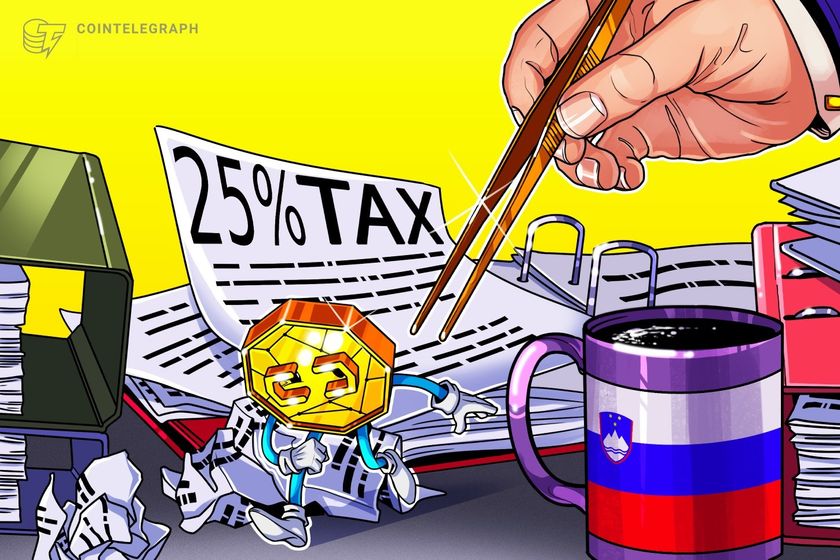
Slovenia’s Finance Ministry is considering a possible 25% tax on crypto trading profits for residents in the country under a new draft law now open for public consultation. 

The bill proposes to tax traders when they sell their cryptocurrency for fiat or pay for goods and services, but crypto-to-crypto and transfers between wallets owned by the same user will be exempt, Slovenia’s Finance Ministry said in an April 17 statement.

Under the proposed legislation, crypto tax will be aligned with existing tax laws. Slovenia taxpayers will be required to keep a record of all their transactions for annual tax returns. The tax base would be calculated on profits by subtracting the purchase price from the sale price. 

In a statement to the Slovenia Times, finance minister Klemen Boštjančič said it’s unreasonable that crypto trading for individuals isn’t currently taxed in the country. 

“The goal of taxation of crypto assets is not to generate tax revenue, but we find it illogical and unreasonable that one of the most speculative financial instruments is not taxed at all,” he said in a statement translated from Slovenian.

New tax could stifle crypto in Slovenia, lawmaker says 

Jernej Vrtovec, a member of Slovenia’s national assembly and New Slovenia opposition party, slammed the proposal in an April 16 statement to X, arguing it could stifle crypto growth in the country. 

“Slovenia has the opportunity to become a crypto-friendly country, but with the government’s proposals, we will miss the train again,” he said in a post also translated from Slovenian.

“With excessive taxation, we will once again see young people and capital fleeing abroad. Taxes should encourage, not stifle.” 

Slovenia’s finance ministry floats 25% tax on crypto transactionsSource: Jernej Vrtovec

The proposal is open to public consultation until May 5. If Slovenian lawmakers pass the bill, it will go into effect on Jan. 1, 2026. 

Slovenia introduced a 10% tax on crypto withdrawals and payments in 2023, but capital gains from occasional crypto trading are not taxed, according to the crypto tax platform Token Tax. 

Related: NFT trader faces prison for $13M tax fraud on CryptoPunk profits

Crypto activity can also currently be exempt from tax if it’s considered a hobby. Business activity, such as mining or staking, is subject to income tax. 

A previous bill proposed in April 2022 planned to levy a 5% tax on profits over 10,000 euros ($11,372), but it was never passed into law. 

Slovenia issued the first digital sovereign bond in the European Union on July 25 last year. It had a nominal size of 30 million euros ($32.5 million) with a 3.65% coupon and a maturity date of Nov. 25 that year. 

The number of crypto users in Slovenia is projected to reach roughly 98,000 in 2025, according to online data platform Statista, with a penetration rate of 4.6% among its population of 2.12 million people. While the projected revenue for the country’s crypto market is slated to hit $2.8 million. 

Magazine: How crypto laws are changing across the world in 2025

Read more at cointelegraph.com

Kyrgyzstan’s president signs CBDC law giving ‘digital som’ legal status

Kyrgyzstan President Sadyr Zhaparov has signed a constitutional law authorizing the launch of a central bank digital currency pilot project while also giving the “digital som” — the national currency in digital form — legal tender status.

The law gives the National Bank of the Kyrgyz Republic the exclusive right to issue the digital som, establish the rules for its issuance and circulation, and oversee the platform on which the national currency will operate, Kyrgyzstan’s presidential office said on April 17.

However, a final decision on whether to officially issue the CBDC is not expected until the end of 2026, local outlet Trend News Agency reported in December.

If the central bank decides to adopt the digital som, it would also need to outline cryptographic protection measures to ensure the digital som remains secure and isn’t used for fraudulent transactions.

Testing of the digital som platform is expected to take place sometime this year.

Zhaparov’s sign-off comes nearly a month after Kyrgyzstan’s parliament, the Jogorku Kenesh, approved the amendment to Kyrgyzstan’s constitutional law on March 18.

CBDCs continue to be heavily criticized by some members of the crypto community, flagging concerns that they could undermine financial privacy and enable excessive government oversight, among other things.

While 115 nations have initiated CBDC projects, only four CBDCs have officially launched — the Bahamas Sand Dollar, Nigeria’s e-Naira, Zimbabwe’s ZiG and Jamaica’s JAM-DEX, data from cbdctracker.org shows.

Over 90 CBDC projects are yet to move past the research stage.

Kyrgyzstan continues to make moves in crypto

Earlier this month, former Binance CEO Changpeng “CZ” Zhao said he would begin advising Kyrgyzstan on blockchain and crypto-related regulation after signing a memorandum of understanding with the country’s foreign investment agency.

Zhaparov said the initiative would assist with the growth of the economy and the security of virtual assets, “generating new opportunities for businesses and society as a whole.”

Kyrgyzstan’s president signs CBDC law giving ‘digital som’ legal statusSource: Sadyr Zhaparov

Related: Bitcoin price levels to watch as Fed rate cut hopes fade

The mountainous, land-locked country is considered well-suited for crypto mining operations due to its abundant renewable energy resources, much of which is underutilized.

Over 30% of Kyrgyzstan’s total energy supply comes from hydroelectric power plants, but only 10% of the country’s potential hydropower has been tapped, according to a report by the International Energy Agency.

Magazine: Your AI ‘digital twin’ can take meetings and comfort your loved ones

Read more at cointelegraph.com

Kyrgyzstan’s president signs CBDC law giving ‘digital som’ legal status

Kyrgyzstan President Sadyr Zhaparov has signed a constitutional law authorizing the launch of a central bank digital currency pilot project while also giving the “digital som” — the national currency in digital form — legal tender status.

The law gives the National Bank of the Kyrgyz Republic the exclusive right to issue the digital som, establish the rules for its issuance and circulation, and oversee the platform on which the national currency will operate, Kyrgyzstan’s presidential office said on April 17.

However, a final decision on whether to officially issue the CBDC is not expected until the end of 2026, local outlet Trend News Agency reported in December.

If the central bank decides to adopt the digital som, it would also need to outline cryptographic protection measures to ensure the digital som remains secure and isn’t used for fraudulent transactions.

Testing of the digital som platform is expected to take place sometime this year.

Zhaparov’s sign-off comes nearly a month after Kyrgyzstan’s parliament, the Jogorku Kenesh, approved the amendment to Kyrgyzstan’s constitutional law on March 18.

CBDCs continue to be heavily criticized by some members of the crypto community, flagging concerns that they could undermine financial privacy and enable excessive government oversight, among other things.

While 115 nations have initiated CBDC projects, only four CBDCs have officially launched — the Bahamas Sand Dollar, Nigeria’s e-Naira, Zimbabwe’s ZiG and Jamaica’s JAM-DEX, data from cbdctracker.org shows.

Over 90 CBDC projects are yet to move past the research stage.

Kyrgyzstan continues to make moves in crypto

Earlier this month, former Binance CEO Changpeng “CZ” Zhao said he would begin advising Kyrgyzstan on blockchain and crypto-related regulation after signing a memorandum of understanding with the country’s foreign investment agency.

Zhaparov said the initiative would assist with the growth of the economy and the security of virtual assets, “generating new opportunities for businesses and society as a whole.”

Kyrgyzstan’s president signs CBDC law giving ‘digital som’ legal statusSource: Sadyr Zhaparov

Related: Bitcoin price levels to watch as Fed rate cut hopes fade

The mountainous, land-locked country is considered well-suited for crypto mining operations due to its abundant renewable energy resources, much of which is underutilized.

Over 30% of Kyrgyzstan’s total energy supply comes from hydroelectric power plants, but only 10% of the country’s potential hydropower has been tapped, according to a report by the International Energy Agency.

Magazine: Your AI ‘digital twin’ can take meetings and comfort your loved ones

Read more at cointelegraph.com