cointelegraph.com

Investors sue Meteora and VC firm, alleging fraud

A group of investors has filed a class-action lawsuit against decentralized cryptocurrency exchange Meteora, alleging the firm was involved in manipulating the launch and market price of the M3M3 token.

In an amended complaint filed on April 21 in the US District Court for the Southern District of New York, the plaintiffs allege that venture capital firm Kelsier Labs, Meteora, and four current or former executives “intentionally misrepresented” information in the M3M3 launch in December 2024.

The investors claimed that they suffered at least $69 million in losses between December 2024 and February 2025 after the parties presented “trusted leaders in the Solana ecosystem” as being behind the token launch, rather than a “blatant fraud” in which sales were manipulated to artificially inflate the price.

“This artificially-inflated valuation communicated highly misleading information to non-insider investors, who reasonably relied on Defendants’ representations that the $M3M3 launch was fully accessible to the public and conducted in a transparent manner fair to non-insider investors, and thus reasonably relied on $M3M3 market price as a meaningful measure of its value,” the complaint reads. “The post-launch price spike also served to corroborate Defendants’ aggressively-marketed, but misleading, assertions that $M3M3 had intrinsic value and a comparatively low risk profile.”

Law, New York, CourtClass-action lawsuit against Meteora, Kelsier Labs, and current and former executives. Source: PACER

The lawsuit is one of many involving different crypto firms that have alleged fraud through violations of US securities laws. Though the US Securities and Exchange Commission (SEC), under acting chair Mark Uyeda since US President Donald Trump took office, has scaled back or dismissed many enforcement actions involving digital assets, the agency said in February it still intended to pursue cases against fraudulent token projects.

The investors added:

“Together, Defendants designed the $M3M3 Token and planned its launch on Meteora in a manner intended to illicitly enrich themselves at the expense of the unsuspecting investing public.”

Related: Meteora says co-founder’s X account hacked after ‘parasitic’ memecoin post

Memecoins in the Solana ecosystem

Meteora has been tied to the launch of several high-profile yet controversial tokens, including those for Trump (TRUMP), his wife Melania (MELANIA), Libra (LIBRA), and online influencer Haliey Welch (HAWK).

According to the lawsuit, the firm “purported to offer a comprehensive solution to the problems in the memecoin investment market” with the launch of M3M3. The defendants in the case allegedly attempted to distinguish the token from other notable memecoins by highlighting the “legitimacy and trustworthiness” through the involvement of Meteora co-founder Ben Chow and the platform.

Kelsier Ventures, KIP Protocol, and Meteora face a similar class-action lawsuit filed in New York in March over LIBRA allegedly being launched in a “deceptive, manipulative and fundamentally unfair” manner. Argentine President Javier Milei briefly promoted the token over social media after his sister reportedly received payments from the project.

Magazine: Memecoin degeneracy is funding groundbreaking anti-aging research

Read more at cointelegraph.com

More than 70 US crypto ETFs await SEC decision this year — Bloomberg

More than 70 cryptocurrency exchange-traded funds (ETFs) are slated for review by the US Securities and Exchange Commission (SEC) this year. According to Bloomberg analyst Eric Balchunas, the list includes proposed ETFs holding a range of assets, from altcoins to memecoins to derivatives instruments.

“Everything from XRP, Litecoin and Solana to Penguins, Doge and 2x Melania and everything in between,” Balchunas said in an April 21 post on the X platform. “Gonna be a wild year.”

More than 70 US crypto ETFs await SEC decision this year — BloombergCrypto ETFs’ SEC review schedule. Source: Eric Balchunas/Bloomberg

Related: ARK adds staked Solana to two tech ETFs

Uncertain institutional demand

The planned funds listings come as institutional investors turn increasingly bullish on crypto as an asset class. 

Upward of 80% of institutions say they plan to increase allocations to crypto in 2025, according to a March report by Coinbase and EY-Parthenon. 

However, analysts caution that just because ETFs are approved for US listings doesn’t guarantee widespread adoption, especially for funds holding more obscure alternative cryptocurrencies.

“Having your coin get ETF-ized is like being in a band and getting your songs added to all the music streaming services,” Balchunas said

“Doesn’t guarantee listens but it puts your music where the vast majority of the listeners are.”

Cryptocurrencies, Bitcoin Price, SEC, Bitcoin Regulation, United States, Financial Derivatives, Bitcoin Options, Ethereum Options, Ethereum ETF, Bitcoin ETF, ETFComparing asset manager Grayscale’s net assets pre-ETF launch across different cryptocurrencies suggests tepid demand for altcoin ETFs. Source: Sygnum Bank

Sygnum Bank’s research head, Katalin Tischhauser, told Cointelegraph she expects altcoin ETFs to see cumulative inflows of several hundred million to $1 billion, far less than spot Bitcoin funds

Funds holding Bitcoin (BTC) — the first spot cryptocurrency approved for listing in a US ETF wrapper — attracted upward of $100 billion in net assets last year. 

However, ETFs using options and other derivatives to provide structured exposure to cryptocurrencies such as Bitcoin and Ether might see more institutional uptake, analysts said. 

Options on spot cryptocurrencies unlock numerous potential portfolio strategies for investors and could potentially catalyze “explosive” price upside for digital assets such as Bitcoin, Jeff Park, Bitwise Invest’s head of alpha strategies, said in September.

Options are contracts granting the right to buy or sell an underlying asset at a certain price.

On April 21, ARK Invest added exposure to staked Solana (SOL) to two of its existing ETFs. The asset manager said it marks the first time spot SOL has been available to US investors in an ETF.

Magazine: ‘Bitcoin layer 2s’ aren’t really L2s at all: Here’s why that matters

Read more at cointelegraph.com

ARK adds staked Solana to two tech ETFs

ARK Invest has added exposure to staked Solana (SOL) to the portfolios of two of its exchange-traded funds (ETFs), the asset manager said in a client email reviewed by Cointelegraph. 

As of April 21, the two ARK funds — ARK Next Generation Internet ETF (ARKW) and ARK Fintech Innovation ETF (ARKF) — now hold shares of 3iQ’s Solana Staking ETF (SOLQ), a Canadian ETF holding staked SOL, ARK said. 

The two ARK funds are designed to offer broad exposure to emerging technologies, and comprise a mix a technology stocks — including crypto-focused companies such as Coinbase, Block, and Robinhood — and spot cryptocurrencies, according to ARK’s website.

According to ARK, adding the SOL ETF shares makes “ARKW and ARKF the first US-listed ETFs to gain exposure to Solana.”

In March, asset manager Volatility Shares launched two ETFs that offer exposure to SOL using financial derivatives, but spot Solana ETFs are still awaiting approval by US regulators.

ARK adds staked Solana to two tech ETFsARKW’s fund holdings. Source: ARK Invest

Related: Spot Solana ETFs to launch in Canada this week

Solana ETFs’ proposals line up for approval

Experts say the recent listing of Solana futures on the Chicago Mercantile Exchange (CME), a US derivatives exchange, indicates that US SOL ETF listings are coming soon

Last week, 3iQ launched its Solana ETF in Canada following approval of several such funds by the Ontario Securities Commission (OSC), Canada’s largest securities regulator. 

Solana is the second-most popular blockchain network after Ethereum. Its total value locked exceeds $7 billion, versus approximately $45 billion for the Ethereum network, according to data from DefiLlama. 

ARK adds staked Solana to two tech ETFsBlockchain networks by TVL. Source: DeFiLlama

The US Securities and Exchange Commission (SEC) authorized spot Ether ETFs to trade in the United States in July 2024. 

In July, ARK partnered with 21Shares, a crypto-focused fund issuer, to launch ARK 21Shares Bitcoin ETF (ARKB), a spot Bitcoin (BTC) fund with nearly $4 billion in net assets as of April 21, according to ARK’s website

It also partnered with 21Shares on an Ether ETF but dissolved the partnership in June, shortly before the fund launched under 21Shares’ branding. 

Magazine: SCB tips $500K BTC, SEC delays Ether ETF options, and more: Hodler’s Digest, Feb. 23 – March 1

Read more at cointelegraph.com

Nasdaq-listed Upexi shares up 630% after  $100M raise, SOL treasury

Upexi, a brand owner that specializes in supply chain management, is diversifying into the cryptocurrency sector. On April 21, the company announced a $100 million raise, with over 90% earmarked for building a Solana (SOL) treasury strategy.

After the announcement, shares of Upexi have skyrocketed from a $2.30 close on April 17 to $16.79 at this writing, marking a 632% jump for the day.

Nasdaq-listed Upexi shares up 630% after  $100M raise, SOL treasuryUPXI intraday performance on the Nasdaq. Source: Google Finance

Many “prominent” crypto venture capitalist firms participated in the $100 million raise, according to an announcement. Backers include the family office of Arthur Hayes, Delta Blockchain Fund, Delphi Ventures, Hivemind, Borderless, and White Star Capital, among others. The round was completed with a sale of around 44 million shares of common stock at a price of $2.28.

According to Upexi’s recent financials, it posted a profit of $3 million in the last quarter of 2024, down 34.8% or $4.6 million from the same time period in 2023.

Companies mimic Strategy

Strategy (formerly MicroStrategy) was one of the first mainstream companies to adopt a cryptocurrency treasury strategy. It started purchasing Bitcoin (BTC) in August 2020, and its stock price has jumped significantly since then. Currently, over 13,000 companies have exposure to Strategy.

Other companies have followed Strategy’s lead in adopting a Bitcoin treasury, including Metaplanet, which topped $400 million in BTC holdings on April 21, and Semler Scientific, which reported paper losses for its BTC holdings on April 16.

Related: Metaplanet, Semler Scientific were ‘zombie companies’ until Bitcoin, execs say

Fewer companies adopting a crypto treasury strategy have chosen a coin other than Bitcoin. One such company is Janover, which was taken over by former Kraken executives on April 7. Like Upexi, it is adopting a Solana treasury strategy and acquired $10.5 million worth of SOL on April 15.

SOL is the native token of the Solana blockchain. The network, once seen as the “Ethereum killer,” has fast speeds based on a proof-of-history consensus mechanism. Solana has been among the big winners of the latest bull market, thanks to use cases like memecoins and decentralized infrastructure applications.

Magazine: Memecoins are ded — But Solana ‘100x better’ despite revenue plunge

Read more at cointelegraph.com

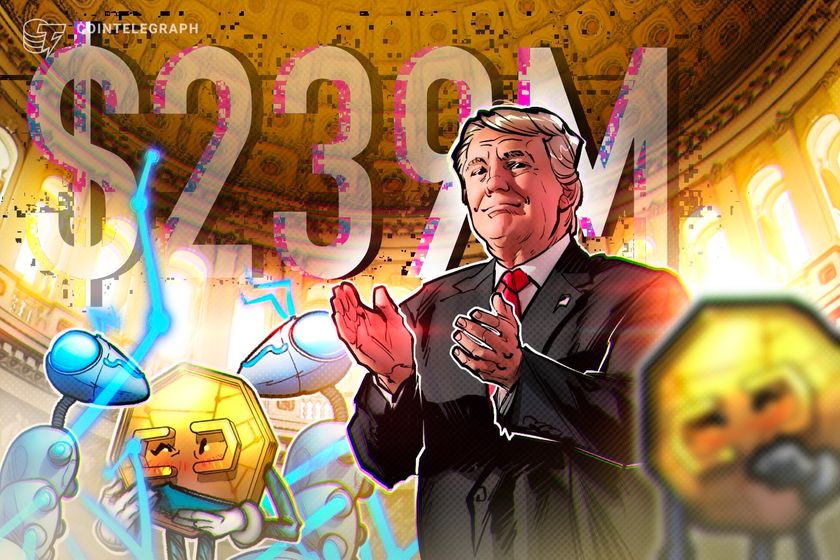
Consensys, Solana, and Uniswap CEO donated to Trump's $239M inauguration fund

New filings from the Federal Election Commission (FEC) reveal that several cryptocurrency firms and their executives made significant contributions to US President Donald Trump’s inauguration fund after the results of the 2024 election. 

According to FEC filings made public on April 20 by the Trump-Vance Inaugural Committee, Uniswap CEO Hayden Adams donated more than $245,000, Solana Labs donated $1 million, and software firm Consensys sent $100,000 in January 2025 to support the then-president-elect’s inauguration. Many major crypto firms had previously announced their support of Trump through donations to the inaugural fund, including Coinbase, Ripple Labs, Kraken, Ondo Finance, and Robinhood.

Politics, Donald Trump, ConsenSys, Uniswap, SolanaJan. 9 contribution from Uniswap CEO Hayden Adams to Trump-Vance inauguration fund. Source: FEC

Altogether, the fund reported more than $239 million in net donations between Nov. 15 and April 20 from companies and individuals. These included $1 million from McDonald’s, $1 million from Meta, $1 million from Apple CEO Tim Cook, $1 million from OpenAI CEO Sam Altman, and various contributions from Delta Air Lines, ExxonMobil, FedEx, Nvidia, PayPal, Target, and Coca-Cola. 

Since Trump took office on Jan. 20 and appointed Mark Uyeda as acting chair of the US Securities and Exchange Commission (SEC), the agency has dropped multiple investigations and enforcement actions against crypto firms, including those that donated to the president’s 2024 campaign or inauguration fund. In February, Uniswap reported that the SEC had dropped its probe into the firm, and Consensys founder Joseph Lubin said the agency had agreed to end a separate lawsuit. 

Memecoins, stablecoin issuers, and future elections

Trump’s memecoin, launched on Jan. 17 on the Solana blockchain — along with his wife Melania’s, which was available a few days later — has many in the crypto industry and the US government questioning the president about conflicts of interest by capitalizing on his position. The president’s family is also behind the launch of World Liberty Financial, a crypto firm responsible for a US dollar-pegged stablecoin at a time when lawmakers are considering legislation to regulate the technology.

In addition to the Consensys case, the SEC said it intended to drop enforcement actions or investigations into Ripple, Kraken, Robinhood and Coinbase. The three firms donated a combined $9 million to the inauguration fund.

Related: Trump’s next crypto play will be Monopoly-style game — Report

The 2024 US election cycle saw crypto-backed political action committees (PACs) spending more than $131 million to influence races in crucial congressional districts. The Fairshake PAC has already said it had more than $100 million available, in part from contributions from Coinbase and Ripple, to spend on the 2026 midterms. 

Magazine: Trump’s crypto ventures raise conflict of interest, insider trading questions

Read more at cointelegraph.com

Consensys, Solana, Uniswap CEO donated to Trump's $239M inauguration fund

New filings from the Federal Election Commission (FEC) reveal that several cryptocurrency firms and their executives made significant contributions to US President Donald Trump’s inauguration fund after the results of the 2024 election. 

According to FEC filings made public on April 20 by the Trump-Vance Inaugural Committee, Uniswap CEO Hayden Adams donated more than $245,000, Solana Labs donated $1 million, and software firm Consensys sent $100,000 in January to support the then-president-elect’s inauguration. Many major crypto firms had previously announced their support of Trump through donations to the inaugural fund, including Coinbase, Ripple Labs, Kraken, Ondo Finance, and Robinhood.

Politics, Donald Trump, ConsenSys, Uniswap, SolanaJan. 9 contribution from Uniswap CEO Hayden Adams to Trump-Vance inauguration fund. Source: FEC

Altogether, the fund reported more than $239 million in net donations between Nov. 15 and April 20 from companies and individuals. These included $1 million from McDonald’s, $1 million from Meta, $1 million from Apple CEO Tim Cook, $1 million from OpenAI CEO Sam Altman, and various contributions from Delta Air Lines, ExxonMobil, FedEx, Nvidia, PayPal, Target, and Coca-Cola. 

Since Trump took office on Jan. 20 and appointed Mark Uyeda as acting chair of the US Securities and Exchange Commission (SEC), the agency has dropped multiple investigations and enforcement actions against crypto firms, including those that donated to the president’s 2024 campaign or inauguration fund. In February, Uniswap reported that the SEC had dropped its probe into the firm, and Consensys founder Joseph Lubin said the agency had agreed to end a separate lawsuit. 

Memecoins, stablecoin issuers, and future elections

Trump’s memecoin, launched on Jan. 17 on the Solana blockchain — along with his wife Melania’s, which was available a few days later — has many in the crypto industry and members of Congress voicing concern over conflicts of interest potentially arising from the president appearing to capitalizing on his position.

Trump’s family is also behind the launch of World Liberty Financial, a crypto firm responsible for a US dollar-pegged stablecoin at a time when lawmakers are considering legislation to regulate the technology.

In addition to the Consensys case, the SEC said it intended to drop enforcement actions or investigations into Ripple, Kraken, Robinhood Crypto and Coinbase. The three firms donated a combined $9 million to the inauguration fund.

Related: Trump’s next crypto play will be Monopoly-style game — Report

The 2024 US election cycle saw crypto-backed political action committees (PACs) spending more than $131 million to influence races in crucial congressional districts. The Fairshake PAC has already said it had more than $100 million available, in part from contributions from Coinbase and Ripple, to spend on the 2026 midterms. 

Magazine: Trump’s crypto ventures raise conflict of interest, insider trading questions

Read more at cointelegraph.com

Bitcoin price tops $88.5K as BTC doubles down on stocks decoupling

Bitcoin (BTC) doubled down on its divergence from stocks at the April 21 Wall Street open as US trade war tensions escalated. Bitcoin price tops $88.5K as BTC doubles down on stocks decouplingBTC/USD 1-day chart. Source: Cointelegraph/TradingView

Trade war reactions fuel BTC price gains

Data from Cointelegraph Markets Pro and TradingView showed BTC/USD matching month-to-date highs above $88,000.

Bitcoin continued higher after the weekly close to catch up with gold as the latter set fresh all-time highs of $3,430 per ounce.

Bitcoin price tops $88.5K as BTC doubles down on stocks decouplingXAU/USD 1-hour chart. Source: Cointelegraph/TradingView

By contrast, stock markets came under renewed selling pressure, with the S&P 500 and Nasdaq Composite Index both down over 2% at the time of writing.

Newfound BTC price strength thus appeared to end lockstep trading with equities as part of reactions to trade-war headlines.

These included warnings about the deterioration of relations with the US from both China and Japan, while US President Donald Trump renewed existing attacks on Federal Reserve Chair Jerome Powell over interest rates.

Bitcoin price tops $88.5K as BTC doubles down on stocks decouplingSource: Donald Trump

“Technology stocks have gotten crushed again over the last week. Nvidia, NVDA, is down over -15% since last Monday while multiple other Mag 7 stocks are down 10%+,” trading resource The Kobeissi Letter wrote in part of a reaction thread on X. 

“Without technology stocks, this market cannot bottom.”Bitcoin price tops $88.5K as BTC doubles down on stocks decouplingS&P 500 1-hour chart. Source: Cointelegraph/TradingView

Kobeissi also referenced downside pressure on the US Dollar Index (DXY), which traded at its lowest levels since March 2022.

“While the USD, DXY, falls to a new 52-week low below 99, Bitcoin and Gold are surging,” it summarized. 

“Markets need trade deals ASAP.”Bitcoin price tops $88.5K as BTC doubles down on stocks decouplingUS dollar index (DXY) vs. BTC/USD chart. Source: The Kobeissi Letter/XBitcoin “institutional confidence returning”

Continuing, trading firm QCP Capital struck an optimistic tone.

Related: US dollar goes ‘no-bid’ — 5 things to know in Bitcoin this week

Bitcoin, it argued in its latest bulletin to Telegram channel subscribers, seemed to be sharing some of gold’s limelight as a hedge against macroeconomic uncertainty after months of failure.

“With equities finishing last week in the red and extending an April drawdown, the narrative of BTC as a safe haven or inflation hedge is once again gaining traction. Should this dynamic hold, it could provide a fresh tailwind for institutional BTC allocation,” it wrote.

QCP even suggested that recent outflows from the US spot Bitcoin exchange-traded funds (ETFs) may soon recover.

“Indeed, we’re already seeing early signs of institutional confidence returning. Spot BTC ETF flows turned positive last week with net inflows of $13.4 million, a stark contrast to the previous week’s $708 million in outflows,” the bulletin noted. 

“In options markets, positioning has turned more balanced. Risk reversals across tenors have flattened out, diverging from the persistent near-dated put skew that has dominated for weeks.”Bitcoin price tops $88.5K as BTC doubles down on stocks decouplingUS spot Bitcoin ETF flows (screenshot). Source: Farside Investors

This article does not contain investment advice or recommendations. Every investment and trading move involves risk, and readers should conduct their own research when making a decision.

Read more at cointelegraph.com

Unlocking the potential of dormant Bitcoin in DeFi

Opinion by: Amitej Gajjala, co-founder and CEO of KernelDAO

Bitcoin is the principal asset of the cryptocurrency world and even one of the world’s top 10 most valuable assets, recognized for its role as a store of value. Yet a huge percentage of the Bitcoin (BTC) supply remains dormant for years, meaning the crypto market only works with a fraction of the circulating supply each year. 

This idle Bitcoin has an enormous amount of untapped financial potential.

Bitcoin’s principal narratives are “store of value” and “never sell.” Today’s decentralized finance (DeFi) tools, however, enable yield gain by holding Bitcoin and taking advantage of dormant Bitcoin, which just sits in investors’ wallets and does nothing. 

Existing dormant Bitcoin is not being fully utilized 

Dormant Bitcoin has not been used for long periods, usually one or more years. According to Glassnode, as of early 2025, the active supply that has not moved in more than one year is approximately 62%.

This Bitcoin is held in wallets that show no activity on the blockchain and remain inactive for various reasons. These could be intentional long-term holding strategies or even permanent loss as a result of negligence or the death of their users. 

Let’s put aside the rest of the reasons and focus on long-term Bitcoin holding strategies. The existence of this group implies that they could enter the market at any time, producing significant volatility in the price of Bitcoin. Why aren’t we using that Bitcoin in DeFi right now? 

Activating dormant Bitcoin will make waves in the market

If large quantities of dormant Bitcoin were to reactivate immediately, it could significantly affect the cryptocurrency market, creating a noticeable event. These movements could dramatically affect Bitcoin’s price in a negative way due to potential selling pressure and influence the market with a significant increase in active circulating supply.

Recent: Stablecoin presence key to blockchain legitimacy, says ZachXBT

If the reactivated Bitcoin is, however, reintegrated into productive DeFi ecosystems rather than sold en masse, it could provide liquidity without destabilizing the market. With that amount of active liquidity, Bitcoin would not only be a “store of value” but also a productive asset with utility and application.

Let’s look at the announcement of the creation of a Bitcoin strategic reserve in the United States. One of the key points of this reserve is that it will follow budget-neutral strategies without selling the estimated 198,000 BTC held by the government. Those conditions are perfect for putting this Bitcoin into restaking and using it in DeFi to obtain rewards. Just picture all the gains the US could make by using most of its Bitcoin reserves in that way, without selling.

We need to explore Bitcoin’s potential in DeFi

Integrating dormant Bitcoin into DeFi platforms offers interesting Bitcoin and decentralized finance opportunities. Bitcoin would encourage transactions and fees on the network to support miners. The total value locked (TVL) in DeFi will be tremendous compared to all the liquidity Bitcoin will add to the DeFi market.

Advances like wrapped tokens and crosschain bridges have enabled Bitcoin holders to engage in flash loans, lending, staking, restaking and yield farming on DeFi platforms. The current levels are, however, insufficient and will not be the only way to take advantage of this enormous liquidity injection. 

As of March 10, Bitcoin’s TVL in DeFi stood at over $5 billion, according to DefiLlama data. This represents only 6% of the TVL of all the current blockchains on the market, with Ethereum the king at 52.56% with $48 billion. If Bitcoin became the new king of TVL in DeFi, it would only need to use some of the dormant Bitcoin mentioned above.

In this scenario, Bitcoin will provide more stability to DeFi, as its holders, including institutional and long-term investors, are not prone to selling during market downturns. In addition, activating even a small fraction of currently idle Bitcoin could unlock billions of dollars of liquidity for decentralized finance applications.

The best way to use BTC in DeFi is restaking

Today, restaking is emerging as an innovative, engaging way to integrate Bitcoin into DeFi while maintaining its appeal as a conservative, secure investment vehicle. Restaking enables holders to stake their assets in decentralized protocols and earn passive income while contributing to the economic security of the network.

This mechanism offers several benefits, including passive income with minimal risk and economic security, by supporting the development of new products. It parallels traditional finance by offering predictable returns while preserving capital, which appeals more to conventional investors.

Restaking aligns with the conservative mindset typical among many Bitcoin holders, allowing them to participate in innovations within the DeFi space. Restaking is desirable for every Bitcoiner to obtain yield with their reserves.

Dormant Bitcoin is a massive opportunity for DeFi

Dormant Bitcoin is a vast, untapped reservoir within the Web3 ecosystem. By integrating Bitcoin into DeFi platforms today, individual investors and the broader ecosystem will significantly benefit from the increased stability, liquidity and growth opportunities.

Opinion by: Amitej Gajjala, co-founder and CEO of KernelDAO.

Read more at cointelegraph.com

Bitget’s $12B VOXEL frenzy fizzled fast, but questions remain

A little-known VOXEL trading pair on cryptocurrency exchange Bitget suddenly clocked over $12 billion in volume on April 20, dwarfing the metrics of the same contract on Binance.

The activity centered on VOXEL/USDT perpetual futures, where traders reported instant order fills — an anomaly many described as a bug that allowed savvy traders to rack up outsized profits by exploiting unusual price behavior.

The atypical metrics drew Bitget’s attention. In the fallout of its early investigation, the exchange suspended accounts suspected of market manipulation and rolled back irregular trades that occurred throughout the day. Traders who copped losses during that period were offered compensation.

Bitget’s response and remediation plan may have prevented lasting investor damage, but the episode is the latest in a series of cases that raise questions about how exchanges handle market makers, internal systems and user safeguards. While Bitget promotes an open API and regularly touts its global market maker program, it has yet to disclose who was behind the April 20 activity or what technical factors led to it.

The lack of incident-level detail has fueled speculations comparable to similar breakdowns on Binance — the world’s largest exchange by trading volume — that included the sudden price crashes of cryptocurrencies GoPlus (GPS) and MyShell (SHELL) in March. Binance kicked out an unnamed market maker it found responsible for manipulation, but the lack of disclosure added fuel to the crypto industry’s infamous rumor mongering.

Bitget’s $12B VOXEL frenzy fizzled fast, but questions remainBitget’s VOXEL/USDT perpetual futures volume exceeded that of all other top 10 markets combined on April 20. Source: Thành CryptoTraders VOXEL market maker bug, Bitget disagrees

Crypto market participants pointed to rapid price fluctuations and what multiple Mandarin-language X accounts described as a bug in a “market maker” bot as the cause of VOXEL’s excessive volume.

Traders claimed that VOXEL’s price flickered between several ranges, such as $0.125 and $0.138. Orders placed between those bands filled instantly due to the suspected bug, X user Dylan said, sharing screenshots and videos of profitable accounts. Perpetual futures contracts are typically matched through an order book, with each trade requiring a counterparty. But in this case, trades appeared to execute automatically and without delay.

Bitget’s $12B VOXEL frenzy fizzled fast, but questions remainA machine-translated post shares how one trader profits hundreds of thousands of dollars with just $100 USDT in starting capital. Source: 0xDy_eth

Traders who spotted the suspected bug early used high-leverage bets to boost their profits, X user Qingshui said, calling the strategy a “zero-cost exploit.” Like Dylan, Qingshui attributed the issue to a market maker bot misfiring and questioned why traders were blocked from accessing profits if the problem originated from Bitget’s side.

Related: How Mantra’s OM token collapsed in 24 hours of chaos

A third user, Hebi555, pointed the finger at Bitget’s market-making team for its poor performance. Xie Jiayin, Bitget’s head of Asia, clapped back, stating that the exchange works with over 1,000 market makers and institutional clients. He added that Bitget’s API is open to the public and emphasized that specific market maker identities could not be disclosed due to confidentiality agreements.

In an April 20 response to Cointelegraph, Bitget CEO Gracy Chen said that suspicious trades were between individual market participants, not the platform. Replying to Cointelegraph’s follow-up inquiry on April 21, Chen neither confirmed nor denied whether a market maker bot was involved, only reiterating that the trading was “between users.”

“We are conducting a thorough review, and once the rollback is completed, trading and account restrictions will be lifted as appropriate. Bitget’s security infrastructure is designed to catch irregularities like this in real time — as it did in this case,” Chen said.

Bitget’s VOXEL anomaly adds to crypto’s market manipulation mystery

Concerns over market manipulation in the cryptocurrency industry have been intensifying. In early March, the prices of two tokens, GPS and SHELL, crashed in tandem with their Binance listings. 

The exchange’s investigation found that the two tokens employed the same unnamed market maker. Binance banished the dubious trading firm from its platform and confiscated its proceeds to help fund compensation efforts for GPS and SHELL traders. Without a suspect to blame, social media users began pointing fingers at several market makers and trading firms. Those named denied any involvement.

Bitget’s $12B VOXEL frenzy fizzled fast, but questions remainGSR was among the most frequently accused firms, but denied being the market maker removed by Binance. Source: GSR

Binance then kicked out another unnamed market maker, this time for trading activities related to the Movement (MOVE) token. The MOVE token’s market maker on Binance was found to have associations with the market maker for GPS and SHELL.

Related: Market maker deals are quietly killing crypto projects

A recent Cointelegraph report found that market makers are employing a loan-based model that is killing off small- and medium-cap projects. The loan model gives market makers access to a project’s tokens in exchange for liquidity provision. But instead, what often happens is that market makers dump the loaned tokens on the open market just to buy them back at a cheaper price, leaving the projects with damaged price charts.

VOXEL was on Bitget, but exploits aren’t limited to CEXs

Both Bitget and Binance’s cases show that even the largest centralized exchanges (CEXs) aren’t immune to market manipulation or traders exploiting platforms for profits.

But a recent case on decentralized exchange (DEX) Hyperliquid shows the issue isn’t confined to CEXs. In late March, a whale allegedly exploited the liquidation parameters on Hyperliquid, resulting in the delisting of the platform’s JELLY perpetual futures product. Hyperliquid then announced a compensation plan for affected users, similar to how Bitget responded to its own VOXEL drama.

Bitget’s $12B VOXEL frenzy fizzled fast, but questions remainX user spotlights double standards in how exchanges respond to bugs. Source: Dotyyds1234

Ironically, Bitget’s Chen had some strong words against Hyperliquid at the time, raising concerns about the network’s centralization. She compared the DEX to FTX, once a billion-dollar trading firm whose founder is now serving a 25-year prison sentence for multiple counts of fraud.

“The way it handled the JELLY incident was immature, unethical, and unprofessional, triggering user losses and casting serious doubts over its integrity. Despite presenting itself as an innovative decentralized exchange with a bold vision, Hyperliquid operates more like an offshore CEX with no [Know-Your-Customer/Anti-Money Laundering], enabling illicit flows and bad actors,” she said.

Bitget’s VOXEL episode may have been contained, and Hyperliquid’s users may be compensated, but the broader pattern is harder to ignore for traders. As platforms scramble to maintain trust, the industry’s vulnerability isn’t just the bugs or exploits, but the silence that follows them.

Magazine: Uni students crypto ‘grooming’ scandal, 67K scammed by fake women: Asia Express

Read more at cointelegraph.com

Bitcoin longs cut $106M — Are Bitfinex BTC whales turning bearish above $86K?

Despite Bitcoin’s (BTC) price reaching its highest level in over three weeks, traders on Bitfinex reduced their leveraged long (bullish) positions on margin contracts by more than $100 million between April 17 and April 19.

This reduction has led to speculation that Bitcoin whales may be anticipating a price correction or, at the very least, are not confident in further short-term gains. Let’s look closer at whether this could be the case.

Bitfinex Bitcoin whales remain bullish

Bitcoin surged above $86,000 on April 21 after US President Donald Trump openly discussed the possibility of replacing Federal Reserve Chair Jerome Powell. Trump criticized Powell for not acting swiftly enough to ease monetary policy.

Additionally, investors are increasingly risk-off due to concerns about a recession as the global trade war escalates, particularly given the ongoing uncertainty in US-China relations.

The rationale behind this profit-taking in margin markets is especially noteworthy, as Bitcoin’s price has remained below $90,000 since early March, prompting some investors to question the likelihood of a sustainable decoupling from traditional markets.

The S&P 500 index futures are trading 1.1% below their closing price on April 17, and rising political tensions in the US are further eroding investor sentiment.

Bitcoin longs cut $106M — Are Bitfinex BTC whales turning bearish above $86K?April 2025: BTC/USD (left, orange) vs. Bitfinex BTC margin longs. Source: TradingView/Cointelegraph

Bitcoin margin longs on Bitfinex stood flat at 80,400 BTC between April 10 and April 17, indicating strong confidence from bullish traders as this level neared a seven-month high. However, even as BTC’s price reclaimed the $83,000 level, these traders chose to reduce their leveraged bullish positions by 1,250 BTC, equivalent to $106 million.

Historically, Bitfinex traders are known for rapidly opening or closing substantial Bitcoin margin positions, indicating that whales and large arbitrage desks are typically behind these movements.

Nevertheless, it is not accurate to suggest that Bitfinex whales have shifted to a bearish stance, considering their margin longs currently total 79,136 BTC, valued at $6.86 billion, while margin shorts amount to just 326 BTC.

Related: Bitcoin whales absorb 300% of newly mined BTC supply — Is $100K next?

The significant difference between bullish and bearish positions can be attributed to the platform’s notably low 2% annual interest rate. In comparison, traders utilizing two-month BTC futures currently pay a 5.7% annualized premium.

This disparity creates opportunities for arbitrage, as one can open Bitcoin longs on the margin market and simultaneously sell the equivalent position on BTC futures to capture the difference.

BTC doesn’t often move with Bitfinex leverage changes

Furthermore, Bitcoin’s price does not always correlate directly with changes in leveraged positions on Bitfinex. For instance, in the two weeks ending March 10, whales increased their margin longs by 13,454 BTC, yet Bitcoin’s price declined from $95,930 to $67,076 during the same period.

Similarly, margin longs decreased by 11,047 BTC in the two weeks ending Dec. 16, 2024, while Bitcoin’s price rose from $96,200 to $106,400.

Bitcoin longs cut $106M — Are Bitfinex BTC whales turning bearish above $86K?Dec. 2024: BTC/USD (left, orange) vs. Bitfinex BTC margin longs. Source: TradingView/Cointelegraph

However, these sophisticated investors have demonstrated strong market timing over the longer term. For example, Bitcoin’s price eventually dropped below $58,000 on Dec. 23, 2024, after margin-long positions had already been reduced by 26% in the preceding 30 days.

This pattern suggests that these traders are generally highly profitable but also display a significantly higher risk tolerance and patience compared to the average investor.

Ultimately, a $106-million reduction in BTC margin longs is not sufficient evidence to claim that professional traders are turning bearish.

As Cointelegraph reported, onchain data suggests Bitcoin whales have grown in number throughout March and April despite the price slump, suggesting accumulation.

This article is for general information purposes and is not intended to be and should not be taken as legal or investment advice. The views, thoughts, and opinions expressed here are the author’s alone and do not necessarily reflect or represent the views and opinions of Cointelegraph.

Read more at cointelegraph.com