cointelegraph.com

Broxus launches blockchain app scalability platform TON Factory

The Open Network (TON) ecosystem participant Broxus has unveiled TON Factory, a new platform designed to accelerate the development and scalability of high-throughput applications like decentralized exchanges (DEXs) and blockchain-based games.

In an April 30 post on Telegram, the project said TON Factory aims to help developers rapidly build and scale projects with modular components, integration tools, and hands-on expert support.

“For OGs already building on TON, TON Factory helps you scale further,” the announcement stated.

The initiative is backed by a team of over 150 engineers with experience delivering production-ready infrastructure in the TON ecosystem, per the announcement.

Broxus launches blockchain app scalability platform TON FactorySource: TON

Related: Venture capital firms invest $400M in TON blockchain

Broxus’ Tycho Protocol powers TON Factory

The underlying architecture leverages Broxus’ Tycho protocol, which combines the TVM with a Directed Acyclic Graph (DAG) consensus mechanism.

This hybrid design is intended to achieve near-instant finality and high throughput, reportedly handling up to 35,000 transactions per second (TPS), a benchmark that could position TON Factory as a serious competitor to other layer-1 and layer-2 scaling solutions:

“TON Factory also supports custom TVM chain deployments and offers tailored scaling solutions, helping ambitious teams drive the ecosystem forward.”

At the time of writing, Toncoin, the native cryptocurrency of The Open Network (TON), is trading at $3.22, down around 1% in the past 24 hours, according to data from CoinMarketCap.

In March 2025, the TON Foundation said several venture capital firms invested more than $400 million in the TON blockchain, signaling growing interest in the Telegram messaging ecosystem. 

Magazine: SEC’s U-turn on crypto leaves key questions unanswered

Read more at cointelegraph.com

TON’s Broxus launches blockchain app scalability platform TON Factory

The Open Network (TON) ecosystem participant Broxus has unveiled TON Factory, a new platform designed to accelerate the development and scalability of high-throughput applications like decentralized exchanges (DEXs) and blockchain-based games.

In an April 30 post on Telegram, the project said TON Factory aims to help developers rapidly build and scale projects with modular components, integration tools, and hands-on expert support.

“For OGs already building on TON, TON Factory helps you scale further,” the announcement stated.

The initiative is backed by a team of over 150 engineers with experience delivering production-ready infrastructure in the TON ecosystem, per the announcement.

TON’s Broxus launches blockchain app scalability platform TON FactorySource: TON

“TON Factory will help developers focusing on L2/appchains with TVM tech and ensuring connectivity with TON,” a spokesperson told Cointelegraph.

They said any TON DApp focusing on scaling its performance while maintaining the strong link with TON network can use the platform.

Related: Venture capital firms invest $400M in TON blockchain

Broxus’ Tycho Protocol powers TON Factory

The underlying architecture leverages Broxus’ Tycho protocol, which combines the TVM with a Directed Acyclic Graph (DAG) consensus mechanism.

This hybrid design is intended to achieve near-instant finality and high throughput, reportedly handling up to 35,000 transactions per second (TPS), a benchmark that could position TON Factory as a serious competitor to other layer-1 and layer-2 scaling solutions:

“TON Factory also supports custom TVM chain deployments and offers tailored scaling solutions, helping ambitious teams drive the ecosystem forward.”

Broxus builds key tools and technology for blockchains that use the TON Virtual Machine, or TVM.

It has created several important decentralized finance (DeFi) products like FlatQube (a decentralized exchange), Octus Bridge (a crosschain bridge) and Ever Wallet.

In March 2025, the TON Foundation said several venture capital firms invested more than $400 million in the TON blockchain, signaling growing interest in the Telegram messaging ecosystem. 

Sequoia Capital, Ribbit, Benchmark, Draper Associates, Kingsway, Vy Capital, Libertus Capital, CoinFund, SkyBridge, Hypersphere and Karatage participated in the investment by purchasing Toncoin.

At the time of writing, Toncoin, the native cryptocurrency of The Open Network (TON), is trading at $3.22, down around 1% in the past 24 hours, according to data from CoinMarketCap.

TON blockchain is a decentralized network that supports the development of Mini Apps for the Telegram ecosystem. Although TON was initially developed by Telegram’s founders, it now operates as an independent chain. 

Magazine: SEC’s U-turn on crypto leaves key questions unanswered

Read more at cointelegraph.com

Ethereum ETF staking will have little impact without multimonth rally: Analyst

Key takeaways

Approving staking for spot Ether exchange-traded funds (ETFs) in the US may have a minimal impact on inflows unless Ether sees a sustained rally, says Eric Balchunas

ETH dropped significantly in price after the launch of the ETFs last year, unlike spot Bitcoin ETFs, which saw new all-time highs just two months after launching.

Balchunas said that for inflows to increase again, ETH would need a multimonth run and a strong narrative.

Spot Ethereum ETFs being able to stake a portion of the tokens under their control may not help garner inflows without a more sustained rally in the token’s price, says Bloomberg ETF analyst Eric Balchunas.

Balchunas said on an April 29 episode of the New Era Finance Podcast that staking being approved for Ether (ETH) ETFs would have “a little” impact on inflows, adding “it’s only going to help — it can’t hurt.”

ETFs to do well on price rally

However, Balchunas noted that one of the main reasons for the weak inflows into Ether ETFs since their July launch in the US is that ETH has yet to sustain a prolonged rally.

“The bigger problem with Ethereum is performance; it just doesn’t ever go on a nice long rally.”

He added that when Ether’s price surged during a run in December, there was a direct correlation with an increase in inflows. 

Donald Trump’s election win in November sparked a crypto market rally which saw ETH surge 71% to reach $4,107 on Dec. 16. 

From Nov. 22, spot Ether ETFs saw a 19-day positive inflow streak, amassing approximately $2.44 billion in inflows, according to Farside data.

Cryptocurrencies, MarketsEther is trading at $1,809 at the time of publication. Source: CoinMarketCap

However, since tapping the $4,107 price level, Ether entered a downtrend and has since fallen 56% to trade around $1,809 at the time of publication, according to CoinMarketCap data.

Balchunas said that for inflows to pick up again, Ether would need a “multimonth run” paired with a “strong narrative.”

“It needs something that is more than just a good week here and there,” he added.

Balchunas noted that after the Ether ETFs launched, the price “went down quickly,” making any recovery difficult, unlike spot Bitcoin ETFs, which saw Bitcoin (BTC) hit a new all-time high just two months after they launched in January 2024.

“When you launch an ETF, and you have that sort of performance out of the gate, it’s tough,” he said.

Related: Ethereum’s ‘capitulation’ suggests ETH price is undervalued: Fidelity report

US ETF issuers are still waiting for the US Securities and Exchange Commission to allow Ether ETFs to offer staking after filing numerous requests for permission earlier this year

Bloomberg ETF analyst James Seyffart said that “it’s possible they could be approved for staking early, but the final deadline is at the end of October.”

“Potential intermediate deadlines before the final approval (or denial) are in late May and late August,” he added.

Magazine: TV hit Peaky Blinders to launch crypto game, FIFA Rivals on Polkadot: Web3 Gamer

This article does not contain investment advice or recommendations. Every investment and trading move involves risk, and readers should conduct their own research when making a decision.

Read more at cointelegraph.com

SEC drops investigation into PayPal’s stablecoin

PayPal says the US Securities and Exchange Commission has abandoned its investigation into the payment giant’s US-dollar stablecoin.

PayPal said in an April 29 regulatory filing that the SEC concluded its investigation into PayPal USD (PYUSD) and wouldn’t be taking any action.

The company said it received a subpoena from the SEC’s Division of Enforcement over its stablecoin in November 2023. 

“The subpoena requests the production of documents. We are cooperating with the SEC in connection with this request,” PayPal stated at the time.

In its latest filing, the firm said the SEC notified it in February that the agency “was closing this inquiry without enforcement action.”

PayPal has said its stablecoin is 100% redeemable for US dollars and “fully backed” by dollar deposits, including short-term treasuries and cash equivalents. 

However, the stablecoin has struggled to gain momentum in a crowded market dominated by rivals Tether and Circle. PYUSD has a market capitalization of just $880 million, less than 1% of Tether’s (USDT) $148.5 billion.

PayPal’s stablecoin has seen better growth this year with a 75% increase in PYUSD circulating supply since the beginning of 2025, according to CoinGecko. It remains down 14% from its peak supply of just over $1 billion in August 2024. 

SEC drops investigation into PayPal’s stablecoinPayPal USD market capitalization. Source: CoinGeckoEarnings on PYUSD, Coinbase partnership

That growth could be bolstered by a company announcement on April 23 introducing rewards for PYUSD in a new loyalty offering that will enable US users to earn 3.7% annually for holding the asset on the platform. 

Meanwhile, on April 24, PayPal announced a partnership with Coinbase to increase the adoption of PYUSD. 

“We are excited to drive new, exciting, and innovative use cases together with Coinbase and the entire cryptocurrency community, putting PYUSD at the center,”  said Alex Chriss, PayPal President and CEO.

Related: PayPal to offer 3.7% yield on stablecoin balances: Report

The payments giant also reported robust first-quarter earnings and the completion of significant share repurchase activities. 

The firm beat Wall Street estimates, earning $1.33 per share in the first quarter, topping analyst expectations of $1.16. Revenue rose 1% from a year before to $7.8 billion. 

Magazine: Bitcoin $100K hopes on ice, SBF’s mysterious prison move: Hodler’s Digest

Read more at cointelegraph.com

FTX sues NFT Stars and Kurosemi in push to recover tokens

Bankrupt crypto exchange FTX has filed lawsuits against the non-fungible token marketplace NFT Stars and the blockchain gaming firm Kurosemi, which operates as Delysium, accusing them of withholding tokens they owed.

The lawsuits, both filed in the Delaware bankruptcy court, alleged that NFT Stars and Delysium failed to deliver all the tokens paid for by FTX despite repeated attempts to resolve the matter.

FTX claimed in an April 28 statement that it made “numerous unanswered attempts” to engage with both firms, and it would be “contacting numerous other token and coin issuers regarding FTX assets and will be filing additional suits against non-responsive parties.”

FTX sues NFT Stars and Kurosemi in push to recover tokensSource: FTX

As part of the complaint against Delysium, FTX claimed its defunct trading arm, Alameda Research, paid $1 million in January 2022 for 75 million of the gaming firm’s AGI tokens.

It claimed the original token launch was in April 2023, and Alameda Research’s share of the tokens was subject to a vesting schedule that started with 20% unlocking after 12 months.

However, FTX said the timeframe was extended to 48 months and then halted altogether due to its bankruptcy following its collapse in November 2022. 

Meanwhile, FTX’s complaint against marketplace NFT Stars claimed it paid $325,000 in November 2021 for 1.35 million SENATE tokens and 135 million SIDUS tokens.

After a partial delivery, FTX claimed NFT Stars halted delivery of the remaining 831,000 SENATE tokens and 83 million SIDUS tokens, also due to the bankruptcy proceedings, the company claimed.

FTX wants tokens plus damages 

FTX asked the court to award it the remaining tokens plus damages, arguing the tokens hit a peak value and could have been sold for a profit had they been delivered on time.

Delysium’s token AGI hit a peak price of $0.672 in May 2024, according to CoinGecko. It has since lost 90% of its value and is trading for $0.067.

SENATE reached $5.85 in January 2022 but has since lost 99% of its value, while Sidus hit its top price so far of $0.19 in January 2022 as well, but has since plunged 99%, CoinGecko data shows.

NFT Stars and Delysium didn’t immediately respond to Cointelegraph’s requests for comment.

FTX has been trying to claw back funds it claims are owed to the collapsed crypto exchange. 

Related: Shaquille O’Neal reaches settlement in FTX lawsuit, terms remain secret

In November last year, it filed a trio of lawsuits, one against SkyBridge Capital and its founder, Anthony Scaramucci, to recoup funds spent by former FTX CEO Sam Bankman-Fried on sponsorship and investment deals. 

Another suit was filed against crypto exchange Binance and its former CEO, Changpeng Zhao, in a bid to recover $1.76 billion worth of cryptocurrency sent to the exchange as part of a July 2021 repurchase deal.

Magazine: ‘Hong Kong’s FTX’ victims win lawsuit, bankers bash stablecoins: Asia Express

Read more at cointelegraph.com

BlackRock files to create digital shares tracking one of its money market funds

Asset manager BlackRock has filed to create digital ledger technology shares from one of the firm’s money market funds, which will leverage blockchain technology to maintain a mirror record of share ownership for investors.

The DLT shares will track BlackRock’s BLF Treasury Trust Fund (TTTXX), which may only be purchased from BlackRock Advisors and The Bank of New York Mellon (BNY), the firm said in its April 29 Form N-1A filing with the Securities and Exchange Commission.

The money market fund holds over $150 million worth of assets, invested almost entirely in US Treasury bills and cash.

BlackRock said that the shares “are expected to be purchased and held through BNY, which intends to use blockchain technology to maintain a mirror record of share ownership for its customers.”

Unlike the BlackRock USD Institutional Digital Liquidity Fund (BUIDL), DLT shares won’t be tokenized but will instead be used as a transparency tool to verify ownership.

BlackRock will continue to maintain traditional book-entry records as the official ownership ledger.

BlackRock didn’t propose a ticker or set a management fee for the DLT shares in its filing.

A minimum initial investment of $3 million worth of DLT is required for institutions seeking to purchase the digital shares.

BlackRock follows Fidelity’s March 21 filing to list an Ethereum-based OnChain share class, which seeks to track the Fidelity Treasury Digital Fund (FYHXX) — an $80 million fund consisting almost entirely of US Treasury bills.

While the OnChain share class filing is pending regulatory approval, Fidelity expects it to take effect on May 30.

Wall Street heavyweights continue to explore blockchain use cases

Asset managers have increasingly turned to blockchain to tokenize Treasury bills, bonds and private credit over the past few years.

Related: BlackRock Bitcoin ETF buys $970M in BTC as inflows surge, boost market

The treasury tokenization market is currently valued at $6.16 billion, led by BlackRock’s BUIDL at $2.55 billion, while the Franklin Templeton-issued Franklin OnChain US Government Money Fund (BENJI) secures over $700 million worth of real-world assets, according to rwa.xyz.

BlackRock files to create digital shares tracking one of its money market fundsMarket caps of blockchain-based Treasury products. Source: rwa.xyz
Ethereum remains the chain of choice for tokenizing treasury assets, and currently houses over $4.55 billion worth, while the Stellar network and Solana round out the top three at $474.9 million and $274.5 million, respectively.

The potential of RWA tokenization has also been championed by BlackRock’s CEO, Larry Fink, who believes the technology could revolutionize investing.

Magazine: Ethereum is destroying the competition in the $16.1T TradFi tokenization race

Read more at cointelegraph.com

US Treasury’s OFAC can’t restore Tornado Cash sanctions, judge rules

The US Treasury Department’s Office of Foreign Assets Control can’t restore or reimpose sanctions against the crypto mixing service Tornado Cash, a US federal court has ruled.

Austin federal court judge Robert Pitman said in an April 28 judgment that OFAC’s sanctions on Tornado Cash were unlawful and that the agency was “permanently enjoined from enforcing” sanctions.

Tornado Cash users led by Joseph Van Loon had sued the Treasury, arguing that OFAC’s addition of the platform’s smart contract addresses to its Specially Designated Nationals and Blocked Persons (SDN) list was “not in accordance with law.” 

OFAC had sanctioned Tornado Cash in August 2022, accusing the protocol of helping launder crypto stolen by the North Korean hacking collective, the Lazarus Group.

The agency dropped the platform from the sanctions list on March 21 and argued that the matter was “moot” after a court ruled in favor of Tornado Cash in January.

This latest amended ruling prevents OFAC from re-sanctioning Tornado Cash or putting it back on the blacklist.

Initially, the court denied a motion for partial summary judgment and granted in favour of the Treasury. However, the Fifth Circuit reversed the decision and instructed the lower court to grant partial summary judgment to the plaintiffs, which led to the sanctions being revoked. 

In March, the Treasury argued there was no need for a final court judgment in the lawsuit.

US Treasury’s OFAC can’t restore Tornado Cash sanctions, judge rulesAn excerpt from Judge Robert Pitman’s ruling. Source: CourtListenerCrypto body petitions White House over Tornado Cash

On April 28, the DeFi Education Fund petitioned White House crypto czar David Sacks to have prosecutors drop charges against Tornado Cash co-founder Roman Storm.

Related: Samourai Wallet, feds ask for time to mull dropping crypto mixer case

Storm was charged in August 2023 with helping launder over $1 billion in crypto through the protocol, and his trial is still set for July.

The group said that the Department of Justice was attempting to hold software developers criminally liable for how others use their code, which they argued was “not only absurd in principle, but it sets a precedent that potentially chills all crypto development in the United States.”

Magazine: Bitcoin $100K hopes on ice, SBF’s mysterious prison move: Hodler’s Digest

Read more at cointelegraph.com

Strategy’s Bitcoin buys should be ‘super careless’ to pump price — Exec

Key takeaways:

Richard Byworth says Michael Saylor’s Strategy could ramp up its Bitcoin buys by acquiring cash-rich companies and converting their cash into Bitcoin.

He says that Strategy should consider accelerating purchases as the Bitcoin supply on exchanges continues to decline.

Byworth argues that aggressively increasing Bitcoin holdings would boost Strategy’s mNAV, benefiting shareholders.

Michael Saylor’s Strategy should take a more aggressive approach to buying Bitcoin by acquiring companies to use their cash holdings to fund purchases and do away with over-the-counter buys, a crypto executive says.

“Saylor’s strategy so far has been the right one,” Syz Capital partner and Jan3 adviser Richard Byworth said on an April 29 podcast.

Strategy should try “super aggressive” buying

However, Byworth pondered what happens when Bitcoin (BTC) reaches an “illiquid supply” point where no Bitcoin is left on crypto exchanges or over-the-counter (OTC) desks.

“Should Saylor buy Bitcoin really carelessly? As in, not try and buy it through OTC desks…and actually just buy it with the intention of massively ramping the price,” Byworth said.

“The point where things are getting less liquid, maybe you should try for a period going super aggressive, super careless buying, market impact all across, and push the price higher.”

Strategy currently holds 553,555 BTC, valued at approximately $52.48 billion at the time of publication, according to Saylor Tracker. 

Fidelity Digital Assets said on April 24 that it has seen Bitcoin supply on exchanges dropping due to purchases by public companies, which it anticipated would accelerate “in the near future.” 

Byworth said a firm like Strategy wouldn’t be concerned with the price of Bitcoin when buying it as its primary focus would be on its mNAV (multiple of Net Asset Value), the value of the assets held, as “it is much more beneficial to [its] shareholders.”

Cryptocurrencies, Markets, MicroStrategy, Michael SaylorRichard Byworth spoke to Bram Kanstein on the Bitcoin for Millennials podcast. Source: Bram Kanstein

He added that when there is no more Bitcoin, “you may as well go aggressive buying, because what happens is it will just ramp the price, it will massively increase [Strategy’s] MNAV, which means [its] dilution will become much more accretive.”

Movements in the NAV premium and discount can give signals about market sentiment or potential future price movements.

Related: New Bitcoin price all-time highs could occur in May — Here is why

Byworth said that Japan has a “large number of zombie companies” holding significant cash reserves. He proposed that Strategy could adopt an aggressive approach by acquiring these companies and “immediately converting that cash into Bitcoin,” similar to the strategy taken by Japanese investment firm Metaplanet.

“There are plenty of companies out there in Japan like that, sitting on these cash flow generative businesses that are pretty boring and have very low price-to-cash ratios,” Byworth added.

On April 21, Metaplanet increased its Bitcoin holdings to more than $400 million after its latest $28 million purchase.

Cryptocurrencies, Markets, MicroStrategy, Michael SaylorBitcoin is trading at $94,680 at the time of publication. Source: CoinMarketCap
Byworth’s comments come as Bitcoin trades below the psychological $100,000 price level, a threshold it fell below in early February, which has widely been attributed to the tariffs imposed by US President Donald Trump.

Bitcoin is trading at $94,680, down 13.22% from its all-time high of $109,000 reached in January, according to data from CoinMarketCap.

Magazine: TV hit Peaky Blinders to launch crypto game, FIFA Rivals on Polkadot: Web3 Gamer

This article does not contain investment advice or recommendations. Every investment and trading move involves risk, and readers should conduct their own research when making a decision.

Read more at cointelegraph.com

Ledger scammers are sending letters to steal seed phrases

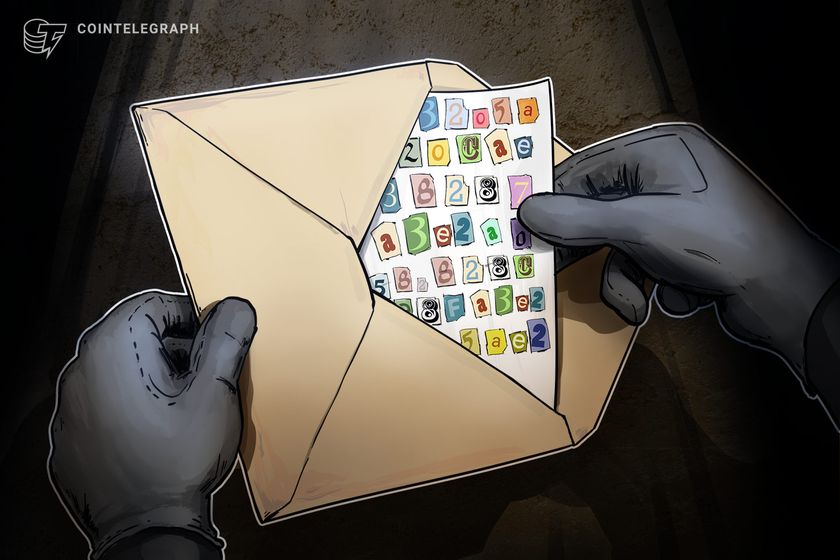
Scammers are mailing physical letters to the owners of Ledger crypto hardware wallets asking them to validate their private seed phrases in a bid to access the wallets to clean them out.

In an April 29 X post, tech commentator Jacob Canfield shared a scam letter sent to his home via post that appeared to be from Ledger claiming he needed to immediately perform a “critical security update” on his device. 

The letter, which uses Ledger’s logo, business address, and a reference number to feign legitimacy, asks to scan a QR code and enter the wallet’s private recovery phrase under the guise of validating the device.

The letter threatens that “failure to complete this mandatory validation process may result in restricted access to your wallet and funds.”

Ledger scammers are sending letters to steal seed phrasesSource: Jacob Canfield

A seed phrase, or recovery phrase, is a string of up to 24 words that unlocks access to a crypto wallet. A scammer with the phrase can access and control the associated wallet to transfer its holdings elsewhere.

Earlier this month, the X account of a crypto hardware wallet reseller said it had also received multiple reports of Ledger users receiving a similar letter.

In response to Canfield’s post, Ledger said the letter is a scam and cautioned its device users to stay vigilant against phishing attempts.

Related: Ledger wallet user reports 10 BTC loss — Community blames phishing

“Ledger will never call, DM [direct message], or ask for your 24-word recovery phrase. If someone does, it’s a scam,” it added.

“Please don’t engage with accounts claiming to be Ledger employees or anyone offering to help recover funds.”Unclear whether connected to the Ledger’s data leak

Canfield suggested that scammers were sending letters to Ledger customers whose data was leaked nearly five years ago.

In July 2020, a hacker breached Ledger’s database and dumped the personal information of more than 270,000 of its customers online, which included names, phone numbers and home addresses

The following year, several Ledger users claimed to have been mailed fake Ledger devices that were tampered with and designed to install malware upon use, Bleeping Computer reported at the time.

Magazine: Your AI ‘digital twin’ can take meetings and comfort your loved ones

Read more at cointelegraph.com

Trump Media considers crypto token and wallet for streaming arm

Trump Media and Technology Group, the social media conglomerate backed by US President Donald Trump, is considering integrating a crypto token and wallet into its video streaming site, Truth+.

“We’re exploring the introduction of a utility token within a Truth digital wallet that can initially be used to pay for Truth+ subscription costs, and later be applied to other products and services in the Truth ecosphere,” Trump Media CEO Devin Nunes wrote in an April 29 letter to shareholders.

He added that the crypto token and wallet would be part of a rewards program that Trump Media is exploring across its services, which include the social media platform Truth Social and the financial services platform Truth.Fi.

Trump Media first signaled plans for a potential crypto payments venture last November when it filed a trademark application with the US Patent and Trademark Office for computer software designed to function as a digital wallet, enable digital asset trading and process crypto payments on Truth.Fi.

Trump Media considers crypto token and wallet for streaming armSource: Cointelegraph

Truth+ launched in October, offering movies and shows mainly targeting a politically conservative audience.

Trump Media signed a binding agreement with the crypto exchange Crypto.com and asset manager Yorkville America Digital to launch exchange-traded funds (ETFs) that will include crypto and stocks “with a Made in America focus” to launch on Truth.Fi.

The company said in January that it plans to invest up to $250 million of its cash reserves into a range of financial products, including Bitcoin (BTC) and other crypto tokens or crypto-related securities, which would be custodied by asset manager Charles Schwab.

More potential for conflict of interest

The launch of a Trump Media utility token would only heighten concerns about the president’s crypto-related ventures potentially conflicting with his duties. Trump, however, transferred his 59% stake into a trust last December.

Related: Trump’s first 100 days ‘worst in history’ despite crypto promises

Trump has also been criticized for backing the crypto platform World Liberty Financial, where he’s named the firm’s “Chief Crypto Advocate” and draws a portion of its profits.

Some senators have raised concerns that Trump’s influence on policy could benefit World Liberty, which is 60% owned by the Trump family.

Trump also received backlash for the controversial launch of his memecoin, Official Trump (TRUMP), on Jan. 18 — just two days before he re-entered the White House.

Magazine: Trump’s crypto ventures raise conflict of interest, insider trading questions

Read more at cointelegraph.com