cointelegraph.com

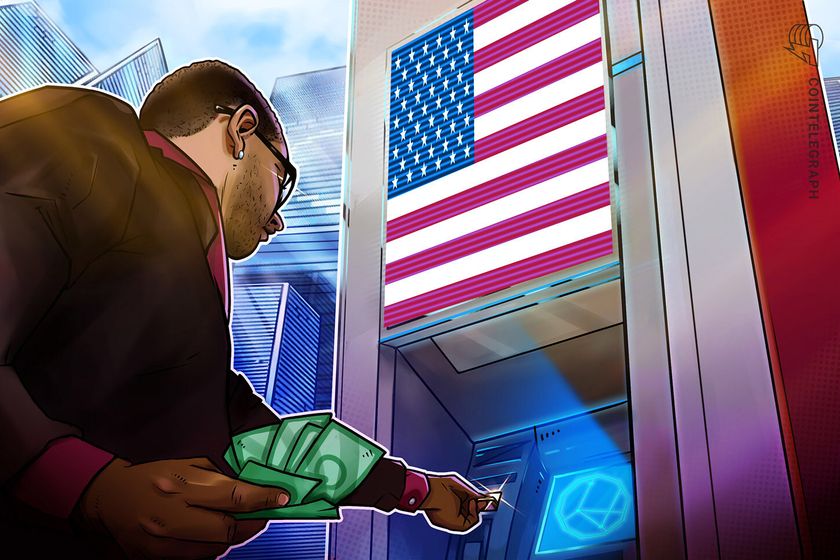
US lawmaker proposes crypto ATMs in federal buildings

A Texas member of the US House of Representatives has proposed that government officials consider installing cryptocurrency ATMs in federal buildings across the country.

In a May 1 letter to Stephen Ehikian, the acting administrator of the General Services Administration (GSA) — the entity responsible for managing the US government’s properties — Rep. Lance Gooden claimed that introducing crypto ATMs to federal buildings would serve as an “educational resource” and reflect advances in financial technology.

He requested that the GSA begin exploring the necessary guidelines and regulations needed to install such ATMs in government-controlled properties across the US, citing alignment with President Donald Trump’s goals.

Cryptocurrencies, ATM, Government, United StatesMay 1 letter pitching crypto ATMs to GSA. Source: Rep. Lance Gooden

According to financial disclosure reports filed with the US House of Representatives, Gooden had held no investments in cryptocurrency or ATM companies since taking office in 2019. He had not yet filed any financial disclosures with the government for 2025 investments.

The GSA website stated it may provide space to ATMs from federal credit unions, but it was unclear whether the acting administrator had the authority to expand the regulations to include digital asset ATMs tied to private companies like Bitcoin Depot or CoinFlip. Cointelegraph reached out to Gooden’s office for comment but did not receive a response at the time of publication.

Related: Eric Trump: USD1 will be used for $2B MGX investment in Binance

Gooden, a Republican and Trump supporter, made the proposal as lawmakers in the US Senate consider legislation to crack down on fraud through crypto ATMs. In February, Illinois Senator Dick Durbin introduced the Crypto ATM Fraud Prevention Act, aimed at placing “common sense guardrails” against fraud affecting many senior citizens.

Who would ultimately make the decision?

It’s unclear whether Ehikian, a Trump appointee, would have the authority to unilaterally — or even with the president’s approval — install the crypto ATMs without an act of Congress to authorize funding. Cointelegraph reached out to the GSA for comment but did not receive a response at the time of publication.

Trump has significant exposure to cryptocurrencies and digital asset firms through his personal holdings, presidential campaign funds, family-backed businesses, and the TRUMP memecoin. In April, the president announced a dinner in DC for top holders of his memecoin.

Magazine: Trump’s crypto ventures raise conflict of interest, insider trading questions

Read more at cointelegraph.com

Institutional Bitcoin buying may soon price out retail — LONGITUDE panel

Retail investors are running out of time to accumulate Bitcoin as institutional adoption accelerates, according to Sergej Kunz, co-founder of exchange aggregator 1inch.

Bitcoin (BTC) is evolving into an alternative reserve currency, propelling institutional demand and potentially pricing out retail investors, Kunz said during Cointelegraph’s LONGITUDE event in Dubai. 

“Every retail user should be thinking about getting at least one Bitcoin — very soon they won’t be able to afford it,” Kunz said. 

If the United States starts buying Bitcoin for a strategic reserve, even smaller countries may soon struggle to acquire the cryptocurrency, he added. “I’m pretty sure we’ll soon see countries battling over who owns more Bitcoin. The US will start.”

Bitcoin demand has accelerated since US President Donald Trump announced sweeping tariffs on US imports in April, setting off a global trade war.

“The only thing that still acts as a true hedge — across borders, against inflation — is Bitcoin,” Animoca Brands co-founder Yat Siu said during the panel. 

Cryptocurrencies, Bitcoin Price, Investments, Bitcoin Regulation, Markets, United States, Cryptocurrency Exchange, Donald Trump, Bitcoin ETFYat Siu (middle) and Sergej Kunz (right) with Cointelegraph’s Gareth Jenkinson at LONGITUDE. Source: Cointelegraph

Related: US President Donald Trump issues 90-day pause on reciprocal tariffs

Global reserve asset?

During the week of April 21-25, Bitcoin exchange-traded funds (ETFs) attracted more than $3 billion in inflows as institutions sought safety in “digital gold” amid mounting macroeconomic uncertainty. 

Analysts say demand from financial institutions could push Bitcoin’s price as high as $200,000 per coin this year. By 2029, institutional Bitcoin adoption could propel the cryptocurrency’s price past $1 million, Bitwise’s head of European research, André Dragosch, said.

Cryptocurrencies, Bitcoin Price, Investments, Bitcoin Regulation, Markets, United States, Cryptocurrency Exchange, Donald Trump, Bitcoin ETFAsset managers still prefer gold for hedging against macro risk. Source: Binance Research

For Bitcoin, “[t]he silver lining is that economic uncertainty has historically accelerated institutional interest in digital assets as a diversification strategy,” David Siemer, co-founder and CEO of Wave Digital Assets, told Cointelegraph.

As of May 1, Bitcoin ETFs and other institutional funds hold upward of $128 billion worth of BTC, according to data from BitcoinTreasuries.NET. Corporate treasuries hold another roughly $73 billion, data shows. 

Sovereign states — including the US, China, and the United Kingdom — collectively hold more than $130 billion worth of BTC. However, much of those holdings are from crypto assets seized by law enforcement, not outright Bitcoin buys. 

Magazine: TV hit Peaky Blinders to launch crypto game, FIFA Rivals on Polkadot: Web3 Gamer

Read more at cointelegraph.com

Crypto to accelerate AI adoption — LONGITUDE panel

Cryptocurrency can accelerate artificial intelligence adoption by helping AI startups onboard users, according to Polygon’s co-founder Sandeep Nailwal.

“You can use crypto incentives and disincentives to onboard users to onboard the ecosystem players,” Nailwal said during a panel discussion at the LONGITUDE by Cointelegraph event.

He added that projects with effective onchain incentive structures might even “build a better AI because you have this incentive engine that brings in developers,” Nailwal said on May 1.

Cointelegraph’s LONGITUDE is an event series that brings together leaders and innovators from the blockchain and Web3 space for exclusive discussions.

Joining the panel, Illia Polosukhin, co-founder of the Near Protocol, expanded on crypto’s long-term synergy with AI, forecasting that crypto-native AI agents could replace traditional web application front-ends as the primary user interfaces for Web3.

“We don’t need applications or websites anymore. Your AI becomes the interface to computing and the internet,” Polosukhin said.

Cryptocurrencies, Dubai, Polygon, Near ProtocolSandeep Nailwal (left) and Illia Polosukhin (middle), with Cointelegraph’s Gareth Jenkinson, speaking at Cointelegraph’s LONGITUDE event in Dubai. Source: Cointelegraph

Related: AI memecoins will become utility tokens

However, Nailwal cautioned that the rise of AI-related tokens onchain has also attracted a wave of opportunistic scams. “We know that 99% of those projects are literally token scams, but very few projects are actually trying to have some meaningful AI project,” he said. 

The era of Web3 AI agents

AI agents are expected to take on a more prominent role within decentralized communities, J.D. Seraphine, co-founder of Web3 developer Raiinmaker, recently told Cointelegraph

According to a report by VanEck, over 1 million AI agents could enter the market in 2025, with many of them tied to decentralized finance applications. Such agents are already reshaping the digital economy, building decentralized applications, launching tokens, and interacting with humans autonomously. 

Cryptocurrencies, Dubai, Polygon, Near ProtocolAI token cumulative market cap. Source: CoinGecko

“AI is an extremely centralizing force. A few companies could become the warlords of the world,” Nailwal said. 

“That’s why crypto-native, peer-to-peer AI solutions are so important—they enable privacy-preserving innovation,” Polosukhin said.

Magazine: Altcoin season to hit in Q2? Mantra’s plan to win trust: Hodler’s Digest, April 13 – 19

Read more at cointelegraph.com

Tether CEO defends decision to skip MiCA registration for USDT

Paolo Ardoino, CEO of stablecoin issuer Tether, addressed criticism over the company’s decision not to seek registration under the European Union’s Markets in Crypto-Assets (MiCA) framework, arguing that the regulations were risky for stablecoins.

Speaking to Cointelegraph at the Token2049 conference in Dubai, Ardoino reiterated that Tether had no plans to apply for its US dollar-pegged stablecoin USDt — the largest by market capitalization — to be compliant under MiCA in European countries, potentially forcing exchanges to delist the stablecoin. He added that though crypto firms had to follow regulations, there was a “fear of compliance” among companies in the EU.

“[…] MiCA license is very dangerous when it comes to stablecoins, and I believe that is even more dangerous for the small, medium banking system in Europe,” said the Tether CEO, adding that banks in the region could “go belly up” in the next few years thanks to MiCA’s requirements, such as keeping 60% of stablecoins reserves in insured cash deposits in European banks. Ardoino added:

“I decided to not apply to the MiCA license because I need to protect the 400 million+ users that we have around the world. They are not as lucky as Europeans. I love Europe, but I think that unfortunately European Central Bank is more interested [in pushing] the digital euro as a way to control people and control how they spend their money.”

Related: Paolo Ardoino: Competitors and politicians intend to ‘kill Tether’

After years of planning and research, EU officials began to implement requirements under MiCA in December 2024. Tether, which is regulated and headquartered in El Salvador, is required to comply with MiCA regulatory requirements if offering products or services in EU member states.

Since the regulations went into effect, many crypto exchanges have acted to ensure their platforms listed as MiCA-compliant tokens. Kraken delisted five stablecoins, including USDt, and Crypto.com announced plans to delist 10 stablecoins as of January.

On nations establishing crypto reserves

Speaking on its intentions for operating in the United States, Ardoino said the country “would require a different type of product,” given the competition with local stablecoin issuers. He added that the US’ and other countries’ efforts to establish a Bitcoin (BTC) stockpile were “just inevitable.”

“In the medium to long term, the more Bitcoin education, the more companies will set the example […] then everyone else will follow,” said the Tether CEO. “It’s never too late to buy Bitcoin.”

Ardoino’s statements came the same day that Tether announced roughly $120 billion in exposure to US Treasurys as of the first quarter of 2025. As of May 1, USDt had a market capitalization of roughly $149 billion.

Magazine: Crypto wanted to overthrow banks, now it’s becoming them in stablecoin fight

Read more at cointelegraph.com

Coinbase suspends trading for MOVE token

Crypto exchange Coinbase has announced it will suspend trading of the Movement Network token (MOVE), the native cryptocurrency of the Movement layer-2 blockchain protocol, developed by Movement Labs, effective May 15.

The decision was shared in a May 1 X post, with Coinbase citing the token’s failure to meet its listing standards. The price of the MOVE token also declined by approximately 14.5% in the last 24 hours. Coinbase specified the details of the suspension in an announcement:

“Trading for MOVE will be suspended on Coinbase, Simple and Advanced Trade, Coinbase Exchange, and Coinbase Prime. We have moved our MOVE order books to limit-only mode. Limit orders can be placed and canceled, and matches may occur.”

The suspension of the token follows a recently announced third-party review orchestrated by the Movement Network Foundation into an agreement allegedly signed by Movement Labs and a market-making firm, which is said to be behind the downfall of the MOVE token price in December 2024.

Coinbase, United States, Cryptocurrency ExchangeSource: Coinbase Assets

A Movement Network Foundation spokesperson recently confirmed to Cointelegraph that the third-party investigation, which commenced on April 21, is ongoing. The investigation is being conducted by Groom Lake, an independent cybersecurity and intelligence firm, and has cast a cloud over the MOVE token’s price.

Related: Binance to purge 14 tokens following ‘vote to delist’ process

Investigation launched into Movement Labs deal

The details of the ongoing investigation, reported by CoinDesk on April 30, revealed an agreement between Movement Labs and Web3Port, a market maker to help distribute the Move token at launch.

According to the report, a company called “Rentech” helped to broker the agreement between the two firms, appearing on both sides of the deal — as a Web3Port subsidiary and as an agent of the Movement Foundation.

The deal reportedly gave Rentech control of over 66 million MOVE tokens that it sold-off after the token launch in early December 2024, triggering $38 million in downward price pressure.

Coinbase, United States, Cryptocurrency ExchangeThe price action for the MOVE token. Source: TradingView

The MOVE token has been in a downtrend ever since early January 2025 and is trading at around $0.20 at the time of this writing.

Magazine: Arbitrum co-founder skeptical of move to based and native rollups: Steven Goldfeder

Read more at cointelegraph.com

Coinbase suspends trading of MOVE token

Crypto exchange Coinbase has announced it will suspend trading of the Movement Network token (MOVE), the native cryptocurrency of the Movement layer-2 blockchain protocol, developed by Movement Labs, effective May 15.

The decision was shared in a May 1 X post, with Coinbase citing the token’s failure to meet its listing standards. The price of the MOVE token also declined by approximately 14.5% in the last 24 hours. Coinbase specified the details of the suspension in an announcement:

“Trading for MOVE will be suspended on Coinbase, Simple and Advanced Trade, Coinbase Exchange, and Coinbase Prime. We have moved our MOVE order books to limit-only mode. Limit orders can be placed and canceled, and matches may occur.”

The suspension of the token follows a recently announced third-party review orchestrated by the Movement Network Foundation into an agreement allegedly signed by Movement Labs and a market-making firm, which is said to be behind the downfall of the MOVE token price in December 2024.

Coinbase, United States, Cryptocurrency ExchangeSource: Coinbase Assets

A Movement Network Foundation spokesperson recently confirmed to Cointelegraph that the third-party investigation, which commenced on April 21, is ongoing. The investigation is being conducted by Groom Lake, an independent cybersecurity and intelligence firm, and has cast a cloud over the MOVE token’s price.

Related: Binance to purge 14 tokens following ‘vote to delist’ process

Investigation launched into Movement Labs deal

The details of the ongoing investigation, reported by CoinDesk on April 30, revealed an agreement between Movement Labs and Web3Port, a market maker to help distribute the Move token at launch.

According to the report, a company called “Rentech” helped to broker the agreement between the two firms, appearing on both sides of the deal — as a Web3Port subsidiary and as an agent of the Movement Foundation.

The deal reportedly gave Rentech control of over 66 million MOVE tokens that it sold-off after the token launch in early December 2024, triggering $38 million in downward price pressure.

Coinbase, United States, Cryptocurrency ExchangeThe price action for the MOVE token. Source: TradingView

The MOVE token has been in a downtrend ever since early January 2025 and is trading at around $0.20 at the time of this writing.

Magazine: Arbitrum co-founder skeptical of move to based and native rollups: Steven Goldfeder

Read more at cointelegraph.com

Coinbase to suspend trading of MOVE token

Crypto exchange Coinbase has announced it will suspend trading of the Movement Network token (MOVE), the native cryptocurrency of the Movement layer-2 blockchain protocol, developed by Movement Labs, effective May 15.

The decision was shared in a May 1 X post, with Coinbase citing the token’s failure to meet its listing standards. The price of the MOVE token also declined by approximately 14.5% in the last 24 hours. Coinbase specified the details of the suspension in an announcement:

“Trading for MOVE will be suspended on Coinbase, Simple and Advanced Trade, Coinbase Exchange, and Coinbase Prime. We have moved our MOVE order books to limit-only mode. Limit orders can be placed and canceled, and matches may occur.”

The suspension of the token follows a recently announced third-party review orchestrated by the Movement Network Foundation into an agreement allegedly signed by Movement Labs and a market-making firm, which is said to be behind the downfall of the MOVE token price in December 2024.

Coinbase, United States, Cryptocurrency ExchangeSource: Coinbase Assets

A Movement Network Foundation spokesperson recently confirmed to Cointelegraph that the third-party investigation, which commenced on April 21, is ongoing. The investigation is being conducted by Groom Lake, an independent cybersecurity and intelligence firm, and has cast a cloud over the MOVE token’s price.

Related: Binance to purge 14 tokens following ‘vote to delist’ process

Investigation launched into Movement Labs deal

The details of the ongoing investigation, reported by CoinDesk on April 30, revealed an agreement between Movement Labs and Web3Port, a market maker to help distribute the Move token at launch.

According to the report, a company called “Rentech” helped to broker the agreement between the two firms, appearing on both sides of the deal — as a Web3Port subsidiary and as an agent of the Movement Foundation.

The deal reportedly gave Rentech control of over 66 million MOVE tokens that it sold off after the token launch in early December 2024, triggering $38 million in downward price pressure.

Coinbase, United States, Cryptocurrency ExchangeThe price action for the MOVE token. Source: TradingView

The MOVE token has been in a downtrend ever since early January 2025 and is trading at around $0.20 at the time of this writing.

Magazine: Arbitrum co-founder skeptical of move to based and native rollups: Steven Goldfeder

Read more at cointelegraph.com

Devs introduce Ethereum R1 layer-2 scaling solution

A group of developers within the Ethereum ecosystem, operating independently of the Ethereum Foundation, have announced Ethereum R1 — a layer-2 (L2) scaling solution for the Ethereum network that does not include a native token.

According to the announcement, the project relies entirely on donations, does not have venture funding, and does not have any pre-mined token allocations or a governance token. The project’s team wrote in a May 1 X post:

“General-purpose L2s should be commodities — simple, replaceable, and free from centralized dependencies or risky governance. Ethereum R1 is our answer to that call — the rollup grounded in credible neutrality, decentralization, and censorship resistance.”

“Most L2s today are acting more like new L1s than an Ethereum scaling solution — private allocations, opaque governance, and centralized control,” the developers continued.

The announcement points to increasing concerns within the Ethereum community regarding the current direction of many layer-2 scaling solutions, which some view as potentially misaligned with the interests of the base layer

Related: Ethereum community members propose new fee structure for the app layer

Ethereum’s L2-centric approach: Unique value proposition or exploitation?

Ethereum’s Dencun upgrade in March 2024 significantly lowered fees for its layer-2 networks. By September, revenue on the Ethereum base layer collapsed by 99%.

As a result, transaction costs on the Ethereum network base layer dropped to a five-year low of roughly $0.16 per transaction in April 2025, due to a lack of demand for block space on the base layer.

Ethereum’s transaction fees are determined by demand and network traffic — higher demand and network traffic translate into higher fees for the base layer and more revenue.

Ethereum 2.0Ethereum’s base layer revenue collapsed in Q1 2025. Source: Token Terminal

While critics continue to argue that this provides perverse incentives for layer-2 networks to grow at the expense of the base layer, protocols continue to argue that Ethereum’s many layer-2 networks are a feature, not a bug.

Anurag Arjun, co-founder of the unified chain abstraction solution Avail, told Cointelegraph that Ethereum’s layer-2 approach gives users a virtually unlimited number of high-throughput chains to choose from, as opposed to the singular one-size-fits-all approach employed by monolithic blockchain protocols.

Magazine: Ethereum is destroying the competition in the $16.1T TradFi tokenization race

Read more at cointelegraph.com

Federal crypto legislation could come with a ‘New York State of Mind’

Love it or leave it, New York State has been a force in crypto regulation.

Ten years ago, the state created the United States’ first comprehensive regulatory framework for firms dealing in cryptocurrencies, including key consumer protection, anti-money laundering compliance and cybersecurity guidelines.

In September 2015, the New York Department of Financial Services (NYDFS) issued its first BitLicense to Circle Internet Financial, enabling the company to conduct digital currency business activity in the state. Ripple Markets received the second BitLicense in 2016. Circle and Ripple went on to become giant players in the global cryptocurrency and stablecoin industry.

Today, the NYDFS regulates one of the largest pools of crypto firms in the world, and it is often cited as the gold standard for crypto regulation in the US.

It’s against that background that Ken Coghill, NYDFS’s deputy superintendent for virtual currencies, appeared at Cornell Tech’s blockchain conference on April 25 to discuss “A New Era of U.S. Innovation in Crypto.” 

“We set the guardrails”

Most of the firms that have come to the NYDFS for a BitLicense are crypto-native firms, and often, they are new to the financial world and not used to dealing with regulators. Many times they don’t fully understand that they are in control of someone else’s asset, noted Coghill at the New York City conference, adding:

If you want to start a business and the only person you’re putting at risk is your own business, that’s not really our concern. We only exist because you’re selling something to somebody else, and you’re maintaining control over that product for someone else.

“We set the guardrails,” Coghill said, and it’s the industry’s job to figure out how to stay within those guardrails. The NYDFS can’t possibly contemplate every element that’s going to go wrong in a business.

These days, more conventional financial institutions are becoming interested in crypto as well, added Coghill. Large banks are beginning to offer crypto custody services, and others are starting to provide settlement services. “The conventional [bank] model is being brought into the crypto [sphere] primarily because it makes people feel comfortable,” said Coghill.

Related: Trump’s first 100 days ‘worst in history’ despite crypto promises

And while the NYDFS has only issued 22 BitLicenses to date, it appears to be ready to handle a tide of applications from TradFi firms if and when they materialize. “On a per capita basis, we have more supervisory resources focused on crypto businesses than we do for all of those other [non-crypto] businesses,” said Coghill. This includes 3,000 banks, insurance companies and other financial institutions. 

Dubai’s crypto regulator

It wasn’t a direct route that brought Coghill to the NYDFS in July 2024. He spent the previous 12 years in the Middle East working for the Dubai Financial Services Authority, eventually becoming the agency’s head of innovation and technology risk supervision.

It was a “whim” that took him to the Middle East in the first place, he recalled. “I went for three years and stayed for 12 years,” spending that time primarily as an official regulating global systemically important banks, or G-SIBs.

There, he was called upon to develop a cryptocurrency supervision model, and so he “spent the last six years regulating cryptocurrency in the Middle East.”

New York, United States, AML, Cybersecurity, FeaturesThe Dubai Financial Services Authority offices. Source: Condé Nast

Eventually, an opportunity arose to return to the US, where he had worked earlier as a manager in the department of market regulation at the Chicago Board Options Exchange. Before that he was an options trader. He took the new assignment with the NYDFS, among other reasons, because “the world looks to New York, and the world looks to the DFS” when it comes to regulation, he told the Cornell Tech audience.

Panel moderator Neil DeSilva asked Coghill what good regulation looks like. “Good regulation is regulation that doesn’t prohibit activity but that applies appropriate guardrails that reduces risk to clients,” he answered. One can’t eliminate risk entirely; to do so would quash all business activity.

Related: Institutions break up with Ethereum but keep ETH on the hook

He compares regulation to a pendulum constantly swinging between two extremes: too lenient and too restrictive. “The pendulum swung too far to one end of the regulation in the last few years [i.e., too restrictive]. Now it’s swinging back.”

What does the state regulator make of the fevered regulatory activity in Washington, DC at the federal level these days? There seem to be some “positive tailwinds” behind cryptocurrencies and stablecoins, noted DeSilva, himself a former chief financial officer for PayPal’s Digital Currencies and Remittances business. 

A pipeline to Washington

“For DFS, it’s largely business as usual,” Coghill commented. That’s because New York State has long had crypto rules in place. In fact, “much of what’s happening now in Washington” — at the federal level — “is influenced by what we’ve done over the last 10 years” at the state level.

The state agency has regularly communicated with the powers-that-be in the US capital regarding digital currencies. “We have a team that practically sits in Washington and has discussions with Congressional members, talking about what we think will work and what won’t work.”

The NYDFS’ crypto initiatives have influenced other US states. California’s crypto reform legislation (AB 1934), signed into law in late September 2024, for instance, builds on New York State’s BitLicense and its limited-purpose trust charter regulations for digital currency businesses — even though BitLicense’s licensing requirements are relatively strict.

Not all in the crypto industry have been enamored with the state’s crypto licensing regime, either, declaring BitLicenses too expensive. Its application fee is $5,000 — too strict with its detailed anti-money laundering protocols and required audits and generally too much of an obstacle for innovative crypto-native firms. Crypto exchange Kraken exited the state when New York implemented its BitLicense requirement, for instance. 

Coghill was asked by DeSilva how the NYDFS actually looks at decentralized protocols compared with how it views the centralized financial institutions that it has historically regulated. 

It’s important to look at the actual purpose of the product, Coghill answered. What’s its underlying intent? Who does it serve, and what are its good and bad impacts? “There are lots of innovations that are created for no purpose other than making a lot of money off of its customers,” said Coghill. “And so it’s incumbent on us to filter those out.” 

“We’re paid to look at everything in a dark, dark way. It’s not our job to look at and say, ‘Yes, this is fantastic.’” Rather, they examine a potential product and ask, “How is this bad for efficiency?” or “How is this bad for inclusion?” 

How does he think things will play out at the federal level this year regarding crypto and stablecoin legislation?

What’s going to ultimately happen [in Washington, DC]? Who knows? We could know six months from now. We could know things next week. Things have been changing very rapidly recently.

In the meantime, “we’re still accepting applications. We’re still processing those applications. We’re still focusing on our underlying objectives: protecting the market, protecting the consumers, supporting innovation.”

Magazine: Crypto wanted to overthrow banks, now it’s becoming them in stablecoin fight
Read more at cointelegraph.com

Bitcoin to $1M by 2029 fueled by ETF and gov’t demand — Bitwise exec

Bitcoin’s expanding institutional adoption may provide the “structural” inflows necessary to surpass gold’s market capitalization and push its price beyond $1 million by 2029, according to Bitwise’s head of European research, André Dragosch.

“Our in-house prediction is $1 million by 2029. So that Bitcoin will match gold’s market cap and total addressable market by 2029,” he told Cointelegraph during the Chain Reaction daily X spaces show on April 30.

Corporations are coming for your bitcoin (feat. André Dragosch, Head of Research at Bitwise) #CHAINREACTION https://t.co/5F3cRWBHzq

— Cointelegraph (@Cointelegraph) April 30, 2025

Gold is currently the world’s largest asset, valued at over $21.7 trillion. In comparison, Bitcoin’s market capitalization sits at $1.9 trillion, making it the seventh-largest asset globally, according to CompaniesMarketCap data.

Bitcoin to $1M by 2029 fueled by ETF and gov’t demand — Bitwise execTop 10 global assets by market capitalization. Source: CompaniesMarketCap

Related: Bitcoin treasury firms driving $200T hyperbitcoinization — Adam Back

For the 2025 market cycle, Bitcoin may surpass $200,000 in the “base case” and $500,000 with more governmental adoption, Dragosch said.

“But once you see sovereign bias like the US government stepping in, all this will change to $500,000.”

“So the base case is $200,000, conditional on the US government not stepping in. If they step in, it will move closer toward $500,000,” said Dragosch, referring to the US government’s plan to potentially make direct Bitcoin acquisitions through “budget-neutral” strategies.

The US is looking at “many creative ways” to fund its Bitcoin investments, including from tariff revenue and by reevaluating the US Treasury’s gold certificates, creating a paper surplus to fund the BTC reserve without selling gold, Bo Hines of the Presidential Council of Advisers for Digital Assets said in an interview on April 14.

Related: Crypto sentiment recovers, but weekend liquidity risks remain

“Structural” ETF inflows, institutional adoption prolong Bitcoin cycle

The US-based spot Bitcoin exchange-traded funds (ETFs) have surpassed all expectations during their first year of trading, exceeding record trading volumes as BlackRock’s iShares Bitcoin Trust ETF became the fastest-growing ETF in history.

The first year is usually the “slowest” for ETFs, Dragosch said, highlighting the launch of the gold ETF:

“That alone implies that in the second and third year, we will see growing inflows. In terms of the four four-year cycle, implies that, this cycle will be prolonged by these structural inflows.”

The Bitcoin cycle may also be prolonged when US wirehouses start gaining exposure to Bitcoin and ETFs.

“In the US, the major distribution channels go via Wirehouses, which are essentially the big banks like Merrill Lynch or Morgan Stanley. […] Not even half of these wirehouses have opened up their distribution channels to US Bitcoin ETFs,” the analyst said.

Adoption from US wirehouses may bring a “huge amount of capital,” since these control over $10 trillion worth of customer assets, Dragosch added.

Magazine: Altcoin season to hit in Q2? Mantra’s plan to win trust: Hodler’s Digest, April 13 – 19

Read more at cointelegraph.com