cointelegraph.com

Bitcoin sell-off to $93.5K is a brief hiccup — Data still supports new BTC highs in 2025

Key takeaways:

Bitcoin price slips, but BTC dominance is on the rise.

Sizable purchases by Strategy and the spot BTC ETFs highlight institutional investors’ appetite for Bitcoin.

Bitcoin’s (BTC) price has dropped by 4.3% in the last three days after nearly reaching $97,900 on May 2. Despite showing resilience at the $94,000 level on May 5, some traders are disappointed that strong institutional inflows have not been enough to maintain bullish momentum. However, several encouraging signs suggest that a new all-time high for Bitcoin in 2025 remains within reach.

Bitcoin sell-off to $93.5K is a brief hiccup — Data still supports new BTC highs in 2025Bitcoin market share excluding stablecoins. Source: TradingView / Cointelegraph

Bitcoin’s dominance over the broader cryptocurrency market has surged, currently standing at 70%, its highest since January 2021. This has occurred despite a wave of new token launches, including several top-50 projects such as SUI, Toncoin (TON), PI, Official Trump (TRUMP), Bittensor (TAO), Ethena (ENA), and Celestia (TIA). This dominance makes riskier altcoins less appealing to new market entrants.

The spot Bitcoin ETFs recorded $4.5 billion in net inflows between April 22 and May 2. At the same time, the increasing appetite for Bitcoin futures signals growing institutional adoption regardless of whether leverage is used for downside protection or bullish bets.

Bitcoin sell-off to $93.5K is a brief hiccup — Data still supports new BTC highs in 2025Bitcoin futures aggregate open interest, BTC. Source: CoinGlass

According to CoinGlass, the total open interest in Bitcoin futures markets has reached 669,090 BTC, a 21% increase since March 5. Even after Bitcoin’s price crashed below $75,000 in early April, demand for leveraged positions remained strong. The open interest in BTC futures on the Chicago Mercantile Exchange (CME) alone exceeds $13.5 billion, indicating robust institutional demand.

Several factors explain why Bitcoin has struggled to reclaim the $100,000 level. Traders who bought in anticipation of the US Strategic Bitcoin Reserve bill on March 6 are growing increasingly frustrated, as the government has yet to disclose its BTC holdings or announce plans for further purchases. Additionally, similar state-level Bitcoin bills have repeatedly failed, including the latest setback in the US state of Arizona.

Strategy doubles its plans for BTC acquisitions despite the global trade war 

Over the past three months, gold has outperformed most assets, rising 16%, while Bitcoin has declined by 5% and the S&P 500 has corrected by 6.5%. This has challenged the notion of Bitcoin as an uncorrelated asset, as the cryptocurrency has repeatedly failed to decouple from the S&P 500 amid rising economic risks. The global trade war has led investors to favor fixed-income assets and cash positions.

Bitcoin sell-off to $93.5K is a brief hiccup — Data still supports new BTC highs in 20255-year US Treasury yield (left) vs. Bitcoin/USD (right). Source: TradingView / Cointelegraph

Bitcoin’s recent drop to $94,000 is particularly concerning given that Strategy, a US-listed company led by Michael Saylor, announced the acquisition of 1,895 BTC on May 5, after doubling its capital increase plan to fund further Bitcoin purchases. However, since investors were previously uncertain about Strategy’s ability to raise additional capital, the announcement of an $84 billion plan on May 1 has reduced some of this risk.

For Bitcoin to reach a new all-time high, investors will likely need reassurance that US-China trade relations are improving, as tariffs have negatively impacted overall risk appetite. Nevertheless, the key elements for a BTC bull run above $100,000 appear to be in place.

This article is for general information purposes and is not intended to be and should not be taken as legal or investment advice. The views, thoughts, and opinions expressed here are the author’s alone and do not necessarily reflect or represent the views and opinions of Cointelegraph.

Read more at cointelegraph.com

US Treasury sanctions Myanmar militia group for alleged crypto scams

The United States Department of the Treasury has sanctioned a Myanmar militia group known as the Karen National Army (KNA), accusing it of crypto-related scams and other criminal activities.

According to a May 5 press release issued by the agency, the Karen National Army has been orchestrating a variety of crypto scams, including the infamous “pig butchering” scam, which lures victims into contributing more and more to fake crypto schemes. Americans “have collectively lost billions of dollars” from scams such as those emanating from Myanmar, the release reads, without specifying an amount.

“Today, the U.S. Department of the Treasury’s Office of Foreign Assets Control (OFAC) sanctioned the Karen National Army (KNA), a militia group in Burma, as a transnational criminal organization, along with the group’s leader Saw Chit Thu, and his two sons, Saw Htoo Eh Moo and Saw Chit Chit, for their role in facilitating cyber scams that harm U.S. citizens, human trafficking, and cross-border smuggling,” the release reads.

Many international bodies, including the US, continue to refer to “Burma,” the country’s former name, to demonstrate that they don’t recognize the military regimes that have been in power at various times since a 1989 coup in which the military changed the name to Myanmar. The KNA operates in southeastern Myanmar, along the Thailand border.

The Treasury’s Office of Foreign Assets Control (OFAC) has issued numerous sanctions against crypto-offenders over the past few years, including Middle East-based terrorist groups, cybercrime units operating overseas, and privacy-focused crypto technology like Tornado Cash.

Related: FBI warns of North Korean ’social engineering’ schemes to steal crypto

Crypto scams target US residents

According to the Federal Bureau of Investigation (FBI), Americans lost $9.3 billion to crypto scams in 2024, an increase of roughly 66% from 2023. The most affected group is formed by individuals over the age of 60, who reported a cumulative loss total of $2.8 billion.

Pig butchering scams are known for their significant impact on victims, both in the crypto space and beyond. The scam consists of a long-term financial fraud where scammers build trust with victims over time, often through social media or messaging platforms, before convincing them to invest in fake or manipulated crypto schemes. According to TRM Labs, a blockchain intelligence company, these scams accounted for well over $4.4 billion stolen in 2023.

According to the Treasury Department’s press release, this type of scam is currently common in Southeast Asia, primarily involving trafficked individuals defrauding victims. The Karen National Army is allegedly engaged in orchestrating both pig butchering scams and human trafficking networks that enable them to operate at scale.

Magazine: Influencers shilling memecoin scams face severe legal consequences

Read more at cointelegraph.com

US Treasury sanctions Myanmar militia group for alleged crypto scams

The United States Department of the Treasury has sanctioned a Myanmar militia group known as the Karen National Army (KNA), accusing it of crypto-related scams and other criminal activities.

According to a May 5 press release issued by the agency, the Karen National Army has been orchestrating a variety of crypto scams, including the infamous “pig butchering” scam, which lures victims into contributing more and more to fake crypto schemes. Americans “have collectively lost billions of dollars” from scams such as those emanating from Myanmar, the release reads, without specifying an amount.

“Today, the U.S. Department of the Treasury’s Office of Foreign Assets Control (OFAC) sanctioned the Karen National Army (KNA), a militia group in Burma, as a transnational criminal organization, along with the group’s leader Saw Chit Thu, and his two sons, Saw Htoo Eh Moo and Saw Chit Chit, for their role in facilitating cyber scams that harm U.S. citizens, human trafficking, and cross-border smuggling,” the release reads.

Many international bodies, including the US, continue to refer to “Burma,” the country’s former name, to demonstrate that they don’t recognize the military regimes that have been in power at various times since a 1989 coup in which the military changed the name to Myanmar. The KNA operates in southeastern Myanmar, along the Thailand border.

The Treasury’s Office of Foreign Assets Control (OFAC) has issued numerous sanctions against crypto-offenders over the past few years, including Middle East-based terrorist groups, cybercrime units operating overseas, and privacy-focused crypto technology like Tornado Cash.

Related: FBI warns of North Korean ’social engineering’ schemes to steal crypto

Crypto scams target US residents

According to the Federal Bureau of Investigation (FBI), Americans lost $9.3 billion to crypto scams in 2024, an increase of roughly 66% from 2023. The most affected group is formed by individuals over the age of 60, who reported a cumulative loss total of $2.8 billion.

Pig butchering scams are known for their significant impact on victims, both in the crypto space and beyond. The scam consists of a long-term financial fraud where scammers build trust with victims over time, often through social media or messaging platforms, before convincing them to invest in fake or manipulated crypto schemes. According to TRM Labs, a blockchain intelligence company, these scams accounted for well over $4.4 billion stolen in 2023.

According to the Treasury Department’s press release, this type of scam is currently common in Southeast Asia, primarily involving trafficked individuals defrauding victims. The Karen National Army is allegedly engaged in orchestrating both pig butchering scams and human trafficking networks that enable them to operate at scale.

Magazine: Influencers shilling memecoin scams face severe legal consequences

Read more at cointelegraph.com

VanEck files for BNB ETF, first in US

Asset manager VanEck has asked US regulators for permission to list an exchange-traded fund (ETF) holding BNB, the native token of Binance’s BNB Chain, regulatory filings show. 

The ETF is designed to accumulate spot BNB (BNB) tokens and “may, from time to time, stake a portion of the [fund’s] assets through one or more trusted staking providers,” according to the ETF’s S-1 prospectus. The filing marks the first time an asset manager has filed for a BNB ETF in the United States.

The BNB token has a market capitalization of roughly $84 billion, according to data from CoinMarketCap. As of May 5, BNB stakers earn a yield of approximately 2.5%, according to data from Stakingrewards.com

Binance’s BNB Chain is among the most popular smart contract networks, with a total value locked (TVL) of nearly $6 billion, according to data from DefiLlama. 

VanEck files for BNB ETF, first in USBNB Chain is among the most popular blockchain networks. Source: DeFILlama

Related: Binance co-founder CZ proposes Bitcoin, BNB for Kyrgyzstan reserves

Bitcoin’s “spillover” effect?

The filing comes days after Binance co-founder Changpeng “CZ” Zhao reportedly said he expects the popularity of Bitcoin (BTC) ETFs to eventually “spill over” into altcoins.

“This cycle so far has been the ETFs. And it’s almost all Bitcoin. Ether hasn’t had as much success but Bitcoin success will spill over to the others eventually,” CZ reportedly said during the Token2049 conference in Dubai. 

Spot Bitcoin ETFs attracted net inflows of more than $40 billion since launching in January of 2024, according to data from Farside Investors.

Cryptocurrencies, Bitcoin Price, Investments, Markets, United States, Ethereum ETF, Bitcoin ETF, ETFCumulative inflows into spot BTC ETFs. Source: Farside Investors

VanEck’s filing is the newest in a flurry of filings seeking to list ETFs holding altcoins. 

The US Securities and Exchange Commission (SEC) has acknowledged dozens of cryptocurrency ETF proposals since US President Donald Trump took office on Jan. 20. 

They include plans for ETFs holding native layer-1 tokens such as Solana (SOL) as well as memecoins such as Dogecoin (DOGE).

VanEck has filed to list other cryptocurrency ETFs over the past few months, including funds holding Solana and Avalanche (AVAX).

Magazine: ZK-proofs are bringing smart contracts to Bitcoin — BitcoinOS and Starknet

Read more at cointelegraph.com

What do crypto users want to happen to Alex Mashinsky?

Crypto users are weighing in as Alex Mashinsky, the former CEO of Celsius Network, prepares to stand before a judge on May 8 to face sentencing for commodities fraud and a fraudulent scheme to manipulate the price of the platform’s token.

In a May 2 filing in the US District Court for the Southern District of New York (SDNY), prosecutors released several impact statements from individuals affected by the collapse of Celsius filed after the initial deadline. Though at least one suggested clemency for the former CEO, many told the court about the financial and personal losses caused by the crypto firm filing for bankruptcy, and hinted that Mashinsky should be held accountable for misrepresenting the company.

“Many of the people who participated in this fraud, benefited from this fraud, and potentially orchestrated this fraud will get away with zero legal consequences,” said Daniel Frishberg of Hillsborough County, Florida, in an April 24 statement. “Please do not allow Mr. Mashinsky to be one of those people (such as with probation/house arrest, as some people supporting him have requested). Please throw the book at him.”

Law, Court, Crimes, CelsiusA victim impact statement from a Celsius user filed with the SDNY on May 2. Source: PACER

Prosecutors have requested that Mashinsky serve up to 20 years in prison for his role in Celsius’ fraud, while the former CEO’s legal team asked for a year and one day. The judge will consider guidelines and victim statements at sentencing on May 8.

Calls for leniency and harsh prison time

Not everyone who sent in a letter to the prosecutors seemed to be in favor of Mashinsky being sent away for decades, as was former FTX CEO Sam “SBF” Bankman-Fried. SBF stood before a different federal judge in the same district in March 2024 and was handed a 25-year sentence, which he is currently serving in a California prison. 

“While Celsius [sic] collapse caused significant losses, particularly for Bitcoin holders, shareholders, and borrowers, despite his mistakes, Mr. Mashinsky was, at times, the more conservative voice in an industry overflowing with unchecked greed,” said Artur Abreu in a victim impact statement.

“The twenty-year sentence suggested by the US DOJ is fair in my opinion, as Mashinsky caused pain and suffering for many crypto investors across the globe – even resulting in suicide for some of those involved,” said Web3 Deep Dive podcast host and former Cointelegraph reporter Rachel Wolfson, who lost access to Bitcoin worth about $5,000 at the time. “Harsh punishment for bad actors in the crypto industry has become necessary to ensure that the space legitimizes over time.”

Mashinsky’s sentencing will be one of the first in significant crypto cases in the district since Jay Clayton became interim US Attorney for SDNY. A Trump appointee, Clayton was previously the chair of the US Securities and Exchange Commission and a crypto proponent on many issues. 

Critics have suggested that Clayton would take a softer approach to crypto enforcement, given his ties to Wall Street firms and the industry. However, he also released a statement in April regarding a $12-million crypto case, suggesting that he supported accountability for fraudulent actions. His response to Mashinsky’s sentencing and other future cases could be a bellwether for the US Attorney’s approach to crypto.

Related: US prosecutors file over 200 victim statements in Celsius ex-CEO’s case

Read more at cointelegraph.com

Price predictions 5/5: SPX, DXY, BTC, ETH, XRP, BNB, SOL, DOGE, ADA, SUI

Key points:

Bitcoin is witnessing a tough battle between the bulls and the bears at the $95,000 level.

Solid buying by spot Bitcoin ETF investors last week signals a positive shift in investor sentiment. 

Select altcoins have held their support levels, increasing the likelihood of a short-term up move.

Bitcoin (BTC) slipped below the breakout level of $95,000 on May 4, indicating profit booking at higher levels. The bulls tried to push the price back above $95,000 on May 5 but are facing stiff resistance from the bears. 

Glassnode senior researcher CryptoVizArt said in a post on X that Bitcoin maintaining above $93,000 was very surprising and also risky as the rally to the $93,000 to $96,000 range “pushed the profit-taking volume above the statistical levels.” CryptoVizArt added that there were more than $9 in realized profits for every dollar realized in loss.

Price predictions 5/5: SPX, DXY, BTC, ETH, XRP, BNB, SOL, DOGE, ADA, SUICrypto market data daily view. Source: Coin360

However, a positive sign in favor of bulls is that the US-based Bitcoin exchange-traded funds witnessed inflows of $1.8 billion last week, per Farside Investors data. The ETF issuers and the institutions acquired 18,644 Bitcoin last week compared to the 3,150 Bitcoin mined during the period, reported asset allocator HODL15Capital on May 4.

What are the crucial support and resistance levels to watch out for in Bitcoin and altcoins? Let’s analyze the charts of the top 10 cryptocurrencies to find out.

S&P 500 Index price prediction

The S&P 500 Index (SPX) extended its recovery last week and rose above the 50-day simple moving average (5,575).

Price predictions 5/5: SPX, DXY, BTC, ETH, XRP, BNB, SOL, DOGE, ADA, SUISPX daily chart. Source: Cointelegraph/TradingView

The 20-day exponential moving average (5,501) has started to turn up, and the relative strength index (RSI) is in the positive territory, indicating advantage to buyers. The up move could reach 5,800, which is expected to attract strong selling by the bears. If the price turns down from 5,800, it is likely to find support at the 20-day EMA. 

Sellers will have to yank the price below the 20-day EMA to suggest that the bullish momentum is weakening. The index may drop to 5,400 and subsequently to 5,300.

US Dollar Index price prediction

The US Dollar Index (DXY) bounced off the 99 support on April 29 and reached the 20-day EMA (100.38) on May 1.

Price predictions 5/5: SPX, DXY, BTC, ETH, XRP, BNB, SOL, DOGE, ADA, SUIDXY daily chart. Source: Cointelegraph/TradingView

Buyers are facing stiff resistance at the 20-day EMA, but a minor positive is that they have not ceded much ground to the bears. That improves the prospects of a break above the 20-day EMA. If that happens, the index could rise to the 61.8% Fibonacci retracement level of 101.39 and then to the 50-day SMA (102.72).

This positive view will be invalidated if the price continues lower and breaks below the 99 level. That could sink the index to the critical support at 97.92.

Bitcoin price prediction

Bitcoin closed below the $95,000 support on May 4, and the bears are trying to extend the pullback to the 20-day EMA ($92,204).

Price predictions 5/5: SPX, DXY, BTC, ETH, XRP, BNB, SOL, DOGE, ADA, SUIBTC/USDT daily chart. Source: Cointelegraph/TradingView

Buyers will have to fiercely defend the 20-day EMA to keep the bullish momentum intact. If the price bounces off the 20-day EMA with strength, the bulls will again try to propel the BTC/USDT pair to the psychological level of $100,000. 

Contrary to this assumption, a break and close below the 20-day EMA signals the bulls are rushing to the exit. That may sink the pair to the 50-day SMA ($86,890). A deeper pullback suggests a range formation in the near term.

Ether price prediction

Buyers have managed to sustain Ether (ETH) above the moving averages, signaling strength.

Price predictions 5/5: SPX, DXY, BTC, ETH, XRP, BNB, SOL, DOGE, ADA, SUIETH/USDT daily chart. Source: Cointelegraph/TradingView

The 20-day EMA ($1,771) is sloping up gradually, and the RSI is in the positive territory, indicating that the path of least resistance is to the upside. There is minor resistance at $1,957, but it is likely to be crossed. The ETH/USDT pair could surge to the breakdown level of $2,111, where the bears are expected to sell aggressively.

A break and close below the moving averages opens the gates for a fall to $1,537 and later to the critical support at $1,368.

XRP price prediction

XRP (XRP) remains stuck between the resistance line and the $2 support, indicating buying on dips and selling on rallies.

Price predictions 5/5: SPX, DXY, BTC, ETH, XRP, BNB, SOL, DOGE, ADA, SUIXRP/USDT daily chart. Source: Cointelegraph/TradingView

Both moving averages have flattened out, and the RSI is just below the midpoint, indicating a balance between supply and demand. This equilibrium will tilt in favor of the bulls if they drive the price above the resistance line. The XRP/USDT pair could soar to $3, suggesting a short-term trend change.

On the contrary, a break and close below $2 will put the sellers in charge. The pair may then retest the vital support at $1.61, where the buyers are expected to step in.

BNB price prediction

BNB (BNB) slipped below the moving averages on May 4, but the bears are struggling to sustain the lower levels.

Price predictions 5/5: SPX, DXY, BTC, ETH, XRP, BNB, SOL, DOGE, ADA, SUIBNB/USDT daily chart. Source: Cointelegraph/TradingView

If buyers push the price above the moving averages, it suggests buying at lower levels. The bulls will then attempt to overcome the barrier at $620. If they succeed, the BNB/USDT pair could shoot up to $644.

Alternatively, if the price turns down from the moving averages, it suggests that the bears are trying to take control. There is support in the $576 to $566 zone, but if it breaks down, the pair could dive to $520.

Solana price prediction

Solana (SOL) is finding support at the 20-day EMA ($143), indicating that the bulls remain buyers on dips.

Price predictions 5/5: SPX, DXY, BTC, ETH, XRP, BNB, SOL, DOGE, ADA, SUISOL/USDT daily chart. Source: Cointelegraph/TradingView

The bulls will again attempt to thrust the price above the $153 resistance. If they manage to do that, the SOL/USDT pair could ascend to $180. Such a move brings the large $110 to $260 range into play.

If bears want to prevent the upside, they will have to swiftly pull the price below the 20-day EMA. If they do that, the pair could descend to the 50-day SMA ($133). That suggests the pair may consolidate between $110 and $153 for a while.

Related: XRP price risks 45% decline to $1.20 — Here is why

Dogecoin price prediction

Buyers have managed to keep Dogecoin (DOGE) above the moving averages but failed to start a strong rebound.

Price predictions 5/5: SPX, DXY, BTC, ETH, XRP, BNB, SOL, DOGE, ADA, SUIDOGE/USDT daily chart. Source: Cointelegraph/TradingView

The flattish moving averages and the RSI near the midpoint suggest the DOGE/USDT pair may extend its stay inside the $0.21 to $0.14 range for some time.

If the price turns up from the moving averages, the bulls will try to push the pair to $0.21. Sellers are expected to defend the level aggressively, but if the bulls prevail, the pair could skyrocket to $0.28. Contrarily, a break below the moving averages could sink the pair to the solid support at $0.14.

Cardano price prediction

Cardano (ADA) is witnessing a tough battle between the bulls and the bears near the moving averages.

Price predictions 5/5: SPX, DXY, BTC, ETH, XRP, BNB, SOL, DOGE, ADA, SUIADA/USDT daily chart. Source: Cointelegraph/TradingView

The flattish moving averages and the RSI just below the midpoint do not give a clear advantage either to the bulls or the bears. The first sign of strength will be a break and close above $0.75. That opens the doors for a rally to $0.83.

On the downside, a close below the moving averages tilts the advantage in favor of the bears. There is solid support at $0.58, but if the level gives way, the ADA/USDT pair could plunge to $0.50.

Sui price prediction

Sui (SUI) is attempting to bounce off the 20-day EMA ($3.09), indicating demand at lower levels.

Price predictions 5/5: SPX, DXY, BTC, ETH, XRP, BNB, SOL, DOGE, ADA, SUISUI/USDT daily chart. Source: Cointelegraph/TradingView

The bulls will try to push the price to $3.90, which is expected to act as a stiff resistance. However, the upsloping 20-day EMA and the RSI in the positive territory suggest that buyers have an edge. A break and close above $3.90 could catapult the SUI/USDT pair to $4.25 and later to $5.

Instead, if the price turns down from the current level or the overhead resistance and breaks below the 20-day EMA, it signals that the bulls have given up. That may pull the price to $2.86 and then to the 50-day SMA ($2.57).

This article does not contain investment advice or recommendations. Every investment and trading move involves risk, and readers should conduct their own research when making a decision.

Read more at cointelegraph.com

What will Bitcoin price be if gold hits $5K?

Key takeaways:

Bitcoin has historically outperformed gold, more recently by sixfold.

Gold’s climb toward $5,000 could set the stage for significant Bitcoin gains.

Weakening US dollar and rising global liquidity remain key drivers for both assets.

Gold’s march toward $5,000 per ounce and beyond has become a big topic among hard-asset bulls, including Yardeni Research’s head Ed Yardeni and billionaire investor John Paulson.

But what could happen to the price of Bitcoin (BTC), touted as “digital gold” by many, if the precious metal surges even higher?

BTC price jumped 6x last time gold rallied

Bitcoin has historically delivered far more substantial gains than gold when their markets rally concurrently.

From March 2020 to March 2022, during the Federal Reserve’s ultra-loose monetary policies, BTC’s price surged approximately 1,110%, while gold increased by only 35.5%.

What will Bitcoin price be if gold hits $5K?XAU/USD vs. BTC/USD and Global M2 supply weekly chart. Source: TradingView

In the November 2022–November 2023 rally, coinciding with rising global money (M2) supply, gold gained about 25%, while Bitcoin jumped by 150% or nearly 6x outperformance.

Related: When gold price hits new highs, history shows ‘Bitcoin follows’ within 150 days — Analyst

Gold’s climb from its current value of around $3,265 to $5,000 will equal 50% gains. So, if history repeats, Bitcoin could grow by 300% or to a price of $285,000 per BTC.

That aligns with analyst apsk32’s projected Bitcoin price target, which is based on a power law model normalized against gold’s market cap.

What will Bitcoin price be if gold hits $5K?Source: X/apsk32Gold boom will push Bitcoin toward $250K — veteran fund manager

Frank Holmes, CEO of US Global Investors, sees gold heading to $6,000 during Trump’s presidential term, arguing that bullion has lagged behind the global M2 money supply surge.

He links this bold target to Trump’s tariff policies, which he believes could weaken the US dollar by around 25%, boosting gold’s appeal alongside strong central bank demand and underweight investor positioning.

Holmes predicts that Bitcoin could break through its $97,000 supply overhang and climb to $120,000–$150,000 in the near term, with a longer-term potential of reaching $250,000 as adoption accelerates.

BTC can hit $155K if gold’s lagging correlation holds

In late April, gold climbed to an all-time high of $3,500, up 33.35% year-to-date (YTD). It has corrected slightly to reach $3,237 as of May 5. In comparison, Bitcoin has risen merely 0.82% YTD.

What will Bitcoin price be if gold hits $5K?BTC/USD and XAU/USD daily chart comparison. Source: TradingView

Some market watchers, including analyst Cryptollica, point to Bitcoin’s past behavior of following gold after a lag, suggesting a possible move toward the $155,000 level if it breaks out of its prevailing consolidation range.

Gold, Bitcoin Price, Bitcoin Analysis, Markets, Market AnalysisBTC/USD vs XAU/USD trend comparison. Source: Cryptollica/X


Bitcoin’s 30% pullback from its record high of around $110,00 appears mild compared to past sell-offs of over 50%. This resilience strengthens its role alongside gold and raises the chance it could follow gold’s rally if market conditions improve.

This article does not contain investment advice or recommendations. Every investment and trading move involves risk, and readers should conduct their own research when making a decision.

Read more at cointelegraph.com

Ripple commits $25M US school nonprofits

Ripple, the US-based crypto services firm behind the XRP Ledger, has committed $25 million in Ripple USD (RLUSD) to education nonprofits DonorsChoose and Teach For America.

According to a May 5 announcement, the grant will be processed through the crypto charity intermediary service The Giving Block. DonorsChoose CEO Alix Guerrier said “teachers are going the extra mile for their students’ education, even spending hundreds — sometimes thousands — of dollars out-of-pocket for their classrooms.” The donations are meant to provide teachers with resources for such initiatives.

Ripple cites a 2024 Gallup survey showing that 55% of US parents and adults are dissatisfied with the quality of K-12 education in the United States. This highlights “constraints and gaps in funding for education,” the reports reads. Ripple CEO Brad Garlinghouse said in the statement:

“We hope to inspire others to do the same, starting with Teacher Appreciation Week, and leading into the rest of the year to support students and teachers with the resources they need to build a stronger future for themselves and their communities.”

Teach For America CEO Aneesh Sohoni said the new funding will allow the organization to expand its “Ignite Tutoring Fellows program, drive innovation in our Reinvention Lab, and provide crucial financial assistance” to prepare teachers.

Related: The Giving Block starts disaster fund for California wildfire victims

Crypto-fueled charity

The cryptocurrency industry is familiar with charitable donations. Last month, Binance co-founder Changpeng “CZ” Zhao pledged over half a million dollars worth of crypto to the earthquake disaster relief effort in Thailand and Myanmar. The Giving Block forecasts crypto donations to reach $2.5 billion in 2025.

Another player in the crypto charity field, Blockchain For Impact (BFI), in March committed $90 million to advance biomedical research.

Magazine: 6 Questions for Alex Wilson of The Giving Block

Read more at cointelegraph.com

Ripple commits $25M to US school nonprofits

Update, May 6, 6:58 am UTC: This article has been updated with comments from Ripple’s senior vice president of strategic initiatives, Eric van Miltenburg.

Ripple, the US-based crypto services firm behind the XRP Ledger, has committed $25 million in Ripple USD (RLUSD) to education nonprofits DonorsChoose and Teach For America.

According to a May 5 announcement, the grant will be processed through the crypto charity intermediary service The Giving Block. DonorsChoose CEO Alix Guerrier said, “teachers are going the extra mile for their students’ education, even spending hundreds — sometimes thousands — of dollars out-of-pocket for their classrooms.” The donations are meant to provide teachers with resources for such initiatives.

Ripple cites a 2024 Gallup survey showing that 55% of US parents and adults are dissatisfied with the quality of K-12 education in the United States. This highlights “constraints and gaps in funding for education,” the report reads. Ripple CEO Brad Garlinghouse said in the statement:

“We hope to inspire others to do the same, starting with Teacher Appreciation Week, and leading into the rest of the year to support students and teachers with the resources they need to build a stronger future for themselves and their communities.”

Teach For America CEO Aneesh Sohoni said the new funding will allow the organization to expand its “Ignite Tutoring Fellows program, drive innovation in our Reinvention Lab, and provide crucial financial assistance” to prepare teachers.

Why donate in digital assets?

Ripple’s senior vice president of strategic initiatives, Eric van Miltenburg, told Cointelegraph that leveraging The Giving Block’s infrastructure allows the donation receivers “to convert their donations to fiat when they need to, reducing exposure to price volatility, liquidity concerns or regulatory uncertainty.”

Miltenburg said that this approach is meant to ensure transparency and efficiency through the use of a public blockchain while also building more familiarity with digital assets:

“As crypto philanthropy continues to grow, this partnership helps organizations better understand wallets, onchain giving, and the tools available to make the most of this emerging donation option.”

Related: The Giving Block starts disaster fund for California wildfire victims

Crypto-fueled charity

The cryptocurrency industry is familiar with charitable donations. Last month, Binance co-founder Changpeng “CZ” Zhao pledged over half a million dollars worth of crypto to the earthquake disaster relief effort in Thailand and Myanmar. The Giving Block forecasts crypto donations to reach $2.5 billion in 2025.

Another player in the crypto charity field, Blockchain For Impact (BFI), in March committed $90 million to advance biomedical research.

Magazine: 6 Questions for Alex Wilson of The Giving Block

Read more at cointelegraph.com

How a $243 million crypto heist led to a real-world kidnapping

$243M Bitcoin scam that led to kidnapping and chaos

In one of the most bizarre crossovers between digital crime and real-world violence, a group of young cybercriminals stole almost $243 million in Bitcoin (BTC). Within weeks, the fallout spilled from the blockchain into a quiet Connecticut suburb, ending in a harrowing kidnapping plot.

If this seems like the plot of a Netflix thriller, you’re not alone in thinking that. But it happened. And fast.

Let’s unpack how a Minecraft-playing teenager, an underground network of crypto thieves and a Lamborghini-driving suburban couple all became tangled in a wild web of digital deception and real-world chaos.

It all started when a Washington, D.C.-based cryptocurrency investor received a suspicious phone call. The person on the other end posed as a security representative from Google. A second call came from someone claiming to be with Gemini, a well-known crypto exchange.

How $243 million Bitcoin heist unfolded

What followed was a textbook case of social engineering. The scammers convinced the victim to download software that gave them remote access to his computer. Moments later, 4,100 Bitcoin worth $243 million at the time vanished from his wallets.

And that’s when things really got weird.

How crypto detectives unmasked the thieves behind the $243M heist

The crypto world may seem like the Wild West, but it has its sheriffs. One of them is ZachXBT, a pseudonymous investigator revered for his blockchain detective work.

ZachXBT was walking through an airport when he got an alert about suspicious transactions. By the time he was in the air, he’d already traced the stolen funds to a mysterious wallet.

Within hours, he and a team of independent investigators started tracking the money across dozens of exchanges, even notifying the platforms to freeze the assets.

But the real breakthrough? A video.

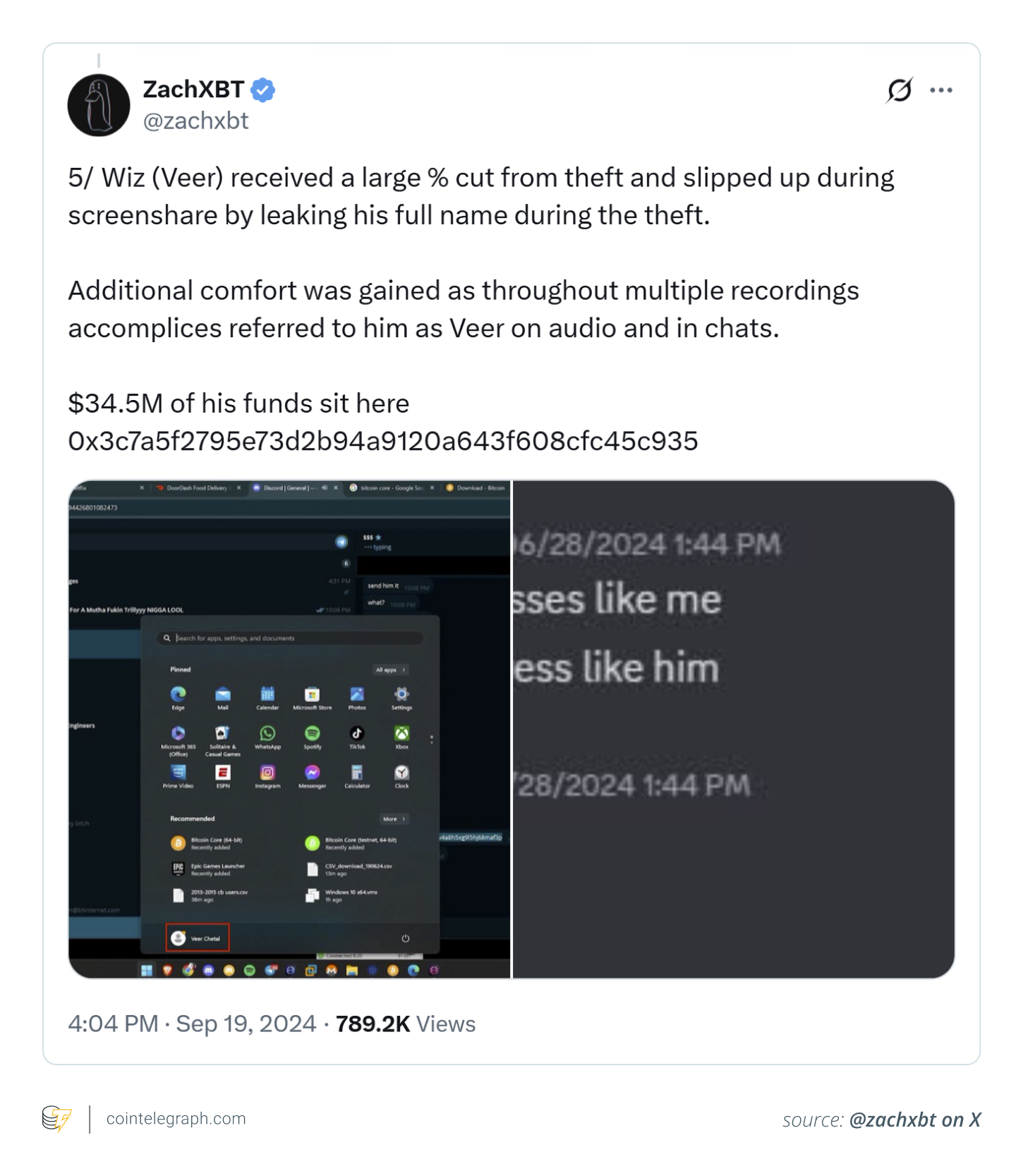
A source anonymously sent ZachXBT screen recordings of the thieves celebrating the heist, cheering over Discord and flashing millions on-screen. One of them accidentally revealed his real name: Veer Chetal, an 18-year-old honor student from Danbury, Connecticut.

Mugshot of Veer Chetal (Wiz) after his alleged arrest

Yes, the same Danbury where the kidnapping took place.

Veer Chetal, a young cybercriminal behind $243 million BTC heist

Did you know? In January 2025, Ledger co-founder David Balland was kidnapped in France and later safely released following a police intervention. The abduction was linked to a cryptocurrency ransom demand, highlighting the growing intersection of digital assets and real-world crime.

Real-world consequences: The kidnapping of Veer’s parents

Just one week after the digital heist, Sushil and Radhika Chetal (Veer’s parents) were house-hunting in their $240,000 Lamborghini Urus when two vehicles ambushed them. Authorities have described Veer’s parents solely as victims of the kidnapping, with no indication they were involved in the crypto theft.

Reportedly, armed attackers dragged the couple into a van, bound them with duct tape and fled the scene. Thankfully, quick-thinking bystanders (including an off-duty FBI agent) helped police track the van. The Chetals were rescued, and four of the six suspects were caught within hours.

But why target the parents?

It turned out the motive was chilling: Veer’s co-conspirators wanted to extort him. They knew he was involved in the crypto theft. Now, they viewed his parents as leverage to force him to share the loot — or more of it.

From Minecraft to multimillion-dollar crime

Veer Chetal wasn’t just some teenager with a knack for crypto. He was allegedly part of “the Com,” an underground online collective that evolved from Minecraft servers and video game scams into a sophisticated criminal network involved in everything from SIM swapping to crypto fraud.

His path from honor student to alleged cybercriminal seems to have accelerated fast. Classmates noticed him suddenly showing up to school in a Corvette, then a BMW, then a Lamborghini. He threw parties on yachts and wore luxury brands that most teens have only seen in rap videos.

His digital partner in crime? Malone Lam, a Singaporean hacker known in online circles as “Greavys” and “Anne Hathaway.” After the heist, Lam blew through millions on nightclubs, cars and champagne in Los Angeles and Miami, even trolling ZachXBT online by holding up signs mocking him in clubs.

Malone Lam, a Singaporean hacker behind $230 million

The collapse: Arrests, raids and guilty pleas

The lavish lifestyle didn’t last long. The FBI, aided by crypto investigators, tracked Lam, Veer and others across states and continents.

Here’s what happened:

Lam was arrested in Miami after a SWAT-style raid on a mansion he’d rented.Another suspect was caught at LAX wearing a $500,000 watch.Veer was quietly arrested, too, the son of the kidnapped couple, and is now facing federal charges.

By March 2025, five out of six of the Florida-based kidnappers had pleaded guilty. They face up to 15 years in prison. Others involved in the digital theft are still under investigation, and a federal wallet now holds the recovered Bitcoin.

Did you know? Despite using sophisticated laundering methods, one co-conspirator failed to use a VPN, exposing his location through an IP address tied to a high-end rental. Authorities traced him to Jeandiel Serrano, aka VersaceGod, who was enjoying a vacation in the Maldives by the time they caught up with him.

The growing link between digital crime and real-world consequences

What’s frightening is how seamlessly this crime flowed from the digital world into the physical. 

As cybersecurity expert Allison Nixon put it: “We are seeing an evolution from disorganized crime to organized crime, and we are somewhere in the middle point of that.”

Groups like the Com are no longer just pranksters or hackers; they’re hardened, organized, and increasingly violent. They share success stories and flaunt wealth, recruiting the next generation through Discord, Telegram and Minecraft.

The $243 million crypto heist that led to a real-world kidnapping is more than just a headline. It’s a warning. It shows how cybercrime no longer stays online, and how youthful arrogance, digital anonymity and unchecked greed can have very real-world consequences.

And as fast as this group got rich, they got caught even faster.

Ultimately, not even Lamborghinis and champagne could protect them from the blockchain breadcrumbs they left behind.

The dark side of crypto and the need for vigilance

While cryptocurrency offers many advantages, it also has a darker side that cannot be ignored. The very features that make crypto attractive — decentralization, anonymity and ease of transfer — are also what make it a breeding ground for illegal activities. 

From money laundering and fraud to scams and cybercrime, crypto has become a tool for a wide range of criminals. The lure of quick profits and easy money, combined with the anonymity of digital currencies, makes crypto especially appealing to young, impressionable individuals. 

Many are introduced to it through seemingly harmless channels, such as online gaming or social media, where they may encounter cybercriminals looking to recruit the next generation of offenders. This makes it all the more important for parents and guardians to stay aware of their child’s digital activities and online behavior.

Cryptocurrency is not inherently dangerous, but it can open the door to hazardous paths if misused. For those new to the space, it’s crucial to understand the risks involved. Scammers can use sophisticated techniques to deceive and steal, and the lack of regulation can leave victims without recourse. 

As crypto continues to grow in popularity, the potential for cybercrime will likely expand, and the consequences of digital theft could become more severe and tangible.

Keeping an eye on your child’s digital activity

With the rise of cryptocurrencies, it’s essential for parents to educate their children about the risks associated with digital assets. 

Keeping an eye on their online interactions, including the apps, games and forums they frequent, is critical in ensuring they don’t fall prey to digital criminals. Encouraging open conversations about internet safety, teaching them about the dangers of sharing personal information online and monitoring their digital wallets are simple yet effective ways to protect them from the darker side of crypto.

As the boundaries between the digital world and real-world consequences continue to blur, it’s important to stay vigilant. Whether it’s ensuring your child’s safety in the digital space or understanding the broader risks posed by crypto, being proactive can help navigate the ever-evolving landscape of digital finance. By taking precautions and staying informed, you can harness the benefits of cryptocurrency while minimizing its dangers.

Read more at cointelegraph.com