cointelegraph.com

Singapore’s Grab taps Solana DePIN project Natix to ‘reshape mapping’

Southeast Asia’s superapp Grab has partnered with Natix, a project within Solana’s decentralized physical infrastructure network (DePIN), to cooperate on mapping and autonomous driving technologies.

The joint collaboration aims to combine Natix’s blockchain-based mapping data with Grab’s camera hardware and mapmaking technology featuring artificial intelligence support, Natix said in an announcement on May 6.

“This partnership brings together the best of both worlds,” the announcement noted, pointing to Grab’s expertise in crowdsourced mapping and Natix’s unique DePIN model that rewards users for providing decentralized data input.

Singapore’s Grab taps Solana DePIN project Natix to ‘reshape mapping’Source: Natix

“By combining GrabMaps’ AI-powered mapping technology with Natix’s decentralized data network, we’re enabling real-time, high-fidelity map updates across the globe,” Grab’s mapping service, GrabMaps, wrote in a LinkedIn post on Tuesday.

360° vehicle imagery for Tesla drivers

As part of the collaboration, Natix will launch VX360, a device built on Grab’s hardware platform that allows Tesla drivers to collect and share 360° vehicle imagery, GrabMaps said in the LinkedIn statement.

“This rich visual data powers fresher maps and provides critical training and validation datasets for autonomous driving and physical AI applications,” it added.

Singapore’s Grab taps Solana DePIN project Natix to ‘reshape mapping’GrabMaps announced a partnership with the Natix Network on LinkedIn. Source: GrabMaps

Apart from Natix, GrabMaps has also collaborated on hyperlocal location map-making tech with partners like Loqate, Bing Maps, Mappls and more, according to its official website.

Driving data incentives for better mapping

According to Natix, traditional centralized mapping methods like Google Street View and TomTom are inefficient, expensive and are often associated with limited coverage and update frequency, requiring firms to invest considerable sums to update maps.

To solve this problem, Natix has built an on-street camera network, which enables crowdsourced models to gather real-time data from users’ devices about road conditions and changes at a “fraction of the cost,” Natix co-founder and CEO Alireza Ghods told Cointelegraph.

“Google has started tapping into this model by asking users to submit road updates, but the data remains proprietary. It is expensive to access and only available in the territories that companies pay for,” he noted, adding:

“A blockchain-based incentivization system provides better results in terms of frequency, participation, and coverage.”

“We’re giving Tesla drivers access and storage for their vehicle’s camera feed — while earning rewards for contributing 360° imagery that will be used for better mapping solutions and to power physical AI,” Natix said in the announcement.

Singapore’s Grab taps Solana DePIN project Natix to ‘reshape mapping’Source: Natix

For the tech to pay attention to map events like accidents and roadwork as well as traffic signs, Natix has also been building AI pipelines for the extraction of data, Ghods said, adding:

“Some are internal efforts, and now we plan to tap into Grab’s AI capabilities as they have cutting-edge technology already built for this need.”

Grab’s growing interest in crypto and blockchain

Grab’s new partnership with Natix is another milestone in the company’s growing number of blockchain and cryptocurrency adoption use cases.

In March 2024, Grab partnered with the payments firm Triple-A to enable its clients to pay for services using five cryptocurrencies, including Bitcoin (BTC), Ether (ETH) and Circle’s USDC (USDC) stablecoin.

Singapore’s Grab taps Solana DePIN project Natix to ‘reshape mapping’An excerpt from Circle’s case study on Grab. Source: Circle

Additionally, Grab is significantly backed by the Japanese multinational investment holding company SoftBank, which is known for its bullish stance on cryptocurrency and AI.

The news comes shortly after Grab reported $773 million of revenue in the first quarter of 2025, posting an 18% increase year-over-year.

Magazine: Crypto AI tokens surge 34%, why ChatGPT is such a kiss-ass: AI Eye
Read more at cointelegraph.com

US stablecoin bill loses democrats amid Trump corruption concerns

Democratic lawmakers in Washington are backing off support for crypto legislation amid heightened concerns over corruption, including the conduct of the Trump family’s World Liberty Financial (WLFI).In March, the GENIUS Act, which would regulate stablecoins in the US, passed a critical committee reading with the support of several pro-crypto Democrats. Democratic Senators Ruben Gallego, Mark Warner, Lisa Blunt Rochester, Andy Kim and Angela Alsobrooks voted with Republicans, opposite lead Democrat and prominent crypto critic Senator Elizabeth Warren.

The bill passed the committee only after a number of changes were made, including stricter requirements for stablecoin issuers and provisions for Anti-Money Laundering, countering terrorism financing and risk management procedures. 

Now, it seems that even those provisions are insufficient to quell Democratic concerns. Following some high-profile crypto deals that personally enrich President Donald Trump, Congressional Democrats are pulling their support.

Bipartisan efforts on stablecoin bills endangered

Of the five pro-crypto Democrats to pass the GENIUS Act in the Senate Banking Committee, four signed their names to a statement on May 3, saying that they do not feel comfortable with the direction stablecoin legislation is taking.

“The bill, as it currently stands, still has numerous issues that must be addressed, including adding stronger provisions on anti-money laundering, foreign issuers, national security, preserving the safety and soundness of our financial system, and accountability,” the announcement reads.

The statement does not explicitly call out corruption nor mention Trump by name, but taken alongside other measures from Democratic lawmakers, it shows a growing reticence to engage on cryptocurrency issues.

As Cointelegraph reported on May 5, Representative Maxine Waters and other Democratic members of the House Financial Services Committee plan to leave a House of Representatives hearing on crypto titled “American Innovation and the Future of Digital Assets” on May 6. According to a staffer familiar with the matter, this would sink the hearing, as House rules require all committee members to be present. 

The hearing concerns a draft bill, announced by Representative French Hill and other top Republicans on May 5, that would change how US financial regulators, namely the Securities and Exchange Commission (SEC) and the Commodity Futures Trading Commission (CFTC), treat cryptocurrencies.

Related: New crypto bill draft seen to curb big crypto firm influence

Waters, who has previously called for bipartisan cooperation on crypto legislation, has harshly criticized Trump, specifically his WLFI crypto investment firm. She characterized his TRUMP memecoin, released on his inauguration, as “the worst of crypto” and has been particularly vocal about the WLFI USD1 stablecoin project.

At a markup hearing on April 2 concerning the STABLE Act — a draft bill circulating the House regarding stablecoins — Waters said the bill, in its current form, allows the president and insiders to “enrich themselves at the expense of everyone else.”

“If there is no effort to block the President of the United States of America from owning his stablecoin business […] I will never be able to agree on supporting this bill, and I would ask other members not to be enablers,” said Waters.

Even Hill, a Republican leading the charge for crypto in Washington, said that Trump’s crypto projects complicate Congress’ ability to pass legislation.

Stablecoin support as political leverage

Corruption concerns may be one factor behind Democrats’ pumping the brakes on bipartisan crypto laws, but some observers believe it could be more of a political ploy. 

Aaron Brogan, a lawyer specializing in regulatory issues in the cryptocurrency industry, said it’s “unlikely that this group of Senators suddenly came to their senses and realized that the mostly benign stablecoin bill they had previously supported lacked protections they refused to name.”

Brogan suggested that either lawmakers wanted to use support for the bill as leverage — Senate Majority Leader Chuck Schumer has reportedly urged Democratic lawmakers in private not to commit to the bill for this very reason — or an influential donor wants to kill the bill or use it as leverage. 

Related: Are Donald Trump’s tariffs a legal house of cards?

Protect Progress, a major political action committee supporting crypto, donated millions to Gallego’s campaign, Brogan noted. He said it is possible that major donors to the committee (i.e., Coinbase) would rather see the bill replaced with something more to their liking.

While he said it’s impossible to know for sure, “Coinbase has attempted to bundle the pending market structure legislation with stablecoins to make it more likely to pass,” he said. 

WLFI accused of shady dealing

WLFI has already netted some $550 million from Trump token sales and is sealing more deals that will enrich its founders and board members, many of whom are Trump family members. 

One of them, Eric Trump, announced on May 1 that Abu Dhabi-based investment firm MGX would use USD1 to settle its $2-billion investment in global crypto exchange Binance.

At Token2049, Eric Trump praised the UAE for its crypto-friendly approach, saying that the regulation-heavy EU is a “lost cause.”

In November 2024, the founder of the Tron blockchain, Justin Sun, became the largest investor in WLFI when he bought some $30 million in TRUMP. More recent reports suggest he has spent nearly $70 million. On Feb. 24, just one month after Trump took office, the SEC, then with Acting Chair Mark Uyeda at the helm, halted its civil fraud investigation into Sun despite previous allegations that Sun and the Tron Foundation had illegally distributed tokens, concealed celebrity donations, and inflated trade volumes. 

Critics claimed that the president was selling exposure to the highest bidder when WLFI announced that top TRUMP tokenholders would be welcomed to a gala with the president himself. This prompted one lawmaker to suggest impeachment — a pipedream in a Congress with Republican majorities in both houses. 

WLFI has not responded publicly or on social media to these criticisms. In a May 5 interview with Meet the Press on NBC, President Trump downplayed the project, saying he was “not profiting from anything.” He said he hasn’t “even looked” at his portfolio.

He also rejected the idea that he should forgo any profits from WLFi. “Should I contribute all of my real estate that I’ve owned for many years if it goes up a little bit because I’m president and doing a good job? I don’t think so,” he said.

With purported scandals and pressure mounting on Democratic officials to block Republican efforts on the Hill, the possibility of a bipartisan stablecoin bill, much less a crypto framework, looks increasingly bleak. 

Magazine: Crypto wanted to overthrow banks, now it’s becoming them in stablecoin fight

Read more at cointelegraph.com

Why is XRP price down today?

Key takeaways:

Ripple’s end-to-quarterly market report fuels uncertainty, impacting XRP price negatively.

Low open interest in XRP futures signals weak trader confidence.

XRP price technicals weaken with resistance at $2.27 and declining RSI.

XRP (XRP) fell on May 6, down 3% in the last 24 hours to trade at $2.09, due to numerous factors. Its trading volume has increased by 25% over the same period to $2.5 billion, reinforcing the momentum of the bears. 

Why is XRP price down today?XRP/USD four-hour chart. Source: Cointelegraph/TradingView

Let’s look at the factors driving the XRP price down today.

Ripple’s discontinues quarterly reports

On May 5, Ripple revealed plans to end its quarterly XRP markets report, which it has released since 2017. The company attributed the decision to the reports falling short of expectations and the increasing focus on institutional adoption, which demands more comprehensive insights and varied perspectives.

This move has sparked concern among investors since the reports provided transparency into XRP’s market dynamics, including sales, escrow activities, and institutional adoption trends. 

Some market participants question whether this shift signals reduced transparency or a strategic pivot toward institutional investors.

Ripple has “announced that the enterprise blockchain company will no longer release its XRP markets reports every quarter,” said X user Shanaka Anslem Perera, adding:

“Is investor confidence going down the drain?”

Another user, Moonchaser, argued that the change is “part of a bigger strategy” to stay private, scale fast, secure infrastructure, and seize the growing Web3 market.

Moonchaser added:

“The shift is strategic. XRP’s future goes beyond any one company – it’s about the entire ecosystem. Decentralisation is key.”

This doesn’t mean the XRP ecosystem is going dark. Quite the opposite.I believe that Ripple is making space for the XRPL Foundation @XRPLF &/or potentially other entities to take the lead on XRP-centric updates, dev support & community growth. Decentralisation in action.5/7

— Moonchaser ☀️🪝 (@Moonchaser2020) May 6, 2025Drop in OI shows sluggish XRP sentiment

XRP open interest (OI) has decreased by 10% to $3.6 billion over the last seven days. This decline in OI signals reduced trader confidence and liquidity, driving down prices.

Why is XRP price down today?Edit the caption here or remove the text

The drawdown in XRP price has also triggered liquidations on the last day, where long positions valued at $7.98 million were forcibly closed, compared to just $660,000 in shorts. This reflects heightened selling pressure as bullish traders are forced to sell at a loss, further pushing prices lower.

The 24-hour long/short ratio of 0.9131 suggests bullish sentiment is waning.

Why is XRP price down today?XRP Long/Short Ratio Chart. Source: CoinGlass

Related: Price predictions 5/5: SPX, DXY, BTC, ETH, XRP, BNB, SOL, DOGE, ADA, SUI

XRP price sealed in a downtrend

XRP price remains stuck within a descending triangle, with the multimonth downtrend line acting as the resistance and the flat line at $2.00 as support, indicating a weakening technical setup.

Why is XRP price down today?XRP/USDT daily chart. Source: Cointelegraph/TradingView

The RSI has dropped from 60 to 43 since April 28, indicating growing bearishness. This will gain momentum if the bears drive the price below the support line at $2.00. The XRP/USDT pair could plunge toward the technical target of the triangle at $1.92.

On the contrary, a break and close above the resistance line should put the bulls back in charge. The pair may then retest the resistance at $2.34, which is also the 100-day SMA. Above that, the next logical move will be toward $3,00, where the sellers are expected to step in.

This article does not contain investment advice or recommendations. Every investment and trading move involves risk, and readers should conduct their own research when making a decision.

Read more at cointelegraph.com

Why is XRP price down today?

Key takeaways:

Ripple’s end-to-quarterly market report fuels uncertainty, impacting XRP price negatively.

Low open interest in XRP futures signals weak trader confidence.

XRP price technicals weaken with resistance at $2.27 and declining RSI.

XRP (XRP) fell on May 6, down 3% in the last 24 hours to trade at $2.09, due to numerous factors. Its trading volume has increased by 25% over the same period to $2.5 billion, reinforcing the momentum of the bears. 

Why is XRP price down today?XRP/USD four-hour chart. Source: Cointelegraph/TradingView

Let’s look at the factors driving the XRP price down today.

Ripple’s discontinues quarterly reports

On May 5, Ripple revealed plans to end its quarterly XRP markets report, which it has released since 2017. The company attributed the decision to the reports falling short of expectations and the increasing focus on institutional adoption, which demands more comprehensive insights and varied perspectives.

This move has sparked concern among investors since the reports provided transparency into XRP’s market dynamics, including sales, escrow activities, and institutional adoption trends. 

Some market participants question whether this shift signals reduced transparency or a strategic pivot toward institutional investors.

Ripple has “announced that the enterprise blockchain company will no longer release its XRP markets reports every quarter,” said X user Shanaka Anslem Perera, adding:

“Is investor confidence going down the drain?”

Another user, Moonchaser, argued that the change is “part of a bigger strategy” to stay private, scale fast, secure infrastructure, and seize the growing Web3 market.

Moonchaser added:

“The shift is strategic. XRP’s future goes beyond any one company – it’s about the entire ecosystem. Decentralisation is key.”

This doesn’t mean the XRP ecosystem is going dark. Quite the opposite.I believe that Ripple is making space for the XRPL Foundation @XRPLF &/or potentially other entities to take the lead on XRP-centric updates, dev support & community growth. Decentralisation in action.5/7

— Moonchaser ☀️🪝 (@Moonchaser2020) May 6, 2025Drop in OI shows sluggish XRP sentiment

XRP open interest (OI) has decreased by 10% to $3.6 billion over the last seven days. This decline in OI signals reduced trader confidence and liquidity, driving down prices.

Why is XRP price down today?Edit the caption here or remove the text

The drawdown in XRP price has also triggered liquidations on the last day, where long positions valued at $7.98 million were forcibly closed, compared to just $660,000 in shorts. This reflects heightened selling pressure as bullish traders are forced to sell at a loss, further pushing prices lower.

The 24-hour long/short ratio of 0.9131 suggests bullish sentiment is waning.

Why is XRP price down today?XRP Long/Short Ratio Chart. Source: CoinGlass

Related: Price predictions 5/5: SPX, DXY, BTC, ETH, XRP, BNB, SOL, DOGE, ADA, SUI

XRP price sealed in a downtrend

XRP price remains stuck within a descending triangle, with the multimonth downtrend line acting as the resistance and the flat line at $2.00 as support, indicating a weakening technical setup.

Why is XRP price down today?XRP/USDT daily chart. Source: Cointelegraph/TradingView

The RSI has dropped from 60 to 43 since April 28, indicating growing bearishness. This will gain momentum if the bears drive the price below the support line at $2.00. The XRP/USDT pair could plunge toward the technical target of the triangle at $1.92.

On the contrary, a break and close above the resistance line should put the bulls back in charge. The pair may then retest the resistance at $2.34, which is also the 100-day SMA. Above that, the next logical move will be toward $3,00, where the sellers are expected to step in.

This article does not contain investment advice or recommendations. Every investment and trading move involves risk, and readers should conduct their own research when making a decision.

Read more at cointelegraph.com

Blockchains ready for institutions, lawyers hesitate: DoubleZero CEO

While blockchain infrastructure may be ready for institutional use, many legal teams at big firms remain cautious about fully integrating the technology. 

At the Token2049 event in Dubai, DoubleZero founder and former Solana head of strategy Austin Federa told Cointelegraph that today’s high-performance blockchains like Solana are technically capable of supporting large-scale institutional usage. However, lawyers need to catch up. 

“Most blockchains nowadays, especially things like Solana, are fast enough for institutions to use them,” Federa said. “It’s really more about the institutions and the institution’s lawyers getting comfortable with crypto.”

Federa added that institutional lawyers and compliance teams are still addressing regulatory concerns. The executive said this may slow adoption despite the growing regulatory clarity in key markets like the United States. 

Blockchains ready for institutions, lawyers hesitate: DoubleZero CEODoubleZero founder Austin Federa. Source: CointelegraphInstitutions are coming; they just move slow

According to Federa, technical infrastructure is no longer a primary barrier for large firms. Tools needed to support enterprise-scale activity on networks like Solana are already in place:

“Especially on networks like Solana and other fast networks, the infrastructure is there today for high amounts of institutional adoption.”

While crypto community members may feel like institutional adoption should be more advanced than it is, Federa said that these organizations are not quick to onboard new technologies.  

“Institutions are coming on board, but they just move really slow,” Federa told Cointelegraph. “People expect these massive institutions to move fast, but that’s just not what they’re good at.”

Until legal departments are fully satisfied with risk controls and compliance structures, Federa said meaningful adoption may unfold gradually. 

Related: DoubleZero’s alternative to public internet targets mainnet rollout in H2

Institutional involvement in crypto infrastructure

Federa highlighted a growing trend of institutional participation in the crypto infrastructure space. He said that bare-metal infrastructure providers and venture capital firms have offered financial support and contributed actual fiber infrastructure to DoubleZero. 

This kind of commitment was almost unthinkable just a few years ago, he said. “Most of those companies two years ago would not have had any interest or thought it was way too legally risky to take something and contribute fiber to it.”

Unlike running a validator node, deploying fiber and infrastructure is a major commitment. Federa said institutional players now allocating serious resources to crypto-native projects reflects a shift in how traditional finance views the sector.

Despite this, he acknowledged that while institutional adoption has grown, the broader crypto product landscape isn’t fully mature. “The products are not quite there yet for the most part,” Federa said.

Magazine: Solana ‘will be a trillion-dollar asset’: Mert Mumtaz, X Hall of Flame

Read more at cointelegraph.com

Blockchains ready for institutions, lawyers hesitate: DoubleZero CEO

While blockchain infrastructure may be ready for institutional use, many legal teams at large firms remain cautious about full integration with the technology. 

At the Token2049 event in Dubai, DoubleZero Labs founder and former Solana head of strategy Austin Federa told Cointelegraph that today’s high-performance blockchains like Solana are technically capable of supporting large-scale institutional usage. However, lawyers still need to catch up. 

“Most blockchains nowadays, especially things like Solana, are fast enough for institutions to use them,” Federa said. “It’s really more about the institutions and the institution’s lawyers getting comfortable with crypto.”

Federa added that institutional lawyers and compliance teams are still addressing regulatory concerns. The executive said this may slow adoption despite the growing regulatory clarity in key markets like the United States. 

Blockchains ready for institutions, lawyers hesitate: DoubleZero CEODoubleZero Labs founder Austin Federa. Source: CointelegraphInstitutions are coming; they just move slow

According to Federa, technical infrastructure is no longer a primary barrier for large firms. Tools needed to support enterprise-scale activity on networks like Solana are already in place:

“Especially on networks like Solana and other fast networks, the infrastructure is there today for high amounts of institutional adoption.”

While crypto community members may feel like institutional adoption should be bigger than it is, Federa said that these organizations are not quick at onboarding new technologies.  

“Institutions are coming on board, but they just move really slow,” Federa told Cointelegraph. “People expect these massive institutions to move fast, but that’s just not what they’re good at.”

Until legal departments are fully satisfied with risk controls and compliance structures, Federa said meaningful adoption may unfold gradually. 

Related: DoubleZero’s alternative to public internet targets mainnet rollout in H2

Institutional involvement in crypto infrastructure

Federa also highlighted a growing trend of institutional involvement in the crypto infrastructure space. He said that bare-metal infrastructure providers and venture capital firms have offered financial support and contributed actual fiber infrastructure to DoubleZero. 

This kind of commitment was almost unthinkable just a few years ago, he said. “Most of those companies two years ago would not have had any interest or thought it was way too legally risky to take something and contribute fiber to it.”

Unlike running a validator node, deploying fiber and infrastructure is a major commitment. Federa said that institutional players now allocating serious resources to crypto-native projects reflects a shift in how traditional finance views the sector.

Despite this, he acknowledged that while institutional adoption grew, the broader crypto product landscape isn’t fully mature. “The products are not quite there yet for the most part,” Federa said.

Magazine: Solana ‘will be a trillion-dollar asset’: Mert Mumtaz, X Hall of Flame

Read more at cointelegraph.com

Citi and SDX partner to tokenize traditional private markets

Investment bank Citi and Switzerland’s SIX Digital Exchange (SDX) are teaming up to modernize traditional private markets through tokenization.

The initiative, revealed during the Point Zero Forum in Switzerland, will leverage SDX’s blockchain-based Central Securities Depositary (CSD) platform to tokenize, settle and safekeep assets, according to a May 6 announcement.

The platform, expected to go live by the third quarter of 2025, will make late-stage, pre-initial public offering (IPO) equities accessible to institutional and eligible investors globally.

The project offers issuers a compliant and scalable framework to manage liquidity, particularly for early investors and employees, while maintaining cap table control. For investors, it opens access to high-growth, venture-backed companies in a more efficient and transparent manner.

“We are excited to welcome Citi to the SDX platform and together deliver this landmark project in the tokenization of private shares,” said David Newns, head of SDX.

Newns added that this will “enable the efficient distribution of shares in mature international private companies, which are expected to generate strong investor interest.”

Citi and SDX partner to tokenize traditional private marketsCiti announcing the partnership. Source: Citi

Related: Real-world asset tokenization: Unlocking a new era of finance

Citi to provide servicing for tokenized assets

Citi will provide end-to-end servicing for these tokenized assets as the digital custodian and tokenization agent. “We are meeting client demand for access to emerging and relevant digital asset ecosystems and investments,” added Ryan Marsh, head of innovation and strategic partnerships, investor services and issuer services at Citi.

Marni McManus, Citi’s country officer for Switzerland, said private markets represent a major and growing opportunity, helping digitize an industry still reliant on manual processes and paper-based documentation.

Citi has been among the earliest major financial institutions to express strong confidence in the future of tokenization, even betting that it would become the next “killer use case” in crypto.

In September 2023, Citigroup introduced Citi Token Services, a private, permissioned blockchain that offers cross-border payments, liquidity and automated trade finance solutions to institutional clients.

In early 2024, Citigroup teamed up with Ava Labs, other traditional financial institutions and digital asset companies to complete a proof-of-concept for tokenizing private equity funds.

Related: $21B tokenized RWA market doubtful, institutions uninterested — Plume CEO

RWA tokenization gains traction

Citi and SDX’s new initiative comes amid a renewed wave of interest in real-world asset (RWA) tokenization, with major players from both traditional finance and crypto making headlines last week.

On April 30, BlackRock filed to create a blockchain-based share class for its $150 billion Treasury Trust Fund, allowing a digital ledger to mirror investor ownership. On the same day, Libre revealed plans to tokenize $500 million in Telegram debt via its new Telegram Bond Fund.

The most significant news came from Dubai, where MultiBank Group inked a $3 billion tokenization deal with UAE real estate firm MAG and blockchain provider Mavryk.

“The recent surge isn’t arbitrary. It’s happening because everything’s lining up,” Eric Piscini, CEO of Hashgraph, told Cointelegraph:

“Rules are getting clearer in major markets. The tech is stronger, faster, and ready to scale. And big players are actually doing it — BlackRock is tokenizing funds, Citi is exploring digital asset custody, and Franklin Templeton has tokenized money market funds on public blockchains.”

Magazine: Tokenizing music royalties as NFTs could help the next Taylor Swift

Read more at cointelegraph.com

Research DAO claims paralyzed rats recover after spinal cord fix

Decentralized autonomous organization (DAO) HydraDAO claims that its researchers were able to use a novel technique to repair severed spines in rats.

In a May 5 X post, decentralized science (DeSci) project HydraDAO said that one of its research projects resulted in “rats who had their spines fully transected” being able to walk again. More notably, recovery from surgery reportedly only took five days.

Science, DAOSource: HydraDAO

The post featured a video of partially shaved (presumably due to surgery) rats walking in what appeared to be a laboratory setting. The effort in question is the Dowell spinal fusogens project led by Michael Lebenstein-Gumovski, which raised 380,700 USDC (USDC) from donors. The dedicated HydraDAO page reads:

“The Dowell team submitted a project proposal to HydraDAO. After careful consideration and two peer reviews, HydraCore deems it in the interest of HydraDAO’s community.“

Related: Experts to gather in Miami to drive longevity research forward

More than smoke and mirrors?

Fusogens are chemicals capable of fusing cell membranes and have long been researched as a means to reconnect severed nerve fibers. One such chemical is polyethylene glycol (PEG), which was shown to promote membrane fusion and seal axonal membranes in other research.

The Dowell team adds a biopolymer from crustacean shells called chitosan, resulting in a PEG-chitosan compound dubbed neuro-PEG. This compound is also photopolymerizable, meaning it can be rapidly solidified using light.

This presumably allows for creating a solid scaffolding that can weld the spinal cord more permanently than liquid PEG-based solutions. Dowell also implements neuroprotection techniques such as localized hypothermia and cellular death inhibitors to prevent further damage to nerve tissue.

A 2023 research paper by Gumovski published in the peer-reviewed scientific journal Surgical Neurology International claimed that pigs treated with the compound recovered mobility in two months. The study’s conclusion read:

“Neuro-PEG affords sensorimotor recovery after complete spinal cord transection. This opens the door to human experimentation, including trials of spinal cord transplantation.“

The Dowell team also filed a patent for developed technologies, with a 2022 Russian patent describing a “method of restoring spinal cord functions after transection using a PEG-chitosan conjugate,” listing Lebenstein-Gumovski among its inventors.

The HydraDAO proposal suggests that “revenue streams include specialized surgical kits priced between $3,500 and $20,000, depending on the market and region.” Furthermore, the team would also provide “comprehensive training and certification for neurosurgeons and emergency medical services” personnel.

Related: Major scientific journal Nature features DeSci project ResearchHub

Some interesting connections

Gumovski is a neurosurgery researcher based in Russia (Stavropol State Medical University and affiliated institutes). He was a member of Sergio Canavero’s research head-transplant project, cited in at least one relevant paper.

Those articles were also published in Surgical Neurology International, while most top scientific publications shied away from the subject. The neurosurgeon from Turin, Italy, claimed to have performed a successful head transplant on a monkey back in 2016.

The team also experimented on human cadavers in preparation for a 2017 live human head transplant, which never took place. Neuroscientist Dean Burnett said at the time that head transplantation presented insurmountable challenges and that Canavero had “offered no feasible explanation or science for his claims to be able to overcome these hurdles.”

While the Dowell team’s project builds on established research and should not be dismissed outright, it is hard not to notice the similarity in making public claims not unlike those that characterized Canavero’s career. Furthermore, fusogens are well studied and less dramatic but similar results have been reported by other teams in the past (2019 example from the University of Texas).

Will the paralyzed walk again?

The evidence provided is promising, but it is advisable to exercise caution, especially until multiple third-party teams independently reproduce the results.

HydraDAO promised additional electrophysiology experiments and tracing dyes to assess connectivity between the brain and lower spine. This extra data may enhance the credibility of the research results.

Still, further research is needed to assess whether it will result in a clinically viable technique for real-world spinal injuries.

Magazine: DeSci: Can crypto improve scientific research?

Read more at cointelegraph.com

How much Bitcoin can Berkshire Hathaway buy?

Key takeaways:

Berkshire holds $347B in cash, enough to buy ~18% of Bitcoin’s supply.

Greg Abel has not signaled a shift from Warren Buffett’s anti-Bitcoin stance.

Berkshire already has indirect crypto exposure via Nu Holdings, Jefferies.

Warren Buffett announced at Berkshire Hathaway’s annual shareholder meeting on May 3 that he will step down as CEO by the end of 2025, with Greg Abel taking over. This transition raises speculation about Berkshire’s financial capacity to purchase Bitcoin (BTC) under the new leadership.

How much Bitcoin can Berkshire Hathaway buy?Source: Discover CryptoBerkshire can easily surpass Strategy’s BTC stash

Berkshire ended Q4 2024 with a record $347 billion in cash and US Treasury bills, representing about 32% of its $1.1 trillion market capitalization.

The company could acquire approximately 3.52 million BTC if it purchases the cryptocurrency at May’s approximate price of $95,000. This equates to about 17.88% of Bitcoin’s circulating supply of 19.69 million coins.

If the company tapped only its estimated $295.98 billion in US Treasury, it could buy around 3.12 million BTC, or 15.85% of the circulating supply, positioning it as a dominant player in the crypto market.

Berkshire Hathaway is 20th Century Bitcoin.

— Michael Saylor (@saylor) May 3, 2025

Such a move would easily eclipse Nasdaq-listed Strategy Inc. (formerly MicroStrategy), the world’s largest corporate Bitcoin holder, which owns 553,555 BTC worth approximately $52.2 billion as of May 6.

In other words, Berkshire can theoretically match Strategy’s stash with roughly one-sixth of its cash pile if it converts it to Bitcoin.

Related: Strategy, Semler bag 2K Bitcoin as price edged toward $100K last week

How much Bitcoin can Berkshire Hathaway buy?Strategy Inc. Bitcoin holdings over time. Source: BitcoinTeasuries.net

Bernstein analysts forecast roughly $330 billion in corporate treasury-driven inflows into Bitcoin by 2029, with $205 billion expected from listed companies between 2025 and 2029.

Much of this, analysts say, will come from smaller, slow-growing companies trying to copy Strategy Inc.’s Bitcoin strategy. They see it as one of the few ways to boost their value when other growth options are scarce.

How much Bitcoin can Berkshire Hathaway buy?Source: X/Matthew Sigel, Head of Digital Asset Research at VanEck US

Bernstein’s bull case anticipates an additional $124 billion of Bitcoin purchases from Strategy alone, backed by the company’s recently upsized capital-raising plans, which aim to secure $84 billion by 2027, nearly double its previous target.

Is Greg Abel pro-crypto?

Whether Berkshire would buy Bitcoin under Abel’s leadership is speculative.

The new Berkshire Hathaway leader has not publicly indicated a shift from Buffett’s value-investing philosophy, prioritizing assets with tangible cash flows over speculative ones like Bitcoin, which Buffett once termed “rat poison squared.”

BTC’s price has climbed by nearly 900% since Buffett’s criticism in May 2018.

How much Bitcoin can Berkshire Hathaway buy?BTC/USD two-week price chart. Source: TradingView
However, Berkshire, despite its anti-crypto stance, has indirect exposure in the sector through investments in crypto-friendly companies like Nu Holdings and Jefferies Financial Group, which holds shares in BlackRock’s iShares Bitcoin Trust (IBIT).

The strategy is similar to how Berkshire approached gold, which Buffett repeatedly ridiculed for lacking productivity. However, Berkshire surprised markets by buying Barrick Gold shares (a gold mining company) in 2020, though it later sold that position.

Under Abel, Berkshire may not dive straight into Bitcoin, but its cautious, indirect approach could expand as markets evolve. Whether that leads to full adoption or careful toe-dipping remains to be seen.

This article does not contain investment advice or recommendations. Every investment and trading move involves risk, and readers should conduct their own research when making a decision.

Read more at cointelegraph.com

Is the Paws Telegram mini app legit? What you need to know

What is the Paws Telegram Mini App?

Paws is a Telegram-based Mini App created by the same team behind other projects, such as Notcoin and Dogs. 

If you’ve been cruising around Telegram lately, chances are you’ve stumbled upon Paws, the viral crypto Mini App that’s got everyone tapping, clicking and inviting their friends like it’s 2010 FarmVille all over again. 

Originally launched in October 2024 on The Open Network (TON) blockchain, Paws exploded in popularity with its ultra-simple tap-to-earn concept. Think of it as a gamified rewards engine embedded directly in Telegram, where users rack up points by completing tasks, referring others and interacting with mini-game elements. 

Within just eight days of going live, Paws pulled in over 20 million users, and within a few months, that figure soared past 80 million.

PAWS massive userbase on Telegram

But the real twist? Paws, in March 2025, migrated from TON to Solana, a move that brought more scalability, lower fees and deeper integration with a broader decentralized finance (DeFi) ecosystem. Alongside this shift came the launch of the PAWS token — used for governance, staking, in-game purchases and more — positioning Paws as more than just a viral hit. 

The app’s core philosophy is simple: You create value every time you engage online, so why not earn for it? With no extra downloads needed, Paws is frictionless. You just activate the bot on Telegram (@PAWSOG_bot), and you’re in. From there, it’s all about interacting: tap items, read posts, join groups, complete quizzes, and get rewarded with points that convert into real tokens.

So, is it legit? Before answering that, we’ll unpack how it actually works.

How does the Paws Telegram Mini App actually work?

PAWS tracks and monitors users’ activity in Telegram and allows them to claim rewards for their engagement.

The core mechanics involves monitoring users’ activities, such as message frequency, participation in groups and interactions with other mini apps. Within the app, users can find a number of tasks to complete or allow it to perform checks on their engagements. This varies from following social channels to reading articles. 

For example, you can earn 250 $PAWS for reading Cointelegraph articles like this:

PAWS app

The rewards are distributed on predetermined criteria and actions users take. In the long run, your earned points and referral contributions will determine your airdrop allocation when the official $PAWS crypto token launches. There are currently no specific dates for the airdrop or token exchange listing. With the project gaining such huge momentum, it is expected to finish its launch campaign in the coming months.

Why Paws migrated to Solana and why it matters

At first, Paws ran on TON, but in a move that surprised some and excited others, Paws announced a major shift to Solana in early 2025.

In early 2025, Telegram introduced a policy mandating that all Mini Apps and third-party crypto wallets on its platform exclusively operate on TON. This move forced projects like Paws to choose between remaining confined to TON or migrating to a different blockchain.

Paws opted to migrate to Solana, a decision that has had significant implications:​

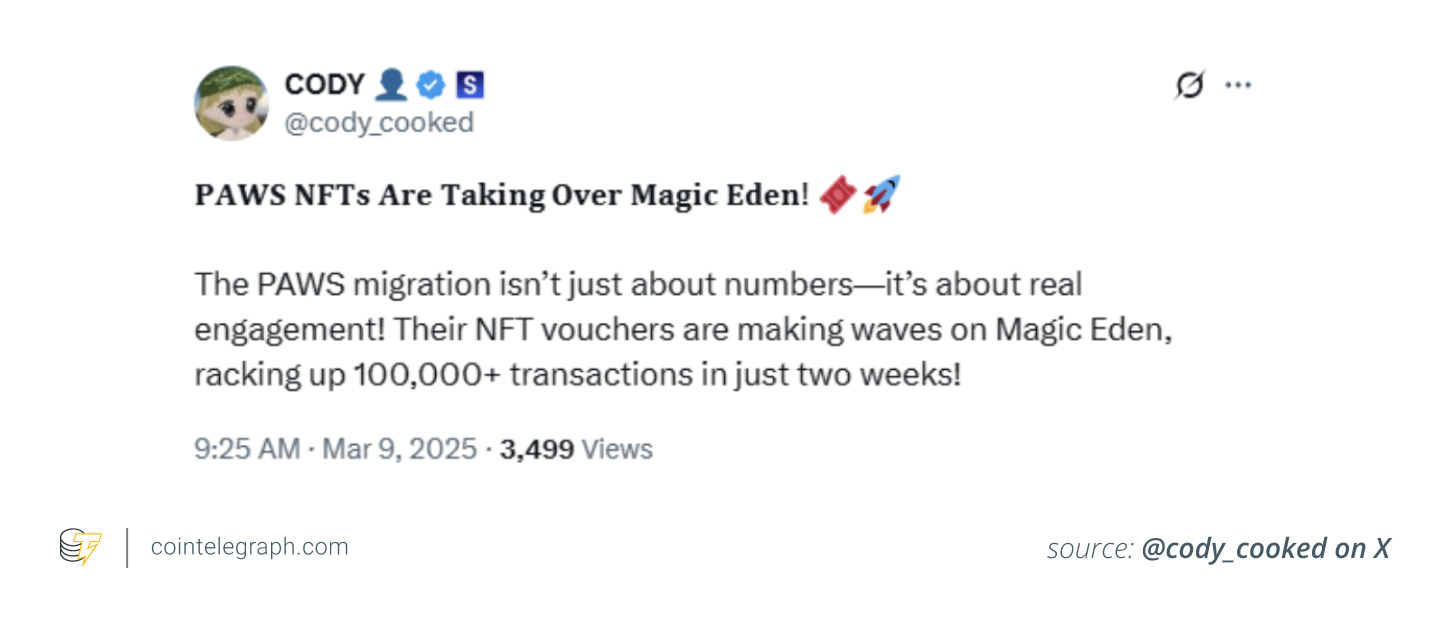
User base migration: Over 80 million Paws users transitioned to Solana, leading to more than 9 million downloads of the Phantom crypto wallet and the creation of over 1 million new Solana addresses. NFT integration: PAWS introduced non-fungible token (NFT) vouchers on the Solana-based marketplace Magic Eden, resulting in over 100,000 transactions within two weeks.Ecosystem expansion: The migration has allowed Paws to evolve from a viral Telegram application into a full-fledged Web3 brand, with plans to integrate DeFi features, gaming partnerships and social engagement tools.

PAWS on Phantom Wallet

This strategic move not only circumvented Telegram’s restrictive policies but also positioned Paws to leverage Solana’s scalability and active DeFi ecosystem, paving the way for broader adoption and innovation.

Did you know? The migration to Solana led to over 9 million new downloads of Phantom Wallet, with more than 1 million fresh Solana addresses created by Paws users. That’s one of the biggest onboarding waves in Solana’s history.

The PAWS airdrop: What you need to know

No viral Web3 game is complete without an airdrop, and Paws is no exception.

Users who engage with the app, tapping, referring and completing tasks earn points, which are later converted into PAWS tokens. These tokens are distributed via an airdrop, and the team has already completed early reward rounds with plans for future drops as the ecosystem expands.

The PAWS token officially launched on March 18, 2025. Here’s a breakdown of the key events that took place:​

March 11-15: Withdrawals opened to exchanges.March 17: Token deposits became available on exchanges.March 18: Withdrawals to Phantom Wallet and the official PAWS listing commenced.​

The airdrop distribution was as follows:​

62.5% allocated to Paws app users.7.5% reserved for established Solana communities.The remaining percentage is designated for ecosystem growth, partnerships and liquidity.

Despite the successful migration and platform enhancements, the PAWS token launch faced some challenges:​

Price volatility: The token experienced a significant drop in value shortly after launch.Airdrop confusion: Many users were unsure about eligibility criteria, leading to dissatisfaction.Communication gaps: Delays and a lack of clear communication regarding the token generation event (TGE) affected community trust on X.

As of April 2025, the PAWS token is listed on a few exchanges, including Bybit, MEXC and KuCoin. There’s growing speculation that listings on more centralized exchanges (CEXs) may follow, especially given the size of the community and early engagement.

Did you know? After migrating to Solana, Paws launched NFT vouchers on Magic Eden. In just two weeks, these NFTs generated over 100,000 transactions.

PAWS NFTs on Magic Eden

Is Paws legit or just another hype train?

Paws has demonstrated substantial growth and user engagement; however, users must do their own research before joining in. 

Let’s get to the big question: Is Paws legit?

Paws has demonstrated substantial growth and user engagement. The following help to make a better assessment on how to approach Paws:​

Pros:

Developed by a team with a track record (Notcoin and Dogs).Successful migration to Solana indicates long-term planning and future orientation.Rapid user adoption and community growth.​

Cons:

Limited transparency with no public team page or comprehensive white paper.Potential for bot-driven airdrop farming, as has been seen on Telegram Mini Apps.The project is navigating regulatory uncertainty, particularly as airdrops via Telegram Mini Apps remain in a legal gray area, often lacking clear Know Your Customer (KYC) requirements.

So, what’s the verdict? While Paws appears to be a well-used platform for casual engagement, users should conduct thorough research and exercise caution, especially when considering financial investments.

What’s next for Paws?

As the platform matures and cements its place, the team behind it has hinted at a much bigger vision: one that turns Paws from a simple viral game into a dynamic Web3 super app. 

Here’s what’s reportedly on the roadmap:

In-app marketplace: Users will soon be able to spend their PAWS tokens within an integrated marketplace. This could include digital goods, services and utility items tied to the app’s gaming ecosystem, such as power-ups, skins or access to exclusive features.NFT rewards and avatar customization: Paws plans to introduce customizable avatars powered by NFTs. These will not only let users personalize their experience but also function as tradable digital assets. The team has already launched early NFT vouchers on Solana’s Magic Eden, showing a clear direction toward gamified asset ownership.Social leaderboards and guild mechanics: Paws is building out more community-first features. Competitive social leaderboards will reward the most active players, while upcoming guild mechanics will allow users to team up, compete and share rewards, blending social gaming with decentralized coordination.DeFi integrations: With its migration to Solana, PAWS has opened the door to deeper DeFi utility. Upcoming features could include staking, lending pools, yield-based games or partnerships with native Solana DeFi protocols, adding more financial layers to the Paws economy.

With a user base now exceeding 80 million and growing, Paws is laying the groundwork to evolve into a full-blown Web3 social and gaming hub — though its rapid rise also warrants caution, as regulatory clarity and long-term sustainability remain key concerns.

Read more at cointelegraph.com