cointelegraph.com

Bitcoin open interest hits record high as bulls stampede toward new BTC price highs

Key takeaways:

Bitcoin futures open interest hit a record $72 billion, signaling rising use of leverage among institutional investors.

$1.2 billion in shorts at $107,000 to $108,000 are at risk of liquidation, boosting BTC’s breakout odds.

The aggregate open interest in Bitcoin (BTC) futures surged to a record high on May 20, raising questions about whether bearish positions are now at risk. Despite repeated failures to break above the $107,000 level since May 18, the sheer volume of leveraged positions could propel Bitcoin to a new all-time high.

Bitcoin open interest hits record high as bulls stampede toward new BTC price highsBitcoin futures aggregate open interest, USD. Source: CoinGlass

The total open interest in BTC futures climbed to $72 billion on May 20, marking an 8% increase from $66.6 billion just a week earlier. Institutional demand continues to be a major driver of this leverage, with the Chicago Mercantile Exchange (CME) leading at $16.9 billion in BTC futures, followed by Binance, which holds $12 billion in open interest.

$1.2 billion in bearish BTC liquidations cluster at $107K–$108K

According to CoinGlass estimates, the largest concentration of bearish BTC futures liquidations is clustered between $107,000 and $108,000, amounting to approximately $1.2 billion.

Bitcoin open interest hits record high as bulls stampede toward new BTC price highsBitcoin futures leverage heatmap, USD million. Source: CoinGlass

While it’s impossible to predict what could spark a breakout above $108,000 to force those leveraged shorts to unwind, there is growing optimism tied to rising concerns over United States fiscal debt. Uncertainty remains about how the government plans to achieve economic growth while reducing spending, especially in light of ongoing disagreement between Democratic and Republican lawmakers.

More importantly, yields on the 20-year US Treasury remain close to 5%, up from 4.82% two weeks earlier. Weak demand for long-term government debt may compel the US Federal Reserve to step in as the buyer of last resort to maintain market stability, reversing a 26-month trend. This approach puts downward pressure on the US dollar and drives investors to seek alternative hedging strategies, including Bitcoin.

Gold dominates, but Bitcoin absorbs flow amid reserve reallocations

Gold remains the dominant alternative asset, but its 24% year-to-date gains in 2025 and $22 trillion market capitalization make it less attractive to many investors. For context, the entire S&P 500 index is valued at $53 trillion, while US bank deposits and Treasury bills (M1) amount to $18.6 trillion. In contrast, Bitcoin currently represents a $2.1 trillion asset class, roughly equivalent in size to silver.

Meanwhile, some regions, notably the US, have begun laying the groundwork to shift portions of their gold reserves into Bitcoin—an action that could easily propel BTC to a new all-time high. A modest 5% reallocation from gold into Bitcoin by those nations would translate into a $105 billion inflow, equivalent to 1 million BTC at a price of $105,000. 

Related: Bitcoin ready to ‘vaporize’ shorts once price discovery above $110K begins

For perspective, Strategy, the US-listed firm led by Michael Saylor, currently holds 576,230 BTC. There is little doubt that institutional buying remains the primary catalyst for Bitcoin to break above the $108,000 level. Such a move would trigger the liquidation of heavily leveraged bearish positions, likely accelerating the push to a new all-time high. However, persistent macroeconomic uncertainty continues to weigh on overall investor sentiment.

As Bitcoin flirts with the $107,000 mark, those holding short positions face heightened risk of forced liquidations—an outcome that could further fuel upward momentum in price.

This article is for general information purposes and is not intended to be and should not be taken as legal or investment advice. The views, thoughts, and opinions expressed here are the author’s alone and do not necessarily reflect or represent the views and opinions of Cointelegraph.

Read more at cointelegraph.com

Bancor files patent infringement lawsuit against Uniswap over DEX tech

Bancor, the creator of a smart contract-based automated market maker, is suing Uniswap for patent infringement, alleging the decentralized finance exchange has used its technology without permission and profited significantly from it.

According to the May 20 announcement of the lawsuit, Bancor designed the technology in 2016 and patented it in January 2017. The technology underpins the “constant product automated market maker,” which involves using mathematics to add or withdraw resources from a liquidity pool. The application subsequently led to two issued patents.

Bancor alleges that Uniswap used the invention to create its protocol, launched in November 2018. The two organizations are considered competitors in the sector of decentralized finance (DeFi).

“When an organization continuously uses our invention without our authorization and does so as a means of competing with us, we must take action,” said Mark Richardson, project lead at Bancor.

At the time of publication, Uniswap had not publicly responded to the lawsuit, filed in the US District Court for the Southern District of New York.

“With this lawsuit, Bprotocol Foundation and LocalCoin seek compensation for Uniswap Labs’ unlicensed use of Bancor’s patented technology and Uniswap Foundation’s inducement of infringement,” it said.

Related: Texas court issues judgment against Bancor DAO after it ignored summons

Uniswap dwarfs Bancor in some DEX metrics

Bancor hasn’t seen similar success to Uniswap, according to DefiLlama. The data aggregator ranks Uniswap as the second among all decentralized exchanges by 24-hour trading volume, with nearly $3.8 billion traded.

Bancor files patent infringement lawsuit against Uniswap over DEX techTop 10 DEXs by 24-hour trading volume. Source: DefiLlama

Bancor, on the other hand, ranks No. 142 for trading 24-hour trading volume, with $378,579 as of May 20.

Uniswap has been one of the largest decentralized exchanges for a number of years. In its lifetime, it has processed $2.8 trillion in trading volume.

“If companies like Uniswap can act unchecked, we fear it will hinder innovation across the industry to the detriment of all DeFi players,” said Richardson.

Magazine: X Hall of Flame: DeFi will rise again after memecoins die down: Sasha Ivanov

Read more at cointelegraph.com

Coinbase CEO's journey from no 'political causes' to hiring DOGE staff

Five years ago, Brian Armstrong wanted employees of his cryptocurrency exchange to refrain from expressing political views at work. Now, the Coinbase CEO seems to be open to involvement with Republican figures, including members of US President Donald Trump’s inner circle.

In a May 13 X post, Armstrong said members of the Department of Government Efficiency (DOGE) team, spearheaded by Elon Musk, though not set up as an actual department, would be welcome to implement cost-cutting changes at Coinbase after leaving the US government.

Armstrong offered to set up an accelerated onboarding process with the exchange, responding to an interview in which at least one DOGE staffer felt ostracized from Harvard University, where he had been enrolled.

“If you are looking for your next mission after serving your country, consider helping create a more efficient financial system for the world at Coinbase,” Armstrong said.

Since assuming a government position at the White House in January, Musk and the DOGE team have faced criticism from both sides of the aisle over their cuts, which often forced out or fired experienced employees without proper notice.

Lawsuits halting DOGE’s efforts or challenging dismissals are pending in federal court from parties alleging illegal or unconstitutional actions.

Coinbase once called itself a ‘mission-focused company’

Armstrong’s remarks, suggesting approval of DOGE’s actions, represented a sharp departure from the CEO’s position before Trump’s second term. At the time, many of the companies and executives in California’s Silicon Valley seemed to be more publicly aligned with Democrats. 

In 2020, amid the COVID-19 pandemic, the death of George Floyd at the hands of police officers in Minneapolis spurred nationwide outrage and protests, prompting many companies to take a public position. Armstrong issued a notice at the time saying that Coinbase was a “mission-focused company” that didn’t “advocate for any particular causes or candidates.”

In response to Armstrong not publicly supporting the Black Lives Matter movement, many Coinbase employees organized a walkout. The CEO responded by claiming the crypto exchange had an “apolitical culture” and that roughly 5% of Coinbase staff who “didn’t feel they could be on board with this direction” had accepted an exit package.

Related: Coinbase considered Saylor-like Bitcoin strategy before opting out: Bloomberg

Less than a month later, Armstrong retweeted a post suggesting he could support Kanye West for US President in 2020. After that time, the CEO made few public statements related to politics and US laws, though he did push for clarification on crypto tax rules in 2021.

Stand with Crypto moves Coinbase closer to political advocacy

It’s not entirely clear how Armstrong, at least in public, moved to be more aligned with political figures. However, for Coinbase, which the CEO said was intended to be “apolitical,” the change seemed to have started around the time the company received a Wells notice from the Securities and Exchange Commission (SEC) in March 2023, suggesting a potential enforcement action.

Armstrong, like many in the crypto industry, had often criticized the SEC before 2023 for not offering regulatory guidelines to follow, but the Wells notice and subsequent lawsuit seemed to move Coinbase from participating in a national political discussion on digital assets to outright advocacy. The company announced the launch of the Stand with Crypto Alliance in August 2023, a group “focused on mobilizing the crypto community to directly engage in the legislative process.”

Before Stand with Crypto, Armstrong used his platform to call on crypto supporters to contact their elected officials about digital asset bills moving through Congress. Even with this initiative tied to the exchange and CEO, the focus wasn’t on partisan politics, but “common-sense legislation to protect consumers and their right to crypto.” 

“Being anti-crypto is a really bad political strategy going into 2024,” said Armstrong in a December 2023 X post, in response to legislation aimed at fighting money laundering with digital assets.

Enter Trump and the 2024 election cycle

In contrast to the 2020 election and even the 2022 midterms, the 2024 cycle stood out in more ways than one. For the first time, a presidential candidate was openly advocating for policies favoring cryptocurrency. The amount of money flowing from companies in the industry, including Coinbase, into federal elections also reached a record high.

Stand with Crypto, as an advocacy organization, was no exception. The group launched its own political action committee (PAC) in May 2024, allowing it to influence the elections through media buys and direct contributions. Though Stand with Crypto still organized like-minded voters, its efforts included a renewed focus on money.

It stood alongside the Fairshake PAC, a committee backed by roughly $45 million from Coinbase and $45 million from Ripple, which spent more than $130 million in the 2024 election cycle. Armstrong personally contributed $1 million to Fairshake.

Though the Coinbase CEO suggested a political preference, he seemed not to take a strong position at the exchange ahead of the election. In Coinbase’s shareholder letter for the third quarter of 2024, the exchange said it was “prepared to work with either administration” in the US, whether that meant Trump or Democratic candidate Kamala Harris.

More front-facing in Washington, DC

Armstrong became more of a presence on Capitol Hill and among members of the Trump administration after the results of the 2024 election. He personally met with the then-president-elect in November and reportedly attended at least one of the inauguration events with other cryptocurrency executives. Coinbase also donated $1 million to Trump’s inauguration fund.

In February, the exchange announced that the SEC would be dropping its enforcement action, marking one of many crypto-related lawsuits the regulator has dismissed under Trump. Armstrong said at the time that the move was “an important signal about where things are going.” 

The CEO was going to Washington, DC, seemingly more frequently than he had before this administration took power. In addition to inauguration events, Armstrong attended a crypto summit at the White House with Trump and other high-level executives and spoke with lawmakers in the Capitol to support bills establishing a regulatory framework for payment stablecoins and crypto markets. 

Coinbase, Politics, Brian Armstrong, Cryptocurrency Exchange, ElectionsCoinbase CEO in the US Capitol rotunda on May 14. Source: Brian Armstrong

The president faces scrutiny from lawmakers and industry leaders about his ties to the crypto industry, from his family-backed platform World Liberty Financial to his own memecoin, which was launched in January. Cointelegraph reached out to Coinbase and Armstrong but had not received a response at the time of publication.

“It’s not my place to really comment on President Trump’s activity,” said Armstrong in response to concerns about the president’s potential conflicts of interest over stablecoins.

Where the CEO takes Coinbase and his role in influencing the US government remains to be seen. There are fewer legal burdens and an administration that is seemingly friendly to the industry and Armstrong personally.

Magazine: Elon Musk’s plan to run government on blockchain faces uphill battle

Read more at cointelegraph.com

Validation Cloud deploys Web3 AI engine on Hedera

Artificial intelligence platform Validation Cloud has launched a new large language model on the Hedera network, potentially giving decentralized finance users the ability to reach blockchain data in a more accessible way.

The Mavrik-1 AI engine has been deployed on Hedera, with several other planned integrations expected during a public rollout later this year, Validation Cloud’s team told Cointelegraph. 

The AI engine is designed to allow users to interact with DeFi protocols and access blockchain data through natural language queries without needing technical expertise or knowledge. 

Mavrik-1 uses live onchain data trained for DeFi, stablecoins and other blockchain applications. 

Validation Cloud deploys Web3 AI engine on HederaHedera DeFi metrics, including total value locked (TVL), decentralized exchange volume and stablecoin activity. Source: DefiLlama

“Despite DeFi accounting for over 50% of all onchain activity, accessing and interpreting that data remains a major hurdle for most users and institutions,” Validation Cloud told Cointelegraph, asserting that existing blockchain data tools like Dune, Flipside and Nansen are harder to grasp for users who aren’t well versed in the industry. 

Since at least 2023, blockchain companies have developed AI chatbots to assist developers and users. However, as Cointelegraph reported at the time, widespread adoption faced major hurdles, particularly for AI-powered smart contracts, which were hindered by high and unpredictable gas fees.

Related: AI-generated content needs blockchain before trust in digital media collapses

AI’s growing utility in Web3

With AI set to be a $15 trillion industry by 2030, more of its activity will migrate to the decentralized web as blockchains give users greater control over computing resources and databases, according to LeewayHertz, an AI development company.

This was further corroborated by Ernst & Young, which reported in 2024 that “AI and Web3 could address shortcomings in each other.”

“Web3 could help AI tackle its trust issues, and AI could help overcome Web3’s adoption challenges,” E&Y said.

Use cases for AI have popped up all over the blockchain industry, with Cointelegraph recently reporting that a Circle co-founder had launched an “AI native bank” with $18 million in fresh startup capital.  

Validation Cloud deploys Web3 AI engine on HederaThe share of venture capital dollars pouring into AI has surged since early 2023. Source: PitchBook
Venture capital poured $73 billion into AI startups during the first quarter, according to Pitchbook data. More than half of the total was a single funding round into ChatGPT developer OpenAI, which raised $40 billion in March.

Although crypto-focused venture capitalists are excited about AI applications, some have expressed reservations about investing until the technology progresses further.

Magazine: Crypto AI tokens surge 34%, why ChatGPT is such a kiss-ass: AI Eye

Read more at cointelegraph.com

SEC crypto task force to release first report 'in the next few months'

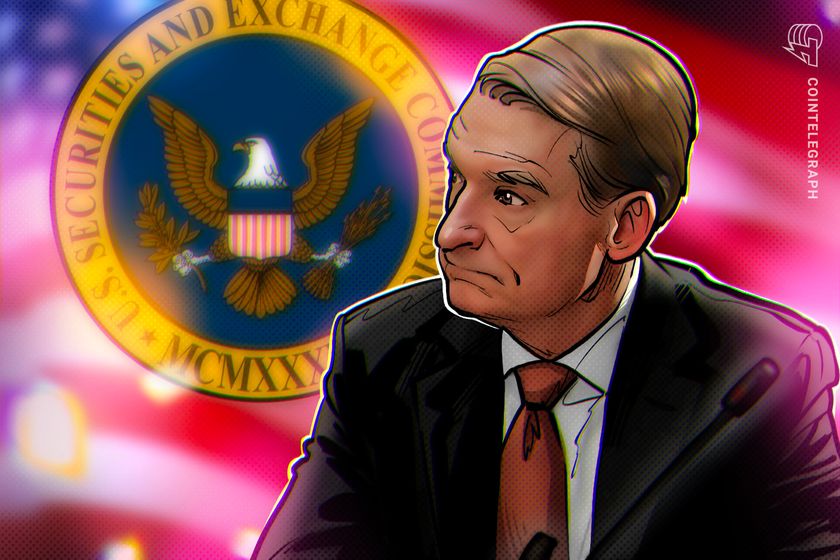
US Securities and Exchange Commission (SEC) Chair Paul Atkins appeared before lawmakers in one of his first hearings since taking the reins at the financial regulator, addressing questions about his plans for the cryptocurrency industry.

In a May 20 hearing discussing oversight of the SEC, Atkins reiterated his pledge to make regulating digital assets a “key priority” while chair. In response to questions from North Carolina Representative Chuck Edwards, the SEC chair did not directly answer how much of the regulator’s funds were used to support the crypto task force headed by Commissioner Hester Peirce, and said its findings were “still under development.”

“We should be having something here in the next few months with proposed steps forward,” said Atkins, referring to the task force’s first report. 

Cryptocurrencies, Government, SEC, United StatesPaul Atkins at a May 20 SEC oversight hearing. Source: House Appropriations Committee

Atkins’ appearance at the oversight hearing was one of his first since being sworn into office in April. Nominated by US President Donald Trump, Atkins, also a former commissioner, was seen by many lawmakers and those in the digital asset industry as someone who could radically change the SEC’s approach to crypto. 

Looking to Congress for help with regulatory clarity

Atkins’ remarks came less than 24 hours after US senators voted to move forward on consideration of a bill to regulate stablecoins, the Guiding and Establishing National Innovation for US Stablecoins Act, or GENIUS Act. The bill is one of many related to aspects of digital assets that could affect how the SEC regulates the industry alongside agencies like the Commodity Futures Trading Commission (CFTC).

“Whatever happens in Congress […] that will help undergird what we do,” said Atkins.

Related: Paul Atkins: ‘Crypto markets have been languishing in SEC limbo

Since being sworn into office in April, the SEC chair has given opening remarks and overseen the commission’s roundtable events on digital assets. The next event, scheduled for June 9, will have SEC commissioners and industry leaders discuss issues related to decentralized finance.

Magazine: SEC’s U-turn on crypto leaves key questions unanswered

Read more at cointelegraph.com

Javier Milei shuts down task force investigating LIBRA scandal

Argentine President Javier Milei has dissolved a task force established to investigate the fallout from LIBRA, the scandalous cryptocurrency project the head of state promoted on his social media channel before it crashed to zero. 

The Investigative Task Force (ITU) was dissolved via a May 19 decree signed by Milei and Justice Minister Mariano Cúneo Libarona, government documents revealed

“The Research Task Unit is dissolved” after completing its mandate, the translated version of the decree read.

The task force is being dissolved despite pressure from opposition groups, which are seeking to activate an investigative commission as soon as May 20, local media outlet Clarin reported

Javier Milei shuts down task force investigating LIBRA scandalA screenshot of Milei’s tweet endorsing LIBRA. Source: TRM Labs

Government officials established the UTI on Feb. 19, mere days after President Milei promoted LIBRA on his official X account.

His endorsement briefly sent LIBRA soaring from practically worthless to $5 a token and a nearly $5 billion market capitalization, before quickly crashing to zero in what appeared to be a classic pump-and-dump scheme. 

The fallout from LIBRA sparked allegations of insider trading and manipulation, with President Milei caught in the crosshairs.

In addition to facing an investigation, Milei’s credibility suffered at home, with nearly 58% of Argentinians saying they no longer trust the president for his role in the scandal.

Related: Argentine President Javier Milei denies promoting failed LIBRA memecoin

“I didn’t promote it, I shared it”

In a televised interview on Todo Noticias, Milei denied any wrongdoing for promoting the project, claiming that he merely shared information about a project that sought to help entrepreneurs access funding options. 

Javier Milei shuts down task force investigating LIBRA scandalSource: tier10k

“I saw a tool that could finance entrepreneurs, and I spread the word. I acted in good faith and took a hit,” he said, according to a translation of the interview. 

Milei also downplayed investors’ losses, claiming that “at most” 5,000 people were affected — the vast majority of whom were Chinese and American. He claimed that only “four or five” Argentinans suffered losses. 

Nevertheless, blockchain data reviewed by Cointelegraph revealed that more than 15,000 wallets sold LIBRA at a profit or loss of more than $1,000. More than 86% of wallets reported a loss totaling $251 million. 

Magazine: Influencers shilling memecoin scams face severe legal consequences

Read more at cointelegraph.com

Argentina's Milei shuts down task force investigating LIBRA scandal

Argentine President Javier Milei has dissolved a task force established to investigate the fallout from LIBRA, the scandalous cryptocurrency project the head of state promoted on his social media channel before it crashed to zero. 

The Investigative Task Force (ITU) was dissolved via a May 19 decree signed by Milei and Justice Minister Mariano Cúneo Libarona, government documents revealed

“The Research Task Unit is dissolved” after completing its mandate, the translated version of the decree read.

The task force is being dissolved despite pressure from opposition groups, which are seeking to activate an investigative commission as soon as May 20, local media outlet Clarin reported

Argentina's Milei shuts down task force investigating LIBRA scandalA screenshot of Milei’s tweet endorsing LIBRA. Source: TRM Labs

Government officials established the UTI on Feb. 19, days after Milei promoted LIBRA on his official X account.

His endorsement briefly sent LIBRA soaring from practically worthless to $5 a token and a nearly $5 billion market capitalization, before quickly crashing to zero in what appeared to be a classic pump-and-dump scheme. 

The fallout from LIBRA sparked allegations of insider trading and manipulation, with Milei caught in the crosshairs.

In addition to facing an investigation, Milei’s credibility suffered at home, with nearly 58% of Argentinians saying they no longer trust the president for his role in the scandal.

Related: Argentine President Javier Milei denies promoting failed LIBRA memecoin

“I didn’t promote it, I shared it”

In a televised interview on Todo Noticias, Milei denied any wrongdoing for promoting the project, claiming that he merely shared information about a project that sought to help entrepreneurs access funding options. 

Argentina's Milei shuts down task force investigating LIBRA scandalSource: tier10k

“I saw a tool that could finance entrepreneurs, and I spread the word. I acted in good faith and took a hit,” he said, according to a translation of the interview. 

Milei also downplayed investors’ losses, claiming that “at most” 5,000 people were affected — the vast majority of whom were Chinese and American. He claimed that only “four or five” Argentinans suffered losses. 

Nevertheless, blockchain data reviewed by Cointelegraph revealed that more than 15,000 wallets sold LIBRA at a profit or loss of more than $1,000. More than 86% of wallets reported a loss totaling $251 million. 

Magazine: Influencers shilling memecoin scams face severe legal consequences

Read more at cointelegraph.com

The crypto market values chains more than standalone applications

Opinion by: Hatu Sheikh, founder of Coin Terminal

Although blockchains and DApps are critical, crypto industry stakeholders often prioritize applications based on adoption principles and revenue distribution. DApps won’t function without their underlying chains. The markets must uphold blockchains for long-term value generation.

The value perspective is wrong 

Blockchains and DApps should work collaboratively to coordinate their functions for better usability. Instead, analysts create a binary between chains and DApps based on Web2’s structural frameworks.

In “Fat Protocols,” Joel Monegro argued that value within the internet stack comprises “thin” protocols and “fat” applications. In other words, investing in the underlying protocol technologies like TCP/IP, HTTP, and SMTP gives lower returns than applications like Google and Facebook.

Monegro further stated that the value is reversed in the “blockchain application stack.” The underlying protocol layer accumulates more value than the application layer, leading to “fat” protocols and “thin” applications. He later published an updated rejoinder to clarify “application-layer success as a requirement for protocol growth” and how value capture depends on the total addressable market.

As apps become more popular, they attract users to the underlying blockchain who use the chain’s token to interact with the app. Such demand pressure results in token price growth and, eventually, builds a strong network where blockchains capture maximum value.

A recent research report demonstrated how revenue generation parameters like onchain fees could flip Monegro’s thesis.

In 2024, blockchains controlling 70% of the total crypto industry market cap (excluding Bitcoin and stablecoins) earned $6 billion in fees. Meanwhile, DApps, with just a 30% market share, made $3.3 billion, generating 35% of total onchain fees. The trend continues in Q1 2025 as DApps recorded $1.8 billion in total fees compared to $1.4 billion for blockchains.

According to the report, apps generate real value and user interaction, as higher fees reflect increased usage rates. Since no one logs into an app just to access a blockchain, people use apps to trade, play, invest, socialize, and spend time. Thus, apps generate value and revenue opportunities.

As apps are users’ first interaction layer, they have higher demands and more growth channels. The report says: “Blockchains may have built the roads — but the apps are building the cities.”

Recent: Every chain is an island: crypto’s liquidity crisis

But without “roads,’’ it’s impossible to navigate and access “cities.’’ Thus, such a value lens to evaluate whether the markets prefer chains or apps is a myopic perspective.

Analysts and crypto industry veterans must understand blockchain’s critical role in running the crypto industry. Consequently, the crypto markets must always support blockchains irrespective of their economic value potential.

Blockchains are fundamental to crypto markets

Blockchains are the necessary trust anchor arbitrating transactions for decentralized applications through transparent and immutable ledgers. During multiparty DApp interactions, blockchains act as a truth source for tamperproof records, making chains an integral infra layer.

The chain vs. app binary argument is false because blockchains are essentially timekeepers for dApp-generated data. Such timestamped data facilitates all onchain transactions and enables people to use DApps trustlessly.

It’s irrelevant if a blockchain’s value potential is based on revenue and user adoption because that’s the task of gaming, social, and financial applications. Blockchains are the foundational layer for building applications and other user products that generate returns on investment capital.

Moreover, despite liquidity and integration challenges, the steady rise of modular app chains is another example of the importance of blockchain architecture. When resource-hungry apps consume network capacities, app chains solve the issue by functioning as independent blockchains to enhance performance and reduce latency.

Using app chains to solve a network’s bottlenecks demonstrates that apps won’t function independently and require the corresponding chain architecture. Each modular appchain thus has its own computational resources, storage capacities, and resources to prevent competing applications from slowing down performance.

These examples illustrate why crypto markets value blockchains more than standalone applications. It’s because apps won’t survive without blockchains.

“Value” doesn’t always mean financial incentives and growth metrics. Sometimes, value also comes from the market’s recognition of their cardinal role within the industry. In this market scenario, blockchains will always be much more valuable than individual applications, regardless of fees and revenue.

Opinion by: Hatu Sheikh, founder of Coin Terminal.

This article is for general information purposes and is not intended to be and should not be taken as legal or investment advice. The views, thoughts, and opinions expressed here are the author’s alone and do not necessarily reflect or represent the views and opinions of Cointelegraph.

Read more at cointelegraph.com

Senate stablecoin vote splits Democrats amid concerns over corruption

US Senate Democrats are getting flak after they helped move stablecoin legislation ahead for discussion on the Senate floor.

On May 19, 16 Democratic senators broke from the party line to pass a motion to invoke cloture, which will now set the bill up for debate on the Senate floor. Some of the same Democrats had held up the bill in early May when they withdrew support, citing corruption concerns over President Donald Trump’s cryptocurrency dealings.

The bill’s opponents hailed lawmakers’ refusal to support it but were soon taken aback when the senators reversed their position. The lightly amended legislation contained no provisions regarding World Liberty Financial, the Trump family’s crypto venture.

Some activists have said that the Democrats supporting the bill should be ousted in the upcoming Democratic primaries in 2026, reflecting a growing rift in the Democratic Party over cryptocurrencies.

Law, Politics, Congress, United States, Stablecoin, FeaturesThe Senate voted 66-32 to move the bill ahead. Source: Stand With CryptoDemocratic lawmakers’ approach to crypto shows split in party

On May 19, moderate Democratic Senator Mark Warner announced he would support the bill, stating that it was “not perfect, but it’s far better than the status quo.”

Warner set corruption concerns aside, stating, “Many senators, myself included, have very real concerns about the Trump family’s use of crypto technologies to evade oversight […] But we cannot allow that corruption to blind us to the broader reality: blockchain technology is here to stay.”

Warner concluded it would be better for the US to move forward on imperfect stablecoin legislation than to fall behind other jurisdictions. 

Democratic Senator Kirsten Gillibrand, one of the bill’s sponsors, also pushed aside Trump corruption concerns, saying they should be addressed separately. 

Related: US Senate moves forward with GENIUS stablecoin bill

“A lot of what President Trump is engaged in is already illegal,” she said, adding that she didn’t want the president’s scandals to “distract us from the important goal of having a clear regulatory structure in the United States that can onshore this industry.”

During the vote, progressive Democrats disagreed. Senator Elizabeth Warren, the top Democrat on the Senate Banking Committee and a vocal critic of the crypto industry, reportedly got into a heated argument with Gillibrand on the Senate floor.

Warren argued on the Senate floor ahead of the vote, “A bill that turbocharges the stablecoin market, while facilitating the President’s corruption and undermining national security, financial stability, and consumer protection is worse than no bill at all.”

Democrats opposing the bill aren’t giving up either. Senator Michael Bennet of Colorado, who voted against the GENIUS Act, immediately introduced another bill, jokingly named “the STABLE GENIUS Act,” combining the names of the bills in the Senate and House of Representatives.

The bill would prevent the president, vice-president and members of Congress from “issuing or endorsing digital assets” and require them to place any assets they hold in a blind trust while in office.

While the bill has little chance of passing — numerous acts that would limit members’ of Congress financial activities have fizzled out — it shows the Democrats are split on how they should provide opposition.

Democratic activists lambast Democratic GENIUS supporters

The progressive and activist wings of the Democratic party have roundly criticized Congressional leadership for compromising with Republicans on measures that, they claim, should be deal breakers. 

In March, activists were enraged when Senator Chuck Schumer, a Democrat from New York and minority leader in the Senate, voted with the Republicans on a continuing resolution for government funding. One progressive observer accused him of giving up leverage and weakening the Democratic position. 

Then, in April, disagreements over how Democrats should fight Trump’s mass deportations further deepened the rift. 

Now, crypto has become another wedge between the activist wing, which provides crucial voter activation during elections, and centrists in Congress.

Ezra Levin, co-founder and co-executive director of progressive activist organization Indivisible, wrote on BlueSky:

Senate stablecoin vote splits Democrats amid concerns over corruptionEzra Levin commenting on crypto bill. Source: Ezra Levin

Communications strategist Murshed Zaheed, who formally worked for the offices of Senator Harry Reid and Representative Louise Slaughter, urged people to call their senators to come out against the bill.

“Any Democrat who votes for this today — should never be taken seriously again if they send out emails, text and do videos […] talking a big game about Trump’s corruption,” he said.

Related: What to expect at Trump’s memecoin dinner

Chris Kluwe, a former American football player who has since become a prominent activist within Democratic politics, said on May 20 he was “excited to get a chance to speak at the CA state Dem convention on May 31st, I’m sure [the bill] won’t come up at all in the 4 minutes I’ve been allotted.”

On BlueSky, labor researcher and media law historian Peter Labuza posted “Primary List” in reply to a post of the 16 Democratic senators who helped support the bill.

The subject of primary elections, the intra-party elections to decide who will represent the party in a given district, has also grown contentious.

On May 12, the Democratic National Convention (DNC) voted to void the results of an internal party vote nominating David Hogg as a vice chair. The decision essentially strips Hogg of his title at the DNC and, with it, the ability to promote his controversial policy of sponsoring progressive challengers in Democratic primary elections. 

Hogg had planned to spend $20 million to support progressive and young candidates in Democratic Party primaries as part of the “Leaders We Deserve” campaign — an activist group that aims to elevate younger leaders with a more combative tone against the Trump administration. 

With the stablecoin bills in the House and Senate poised to move ahead, the Democrats seem ill-suited to mount an effective opposition to the bills. Internal struggles and interests within Congress have disunited lawmakers, while activists want a new crop of congresspeople to represent them next term.

In the Democratic Party’s internal battle between the anti-crypto progressive wing and the pro-crypto pragmatists, the latter is winning out, so far. 

Magazine: Father-son team lists Africa’s XRP Healthcare on Canadian stock exchange

Read more at cointelegraph.com

Robinhood proposes SEC rules for tokenized real-world assets

Robinhood submitted a 42-page proposal to the US Securities and Exchange Commission (SEC), calling for a national framework to regulate tokenized real-world assets (RWAs).

The brokerage is seeking to modernize financial infrastructure by making tokenized assets legally equivalent to their traditional counterparts and enabling compliant onchain settlement, Forbes reported on May 20.

In the proposal, Robinhood also revealed plans for creating the Real World Asset Exchange (RRE), a trading platform offering offchain trade matching and onchain settlement for efficiency and transparency.

Robinhood is advocating for uniform federal standards to replace the patchwork of state-level securities regulations that currently apply. The platform would also integrate Know Your Customer (KYC) and Anti-Money Laundering (AML) tools through partners like Jumio and Chainalysis to meet global compliance expectations.

Related: Central banks testing smart contract toolkit under BIS Project Pine

Robinhood asks for token-asset equivalence

A key feature of the proposal is the push for token-asset equivalence. Under Robinhood’s plan, a token representing a US Treasury bond, for instance, would be treated as the bond itself, not a derivative or synthetic product.

That would allow institutions and broker-dealers to handle tokenized RWAs within the existing regulatory system, potentially streamlining custody, trading and settlement processes.

Robinhood proposes SEC rules for tokenized real-world assetsSource: Cointelegraph

Technically, RRE would be built on a dual-chain architecture utilizing Solana and Base, according to an overview of the proposal by Franklin Elevator. The system is designed to combine high-frequency offchain trade matching with onchain settlement.

Franklin Elevator said Robinhood projects the platform will achieve sub-10 microsecond matching latency and throughput of up to 30,000 transactions per second.

This could compress the US capital markets’ standard settlement time from T+2 to T+0, cutting trading costs by an estimated 30% annually.

“RWA tokenization represents a new paradigm for institutional asset allocation. Robinhood is committed to leading this trend under a compliant framework,” Robinhood CEO Vlad Tenev said.

Cointelegraph reached out to Robinhood for comment, but they hadn’t responded by publication time.

Related: SEC Chair: Blockchain ‘holds promise’ of new kinds of market activity

Tokenization gains momentum

Robinhood’s proposal comes amid a renewed wave of interest in RWA tokenization, with major players from both traditional finance and crypto making headlines last week.

On April 30, BlackRock filed to create a blockchain-based share class for its $150 billion Treasury Trust Fund, allowing a digital ledger to mirror investor ownership. On the same day, Libre revealed plans to tokenize $500 million in Telegram debt via its new Telegram Bond Fund.

On May 1, MultiBank Group inked a $3 billion tokenization deal with UAE real estate firm MAG and blockchain provider Mavryk.

“The recent surge isn’t arbitrary. It’s happening because everything’s lining up,” Eric Piscini, CEO of Hashgraph, told Cointelegraph. “Rules are getting clearer in major markets. The tech is stronger, faster, and ready to scale. And big players are actually doing it,” he added.

Magazine: Father-son team lists Africa’s XRP Healthcare on Canadian stock exchange

Read more at cointelegraph.com