cointelegraph.com

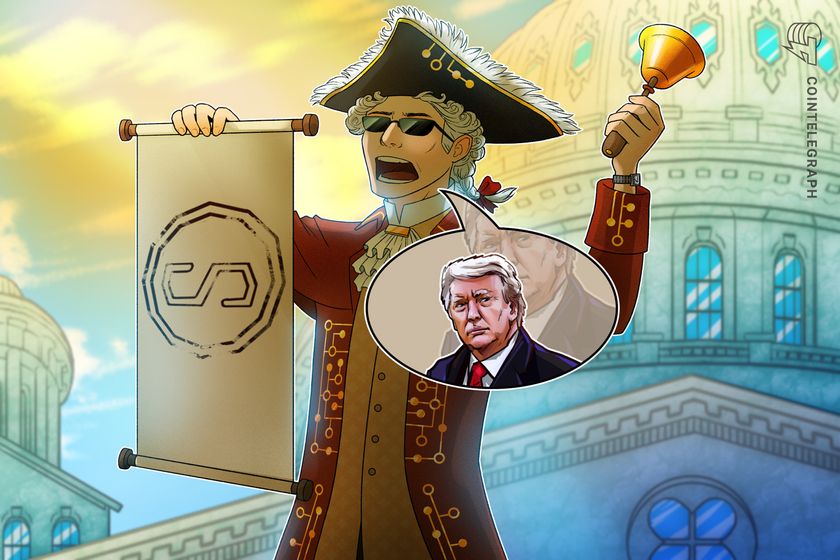
Senators plan to amend GENIUS Act to address Trump family's stablecoin

Though a majority of members of the US Senate voted to advance a bill to regulate payment stablecoins on May 20, high-ranking Democrats are planning to propose an amendment to the legislation to address President Donald Trump’s connections to the cryptocurrency industry.

According to a May 22 Axios report, Senate Minority Leader Chuck Schumer and Senators Elizabeth Warren and Jeff Merkley will file an amendment to the Guiding and Establishing National Innovation for US Stablecoins Act, or GENIUS Act, to block a US president from profiting from stablecoins. The proposed amendment would come after 18 Democrats sided with Republicans in the Senate in voting to advance the bill on May 20 after it failed a procedural vote on May 8.

“Passing the GENIUS Act without our anti-corruption amendment stamps a Congressional seal of approval on Trump selling access and influence to the highest bidder,” Merkley said in a May 22 X post.

Trump his three sons are involved in the crypto platform World Liberty Financial (WLFI), which launched its USD1 stablecoin in March. Critics have pointed out that the president could continue to personally benefit from legislation that helps recognize stablecoins like USD1 as financial instruments in the US. 

Related: US lawmaker introduces anti-corruption bill ahead of Trump’s dinner

An Abu Dhabi-based investment firm said that it would use USD1 to settle a $2-billion investment in Binance, effectively allowing the president’s family to profit from the transaction fees. Democratic lawmakers have already called for an investigation into Trump’s connections to the platform, which was largely dismissed as “flawed” by WLFI co-founder Zach Witkoff.

Stablecoins are just one of many potential conflicts, say Democrats

Merkley and Warren are also planning responses to Trump hosting a dinner at his golf club for up to 220 people who purchased the most significant amounts of his personal memecoin. Merkley is expected to attend a protest organized by the consumer advocacy group Public Citizen, in partnership with progressive political organization Our Revolution, outside the Trump venue on May 22. 

Warren held a press conference with Merkley, Senator Chris Murphy and Public Citizen representatives, calling on Trump to “release the guest list” for the dinner event. Though a few of the potential attendees have publicly announced they were the owners of the wallets who purchased the memecoin and intended to go, the majority were still anonymous at the time of publication.

“What is happening tonight — this private, secret dinner — in which individuals who have put money in Donald Trump’s pocket, get access to him, is maybe the most corrupt of all the corruption,” said Murphy, adding:

“They were able to pay their way in to get an audience with the President of the United States to ask for favorable national security concessions.”

Cointelegraph reached out to the White House for comment, but had not received a response at the time of publication.

Magazine: Trump’s crypto ventures raise conflict of interest, insider trading questions

Read more at cointelegraph.com

Senators plan to amend GENIUS Act to address Trump family's stablecoin

Though a majority of members of the US Senate voted to advance a bill to regulate payment stablecoins on May 20, high-ranking Democrats are planning to propose an amendment to the legislation to address President Donald Trump’s connections to the cryptocurrency industry.

According to a May 22 Axios report, Senate Minority Leader Chuck Schumer and Senators Elizabeth Warren and Jeff Merkley will file an amendment to the Guiding and Establishing National Innovation for US Stablecoins Act, or GENIUS Act, to block a US president from profiting from stablecoins. The proposed amendment would come after 18 Democrats sided with Republicans in the Senate in voting to advance the bill on May 20 after it failed a procedural vote on May 8.

“Passing the GENIUS Act without our anti-corruption amendment stamps a Congressional seal of approval on Trump selling access and influence to the highest bidder,” Merkley said in a May 22 X post.

Trump his three sons are involved in the crypto platform World Liberty Financial (WLFI), which launched its USD1 stablecoin in March. Critics have pointed out that the president could continue to personally benefit from legislation that helps recognize stablecoins like USD1 as financial instruments in the US. 

Related: US lawmaker introduces anti-corruption bill ahead of Trump’s dinner

An Abu Dhabi-based investment firm said that it would use USD1 to settle a $2-billion investment in Binance, effectively allowing the president’s family to profit from the transaction fees. Democratic lawmakers have already called for an investigation into Trump’s connections to the platform, which was largely dismissed as “flawed” by WLFI co-founder Zach Witkoff.

Stablecoins are just one of many potential conflicts, say Democrats

Merkley and Warren are also planning responses to Trump hosting a dinner at his golf club for up to 220 people who purchased the most significant amounts of his personal memecoin. Merkley is expected to attend a protest organized by the consumer advocacy group Public Citizen, in partnership with progressive political organization Our Revolution, outside the Trump venue on May 22. 

Warren held a press conference with Merkley, Senator Chris Murphy and Public Citizen representatives, calling on Trump to “release the guest list” for the dinner event. Though a few of the potential attendees have publicly announced they were the owners of the wallets who purchased the memecoin and intended to go, the majority were still anonymous at the time of publication.

“What is happening tonight — this private, secret dinner — in which individuals who have put money in Donald Trump’s pocket, get access to him, is maybe the most corrupt of all the corruption,” said Murphy, adding:

“They were able to pay their way in to get an audience with the President of the United States to ask for favorable national security concessions.”

Cointelegraph reached out to the White House for comment, but had not received a response at the time of publication.

Magazine: Trump’s crypto ventures raise conflict of interest, insider trading questions

Read more at cointelegraph.com

Sui validators freeze majority of stolen funds in $220M Cetus hack

Cetus, a decentralized crypto exchange (DEX) built atop the Sui blockchain network, said $162 million of over $220 million stolen in a May 22 hack has been frozen.

According to the Cetus team, the DEX is working with the Sui Foundation and other entities within the ecosystem to recover the remainder of the funds. The Sui Foundation also confirmed:

“A large number of validators identified the addresses with the stolen funds and are ignoring transactions on those addresses until further notice. The Cetus team is exploring paths to recover those funds and return them to the community.”

The Cetus hack is the latest in a string of such incidents impacting crypto and Web3 in the first half of 2025. Cybersecurity continues to be a major issue in crypto, with many industry executives calling for the sector to police itself and establish more robust defenses or risk increased regulatory scrutiny.

Smart Contracts, Cybersecurity, Hacks, SUISource: Cetus

Related: Germany seizes $38M in crypto from Bybit hack-linked eXch exchange

The Cetus hack: the story so far

On May 22, the Cetus DEX was hacked in what is believed to be a smart contract code exploit that saw the DEX drained of approximately $223 million in user funds.

According to the team behind the Extractor Web3 security notification tool, $63 million of the stolen funds were bridged to the Ethereum network.

The Extractor team also identified a wallet address ending in “AF16” used by the threat actors to launder 20,000 Ether (ETH), valued at roughly $53 million.

Smart Contracts, Cybersecurity, Hacks, SUIThe Cetus hackers transfer 20,000 Ether to a new wallet address. Source: Etherscan

The recovery efforts and the asset freeze coordinated by different projects, platforms, and validators in the Sui ecosystem drew mixed reactions from the crypto community.

“Good news for the victims, but if validators, 114 only in total, can freeze wallets when they want, it raises a major question about the network’s censorship resistance. Sui is anything but decentralized,” one user wrote in response.

Magazine: $55M DeFi Saver phish, copy2pwn hijacks your clipboard: Crypto Sec

Read more at cointelegraph.com

OpenAI plans to ship 100 million pocket-sized AI devices for everyday use

OpenAI is planning to develop AI “companion” devices that will integrate artificial intelligence capabilities with everyday life, potentially opening the door to a new high-tech innovation used alongside laptops and smartphones.

In an interview with The Wall Street Journal, OpenAI CEO Sam Altman said he and former Apple chief design officer Jony Ive are developing these secret devices for mass consumption, with plans to ship 100 million units upon launch.

Ive joined OpenAI after his startup, io, was acquired by Altman’s company in a $6.5 billion deal, the Journal reported on May 21. 

Neither Altman nor Ives specified what these companion devices would look like or how they would operate. Ives simply referred to them as a “new design movement” that would be similar to Apple’s family of hardware and software integrations. 

OpenAI has raised billions of dollars from investors, who view the company as a stalwart in the AI industry following the overwhelming success of its ChatGPT large language model (LLM). As of May, ChatGPT had nearly 800 million weekly active users, according to industry data. 

These usage trends were behind OpenAI’s massive $157 billion valuation as of October 2024 — a figure that nearly doubled to $300 billion by March 2025.

OpenAI plans to ship 100 million pocket-sized AI devices for everyday useChatGPT usage trends. Source: DemandSage

Related: Microsoft and OpenAI renegotiate investment deal: Report

Not the first “secret” project

In addition to its secretive companion devices, OpenAI’s ambitions extend to social media, where the company plans to take on Elon Musk’s X and Mark Zuckerberg’s Meta platforms, according to an April 15 report by The Verge. 

The new social media platform will reportedly combine ChatGPT’s image generation capabilities with a social media feed similar to X’s. It’s unclear whether the new social media platform would launch as a standalone product or be incorporated into ChatGPT.

The blend between AI and social media has also bled into the blockchain industry, with several startups utilizing these technologies to build AI agents, LLM tools and decentralized social media networks.

As Cointelegraph reported, Validation Cloud recently deployed an LLM on the Hedera network, giving decentralized finance users the ability to query blockchain data more easily. 

Related: OpenAI’s Altman appears to reject Musk’s $97.4B bid for control

Read more at cointelegraph.com

Kraken to offer tokenized US stocks to non-US clients

Crypto exchange Kraken is planning to offer non-US customers the option of trading tokenized US stocks, part of the company’s push to offer more traditional assets via tokenization.

The products will be offered through Backed, a new Kraken partner, according to a statement shared with Cointelegraph. Tokens representing the stocks will be stored on the Solana blockchain due to its “unmatched performance, low latency and thriving global ecosystem,” the statement said.

“The whole point of crypto is that we’re able to see things very transparently,” Kraken co-CEO Arjun Sethi said during Solana’s Accelerate event on May 22. ”It’s decentralized. It is open-source. You can innovate as quickly as possible, and there’s no reason why companies like us can’t morph to do that.”

The decision to incorporate more traditional investment options may indicate a shift by Kraken to compete less with crypto-native exchanges like Coinbase and more with larger brokerages like Robinhood, which provide a wide range of investment options.

Kraken, Stocks, RWA TokenizationArjun Sethi on screen at Solana’s Accelerate event in New York City. Source: Cointelegraph
On April 14, Kraken opened access to exchange-traded funds and stock trading to US clients based in New Jersey, Connecticut, Wyoming, Oklahoma, Idaho, Iowa, Rhode Island, Kentucky, Alabama and the District of Columbia.

In 2021, cryptocurrency exchange Binance launched a similar initiative but ultimately canceled it due to issues with regulatory agencies in various countries worldwide.

According to Sethi, Kraken is building “a set of microservices” to scale out its products to customers.

Related: Crypto exchange Kraken exploring $1B raise ahead of IPO: Report 

Kraken’s tokenization move

Real-world assets (RWA) tokenization has been a central topic in crypto over the past few months. The sector’s market capitalization has climbed from $15.9 billion on Jan. 3 to $22.7 billion on May 20, representing a 42.8% jump in the period.

Tokenized private credit and US Treasurys are dominant assets in the market, while stocks account only for $373.4 million.

Robinhood is also moving to offer tokenized stocks. According to a recent announcement, the brokerage is working on a blockchain for tokenized securities that will offer European investors exposure to US-listed companies.

RWA tokenization is gaining traction among brokerages, exchanges, and firms due to several key advantages. It reduces upfront costs by minimizing reliance on traditional financial infrastructure. Additionally, tokenization helps democratize access to investment opportunities, enabling retail investors to participate in markets that were previously limited to accredited investors.

Magazine: TradFi is building Ethereum L2s to tokenize trillions in RWAs — Inside story

Read more at cointelegraph.com

US lawmaker introduces anti-corruption bill ahead of Trump's dinner

California Representative Maxine Waters, ranking member of the US House Financial Services Committee, has announced plans to introduce legislation “to block [Donald] Trump’s memecoin and stop his crypto corruption.”

In a May 22 notice, Waters said the Stop Trading, Retention, and Unfair Market Payoffs (TRUMP) in Crypto Act of 2025 bill would be aimed at blocking the US president, vice president, members of Congress and their families from engaging in “crypto crime.”

The US lawmaker referred to Trump and his wife, Melania, issuing personal memecoins in January, his family launching a stablecoin, USD1, through the crypto platform World Liberty Financial, and the president attempting to establish a national Bitcoin (BTC) reserve as his sons back a BTC mining venture.

“Donald Trump is preparing to dine with the top donors of his memecoin who’ve made him, and his family, richer,” said Waters, adding:

“Trump’s crypto con is not just a scam to target investors. It’s also a dangerous backdoor for selling influence over American policies to the highest foreign bidder.”Government, Donald Trump, Corruption, MemecoinHR 3573, Stop TRUMP in Crypto Act of 2025, introduced by Rep. Maxine Waters. Source: House Financial Services Committee Democrats

Waters’ bill was one of many actions announced to oppose the president’s dinner to reward memecoin holders. Senators Chris Murphy and Elizabeth Warren are expected to attend a press event with representatives for the consumer advocacy group Public Citizen, and two Democratic organizations are set to protest at the Trump National Golf Club outside Washington, DC, where the memecoin dinner will be held.

Majority of participants have stayed anonymous ahead of dinner

The number and names of attendees to the May 22 dinner were still largely unknown, but several revealed their intentions through social media and news outlets to apply for background checks and meet the president.

Bloomberg reported that more than half of the participants eligible for the dinner and “VIP Tour” — a separate experience limited to the top 25 memecoin holders — were likely foreign nationals.

Among those claiming to attend included Tron founder Justin Sun, Hyperithm co-CEO Oh Sangrok, Kronos Research chief investment officer Vincent Liu, and Synthetix founder Kain Warwick. Sun posted to X on May 21, showing him appearing to gain access to the Eisenhower Executive Office Building in Washington, DC, which is part of the White House compound.

Related: What to expect at Trump’s memecoin dinner

Addressing members of the press on May 22, White House Press Secretary Karoline Leavitt said Trump was attending the dinner “in his personal time.” She denied that the event would be taking place at the White House, despite the memecoin project’s website previously stating the top 25 holders would be eligible for a tour of the government building.

Since the launch of the TRUMP memecoin on Jan. 17, many lawmakers and industry figures, including some generally supportive of the president’s policies, have criticized the project. In a May 20 article, The Wall Street Journal Editorial Board called on the White House to disclose the names of those attending the dinner, adding that Trump would “help himself by calling off his Thursday gala.”

Two organizations behind the TRUMP token are tied directly to the president and control roughly 80% of the total supply, opening up the potential for a rug pull in the future. In the previous 24 hours, the price of the memecoin has risen more than 11%, to $15.76 from $14.13.

Magazine: Trump’s crypto ventures raise conflict of interest, insider trading questions

Read more at cointelegraph.com

BTC price eyes $112K as risk assets 'ignore bad news' on unemployment

Key points:

Mixed results for US jobless claims fail to dent risk-asset enthusiasm.

Despite concerns over the bond market, Bitcoin and stocks enjoy stability at the start of the Wall Street trading session.

BTC price expectations remain lofty amid low volatility and a curious lack of profit-taking.

Bitcoin (BTC) focused on $111,000 around the May 22 Wall Street open as record highs met mixed US unemployment data.

BTC price eyes $112K as risk assets 'ignore bad news' on unemploymentBTC/USD 1-hour chart. Source: Cointelegraph/TradingViewBitcoin, stocks brush off jobs uncertainty

Data from Cointelegraph Markets Pro and TradingView showed BTC price volatility cooling in line with stocks.

The latest US macroeconomic data painted a conflicting picture of labor market resilience to inflation trends.

Initial jobless claims came in below expectations at 227,000, while continuing claims exceeded their target by 13,000.

Far from a wary reaction, however, risk assets maintained prior levels, leading analysts to bullish conclusions over market sentiment.

“Initial Jobless Claims came in cooler than expected. Continuing Claims came in hotter than expected,” Blacknox, cofounders of trading resource Material Indicators, wrote on X. 

“BTC is in price discovery, and the market wants to celebrate the good news and ignore the bad news.”

Fellow co-founder Keith Alan described the jobless numbers as “a bit more fuel for BTC momentum.”

“Keep watching Bitcoin and Gold,” trading resource The Kobeissi Letter continued.

Kobessi added that it expected some form of government intervention in the bond market after stocks’ volatility kicked in the day prior.

On today’s episode of the bond market:The US 30Y Bond yield just hit 5.15% for the first time since October 2023.Other than October 2023, 30Y Yields have not been this high since July 2007.We expect attempted intervention by Trump and Bessent as the Fed refuses to cut… https://t.co/GUptlBLyCK pic.twitter.com/0DONKceum6

— The Kobeissi Letter (@KobeissiLetter) May 22, 2025Bitcoin due “bigger move” amid low profit-taking

Comparing the latest all-time highs to previous cycles, meanwhile, Bitcoin market participants revealed surprising behavior.

Related: Bitcoin ‘looks exhausted’ as next bear market yields $69K target

Volatility and mass profit-taking, they noted, were both conspicuously lacking at $111,000.

“Can’t recall a time in history where $BTC just casually traded around in a 1% range at all time highs,” popular trader Daan Crypto Trades told X followers. 

“Bigger move following once it breaks this local tiny range. Quite a lot of positions being build up on both sides.”BTC price eyes $112K as risk assets 'ignore bad news' on unemploymentBTC/USDT 15-minute chart. Source: Daan Crypto Trades/X

Order book liquidity data from monitoring resource CoinGlass thickening bids and asks around spot price. 

BTC price eyes $112K as risk assets 'ignore bad news' on unemploymentBTC liquidation heatmap. Source: CoinGlass

Elsewhere, onchain analytics platform Glassnode flagged steadfast resolve among hodlers despite 100% supply profitability.

“When $BTC hit all-time high yesterday, total profit-taking volume was around $1.00B – less than half the amount realized when Bitcoin first crossed $100K last December, which hit $2.10B,” it noted on the day. 

“Despite a higher price, profit realization was far more muted.”BTC price eyes $112K as risk assets 'ignore bad news' on unemploymentBitcoin spent volume by coin dormancy. Source: Glassnode

This article does not contain investment advice or recommendations. Every investment and trading move involves risk, and readers should conduct their own research when making a decision.

Read more at cointelegraph.com

Bitcoin could go much higher due to lack of FOMO and futures market euphoria — Analysts

Key takeaways:

Bitcoin’s rally to new price highs happened as funding rates and trading sentiment remained unusually subdued.

Rising stablecoin supply and global M2 growth indicate untapped liquidity and the potential for further price increases.

Long-term holders are not aggressively selling, reflecting their expectation for continued Bitcoin price appreciation.

Bitcoin (BTC) hit a new all-time high on May 21, with prices rising to $111,860 on Binance on May 22, but the markets lack the state of frenzy associated with new highs. Economist and crypto commentator Alex Krüger noted that “this is the least euphoric new all-time highs” for Bitcoin, after highlighting subdued funding rates for Bitcoin across crypto exchanges.

Bitcoin could go much higher due to lack of FOMO and futures market euphoria — AnalystsBitcoin price and aggregated funding rate. Source: Coinalyze

The chart illustrates that the current BTC funding rate is significantly below previous market highs observed during March and November 2024. The funding rate was six times higher in Q1 and three times higher in Q4 last year.

These low rates indicate minimal speculative activity in the futures market, with the rally driven by spot buyers rather than leveraged traders, reducing the risk of over-leveraged corrections. 

Such a scenario also indicates that Bitcoin might not have reached a state of euphoria yet. 

The availability of untapped liquidity in the crypto ecosystem underscores the potential for further growth. Stablecoin market capitalization, often a leading indicator of incoming capital, has risen to 14% in 2025. Tether’s (USDT) market cap jumped to $152 billion from $139 billion in January, while Circle’s USDC supply has increased by 35% to $58 billion. 

Bitcoin could go much higher due to lack of FOMO and futures market euphoria — AnalystsTotal stablecoin supply. Source: Token Terminal

Stablecoins often act as a bridge for new capital entering the crypto market, and their growth suggests a substantial pool of liquidity that has yet to be fully deployed into Bitcoin and other crypto assets. 

Additionally, global liquidity trends provide further tailwinds. The global M2 money supply, which measures the total money in circulation across major economies, grew by 5% in Q1 2025, driven by monetary policy adjustments in the US, EU, and Japan.

Cointelegraph reported a strong correlation, exceeding 80%, between Bitcoin’s price and global liquidity, typically with a 60-day lag, pointing to further buying pressure in the coming months.

Bitcoin could go much higher due to lack of FOMO and futures market euphoria — AnalystsBitcoin price and Global M2 supply. Source: X.com

Related: These 4 memecoins can outperform Bitcoin this cycle

“Muted” profit-taking reflects confidence in Bitcoin

Glassnode data adds another layer of insight into Bitcoin’s current market dynamics. Despite the new highs, profit-taking among Bitcoin holders remains restrained. The data analytics platform noted,

“When $BTC hit all-time high yesterday, total profit-taking volume was around $1.00B – less than half the amount realized when #BTC first crossed $100K last December, which hit $2.10B. Despite a higher price, profit realization was far more muted.”

This muted activity suggests that long-term holders are not rushing to cash out, which typically reflects confidence in further price appreciation.

Bitcoin could go much higher due to lack of FOMO and futures market euphoria — AnalystsBitcoin spent volume by age data. Source: X.com

The lack of widespread participation indicates that Bitcoin’s rally is not a crowded trade, leaving room for new capital to enter the market. The restrained profit taking, combined with low speculative activity in the futures market, paints a picture of a market far from overheated or “euphoria”.

Related: Bitcoin tops Amazon market cap on ‘Pizza Day’ as price sets new highs

This article does not contain investment advice or recommendations. Every investment and trading move involves risk, and readers should conduct their own research when making a decision.

Read more at cointelegraph.com

Carmaker DeLorean tokenizes EV reservations on Sui

DeLorean launched an onchain reservation system and non-fungible token (NFT) marketplace for its upcoming electric vehicle launch, introducing a new blockchain-based approach for reserving and reselling cars.

According to DeLorean, its Build Slot NFT collection grants holders priority access to purchase DeLorean’s upcoming electric car, Alpha 5 EV. The model is the carmaker’s first vehicle in over 40 years, inspired by the iconic flux capacitor from the movie Back to the Future.

The company created an exclusive marketplace for its NFT holders, in which users can buy or trade the NFTs using the USDC (USDC) stablecoin on the Sui network and will be able to earn rewards.

DeLorean says that each vehicle’s history and performance data will be recorded onchain through the FLUX protocol, including key data such as battery health, maintenance records, accident history, and verified odometer readings. 

This detailed data makes it easier for auto enthusiasts to bid on or resell vehicles in the secondary market, the company said.

Carmaker DeLorean tokenizes EV reservations on SuiDeLorean NFT platform. Source: DeLorean

“Since DeLorean’s emergence in the 1980s, the brand has stood as a symbol of vision, rebellion, and futuristic innovation,” according to Cameron Wynne, the chief brand officer at DeLorean. “By using blockchain technology, we’re setting a new standard for the automotive industry,” Wynne said.

The NFT-based reservation system and the tokenization of an electric vehicle signal DeLorean’s interest in digital assets. The company is also the first carmaker to introduce a utility token, the DeLorean ($DMC) token.

Carmaker DeLorean tokenizes EV reservations on SuiDMC tokenomics. Source: Deloreanlabs Luxury brands exploring blockchain, NFTs

NFTs are becoming digital passports for luxury goods, linking to full lifecycle benefits such as reservation, maintenance, resale, and membership services.

By tokenizing luxury products using NFTs, brands can enhance their technological appeal while reinforcing a sense of scarcity and community value.

Global fashion brand Louis Vuitton ventured into NFTs in 2023, offering NFT holders exclusive access to certain products like a $6,400 digital mini trunk, a $9,000 bag and a varsity jacket worth around $8,400.

LVMH Group launched the blockchain-based AURA platform, where luxury items are represented as unique NFTs containing information such as the origin of raw materials, production date and maintenance history.

Magazine: Pranksy: Inside the anonymous life of an NFT legend — NFT Collector

Read more at cointelegraph.com

Carmaker DeLorean tokenizes EV reservations on Sui

DeLorean launched an onchain reservation system and non-fungible token (NFT) marketplace for its upcoming electric vehicle launch, introducing a new blockchain-based approach for reserving and reselling cars.

According to DeLorean, its Build Slot NFT collection grants holders priority access to purchase DeLorean’s upcoming electric car, Alpha 5 EV. The model is the carmaker’s first vehicle in over 40 years, inspired by the iconic flux capacitor from the movie Back to the Future.

The company created an exclusive marketplace for its NFT holders, in which users can buy or trade the NFTs using the USDC (USDC) stablecoin on the Sui network and will be able to earn rewards.

DeLorean says that each vehicle’s history and performance data will be recorded onchain through the FLUX protocol, including key data such as battery health, maintenance records, accident history, and verified odometer readings. 

This detailed data makes it easier for auto enthusiasts to bid on or resell vehicles in the secondary market, the company said.

Carmaker DeLorean tokenizes EV reservations on SuiDeLorean NFT platform. Source: DeLorean

“Since DeLorean’s emergence in the 1980s, the brand has stood as a symbol of vision, rebellion, and futuristic innovation,” according to Cameron Wynne, the chief brand officer at DeLorean. “By using blockchain technology, we’re setting a new standard for the automotive industry,” Wynne said.

The NFT-based reservation system and the tokenization of an electric vehicle signal DeLorean’s interest in digital assets. The company is also the first carmaker to introduce a utility token, the DeLorean ($DMC) token.

Carmaker DeLorean tokenizes EV reservations on SuiDMC tokenomics. Source: Deloreanlabs Luxury brands exploring blockchain, NFTs

NFTs are becoming digital passports for luxury goods, linking to full lifecycle benefits such as reservation, maintenance, resale, and membership services.

By tokenizing luxury products using NFTs, brands can enhance their technological appeal while reinforcing a sense of scarcity and community value.

Global fashion brand Louis Vuitton ventured into NFTs in 2023, offering NFT holders exclusive access to certain products like a $6,400 digital mini trunk, a $9,000 bag and a varsity jacket worth around $8,400.

LVMH Group launched the blockchain-based AURA platform, where luxury items are represented as unique NFTs containing information such as the origin of raw materials, production date and maintenance history.

Magazine: Pranksy: Inside the anonymous life of an NFT legend — NFT Collector

Read more at cointelegraph.com