cointelegraph.com

Conduit raises $36M for stablecoin, fiat cross-border payment network

Conduit, a cross-border payments company based in Boston, has raised $36 million in a Series A funding round led by Dragonfly and Altos Ventures. The capital will go to scale its payment system and expand currency offerings across fiat and stablecoins.

Conduit markets its payment system as an alternative to the messaging network SWIFT, or Society for Worldwide Interbank Financial Telecommunications. Banks have relied on the SWIFT protocol to process wire transfers since the 1970s.

Conduit claims its platform offers a modern alternative, enabling near real-time cross-border settlements by combining stablecoins with local fiat currencies through crypto infrastructure.

“Traditional cross-border payment systems do not meet the demands of modern businesses,” Kirill Gertman, Conduit CEO, said in a statement.

Additional participants in the funding round include Sound Ventures, Commerce Ventures, DCG, Circle Ventures, and two previous investors, Helios Digital Ventures and Portage Ventures. Conduit claims its clients have saved more than 60,000 hours in settlement times and over $55 million in fees since launching in 2021.

Related: UK FCA requests public comments on stablecoin, crypto custody regulation

Funding for stablecoin companies increases

Stablecoins are seeing increased adoption. According to DefiLlama data, the market capitalization of stablecoins reached $247 billion on May 28, a steep rise from $161 billion a year before. Over the past 12 months, the market cap has jumped 54%.

Conduit raises $36M for stablecoin, fiat cross-border payment networkTether’s USDT is keeping pace with growing stablecoin markets. Source: DefiLlama

Investors continue to bet on stablecoin-focused startups. In April, stablecoin firm Cap raised $11 million in seed funding, while Plasma secured $24 million in February. Startup Cedar Money also closed a $9.9 million round in January to support its stablecoin payments platform.

Circle, the issuer of USDC and one of Conduit’s backers, is preparing for a public debut. The company is aiming to raise $624 million through an initial public offering, targeting a valuation of $6.71 billion, according to its IPO filings.

Magazine: Legal Panel: Crypto wanted to overthrow banks, now it’s becoming them in stablecoin fight

Read more at cointelegraph.com

BlackRock eyes 10% stake in Circle's IPO

BlackRock is reportedly planning to take a significant stake in Circle’s upcoming initial public offering (IPO).According to a May 28 Bloomberg report citing anonymous sources, BlackRock is looking to purchase roughly 10% of the offering. Circle, the issuer of the USDC stablecoin, is aiming to raise $624 million in its initial public offering

Cathie Wood’s Ark Investment Management is also interested in buying $150 million worth of shares in the offering. Circle launched its offering of 24 million shares of Class A common stock on May 27. The offering consists of shares from the company as well as shares of existing stakeholders, including co-founder and CEO Jeremy Allaire.

This is a developing story, and further information will be added as it becomes available.

Read more at cointelegraph.com

BlackRock eyes 10% stake in Circle's IPO — Report

BlackRock is reportedly planning to take a significant stake in Circle’s upcoming initial public offering (IPO).

According to a May 28 Bloomberg report citing anonymous sources, BlackRock is looking to purchase roughly 10% of the offering. Circle, the issuer of the USDC stablecoin, is aiming to raise $624 million in its initial public offering

Cathie Wood’s Ark Investment Management is also interested in buying $150 million worth of shares in the offering, the report said. 

Circle launched its offering of 24 million shares of Class A common stock on May 27. The offering consists of shares from the company as well as shares of existing stakeholders, including co-founder and CEO Jeremy Allaire. According to the report, Circle’s IPO has now received orders for multiple times the shares available.

The company filed for an initial public offering on April 1, but delayed plans citing economic uncertainty. Crypto firms Ripple and Coinbase were reportedly exploring a potential acquisition of Circle. The company has since dismissed the speculation, saying it “is not for sale.”

Related: Circle co-founder to create ‘AI-native’ bank after $18M raise

USDC market share

With a market capitalization of $60.9 billion as of May 28, Circle’s USDC (USDC) represents 24.6% of the stablecoin market, only behind Tether’s USDt (USDT).

Circle, IPO, Stablecoin, BlackRockStablecoins by market cap. Source: DefiLlama

According to its Form S-1 registration statement, Circle had $1.67 billion in revenue in 2024, representing a 16% increase year-over-year. However, its net income fell from $267.6 million in 2023 to $155.7 million in 2024, a 41.8% decline.

Circle’s main competitor, Tether, is seemingly not interested in pursuing an IPO. In an X post on April 4, Tether CEO Paolo Ardoino said that “Tether doesn’t need to go public.”

Magazine: Legal Panel: Crypto wanted to overthrow banks, now it’s becoming them in stablecoin fight

Read more at cointelegraph.com

Coinbase data breach 2025: What was stolen and what you need to know

Background of Coinbase’s May 2025 breach

Coinbase, America’s largest cryptocurrency exchange, received an unsolicited email from an unknown threat actor on May 11, 2025. They claimed to possess sensitive information about its customers and demanded a ransom of $20 million. 

Before examining the breach, it is interesting to understand how it happened at a public company that spends millions monthly on cybersecurity. In February, blockchain investigator ZachXBT reported increased thefts involving Coinbase users. He blamed aggressive risk models and pointed out Coinbase’s failure to prevent $300 million in yearly losses from social engineering scams

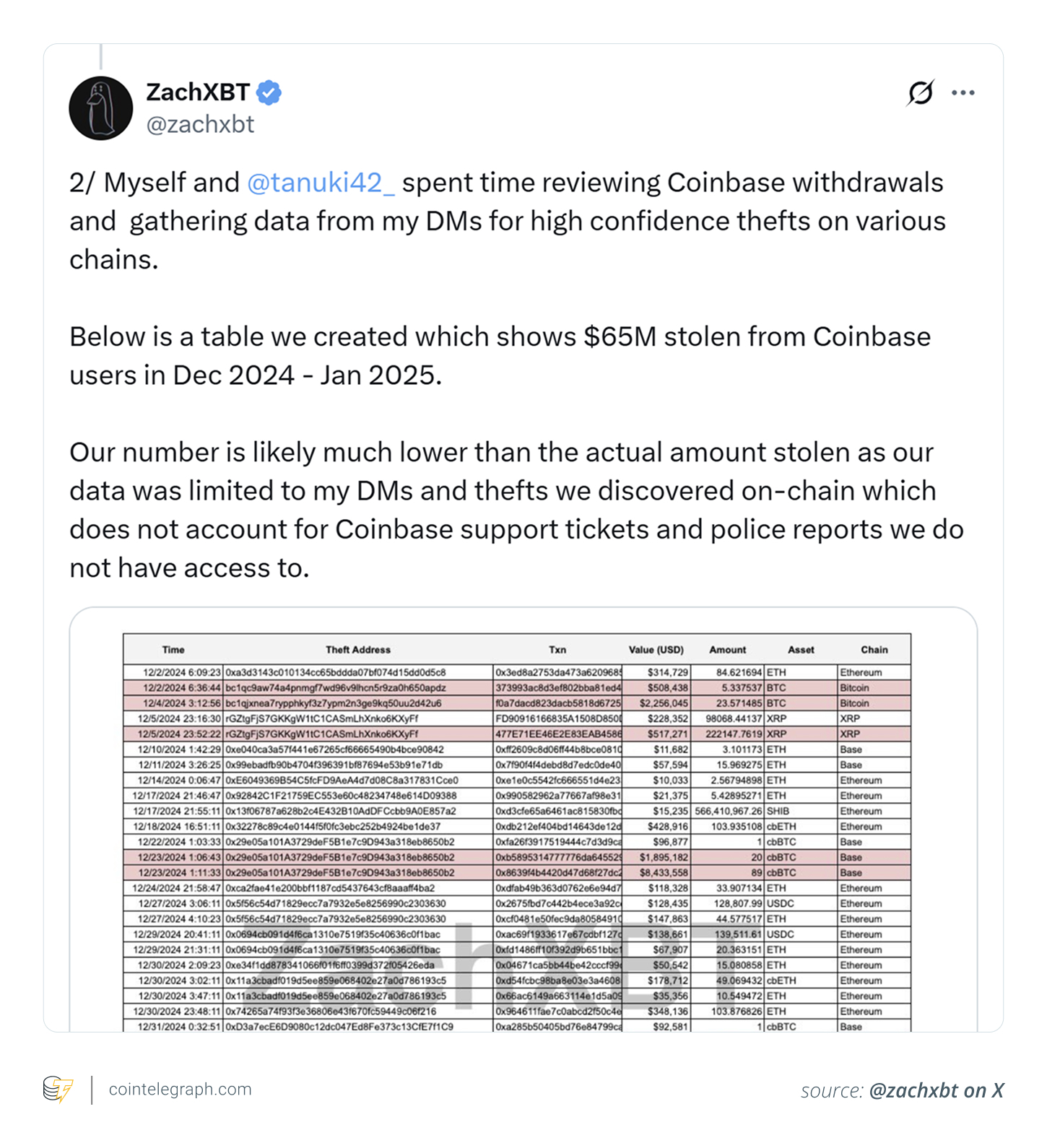
A table ZachXBT shared on X showed $65 million stolen from users between December 2024 and January 2025. He also said the real losses could be higher, as his data only came from his direct messages about onchain thefts, and excluded Coinbase support tickets and police reports he couldn’t access. 

A table shared by ZachXBT showed $65M were stolen from Coinbase users in Dec. 2024 - Jan. 2025

The fear of cybercriminals stealing valuable information came true on May 11 when Coinbase published a blog post confirming that account balances, ID images, phone numbers, home addresses and partially hidden bank details were stolen during the data breach.

On May 21, the same threat actor swapped about $42.5 million from Bitcoin (BTC) to Ether (ETH) via THORChain. They used Ethereum transaction input data to write “L bozo,” following it with a meme video of NBA player James Worthy smoking a cigar, seemingly mocking ZachXBT, who later flagged the message on his Telegram channel.

Coinbase data hacker trolling ZachXBT

What happened: Timeline of the Coinbase breach

The 2025 Coinbase breach wasn’t a typical crypto hack involving smart contracts or blockchain vulnerabilities. Instead, it was like a traditional IT security failure, marked by insider manipulation, corporate espionage and an extortion attempt.

Below is a breakdown of how the incident unfolded:

Insider recruitment and information theft began: To steal information from Coinbase, unknown cyber attackers began recruiting some overseas customer service agents (based in India) working for Coinbase. These insiders were paid to leak sensitive customer data and internal documentation, particularly that around customer service and account management systems. The stolen information was intended for future impersonation scams targeting users.Security detection and employee termination: Coinbase’s internal security team eventually detected suspicious activity linked to these employees. The involved staff were swiftly terminated, and the company alerted affected users. Though just 69,461 accounts were impacted, a fraction of Coinbase’s user base, the depth of stolen personal data made the breach significant.Extortion attempt via email (May 11, 2025): Coinbase received an unsolicited email claiming to possess internal system details and personally identifiable information (PII). This was later confirmed as credible in an 8-K SEC filing. Coinbase refuses to pay $20M ransom (May 14, 2025): Rather than accepting extortion, Coinbase flipped the script. The company reported the breach to law enforcement, disclosed it publicly and offered a $20 million reward for information leading to the attackers’ arrest, turning defense into offense. Breach disclosure and public notification: Shortly after the SEC filing, Coinbase publicly confirmed the breach, clarifying the scope and nature of the attack. A data breach notification was filed with the Maine Attorney General’s office, officially stating 69,461 users were affected. 

This timeline reflects how a crypto company responded differently to an attempted cyber-extortion, with transparency, resistance and bold countermeasures. This may bring in a change in the way companies respond to threats from cyber criminals.

Michael Rubin, an attorney for Coinbase, filed a data breach notification with Maine Attorney General

Did you know? North Korea’s Lazarus Group has stolen over $6 billion in crypto since 2017, including a record-breaking $1.46 billion from Bybit in 2025. 

What data was compromised in the Coinbase data breach in 2025?

According to a notification letter issued by Coinbase, attackers sought this information because they planned to launch social engineering attacks. The information they stole could help them appear credible to victims and possibly convince them to move their funds.

Coinbase detailed the information the threat actors had got access to and what they could not. 

What attackers gotName, address, phone, and emailGovernment‑ID images (e.g., driver’s license, passport)Masked Social Security (last four digits only)Account data (balance snapshots and transaction history)Masked bank account numbers and some bank account identifiersLimited corporate data (including documents, training material, and communications available to support agents)What attackers couldn’t getLogin credentials or 2FA codesPrivate keysAccess to Coinbase Prime accountsAny ability to move or access customer fundsAccess to any Coinbase or Coinbase customer hot or cold wallets

Did you know? In 2022, Crypto.com lost $30 million from 483 accounts. Initially, they claimed no funds were stolen, but later admitted the breach and refunded victims, highlighting the importance of transparency in crypto hacks.

How Coinbase responded to the 2025 criminal data breach

In response to the 2025 data breach, Coinbase implemented a comprehensive strategy to mitigate damage, support affected users and strengthen its security infrastructure.

Key actions taken by Coinbase included:

Refusal to pay ransom: Coinbase declined the $20 million ransom demanded by the attackers. Instead, the company established a $20 million reward fund for information leading to the arrest and conviction of those responsible.Customer reimbursements: The company committed to reimbursing customers who were deceived into sending funds due to the breach. Estimated costs for remediation and reimbursements range between $180 million and $400 million.Theft protection services: The company is providing all affected individuals with one year of complimentary credit monitoring and identity protection services. This includes credit monitoring, a $1 million insurance reimbursement policy, identity restoration services, and dark web monitoring to detect if any personal information appears on illicit online platforms.Enhanced customer safeguards: Affected accounts will require additional ID verification for large withdrawals, including mandatory scam-awareness prompts to prevent further social engineering attacks.Strengthened support operations: Coinbase is opening a new support hub in the US. It has implemented stronger security controls and monitoring across all locations to prevent insider threats.Collaboration with law enforcement: The company is cooperating closely with US and international law enforcement agencies. Insiders involved in the breach were terminated and referred for criminal prosecution.Transparency and communication: Coinbase immediately notified affected customers once the breach was recognized. It is providing ongoing updates about the breach and the steps being taken to address it.

These measures reflected Coinbase’s commitment to customer protection and its proactive approach to cybersecurity challenges.

Did you know? Crosschain bridges, like Nomad Bridge, lost $190 million in 2022 due to complex smart contract vulnerabilities. These bridges are hacker favorites because they store massive crypto assets, making them lucrative targets.

How to stay safe in the event of Coinbase-like data breaches

In the wake of large-scale data breaches of crypto platforms, you should take proactive steps to protect yourself from social engineering attacks. 

Here is how you could stay safe in such an event:

Never share sensitive information with impersonators: Scammers often pose as support staff or security agents after a breach. They may push you toward moving funds to crypto wallets they share with you or revealing sensitive information under various texts. Never share your password, two-factor authentication (2FA) codes, or recovery phrases with such impersonators. No crypto exchange will ask you to transfer crypto to a “new” or “safe” wallet. Turn on allow-listing of wallet addresses: Some exchanges provide this feature, which restricts withdrawals to pre-approved wallet addresses you fully control. This prevents unauthorized transfers even if your account is compromised. Enable strong 2FA: For 2FA, use a hardware security key or a trusted authentication app. Avoid relying on SMS-based 2FA, which is vulnerable to SIM-swapping attacks. Be cautious with unsolicited communication: Hang up immediately if someone calls claiming to be from a crypto platform and asks for security credentials or requests asset transfers. Do not respond to unknown texts or emails with your personal information. Lock first, investigate later: If anything feels suspicious, lock your account immediately through the app or platform and report the incident to customer support via official channels. Stay informed: Regularly review security tips and updates from your crypto services to recognize and avoid evolving scam tactics.

Read more at cointelegraph.com

Cork Protocol hacked for $12M, smart contracts paused

Cork Protocol, a decentralized finance (DeFi) platform, was hit by a smart contract exploit on May 28, resulting in the loss of roughly $12 million in digital assets.

Cybersecurity firm Cyvers said the hack occurred at 11:23:19 UTC and was funded by an address ending in “762B.” According to the firm, the attacker used the exploit to steal roughly 3,761 Wrapped Staked Ether (wstETH), which was converted to Ether (ETH) almost immediately after the attack.

“We are investigating a potential exploit on Cork Protocol and are pausing all contracts. We will report back with more information,” Cork Protocol co-founder Phil Fogel wrote on X.

Cybersecurity, HacksCork Protocol smart contract exploit details. Source: Cyvers

The Cork Protocol exploit is the latest hacking incident to impact the crypto industry as cybersecurity continues to be a major issue in the sector, lowering consumer confidence, and prompting calls to improve security measures from crypto industry executives.

Related: Hacken CEO sees ‘no shift’ in crypto security as April hacks hit $357M

Cetus hacked for $223 million days ago

The Cetus decentralized crypto exchange (DEX), a trading platform built on the Sui network, was hacked on May 22, resulting in $223 million in stolen funds.

Sui validators froze a majority of the funds, sparking a debate about the centralization of the network and the appropriate course of action for blockchain validators following a major hacking incident.

The Cetus team announced a $6 million bounty for white hat hackers assisting in the return of the remaining stolen funds.

Blockchain security firm Dedaub released a post-mortem report dissecting the incident details. According to the report, the hack was caused by an exploit of the liquidity parameters used by the Cetus automated market maker (AMM).

The hackers manipulated the field by altering values that went undetected in a most significant bits (MSB) check. Changes to a binary code’s most significant bits dramatically alter the values produced by that binary code.

This allowed the hackers to add massive amounts of liquidity to the system with only a keystroke and drain other liquidity pools of hundreds of millions of dollars.

Magazine: Weird ‘null address’ iVest hack, millions of PCs still vulnerable to ‘Sinkclose’ malware: Crypto-Sec

Read more at cointelegraph.com

Polygon-backed, high-yield blockchain launches for institutional adoption

The Katana Foundation, a nonprofit focused on decentralized finance (DeFi) development, is launching its private mainnet, aiming to unlock greater crypto asset productivity via deeper liquidity and higher yields for users.

The Katana Foundation launched a DeFi-optimized, private blockchain, Katana, on May 28, incubated by GSR Markets and Polygon Labs, with the public mainnet launch set for June.

The new blockchain will enable users to earn higher yields and explore DeFi in a “unique, optimized yield environment” that unlocks latent value through an ecosystem that makes every digital asset “work harder,” according to an announcement shared with Cointelegraph.

“DeFi users deserve ecosystems that prioritize sustainable liquidity and consistent ‘real’ yields,” wrote Marc Boiron, the CEO of Polygon Labs and core contributor at Katana, adding: 

“Katana’s user-centric model turns inefficiencies into advantages, establishing a truly positive-sum environment for builders and participants alike.”Polygon-backed, high-yield blockchain launches for institutional adoptionSource: Katana

Katana aims to solve the crypto industry’s liquidity fragmentation issue, which can cause significant price slippage, as one of the main barriers limiting institutional DeFi participation

Related: Here’s how abstraction minimizes fragmentation in DeFi, making it more fluid

To reduce the value slippage in DeFi, Katana’s blockchain concentrates the liquidity from numerous protocols and collects yields on all potential sources to create an ecosystem with deeper liquidity and more predictable lending and borrowing rates.

Polygon-backed, high-yield blockchain launches for institutional adoption2025 Institutional Investor
Digital Assets Survey. Source: EY-Parthenon

Institutional participation in DeFi is set to triple over the next two years to 75% from 24% of 350 surveyed institutional investors, according to management consulting firm EY-Parthenon.

To tackle the growing institutional liquidity needs, Katana’s liquidity pool is composed of multiple protocols, including lending protocol Morpho, decentralized exchange (DEX) Sushi and perpetual DEX Vertex, enabling users to trade “blue-chip assets” without needing crosschain transfers.

Katana has also incorporated Conduit’s sequences and Chainlink’s decentralized oracle network.

Related: Polygon CEO: DeFi must ditch hype for sustainable liquidity

Katana to compound DeFi yield from “Ethereum-based opportunities”

Katana aims to boost sustainable yield by building a cohesive DeFi ecosystem. For instance, VaultBridge deploys bridged assets into overcollateralized, curated lending strategies on Ethereum via Mopho to earn yield, which is routed back and compounded on Katana.

The protocol will reinvest network fees and a portion of application revenue back into its ecosystem.

“This reduces reliance on short-term incentives, generates consistent yield, and as it grows, acts as an increasingly stable backstop during periods of volatility and liquidity shocks,” Polygon Labs’ Boiron told Cointelegraph, adding:

“Yield is distributed pro-rata to each chain using VaultBridge protocol based on their share of total deposits into VaultBridge.”

“So if Katana supplies 20% of the total vault deposits, it receives 20% of the yield back,” he added.

Katana will subsequently allocate its share of yield to users through boosted DeFi incentives across “core apps” such as Sushi, Morpho or Vertex. The yield is generated from “Ethereum-based opportunities and then enhanced through Katana’s core applications,” said Boiron.

Polygon Labs’ CEO previously criticized DeFi protocols for fueling a cycle of “mercenary capital” by offering sky-high annual percentage yields (APYs) through token emissions. 

Beyond infrastructure-related limitations, regulatory uncertainty remains another significant barrier to institutional DeFi adoption.

Polygon-backed, high-yield blockchain launches for institutional adoption2025 Institutional Investor
Digital Assets Survey. Source: EY-Parthenon

Regulatory concerns were the main barrier to entry, flagged by 57% of institutional investors as the main reason for not planning to participate in DeFi activities.

Magazine: DeFi will rise again after memecoins die down: Sasha Ivanov, X Hall of Flame

Read more at cointelegraph.com

Bitcoin’s physical infrastructure is the industry’s most overlooked asset

Opinion by: Scott Buchanan, chief operating officer of Bitcoin Depot

A new proposal to install Bitcoin ATMs in federal buildings highlights an important question: Can crypto truly go mainstream without a stronger physical presence? For years, the industry has focused on software and decentralization, but its reluctance to invest in real-world infrastructure is starting to show. Without physical access points, crypto risks becoming an exclusive, insiders-only system, rather than the open alternative it sets out to be.

Everyone loves to talk about decentralization. There’s a good reason behind this. It defines the movement, shapes the technology, and supports the vision of a better financial system. While the industry focuses on code and algorithms, it lacks something basic. A decentralized system that exists only online is not genuinely decentralized.

Physical infrastructure is the missing link

Bitcoin’s physical infrastructure is the missing link. Without tools like ATMs, kiosks and access points at traditional retail locations, crypto remains out of reach for millions. Decentralization is not just about removing intermediaries. True decentralization requires expanding access. Without real-world touchpoints, even the most advanced network becomes limited to a closed circle of insiders.

Recent: Arizona governor kills two crypto bills, cracks down on Bitcoin ATMs

For crypto to become mainstream, it must be easy to reach digitally and physically. That means showing up in places people already go and seamlessly integrating into people’s lives. Many groups in the American population still rely on cash or don’t have access to traditional banks. According to the latest Federal Deposit Insurance Corporation report, around 5.6 million American households don’t have a bank or savings account. Bitcoin ATMs give these users access without needing an app, a bank account or a crash course in blockchain. Most crypto tools today assume a level of financial fluency and infrastructure that millions simply do not have. The result is a digital-only ecosystem that locks out newcomers and widens the divide between early adopters and everyone else.

User-friendly screen in the right place

Physical infrastructure helps address this issue. A Bitcoin ATM in a grocery store or gas station is not just a convenience but a bridge to financial inclusion. It is an invitation to someone who has never bought crypto, telling them they can participate. No bank, no broker, just a user-friendly screen in a familiar place.

These machines also generate new economic activity. Local businesses benefit from increased foot traffic as the kiosks create passive revenue. For many communities, they provide access to a parallel financial system that was previously out of reach. This is a tangible example of crypto’s real-world utility. It is already happening, and it is measurable.

The crypto industry’s blind spot

The industry often treats physical infrastructure like an afterthought. The obsession with building new digital solutions has created a blind spot. Innovation without usability builds systems that serve the few but exclude the many. If someone can buy Bitcoin (BTC) at the same place they buy their morning coffee, that is when crypto stops feeling like an obscure digital asset and starts becoming part of everyday life.

As governments increase regulation, trusted and transparent interfaces will become more important. When operated within regulatory frameworks, Bitcoin ATMs offer a way to provide access between traditional finance and digital assets. They are familiar, easy to monitor and offer a more approachable entry point for the general public.

Like any financial tool, Bitcoin ATMs have drawn scrutiny, particularly in cases where bad actors use them. Rather than dismissing the machines themselves, we should focus on investing in better oversight, stronger consumer education and smarter regulation. The overwhelming majority of people who use Bitcoin ATMs do so for legitimate reasons: to send remittances, to move money securely or to access digital assets without traditional banking barriers. Building trust does not mean avoiding or dismantling physical access, but improving it.

The first time someone uses Bitcoin should not involve reading a white paper or navigating a tutorial. It should be as familiar as using an ATM or tapping a payment terminal. This is not an argument against innovation. Software and protocols will continue to evolve and play an important role. Physical infrastructure provides something those tools cannot: trust through presence. When people can see and use crypto in their neighborhood, at a store they already visit or in a format they already understand, it changes how they think about crypto and who it is for. 

According to Coin ATM Radar, there are over 30,000 Bitcoin ATMs in the US. It’s a meaningful start, but still only a small step toward widespread access. 

Crypto’s long-term success will depend not just on innovation but also on inclusion. That means building more than networks; it means building presence. When people can interact with crypto in the physical world, it stops being abstract and becomes usable. That is how digital finance becomes everyday finance.

Opinion by: Scott Buchanan, chief operating officer of Bitcoin Depot.

This article is for general information purposes and is not intended to be and should not be taken as legal or investment advice. The views, thoughts, and opinions expressed here are the author’s alone and do not necessarily reflect or represent the views and opinions of Cointelegraph.

Read more at cointelegraph.com

Elderly crypto investors are getting scammed: Teach them these key safety tips

Why are seniors being targeted in crypto scams?

Scammers prey on seniors because they view them as financially secure, trusting and less familiar with rapidly evolving technology.

Let’s understand why seniors are key targets.

Perception of wealth: Many older adults have retirement savings or pensions, making them lucrative targets.Lower tech fluency: Navigating crypto wallets, private keys and blockchain concepts can be intimidating, something scammers exploit.Embarrassment prevents reporting: Victims often feel ashamed, making them less likely to report the crime.Crypto is irreversible: Once funds are sent via Bitcoin or another cryptocurrency, there’s no reversing the transaction. That’s a dream scenario for scammers.

According to the Federal Trade Commission (FTC), seniors report growing losses linked to cryptocurrency investment fraud, romance scams and government impersonation. In South Carolina’s Beaufort County alone, seniors reported over $3.1 million in crypto scam losses in 2024.

FBI - Americans aged 60 and older reported losing almost $3 billion to crypto fraud in 2024

And these scams are becoming more sophisticated. AI tools can now clone voices, spoof caller IDs and create fake websites that mimic legitimate exchanges or financial institutions to steal from unsuspecting seniors.

Examples of crypto scams targeting older adults

From crypto romance fraud in Cambodia targeting British pensioners to ATM scams in Minnesota and impersonation schemes across the US, scammers have stolen millions by preying on older adults’ trust and unfamiliarity with digital assets.

1. Cambodian scam compounds exploiting British pensioners

In Bavet, Cambodia, scam compounds operated by networks linked to the Chinese mafia have been uncovered. These operations enslave trafficked workers, forcing them to participate in romance and cryptocurrency fraud. British pensioners have been prime targets, suffering significant losses.. 

One victim from the West Midlands lost over 250,000 British pounds ($340,000). These scams often employ “pig-butchering” tactics, cultivating trust online before executing large-scale financial fraud.

Pig butchering scams in crypto

2. Crypto ATM scams in Minnesota

In Minnesota, over 5,500 incidents involving cryptocurrency kiosks led to losses exceeding $189 million in 2023. Seniors were the most vulnerable victims, accounting for nearly two-thirds of the stolen funds. Scammers often direct victims to transfer funds using QR codes tied to fraudulent accounts. Cities like Stillwater have implemented bans on crypto ATMs to protect residents.

3. Romance scam targeting a disabled woman in the UK

Lisa Nock, a 44-year-old woman from Staffordshire with autism and mobility issues, fell victim to a romance scam after being targeted on Instagram by someone impersonating Australian TV vet Dr. Chris Brown. 

Over 18 months, the scammer manipulated her into transferring £11,000 in cryptocurrency, claiming the funds were for flights, visas and hiring a substitute vet. Lisa eventually realized the deceit and reported the fraud to authorities.

4. Government or bank impersonators demanding crypto payments

Scammers may impersonate the IRS, Social Security Administration, Medicare or local law enforcement. Their script is simple: You’re in legal trouble or owe back taxes, and the only way to avoid arrest or penalties is to pay in Bitcoin.

This tactic has been used across the US. In South Carolina, a retired healthcare worker named Marianne was told she missed jury duty and owed $7,500. Following fake sheriff’s instructions, she fed the cash into a Coinstar crypto ATM, which instantly converted her money to Bitcoin and sent it straight to scammers.

5. Ohio woman loses life savings in cryptocurrency investment scam 

An Ohio woman lost her life savings in a cryptocurrency investment scam that defrauded victims of about $4.9 million. The scheme involved 33 identified victims nationwide, with five more accounts under FBI investigation.

Did you know? A $243 million Bitcoin heist involving a fake Google call spiraled into a real-world kidnapping plot straight out of a Netflix thriller.

7 Key safety tips every elderly crypto investor should know

Elderly investors should follow key safety steps like never sending crypto to strangers, verifying suspicious contacts, enabling two-factor authentication, avoiding public WiFi and discussing large transactions with trusted family before acting.

Here are the key safety tips every elderly crypto investor should be aware of:

Never send crypto to strangers: If someone you’ve never met in person asks for Bitcoin or other cryptocurrencies,  it’s almost certainly a scam. This includes social media, messages on Facebook, emails from supposed tech support or even someone you’ve been chatting with on a dating site. No legitimate person or organization will randomly ask for crypto. If you’re being told, “Send me $500 and I’ll send back $1,000,” you’re being conned. Always assume unsolicited crypto requests are fraudulent.Double-check all contacts: If you get a call, email, or text from a bank, the IRS or even a family member in crisis, don’t respond immediately. Call the official number on your bank card or government website to verify.Use trusted wallets and exchanges only: Stick to platforms with strong security and regulation like Coinbase, Kraken and Binance.US. Avoid apps from unknown websites or links in emails.Watch for pressure tactics: Scammers thrive on urgency; you only have two hours to pay; act now to claim your prize. Real financial institutions do not use this kind of pressure.Set up two-factor authentication (2FA): All crypto wallets and exchange accounts should have 2FA enabled. This adds a second layer of protection even if a password is stolen.Avoid public WiFi for crypto transactions: Never send crypto or log in to financial apps over public WiFi at coffee shops, airports or hotels. These networks are often unsecured and can be intercepted by hackers. Use your home WiFi or mobile data instead, and ensure your device has up-to-date antivirus protection.Talk to family before big transactions: Before sending large amounts of crypto or any money, have a quick conversation with someone you trust. Scammers often isolate victims and make them feel they must act alone. Encourage seniors to adopt a simple rule: If it’s more than $100, talk to someone first. A five-minute phone call could prevent a five-figure mistake.

Think grandma got scammed? Here’s what to do immediately

If you’ve been scammed, act fast: Report it to the crypto exchange (they might freeze the funds), file a fraud report with the FTC or Chainabuse and contact elder support services for guidance and protection.

1. Report the scam to the exchange

If the funds were sent through Coinbase, Binance or another exchange, contact them right away. Some may be able to freeze accounts if action is taken quickly.

2. File a report with law enforcement and the FTCCall your local police department.Report fraud to the FTC at ReportFraud.ftc.gov.You can also report crypto fraud at Chainabuse.com, a trusted crypto crime reporting platform.3. Contact elder support resourcesElderCare Locator (USA): Connects older adults and families to local services, including Adult Protective Services for financial exploitation cases.Action Fraud (UK): The UK’s national fraud reporting center for scams, including those involving crypto.Scamwatch, ACCC (Australia): Provides scam alerts and allows reporting of cryptocurrency and financial scams affecting seniors.Canadian Anti-Fraud Centre (Canada): A national agency for reporting and tracking fraud, including crypto scams targeting older adults.National Council on Aging – NCOA (US): Offers educational resources and scam prevention tools for seniors and caregivers.Age UK (UK): Provides advice and support for older people facing financial abuse, including online and crypto scams.

Did you know? Hackers have been caught selling counterfeit smartphones infected with the Triada Trojan, malware that steals crypto and sensitive data by deeply embedding itself in the device’s system.

Is crypto safe for seniors?

Yes, but only with proper education and safeguards. Cryptocurrency can be empowering, offering independence and investment opportunities. However, seniors can become easy targets without a strong awareness of the risks.

Scammers increasingly target seniors through sophisticated tactics like fake investment platforms, romance scams and impersonation of government or tech support personnel. These schemes often involve urgent demands, emotional manipulation or unfamiliar technologies like crypto ATMs.

To minimize risk, seniors should be educated on the basics of cryptocurrency, recognize common fraud tactics, use reputable platforms and involve trusted family or advisers before making transactions. Awareness and vigilance are essential to protect both assets and peace of mind in the digital age.

As crypto continues to go mainstream, scammers are adapting fast. Don’t let your loved ones get rug-pulled or emotionally manipulated into losing everything. Share these tips. Stay involved. And when in doubt, always verify before sending funds.

Read more at cointelegraph.com

UK FCA requests public comments on stablecoin, crypto custody regulation

The United Kingdom’s Financial Conduct Authority (FCA) has requested public feedback on proposed regulations for stablecoins and cryptocurrency custody.

In a May 28 request for comment, the United Kingdom’s financial regulator announced that its regulatory proposals are “the latest milestone on the road to crypto regulation.” The draft rules are based on prior roundtables and industry feedback. David Geale, executive director of payments and digital finance at the FCA, said the agency aims to support innovation while ensuring market trust:

“At the FCA, we have long supported innovation that benefits consumers and markets. At present, crypto is largely unregulated in the UK. We want to strike a balance in support of a sector that enables innovation and is underpinned by market integrity and trust.”

The FCA also noted it will work with the UK’s central bank to regulate stablecoins. Bank of England Deputy Governor Sarah Breeden said, “For those stablecoins that expect to operate at systemic scale, the Bank of England will publish a complementary consultation paper later this year.”

Related: UK outpaces global crypto ownership growth in 2025: Gemini report

Ensuring stablecoins remain stable

The FCA said that its rules “aim to ensure regulated stablecoins maintain their value.” The regulator said customers must be clearly informed about how the backing assets are managed. It also recommended that stablecoin issuers appoint independent third-party custodians to hold reserve assets:

“We propose to require issuers to provide holders with the right to redeem qualifying stablecoins at par value with the reference currency, irrespective of the value of the backing assets portfolio, with a payment order placed to an account in the name of the holder at the latest by the end of the business day following receipt of a valid request.“

Breeden added that the FCA’s proposals are part of a broader effort to build the UK’s stablecoin regime.

Related: UK to require crypto firms to report every customer transaction

Crypto custody rules incoming

The FCA’s proposals also introduce new requirements for firms providing crypto custody services, as outlined in a separate discussion paper. The rules are designed to ensure that user assets are secure and can be accessed at any time:

“The FCA’s proposals would require firms providing crypto custody services, who have responsibility for keeping consumers’ crypto safe, to ensure they are effectively secured and can be easily accessed at any time.“

Proposed measures also aim to reduce both the likelihood and impact of crypto firms failing, both in the crypto custody and stablecoin sectors. The ongoing efforts also follow the recent revelation by UK Chancellor of the Exchequer Rachel Reeves of plans for a “comprehensive regulatory regime” aimed at making the country a crypto leader.

Magazine: UK’s Orwellian AI murder prediction system, will AI take your job? AI Eye

Read more at cointelegraph.com

UK FCA requests public comments on stablecoin, crypto custody regulation

The United Kingdom’s Financial Conduct Authority (FCA) has requested public feedback on proposed regulations for stablecoins and cryptocurrency custody.

In a May 28 request for comment, the United Kingdom’s financial regulator announced that its regulatory proposals are “the latest milestone on the road to crypto regulation.” The draft rules are based on prior roundtables and industry feedback. David Geale, executive director of payments and digital finance at the FCA, said the agency aims to support innovation while ensuring market trust:

“At the FCA, we have long supported innovation that benefits consumers and markets. At present, crypto is largely unregulated in the UK. We want to strike a balance in support of a sector that enables innovation and is underpinned by market integrity and trust.”

The FCA also noted it will work with the UK’s central bank to regulate stablecoins. Bank of England deputy governor Sarah Breeden said, “For those stablecoins that expect to operate at systemic scale, the Bank of England will publish a complementary consultation paper later this year.”

Related: UK outpaces global crypto ownership growth in 2025: Gemini report

Ensuring stablecoins remain stable

The FCA said that its rules “aim to ensure regulated stablecoins maintain their value.” This also means that customers should be provided with clear information on how the backing assets are being managed. The regulator said customers must be clearly informed about how the backing assets are managed. It also recommended that stablecoin issuers appoint independent third-party custodians to hold reserve assets:

“We propose to require issuers to provide holders with the right to redeem qualifying stablecoins at par value with the reference currency, irrespective of the value of the backing assets portfolio, with a payment order placed to an account in the name of the holder at the latest by the end of the business day following receipt of a valid request.“

Breeden added that the FCA’s proposals are part of a broader effort to build the UK’s stablecoin regime.

Related: UK to require crypto firms to report every customer transaction

Crypto custody rules incoming

The FCA’s proposals also introduce new requirements for firms providing crypto custody services, as outlined in a separate discussion paper. The rules are designed to ensure that user assets are secure and can be accessed at any time:

“The FCA’s proposals would require firms providing crypto custody services, who have responsibility for keeping consumers’ crypto safe, to ensure they are effectively secured and can be easily accessed at any time.“

Proposed measures also aim to reduce both the likelihood and impact of crypto firms failing, both in the crypto custody and stablecoin sectors. The ongoing efforts also follow the recent revelation by UK Chancellor of the Exchequer Rachel Reeves of plans for a “comprehensive regulatory regime” aimed at making the country a crypto leader.

Magazine: UK’s Orwellian AI murder prediction system, will AI take your job? AI Eye

Read more at cointelegraph.com