cointelegraph.com

Bitcoin-to-gold ratio breaks 12-year support as gold price hits a record $3K

Bitcoin (BTC) breached a rising support trendline against gold (XAU), which has been intact for over 12 years, on March 14. Bitcoin-to-gold ratio breaks 12-year support as gold price hits a record $3K

XAU/BTC ratio weekly performance chart. Source: TradingView/NorthStar

Popular analyst NorthStar says this breakdown could spell the end of Bitcoin’s 12-year bull run if it stays under the gold trendline for even a week or—worse—a month.

Is Bitcoin’s bull market over? Let’s take a closer look at BTC’s correlation with gold.

Gold hits new record high as Bitcoin’s uptrend cools

The BTC/XAU ratio breakdown occurred as spot gold rates hit a new record high above $3,000 per ounce on March 14, after rising by about 12.80% year-to-date.

In contrast, Bitcoin, which is often called “digital gold,” has dropped by 11% so far in 2025.

Bitcoin-to-gold ratio breaks 12-year support as gold price hits a record $3K

BTC/USD vs. XAU/USD YTD performance chart. Source: TradingView

The performances reflect the contrasting net flows into US-based spot exchange-traded funds (ETF) tracking Bitcoin and gold.

For instance, as of March 14, the US-based spot gold ETFs had collectively attracted over $6.48 billion YTD, according to data resource World Gold Council. Globally, gold ETFs have seen $23.18 billion in inflows.

Bitcoin-to-gold ratio breaks 12-year support as gold price hits a record $3K

Gold ETFs weekly holdings by region. Source: GoldHub.com

On the other hand, US-based spot Bitcoin ETFs saw nearly $1.46 billion in outflows YTD, according to onchain data platform Glassnode.

Gold, Bitcoin Price, Bitcoin Analysis, Markets, Market Analysis, Bitcoin ETF

US Bitcoin ETFs year-to-date net flows. Source: Glassnode

The driving force behind this divergence lies in growing macroeconomic uncertainty and risk-off sentiment, exacerbated by President Donald Trump’s aggressive trade policies.

Related: Bitcoin panic selling costs new investors $100M in 6 weeks — Research

New tariffs on China, Mexico, and Canada have heightened fears of a global economic slowdown, pushing investors toward traditional safe-haven assets like gold.

Meanwhile, central banks, including those in the US, China, and the UK, have accelerated their gold purchases, further boosting gold prices.

Bitcoin-to-gold ratio breaks 12-year support as gold price hits a record $3K

Countries that acquired the most gold so far in 2025. Source: GoldHub.com

In contrast, Bitcoin is mirroring the broader risk-on market. As of March 14, its 52-week correlation coefficient with the Nasdaq Composite index was 0.76.

Bitcoin-to-gold ratio breaks 12-year support as gold price hits a record $3K

BTC/USD vs. Nasdaq Composite 52-week correlation coefficient chart. Source: TradingView

Has Bitcoin price topped?

The current Bitcoin-to-gold breakdown aligns with historical patterns, particularly the March 2021–March 2022 fractal, which preceded the last bear market.

At that time, the BTC/XAU ratio exhibited a bearish divergence, characterized by rising prices juxtaposed against a declining relative strength index (RSI). This pattern suggested diminishing upward momentum.

Bitcoin-to-gold ratio breaks 12-year support as gold price hits a record $3K

BTC/XAU ratio two-week performance chart. Source: TradingView

Consequently, the ratio initially retreated toward the 50-period, two-week exponential moving average (EMA) support level before ultimately plummeting by 60%.

That BTC/XAU breakdown period coincided with Bitcoin’s 68% correction against the US dollar.

Bitcoin-to-gold ratio breaks 12-year support as gold price hits a record $3K

BTC/USD two-week performance chart. Source: TradingView

BTC/XAU has once again completed a two-phase EMA retest, echoing the 2021–2022 fractal.

Bitcoin-to-gold ratio breaks 12-year support as gold price hits a record $3K

BTC/USD two-week performance chart (zoomed). Source: TradingView

With the RSI showing bearish divergence, momentum appears to be fading, increasing the probability of further declines, especially if the ratio drops decisively below the 50-2W EMA support (~26 XAU).

As a result, it could also indicate Bitcoin’s increased vulnerability to price declines in dollar terms, with the 50-2W EMA below $65,000 acting as the next potential downside target.

Bitcoin-to-gold ratio breaks 12-year support as gold price hits a record $3K

BTC/USD 2W price performance chart. Source: TradingView

That is down about 40% from Bitcoin’s record high of around $110,000 established in January.

Still, Nansen analysts consider such a decline as a “correction within a bull market,” raising possibilities of a bullish revival if the 50-2W EMA holds as support. However, a definitive break below the EMA could thrust Bitcoin into bear market territory.

That could drag Bitcoin’s 2025 downside target toward the 200-period two-week EMA (the blue wave) to as low as $34,850 if this Bitcoin-gold fractal repeats.

This article does not contain investment advice or recommendations. Every investment and trading move involves risk, and readers should conduct their own research when making a decision.

Read more at cointelegraph.com

Hong Kong fintech sector sees 250% blockchain growth since 2022

Hong Kong anticipates the continued growth of its fintech ecosystem, with blockchain, digital assets, distributed ledger technology (DLT) and artificial intelligence playing a central role in shaping its future.

Hong Kong is home to over 1,100 fintech companies. This includes 175 blockchain application or software firms and 111 digital asset and cryptocurrency companies, which marked 250% and 30% increases, respectively, since 2022, according to the Hong Kong Fintech Ecosystem report by InvestHK, a government department overseeing Foreign Direct Investments.

Hong Kong fintech sector sees 250% blockchain growth since 2022

Participants of the Hong Kong Fintech Ecosystem. Source: InvestHK

Exploring deeper fintech revenue streams

The expansive growth of Hong Kong’s Web3 industry is attributed to proactive government policies and an active licensing regime for crypto exchanges or virtual asset trading platforms.

“The revenue for the Hong Kong fintech market is projected to reach US$606 billion by 2032, with an anticipated annual growth rate of 28.5% from 2024 to 2032,” the report stated.

InvestHK, along with other Hong Kong authorities, surveyed 130 fintech companies operating in Hong Kong and identified talent shortage as the top concern in the region, cited by 58.8% of respondents, followed by access to capital at 43.9%. 

Related: Coinbase to add 1,000 more US jobs in 2025, thanks to Trump — Brian Armstrong

Addressing these hurdles will be critical to sustaining Hong Kong’s momentum to become the top financial hub.

Over 73% of the surveyed fintech companies operate in the AI subsector, far exceeding the 41.5% focused on digital assets and cryptocurrency.

China’s “one country, two systems” policy at play

The InvestHK report highlighted Hong Kong’s advantage in adopting China’s “one country, two systems” policy, allowing it to maintain a free-market economy, unrestricted capital flow and strong global trade relations while benefiting from its proximity to mainland China.

As a result, the Hong Kong government was able to roll out several Web3 innovations, including a licensing regime, spot Bitcoin (BTC) and Ether (ETH) exchange-traded funds, the Hong Kong Monetary Authority’s stablecoin sandbox and tokenized finance and AI integration.

Hong Kong fintech sector sees 250% blockchain growth since 2022

Hong Kong Monetary Authority’s five-step “Fintech 2025” strategy. Source: HKMA

In 2021, the HKMA unveiled a strategy to establish itself as a financial hub by 2025

The strategy included encouraging fintech adoption among banks, increasing Hong Kong’s readiness in issuing central bank digital currencies at both wholesale and retail levels, enhancing the city’s existing data infrastructure and building new ones, increasing the supply of fintech talent and formulating supportive policies for the Hong Kong fintech ecosystem.

Magazine: Vitalik on AI apocalypse, LA Times both-sides KKK, LLM grooming: AI Eye

Read more at cointelegraph.com

Hong Kong fintech sector sees 250% blockchain growth since 2022

Hong Kong anticipates the continued growth of its fintech ecosystem, with blockchain, digital assets, distributed ledger technology (DLT) and artificial intelligence playing a central role in shaping its future.

Hong Kong is home to over 1,100 fintech companies, which include 175 blockchain application or software firms and 111 digital asset and cryptocurrency companies, marking a 250% and 30% increase, respectively, since 2022, according to the Hong Kong Fintech Ecosystem report by InvestHK, a government department overseeing Foreign Direct Investments.

Hong Kong fintech sector sees 250% blockchain growth since 2022

Participants of the Hong Kong Fintech Ecosystem. Source: InvestHK

Exploring deeper fintech revenue streams

The expansive growth of Hong Kong’s Web3 industry is attributed to proactive government policies and an active licensing regime for crypto exchanges or virtual asset trading platforms.

“The revenue for the Hong Kong fintech market is projected to reach US$606 billion by 2032, with an anticipated annual growth rate of 28.5% from 2024 to 2032,” the report stated.

InvestHK, along with other Hong Kong authorities, surveyed 130 fintech companies operating in Hong Kong and identified talent shortage as the top concern in the region, cited by 58.8% of respondents, followed by access to capital (43.9%). 

Related: Coinbase to add 1,000 more US jobs in 2025, thanks to Trump — Brian Armstrong

Addressing these hurdles will be critical to sustaining Hong Kong’s momentum to become the top financial hub.

Over 73% of the surveyed fintech companies operate in the AI subsector, far exceeding the 41.5% focused on digital assets and cryptocurrency.

China’s “one country, two systems” policy at play

The InvestHK report highlighted Hong Kong’s advantage in adopting China’s “one country, two systems” policy, allowing it to maintain a free-market economy, unrestricted capital flow, and strong global trade relations while benefiting from its proximity to mainland China.

As a result, the Hong Kong government was able to roll out several Web3 innovations, including a licensing regime, spot Bitcoin (BTC) and Ether (ETH) exchange-traded funds, the Hong Kong Monetary Authority’s stablecoin sandbox and tokenized finance and AI integration.

Hong Kong fintech sector sees 250% blockchain growth since 2022

Hong Kong Monetary Authority’s five-step “Fintech 2025” strategy. Source: HKMA

In 2021, the HKMA unveiled a strategy to establish itself as a financial hub by 2025

The strategy included encouraging fintech adoption among banks, increasing Hong Kong’s readiness in issuing central bank digital currencies at both wholesale and retail levels, enhancing the city’s existing data infrastructure and building new ones, increasing the supply of fintech talent and formulating supportive policies for the Hong Kong fintech ecosystem.

Magazine: Vitalik on AI apocalypse, LA Times both-sides KKK, LLM grooming: AI Eye

Read more at cointelegraph.com

US Rep. Byron Donalds to introduce bill codifying Trump’s Bitcoin reserve

A new bill set to be introduced in Congress aims to formalize President Donald Trump’s executive order establishing a US Strategic Bitcoin Reserve, a move that could further integrate Bitcoin into the nation’s financial strategy.

Trump signed an executive order on March 7 to use Bitcoin (BTC) seized in government criminal cases to establish a national reserve.

The legislation, introduced by US Representative Byron Donalds, seeks to ensure the Bitcoin reserve becomes a permanent fixture, preventing future administrations from dismantling it through executive action.

US Rep. Byron Donalds to introduce bill codifying Trump’s Bitcoin reserve

Source: Margo Martin

“For years, the Democrats waged war on crypto,” Donalds, a Florida Republican, said in a statement to Bloomberg. “Now is the time for Congressional Republicans to decisively end this war.”

If the bill is passed, it would ensure that the Strategic Bitcoin Reserve and the US Digital Asset Stockpile could not be eliminated via executive actions by a future administration.

The bill will require at least 60 votes in the Senate and a House majority to pass. With Republicans holding a Senate majority — and amid a generally more crypto-friendly environment — the bill has a chance of passing.

US Rep. Byron Donalds to introduce bill codifying Trump’s Bitcoin reserve

US states with Bitcoin reserve bill propositions. Source: Bitcoinlaws

According to Bitcoinlaws data, at least 23 US states have introduced legislation supporting a Bitcoin reserve, reflecting growing state-level interest in integrating crypto into fiscal policy.

Related: Trump turned crypto from ‘oppressed industry’ to ‘centerpiece’ of US strategy

A “pivotal moment” for US crypto regulations

The introduction of the Bitcoin reserve-related bill marks a pivotal moment for the wider crypto industry, not just BTC.

The legislation “aims to cement the reserve as a permanent fixture, shielding it from reversal by future administrations,” according to Anndy Lian, author and intergovernmental blockchain expert.

The bill signals the US government’s intent to integrate Bitcoin into its financial framework, Lian told Cointelegraph, adding:

“It builds on Trump’s earlier executive action by providing a statutory backbone, potentially clarifying the government’s stance on digital assets. If passed, the bill could reduce uncertainty that has long plagued the crypto space, where agencies like the SEC and CFTC have often clashed over jurisdiction.”

“A codified reserve might encourage a more cohesive regulatory approach, offering businesses and investors a clearer path forward,” he added.

However, identifying the right funding mechanisms and custody solutions for the Bitcoin reserve is a challenging step for governmental entities that may delay the fund’s creation.

Related: European lawmakers silent on US Bitcoin reserve amid digital euro push

The bill may also provide more clarity on the government’s future Bitcoin acquisition strategies. Although the current plan does not involve government Bitcoin purchases, the order does not rule them out.

The order authorizes the US Treasury and Commerce secretaries to develop “budget-neutral strategies” to buy more Bitcoin for the reserve, provided there are no additional costs to taxpayers.

Magazine: SCB tips $500K BTC, SEC delays Ether ETF options, and more: Hodler’s Digest, Feb. 23 –March. 1

Read more at cointelegraph.com

FTX liquidated $1.5B in 3AC assets 2 weeks before hedge fund’s collapse

Newly revealed court documents show that FTX secretly liquidated $1.53 billion in Three Arrows Capital (3AC) assets just two weeks before the hedge fund collapsed in 2022. The disclosure challenged previous narratives that 3AC’s downfall was solely market-driven.

Once valued at over $10 billion, 3AC collapsed in mid-2022 after a series of leveraged directional trades turned sour. The hedge fund had borrowed from over 20 large institutions before the May 2022 crypto crash, which saw Bitcoin (BTC) fall to $16,000.

However, recently-discovered evidence shows that the FTX exchange liquidated $1.53 billion worth of 3AC’s assets just two weeks ahead of the hedge fund’s collapse.

3AC “asked a bankruptcy court to let it increase its claim against FTX from $120 million to $1.53 billion,” according to “Mbottjer,” the pseudonymous co-founder of FTX Creditor, a group FTX creditors and bankruptcy claim buyers.

“3AC says it only recently discovered evidence that FTX liquidated $1.53B of 3AC’s assets just two weeks before 3AC itself went into liquidation, much more than the $120M originally claimed,” they stated.

FTX liquidated $1.5B in 3AC assets 2 weeks before hedge fund’s collapse

Source: Mbottjer

The crypto hedge fund claims it was never notified of these liquidations due to FTX’s own bankruptcy proceedings. A court ruled that 3AC acted in good faith, allowing it to pursue its full $1.53 billion claim in FTX’s bankruptcy case.

On Dec. 21, 2023, a British Virgin Islands court froze $1.14 billion worth of 3AC co-founder Kyle Davies and Su Zhu’s assets. Teneo has since estimated that 3AC creditors are still owed roughly $3.3 billion following the hedge fund’s collapse in 2022.

Davies claimed that allegations from Teneo — the firm in charge of 3AC’s liquidation — that he and co-founder Su Zhu were “not cooperating” were exaggerated.

Related: US court gives Three Arrows nod to increase its FTX claim to $1.53B

Missing $1.5 billion not enough to avoid 3AC collapse

While the $1.53 billion sum is significantly larger than FTX’s previously disclosed liquidations, it may not have been enough to save 3AC from bankruptcy, according to Nicolai Sondergaard, research analyst at Nansen:

“From what I can see, even if they in 2022 had the additional $1.5 billion they still would not have been able to meet creditor claims/debt repayments.”

“Without being a legal expert, it seems to me that 3AC, while being allowed to pursue a much larger amount, likely won’t get the full $1.53 billion claim. It seems realistic that they will get more, but how much is uncertain,” the analyst added.

Related: 3AC liquidators file $1.3B claim against Terraform Labs

Binance co-founder and former CEO Changpeng Zhao called the revelations an “interesting turn of events.”

FTX liquidated $1.5B in 3AC assets 2 weeks before hedge fund’s collapse

Source: CZ BNB

“I am curious if FTX had anything to do with the LUNA/UST crash/depeg in May 2022,” Zhao said in a March 14 X post.

The collapse of 3AC occurred a month after that of Terraform Labs’ Terra (LUNC) and TerraClassicUSD (USTC) tokens and shortly before crypto lender Celsius paused all user withdrawals after its native token Celsius (CEL) dropped 90%.

Magazine: ‘Hong Kong’s FTX’ victims win lawsuit, bankers bash stablecoins: Asia Express

Read more at cointelegraph.com

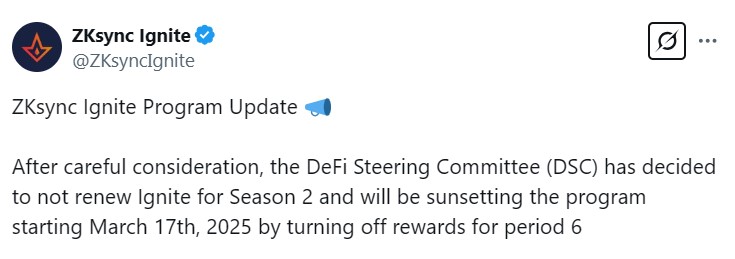
ZKsync sunsets liquidity program amid bearish market

ZKsync’s DeFi Steering Committee (DSC) said it will not renew ZKsync Ignite, its liquidity reward program, as the project shifts its focus to broader network expansion.

The DSC confirmed that Ignite’s second season will not proceed and that the program will be discontinued on March 17. This also cancels the reward allocation for period 6, the final phase of the program’s first season.

ZKsync said it would focus its resources on its Elastic Network, an architecture that aims to transform the platform into an ecosystem of interconnected zero-knowledge (ZK) chains. “Our long-term vision for ZKsync is increasingly centered on the Elastic Network, and we want to focus our resources to accelerate this becoming a reality,” the project stated. 

It said that pouring its resources into a single-chain program does not align with this interoperability goal. 

Cointelegraph reached out to Matter Labs, the company behind ZKsync, for comment, but had received no response at the time of writing.

ZKsync sunsets liquidity program amid bearish market

Source: ZKsync Ignite

Navigating a bearish crypto market

The team acknowledged that current market conditions influenced the decision to end Ignite.

“To stay sustainable, we’re tightening our focus and spending smarter rather than fighting headwinds,” the team said. 

ZK tokens performed well in 2024, reaching a high of $0.26 on Dec. 8. However, ZK prices failed to maintain their highs, experiencing continued sell pressure as market conditions worsened. The token currently trades at $0.06, a 76% drop from its price in December. 

ZKsync sunsets liquidity program amid bearish market

ZKsync token’s 1-year price chart. Source: CoinGecko

Related: ZKsync targets 10K TPS and sub-zero fees by 2025 roadmap goals

ZKsync Ignite boosted the project’s TVL to $270 million

According to ZKsync, the program surpassed its goal of driving DeFi total value locked (TVL) to $100 million. The program helped drive TVL to over $270 million, making trading on the chain more seamless. However, DefiLlama data shows that ZKsync’s TVL is currently down to $139 million. 

ZKsync sunsets liquidity program amid bearish market

ZKsync’s total value locked. Source: DefiLlama

The Ignite program originally planned to allocate 300 million ZK tokens in a span of nine months to DeFi users who would provide liquidity to key token pairs. The first season was scheduled from Jan. 6 to March 31, allocating 100 million tokens worth about $21 million during launch. At current ZK prices, 100 million tokens are only worth $6.8 million. 

Apart from ZKsync, the broader crypto market is also experiencing an industry-wide downturn, with top crypto assets like Bitcoin (BTC) and Ether (ETH) struggling to maintain prices. 

Magazine: Vitalik on AI apocalypse, LA Times both-sides KKK, LLM grooming: AI Eye

Read more at cointelegraph.com

Pump.fun memecoins are dying at record rates, less than 1% survive

The memecoin frenzy on Pump.fun is hitting a wall, with the platform’s “graduation rate” sinking below 1% for a fourth straight week.

“Graduation rate” is the memecoin launchpad’s term for tokens that make it through the incubation phase and become fully tradable on a Solana decentralized exchange (DEX). To graduate, a token must meet specific liquidity and trading requirements.

Over the past four weeks, starting Feb. 17, Pump.fun’s graduation rate has remained below 1% for the first time, Dune Analytics data shows.

Pump.fun memecoins are dying at record rates, less than 1% survive

Pump.fun’s tanking token success rate. Source: Dune Analytics

Pump.fun’s graduation rate has never been particularly high. The platform’s best-performing week was in November 2024 when 1.67% of memecoins moved on to the open market.

However, the sheer volume of tokens launched on the platform at the time made this percentage more significant than it is now. During the week starting Nov. 11, 323,000 tokens were created on Pump.fun, meaning the 1.67% graduation rate translated to roughly 5,400 tokens entering Solana’s DeFi economy in a single week.

Related: Pump.fun’s memecoin freak show may result in criminal charges: Expert

With token creation volume declining on both Pump.fun and Solana, weekly token graduations have plummeted to a four-week average of around 1,500 tokens at the time of writing, according to Dune.

Memecoins are dying, and they’re not responding to positive market signals

Pump.fun’s dropping graduation rate reflects waning investor appetite for memecoins, which have developed a reputation as degenerate lottery tickets or quick cash grabs for their creators.

Several political figures have launched their own memecoins as well, including US President Donald Trump. His token is down 84% from its all-time high set on Jan. 19, according to CoinGecko.

Related: Argentine lawyer requests Interpol red notice for LIBRA creator: Report

Memecoins’ struggles persist despite improving liquidity, according to Matrixport. In February, Matrixport analysts noted that a strengthening US dollar had pressured Bitcoin prices by tightening dollar-denominated liquidity.

Since then, the US dollar has weakened. Over the past month, the US Dollar Index (DXY), which measures the dollar against a basket of major currencies, peaked at 107.61 on Feb. 28 before dropping to 103.95 on March 14.

Pump.fun memecoins are dying at record rates, less than 1% survive

DXY performance in the past month shows the US dollar weakening. Source: TradingView

“The US dollar has recently weakened, leading to a rebound in liquidity indicators and some marginal improvements in inflation data. Despite these positive shifts, memecoins — previously one of the strongest narratives during this bull market — continue to struggle significantly, with no apparent recovery,” Matrixport said in its report.

Bitcoin caught in memecoin aftershocks

The struggling memecoin market has contributed to a $1 trillion wipeout in crypto market capitalization, according to Matrixport.

“This redistribution of wealth may lead investors to remain cautious about deploying further capital, causing rebounds — even those triggered by better-than-expected inflation data — to be limited,” the report noted.

Matrixport analysts warn that this could lead to further Bitcoin declines, with a potential retracement to as low as $73,000 — a level they believe would provide “strong support.”

Magazine: Ridiculous ‘Chinese Mint’ crypto scam, Japan dives into stablecoins: Asia Express

Read more at cointelegraph.com

Bitcoin panic selling costs new investors $100M in 6 weeks — Research

Bitcoin speculators suffered losses of over $100 million in just six weeks thanks to panic selling, new research calculated.

Data from onchain analytics platform CryptoQuant revealed the extent of recent capitulation by short-term holders (STHs).

Bitcoin speculators run to the exit “in the red”

Bitcoin (BTC) entities hodling coins between one and three months bore the brunt of a brutal bull market drawdown, and many did not stay the course.

CryptoQuant suggested that this section of the overall STH investor cohort, defined as those buying up to six months ago, is around $100 million out of pocket.

“This represents a significant reduction in the value of Bitcoin held by this cohort, who are now underwater as many bought at higher prices and are exiting with losses,” contributor Onchained wrote in one of its “Quicktake” blog posts on March 13.

Onchained referenced the market cap and realized cap of the relevant entities, corresponding to the current value of the BTC they own versus the price at which they last moved onchain.

“The market capitalization (MC) of their holdings is now lower than the realized capitalization (RC), signaling that these holders are locking in realized losses,” the post said. 

“This behavior is contributing to increased selling pressure and could lead to further downward price action in the short term.”Bitcoin panic selling costs new investors $100M in 6 weeks — Research

Bitcoin 1-3 month investor market cap, realized cap (screenshot). Source: CryptoQuant

An accompanying chart shows a dramatic negative weekly change in the realized cap on a scale not seen in many months.

The cohort’s net unrealized profit/loss (NUPL) score is currently at -0.19, likewise suggesting more coins are being held “underwater” than at any time over the past year.

Bitcoin panic selling costs new investors $100M in 6 weeks — Research

Bitcoin 1-3 month investor NUPL. Source: CryptoQuant

BTC price drawdown belies “broader bearish phase”

February marks just the latest trial for recent Bitcoin buyers, with BTC/USD losing up to 30% versus its latest all-time highs seen in mid-January.

Related: Bitcoin price drops 2% as falling inflation boosts US trade war fears

As Cointelegraph reported, sudden corrections have tended to cost speculative investors heavily, with loss-making sales commonplace as fear and panic set in.

Large-volume entities, meanwhile, are increasingly ignoring short-term BTC price fluctuations to add exposure at levels around $80,000.

In its latest weekly report seen by Cointelegraph on March 12, CryptoQuant warned that the current correction may be more tenacious than it appears on the surface.

“Historically, bull market corrections tend to be short-lived and followed by strong recoveries, but current on-chain indicators point to a potential structural shift that could preclude a broader bearish phase,” it summarized.

Bitcoin panic selling costs new investors $100M in 6 weeks — Research

Bitcoin price drawdowns by year. Source: CryptoQuant

This article does not contain investment advice or recommendations. Every investment and trading move involves risk, and readers should conduct their own research when making a decision.

Read more at cointelegraph.com

Behind Elon Musk’s X outage: What really happened and why it matters

What caused the X outage?

On March 10, 2025, X’s services went down for many users, causing frustration and confusion across the platform. 

The outages were significant enough to make headlines and draw attention from the tech community and the media. Elon Musk, ever the outspoken owner, quickly attributed the disruptions to a “massive cyberattack.”

Elon Musk on X's outage

While the initial response was that the attack might have originated from a coordinated group or even a nation-state, Musk’s comments pointed to Ukrainian IP addresses as the suspected source. However, he later clarified that the evidence was not definitive.

Also, several cybersecurity experts emphasized that attributing the source of such attacks based solely on IP addresses is unreliable, as attackers often use compromised devices worldwide to mask their actual location. 

So, what was the cause of X’s disruption? 

It was a large-scale, distributed denial of service (DDoS) attack. Such attacks involve overwhelming a server with so much traffic that it cannot serve legitimate requests, effectively bringing down the platform. This attack is a common method for cybercriminals to take down websites and was the primary factor behind X’s downtime.

The technical side: How the DDoS attack impacted X

DDoS attacks are no small feat. These attacks flood the target’s servers with excessive traffic, rendering them unable to function correctly. 

It’s a strategy designed to exhaust a system’s resources and make it impossible for genuine users to access the service. Experts pointed out that the attack on X was massive and well-coordinated, taking down parts of the platform for hours.

How a DDoS attack works

Here’s a timeline of the events on March 10:

Early morning (Eastern Time): Users began reporting issues accessing X, with over 21,000 reports in the US and 10,800 in the UK. 9:30 am ET: A second wave of outages occurred, with about 40,000 users reporting disruptions. This outage persisted into the afternoon.Throughout the day: Users continued to experience intermittent access issues, with reports peaking during critical periods such as the start of National Football League free agency.Evening: By 6:24 pm ET, the number of reported issues decreased significantly to 403 in the US and 200 in the UK, indicating that the platform was stabilizing.

Security experts noted that some of X’s origin servers had not been adequately protected behind Cloudflare’s DDoS defense systems. This created a vulnerability that cyber attackers could exploit, contributing to the success of the attack.

Did any individual or group claim responsibility?

Yes, in the aftermath of the attack, a pro-Palestinian hacker group known as Dark Storm Team claimed responsibility. This group has been active since late 2023 and is known for targeting organizations and governments perceived to support Israel. Their tactics often involve DDoS attacks to disrupt services and draw attention to their political motives. 

While X took quick action to shore up these weaknesses, this incident served as a reminder that even the most prominent platforms are not immune to cyber threats if their security infrastructure isn’t up to the task.

Did you know? Cloudflare is renowned for its robust DDoS protection, having previously defended against some of the largest recorded attacks, including a 5.6 terabit per second assault in October 2024.

From fail whale to Musk’s era: Major X outages in history

Over the years, the platform has faced several high-profile outages caused by cyberattacks, internal errors and technical limitations.

In its early days, X (then Twitter) was notorious for frequent crashes, often displaying the now-iconic “fail whale” image to users. These outages were primarily due to the platform’s struggle to handle surges in traffic, particularly during major global events like elections, award shows and sports finals.

“Fail Whale” was Twitter’s old error message, showing a cartoon whale being lifted by birds. It appeared when Twitter was overloaded or crashed. It became a symbol of Twitter’s frequent outages, especially in its early days.

Twitter's fail whale image

Notable incidents from Fail Whale to Musk’s X era include:

2016 Dyn DDoS attack: One of the most severe outages in X’s history occurred during the Dyn cyberattack in October 2016. This massive DDoS attack targeted a key internet infrastructure provider, taking down major websites, including X, Reddit and Spotify. The incident underscored the risks of centralized internet infrastructure.2020 API failures: In October 2020, a widespread outage due to internal system changes led to API failures. While not a cyberattack, the event demonstrated how a misconfiguration could bring down the platform for hours.2022 takeover disruptions: Following Elon Musk’s acquisition in late 2022, several outages occurred due to mass layoffs affecting critical engineering teams. Reduced staffing raised concerns about the platform’s ability to maintain reliability.2023 rate limit issues: In July 2023, X imposed strict rate limits on users due to excessive data scraping. This decision led to widespread service disruptions, with many users unable to load tweets.

Comparison of X outage counts before and after acquisition by Musk

Did you know? The US Treasury is being sued for allegedly giving Elon Musk’s Department of Government Efficiency (DOGE) access to millions of Americans’ sensitive financial and personal data. The lawsuit, filed by the AFL-CIO, claims this access violates federal laws and raises significant privacy concerns. Lawmakers, including Senator Elizabeth Warren, have warned that Musk’s involvement could lead to unprecedented data misuse.

The growing importance of social media security

The X outage highlights the growing concern about social media security in today’s digital world. Platforms like X, Meta and Instagram have become crucial communication channels for individuals, businesses, governments and activists. Even X has become a hub for the crypto community, serving as a central platform for discussions, updates, and networking within the industry. However, these platforms are increasingly under threat from cyberattacks, misinformation campaigns and data breaches.

Here are some key areas where social media security is essential:

Protecting user data: With millions of users actively posting, messaging and storing sensitive data, social media platforms are prime targets for hackers. Personal information, including emails, phone numbers and even financial data, can be compromised if security measures are weak.Enhancing user authentication: Stronger authentication methods, such as multifactor authentication (MFA), biometric logins and encrypted messaging, can reduce the risk of unauthorized access. Users should be encouraged to enable MFA to add an extra layer of security to their accounts.Fighting disinformation and fake accounts: Cyberattacks aren’t always about taking down a platform; sometimes, they aim to manipulate public perception. Fake accounts, bots and misinformation campaigns can create chaos, influence elections and spread propaganda. Social media companies must use advanced AI tools to proactively detect and remove such threats.Preventing DDoS and cyberattacks: As seen in the case of X, DDoS attacks can cripple a platform. While companies invest heavily in cybersecurity, hackers continue to evolve their tactics. This calls for constant vigilance and AI-driven security systems to detect and mitigate threats in real-time.Regular security audits and updates: Cybersecurity is an ongoing process. Social media companies must conduct regular security audits to identify and patch vulnerabilities before attackers can exploit them. Keeping systems updated ensures that the latest security measures are in place.

Finally, as you continue to integrate social media into various aspects of your lives, prioritizing security will ensure that these platforms remain trusted and reliable channels for communication and engagement.

Read more at cointelegraph.com

Hong Kong crypto payment firm RedotPay wraps $40M Series A funding round

Hong Kong-based crypto payment platform RedotPay closed a $40 million Series A funding round led by Lightspeed, with participation from HSG and Galaxy Ventures.

RedotPay aims to enable cryptocurrency use in everyday transactions while simplifying blockchain transactions for spenders, akin to fiat. In November 2023, the company launched its own physical Visa cards, which can be used for ATM cash withdrawals, along with a virtual card that supports digital payment services like Apple Pay and Google Pay.

The company has expanded its blockchain integrations, adding Solana in December 2024 and Ethereum layer 2 Arbitrum in February. Additionally, it partnered with StraitX and Visa to support retail crypto payments in Singapore.

Still, RedotPay appears to have cross-border service restrictions. Visitors outside Hong Kong are greeted with a warning when accessing the company’s website.

Hong Kong crypto payment firm RedotPay wraps $40M Series A funding round

RedotPay appears to have cross-border service restrictions. Visitors outside Hong Kong Source: RedotPay

Crypto payments options rising in Asia, with stablecoins at the forefront

Direct cryptocurrency payment solutions are gaining traction across Asia. In November 2024, Singapore-based digital asset trading platform Crypto.com partnered with Triple-A to enable direct crypto payments, eliminating the need to convert crypto into fiat.

Hong Kong has its share of competitors. Infini, a stablecoin-focused crypto payment firm, offers payment services while earning yields. However, it recently suffered a $50 million USDC exploit, allegedly orchestrated by a rogue developer who swapped USDC for DAI — a decentralized stablecoin that cannot be frozen like its centralized counterparts.

Related: Infini loses $50M in exploit; developer deception suspected

Unlike volatile cryptocurrencies like Bitcoin (BTC) or Ether (ETH), stablecoins can offer a more consistent option to hold for those who want to use them for payments, as the assets are designed to maintain a value pegged to their fiat counterparts. 

Japan, the second-largest Asian economy by gross domestic product, is making significant strides in stablecoin adoption. A recent report by Tokyo-based research and consulting firm Yuri Group shared with Cointelegraph Magazine suggests that the Japanese government views stablecoins as a potential catalyst to unlock $14 trillion in household savings.

Hong Kong crypto payment firm RedotPay wraps $40M Series A funding round

Japan’s eyes digital assets resurgence behind established financial institutions. Source: Yuri Group

Yuri Group highlights Progmat as a key player in Japan’s digital asset ecosystem. Backed by the nation’s largest bank, Mitsubishi UFJ Progmat operates in compliance with Japan’s strict regulatory framework, which mandates a 1:1 reserve backing. This ensures that Japan’s established financial institutions remain at the forefront of digital asset management.

In contrast, China, Asia’s largest economy, has banned cryptocurrency trading and recognizes the renminbi as the country’s sole legal tender.

Magazine: How Chinese traders and miners get around China’s crypto ban

Read more at cointelegraph.com