cointelegraph.com

UK authorizes charges against NCA officer for alleged Bitcoin theft

The agency responsible for conducting criminal prosecutions in England and Wales announced that a National Crime Agency (NCA) officer was due to be charged with the alleged theft of Bitcoin worth roughly $75,000 in 2017.

In a March 14 notice, the Crown Prosecution Service said it had authorized the Merseyside Police to charge NCA officer Paul Chowles with 15 offenses related to the alleged Bitcoin (BTC) theft “during an investigation into online organized crime.” Authorities said Chowles could face one count of theft, 11 charges for concealing, disguising, or converting criminal property and three counts for acquiring, using or possessing criminal property.

The 50 Bitcoin, worth roughly $75,000 before the December 2017 bull run, was valued at more than $4.2 million at the time of publication at a BTC price of $84,541. The NCA officer is expected to appear at the Liverpool Magistrates’ Court on April 25.

Related: British man sues council for $647M over lost Bitcoin in landfill

In April 2024, amendments to the UK’s Economic Crime and Corporate Transparency Act authorized NCA officers and local police to seize crypto from suspected criminals without arresting them. The Crown Prosecution Service did not mention how Chowles allegedly stole the Bitcoin or whether the funds were connected to illicit activities.

Crypto policies across the pond

The NCA said in December 2024 that it had seized roughly $26 million in cash and crypto and arrested 84 people as part of a global campaign to fight money laundering and organized crime. Some of the crypto addresses targeted by UK authorities at the time “showed regular exposure to Garantex.” The founder of the Russian crypto exchange was arrested in India in March and is expected to be extradited to the US to face criminal charges. 

The UK government is expected to move forward on creating a comprehensive regulatory framework for digital assets in 2025 following the Labour government’s election victory. The country remains a significant market for crypto users, with Coinbase securing approval to operate from the financial regulatory body in February.

Magazine: Crypto fans are obsessed with longevity and biohacking: Here’s why

Read more at cointelegraph.com

Crypto Biz: Is Trump intentionally crashing the market?

The odds of a recession are rising, markets are crashing and President Donald Trump is forging ahead with tariffs.

This volatile playbook is eerily similar to Trump’s first term, which started with a bang before giving way to one of the biggest bull markets in recent history. However, this time, Trump seems to have dropped the stock market as one of his favorite barometers of success, opting instead to focus on the long-term health of the US economy. 

Trump has promised to usher in America’s next “Golden Age,” but before that happens, the economy might need a painful dose of medicine. There is growing speculation that Trump is purposely stoking growth fears and crashing the market to force the Federal Reserve to lower interest rates.

It might sound crazy, but there may be a method to Trump’s apparent madness. 

A coordinated crash

For decades, there was an unspoken rule in Washington that the president must remain tight-lipped about Fed policy. However, Trump threw that convention out the window when he publicly stated that the Fed should consult the president on interest rates. 

In February, Trump took to social media to say, “Interest Rates should be lowered.” When the central bank refused to play ball, the Trump administration took matters “into their own hands [by] crashing asset prices in an attempt to force Jerome Powell to cut interest rates,” according to entrepreneur and market commentator Anthony Pompliano.

Pompliano and others say the Trump administration is intentionally crashing the stock market to bring borrowing costs down before the US government needs to refinance $7 trillion in debt over the next six months.

The plan appears to be working, with the 10-year yield plunging nearly 60 basis points from its peak earlier this year. While the Fed isn’t expected to cut interest rates at its upcoming meeting in March, the odds of a May cut are now above 50%. 

Crypto Biz: Is Trump intentionally crashing the market?

Source: Alex Kruger

Recession odds spike to 40%: JPMorgan

The crypto and stock market sell-off on March 10 was largely driven by fears that the US economy was barreling toward a recession. Those fears were echoed in the bond market, with the 10-year yield plunging to the lowest level since Trump was elected. 

Against this backdrop, analysts at JPMorgan have upped their odds of a recession this year to 40% from 30%. 

Crypto Biz: Is Trump intentionally crashing the market?

Growing recession odds crash the crypto market. Source: CoinMarketCap

“We see a material risk that the US falls into recession this year owing to extreme US policies,” the analysts said.

Goldman Sachs economists also worry that Trump’s trade war could plunge the US economy into a sharp downturn. They raised their 12-month recession odds to 20% from 15%. 

According to Goldman, the outlook could worsen if the Trump administration remains steadfast in its policies “even in the face of much worse data.”

BlackRock’s BUIDL enters DeFi

Real-world asset (RWA) tokenization company Securitize has selected RedStone to provide data feeds for its tokenized products, which include BlackRock’s USD Institutional Digital Liquidity Fund (BUIDL). With the partnership, Securitize’s funds can now be used across DeFi products, including Morpho, Compound and Spark. This could expand BUIDL’s use cases into money market exchanges and collateralized DeFi platforms.

BlackRock’s BUIDL is the world’s largest tokenized Treasury fund, reaching $500 million in assets under management in less than four months. It was launched on the Ethereum network and can be accessed through Securitize. The fund invests all of its assets in cash, US Treasury bills and repurchase agreements. 

Staking ETH?

Cboe BZX, a leading securities exchange headquartered in Chicago, is seeking approval from US regulators to add staking into Fidelity’s Ether (ETH) exchange-traded fund.

According to a March 11 filing, Cboe is proposing a rule change that would allow the Fidelity Ethereum fund to “stake, or cause to be staked, all or a portion of the Trust’s Ether through one or more trusted staking providers.”

Staking could potentially boost the appeal of Ether ETFs by giving investors access to yields. 

In February, the Securities and Exchange Commission (SEC) acknowledged more than a dozen crypto-related ETF filings. Recognizing the SEC’s regulatory pivot since President Trump’s inauguration, Cboe is attempting to strike while the iron is hot. 

Crypto Biz is your weekly pulse on the business behind blockchain and crypto, delivered directly to your inbox every Thursday.

Read more at cointelegraph.com

XRP flips Ether’s FDV amid change in market dynamics

XRP’s fully diluted valuation (FDV) has surpassed Ether (ETH), according to March 14 data from CoinGecko. 

The FDV flip signifies a reversal of fortune for both layer-1 (L1) blockchain networks behind the tokens, as XRP Ledger’s decentralized finance (DeFi) ecosystem gains traction and Ethereum grapples with competition from rival L1s, such as Solana.

As of March 14, XRP’s FDV stood at nearly $235 billion, more than $1 billion higher than Ether’s, according to CoinGecko. Ether’s market capitalization still leads at $233 billion versus XRP’s $136 billion, the data shows. 

FDV measures the cumulative value of all existing tokens, whereas market capitalization only counts tokens already in circulation. 

XRP’s developer, Ripple Labs, holds a multibillion-dollar allocation of its chain’s native token. 

XRP flips Ether’s FDV amid change in market dynamics

Cryptocurrencies by FDV. Source: CoinGecko

Related: XRP Ledger unveils institutional DeFi roadmap

Changing fortunes

XRP’s price has risen by more than 300%, to around $2.3 per token, since President Donald Trump prevailed in the US elections on Nov. 5. 

Trump said he wants America to become the “world’s crypto capital” and has appointed industry-friendly leadership to key regulators. 

The thawing US regulatory environment is especially beneficial for XRP, which prioritizes enterprise users and unveiled an institutional DeFi roadmap in February.

As of January, XRP’s native decentralized exchange (DEX) has handled more than $1 billion in swap transactions since launching in 2024.

The XRP token saw further support when Trump said he planned to include XRP in a proposed US Digital Asset Stockpile alongside other cryptocurrencies, such as Solana (SOL) and Cardano (ADA). 

The stockpile will only comprise assets acquired by law enforcement and other legal proceedings and will not buy crypto. 

The US Securities and Exchange Commission is reportedly “in the process of wrapping up” an enforcement action against Ripple that has beleaguered the XRP developer since 2020. 

The regulator has already dropped actions against crypto firms such as Coinbase, Kraken and Uniswap.

Meanwhile, Ether’s spot price has struggled since March 2024, when the network’s Dencun upgrade cut transaction fees by approximately 95%. 

As of March, trading volume on Solana, which prioritizes fast transaction execution and was central to 2024’s memecoin frenzy, rivals that of Ethereum and all of its layer-2 scaling chains combined. 

Magazine: ‘Hong Kong’s FTX’ victims win lawsuit, bankers bash stablecoins: Asia Express

Read more at cointelegraph.com

‘Scale or fail’: RLNC technology can boost Web3 adoption — MIT Professor

After 15 years of research at the Massachusetts Institute of Technology (MIT), Random Linear Network Coding (RLNC) is ready for commercialization in the Web3 industry, according to Muriel Médard, an MIT professor and founder of blockchain infrastructure developer Optimum.

Optimum emerged from stealth on Feb. 28 as a decentralized memory infrastructure that can be utilized by any blockchain seeking to bring scalability to Web3. It utilizes the RLNC technology that was first formulated by Professor Médard. 

RLNC is a breakthrough in coding that is already used in the 5G, satellite telecommunications and Internet of Things (IoT) industries. 

In an interview with Cointelegraph, Professor Médard said RLNC is equivalent to “breaking a puzzle into small pieces, mixing those pieces together into equations, and sending them to your friends.”

“Even if a few pieces get lost, your friends can still put the whole puzzle together from the pieces they receive. Rather than look for specific pieces, you look for just enough pieces,” she said.

RLNC technology can help blockchains overcome “critical bottlenecks in scalability” by “encoding data into mathematical equations, enabling faster transmission, reduced bandwidth usage, lower barriers to entry for flexnodes and more reliable delivery,” said Médard.

Médard founded Optimum with the help of Nancy Lynch, an adviser and co-inventor of the Byzantine Fault Tolerant consensus, after “several years of witnessing the rise and maturation of Web3,” she said.

“[The] vision is to bring the efficiency of traditional computer memory (RAM) to decentralized networks, laying the foundation for a breakthrough in Web3 infrastructure.”

Related: The future of Ethereum scaling lies in hardware, not software

“Scale or Fail”

RLNC’s potential use case in Web3 has attracted notable backers, several of whom invested in Optimum as angel investors. They include Polygon co-founder Sandeep Nailwal, Wormhole co-founder Robinson Burkey, Polychain chief technology officer Abhijeet Mahagaonkar, Bitget CEO Gracy Chen and Arthur Cheong, the founder and CEO of DeFiance Capital.

Professor Médard told Cointelegraph that scalability breakthroughs in Web3 are needed, especially as blockchain adoption continues to grow for the “purposes of payments, financial instruments and even diversification of national government strategies.”

“We believe this trend will continue, and as usage and demand increase, blockchains will need to scale or they will fail,” she said. 

Scalability remains one of the industry’s biggest bottlenecks, having plagued the development of both Bitcoin and Ethereum at various points over their history. Competing networks have vowed to fix scalability issues stemming from mass consumer adoption, though their track record has been far from perfect. 

Against this backdrop, the crypto payments landscape has evolved significantly in recent years, shifting from tokens to stablecoins that are much faster and cheaper. 

Research, MIT, Coding, Scalability, Web3

Stablecoins have emerged as one of blockchain’s most popular use cases, especially for payments and cross-border remittances. Source: DefiLlama

An August report by wealth manager Bernstein said Solana is a leading network for stablecoin adoption, but even it struggles to scale with growing payment and remittance demand.

Although Solana has piloted stablecoin payments with Visa and Shopify, it’s unclear whether the blockchain can facilitate mainstream adoption without a massive boost in capacity, Bernstein said. 

Magazine: How crypto laws are changing across the world in 2025

Read more at cointelegraph.com

US House kills IRS DeFi broker rule, Solana won’t cut 80% inflation rate: Finance Redefined

In a significant regulatory development for the crypto industry, the United States House of Representatives voted to nullify a bill that threatened the privacy-preserving properties of decentralized finance (DeFi) protocols.

In the wider crypto space, one of the Solana network’s most significant governance proposals was rejected; it sought to implement a mechanism to reduce Solana’s inflation rate by about 80%.

US House follows Senate in passing resolution to kill IRS DeFi broker rule

The US House of Representatives voted to nullify a rule requiring decentralized finance (DeFi) protocols to report to the Internal Revenue Service.

On March 11, the House of Representatives voted 292 for and 132 against a motion to repeal the so-called IRS DeFi broker rule that aimed to expand existing IRS reporting requirements to crypto.

All 132 votes to keep the rule were Democrats. However, 76 Democrats joined with the Republicans to repeal it. 

This followed the Senate’s March 4 vote on the motion, which saw it pass 70 to 27.

The rule would have forced DeFi platforms, such as decentralized exchanges, to disclose gross proceeds from crypto sales, including information regarding taxpayers involved in the transactions.

After the vote, Republican Representative Mike Carey, who submitted the repeal motion, said, “The DeFi broker rule invades the privacy of tens of millions of Americans, hinders the development of an important new industry in the United States and would overwhelm the IRS.”

US House kills IRS DeFi broker rule, Solana won’t cut 80% inflation rate: Finance Redefined

Congressman Mike Carey speaking after the vote. Source: Mike Carey

Continue reading

Solana proposal to cut inflation rate by up to 80% fails

A proposal to dramatically change Solana’s inflation system was rejected by stakeholders but is being hailed as a victory for the network’s governance process.

“Even though our proposal was technically defeated by the vote, this was a major victory for the Solana ecosystem and its governance process,” commented Multicoin Capital co-founder Tushar Jain on March 14.

Around 74% of the staked supply voted on proposal SIMD-228 across 910 validators, but just 43.6% voted in favor of it, with 27.4% voting against it and 3.3% abstaining, according to Dune Analytics. It needed 66.67% approval from participating votes to pass and only received 61.4%.

Jain added that this was the biggest crypto governance vote ever, by the number of participants and the participating market cap, of any ecosystem, chain or network.

“This was a meaningful scaling stress test — a social, rather than technical, stress test — and the network passed despite a wide stratification of diverging opinions and interests.”

Continue reading

Bitcoin $70,000 retracement part of “macro correction” in bull market — Analysts

Bitcoin’s potential retracement to $70,000 may be an organic part of the current bull market, despite crypto investor fears of an early arrival of a bear market cycle.

Bitcoin (BTC) fell more than 14% during the past week to close at around $80,708 after investors were disappointed with the lack of direct federal Bitcoin investments in President Donald Trump’s March 7 executive order. It outlined a plan to create a Bitcoin reserve using cryptocurrency forfeited in government criminal cases.

Despite the drop in investor sentiment, cryptocurrencies and global markets remain in a “macro correction” as part of the bull market, according to Aurelie Barthere, principal research analyst at the Nansen crypto intelligence platform.

US House kills IRS DeFi broker rule, Solana won’t cut 80% inflation rate: Finance Redefined

BTC/USD, 1-month chart. Source: Cointelegraph

Most cryptocurrencies have broken key support levels, making it hard to estimate the next key price levels, the analyst told Cointelegraph, adding:

“This is a macro correction (US tech will be down by 3% in the future, as discussed), so we have to monitor BTC. Next level will be $71,000 – $72,000, top of the pre-election trading range.”

The analyst added: “We are still in a correction within a bull market: Stocks and crypto have realized and are pricing; a period of tariff uncertainty and fiscal cuts, no Fed put. Recession fears are popping up.”

Continue reading

Calls for stricter rules on political memecoins after $4 billion Libra collapse

Industry voices warned that politically endorsed cryptocurrencies must adopt stronger investor protections and liquidity safeguards to prevent another significant market collapse.

Investor sentiment remains shaken after the Libra (LIBRA) token, which was endorsed by Argentine President Javier Milei, suffered a $4 billion market cap wipeout due to insider cash-outs.

According to blockchain analytics firm DWF Labs, at least eight insider wallets withdrew $107 million in liquidity, triggering the massive collapse.

US House kills IRS DeFi broker rule, Solana won’t cut 80% inflation rate: Finance Redefined

Source: Kobeissi Letter

To avoid a similar meltdown, tokens with presidential endorsements will need more robust safety and economic mechanisms, such as liquidity locking or making the tokens in the liquidity pool non-sellable for a predetermined period, DWF Labs wrote in a report shared with Cointelegraph.

The report stated that tokens from high-profile leaders also need launch restrictions to limit participation from crypto-sniping bots and large holders or whales.

“Limiting bot and whale activity is essential in limiting the impact of individuals acting on insider information to corner a large percentage of the token supply,” according to Andrei Grachev, managing partner at DWF Labs.

Continue reading

Hyperliquid ups margin requirements after $4 million liquidation loss

Hyperliquid, a blockchain network specializing in trading, increased margin requirements for traders after its liquidity pool lost millions of dollars during a massive Ether (ETH) liquidation, the network said.

On March 12, a trader intentionally liquidated a roughly $200 million Ether long position, causing Hyperliquid’s liquidity pool, HLP, to lose $4 million, unwinding the trade.

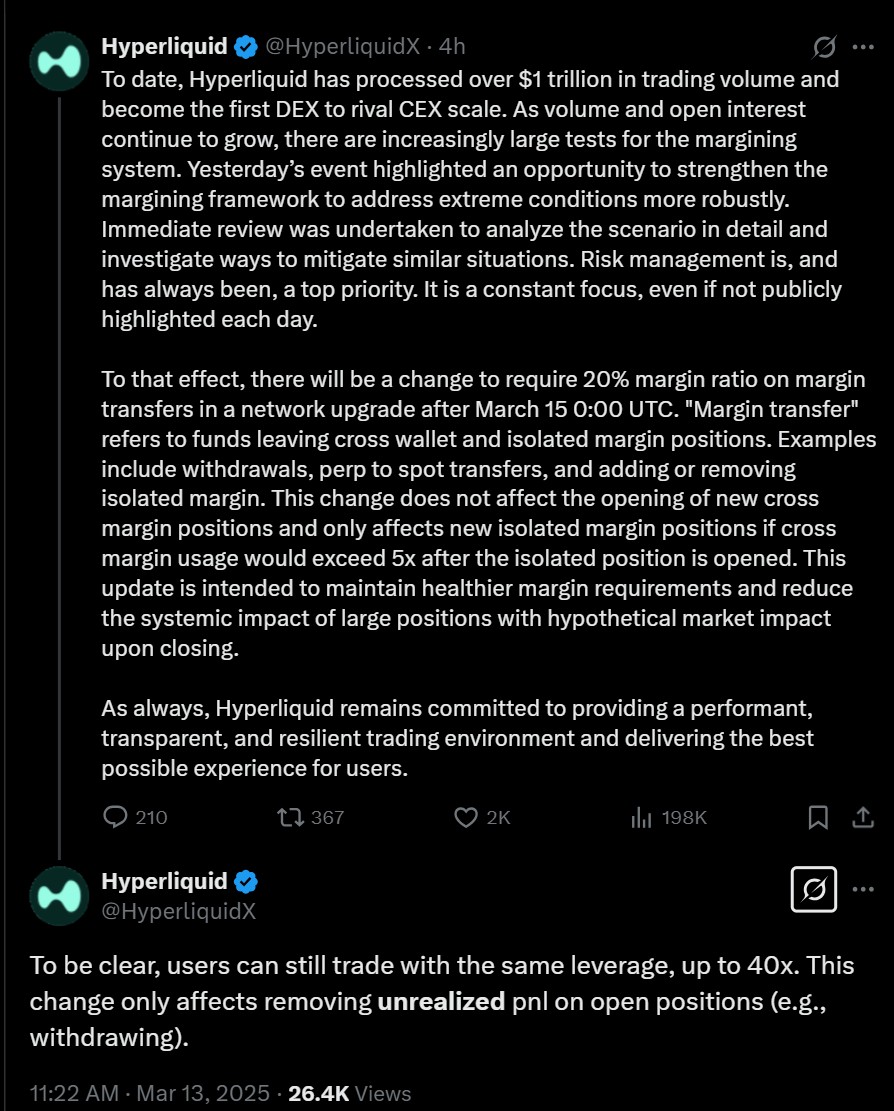
Starting March 15, Hyperliquid will require traders to maintain a collateral margin of at least 20% on certain open positions to “reduce the systemic impact of large positions with hypothetical market impact upon closing,” Hyperliquid said in a March 13 X post.

The incident highlights the growing pains confronting Hyperliquid, which has emerged as Web3’s most popular platform for leveraged perpetual trading. 

US House kills IRS DeFi broker rule, Solana won’t cut 80% inflation rate: Finance Redefined

Hyperliquid has adjusted margin requirements for traders. Source: Hyperliquid

Hyperliquid said the $4 million loss was not from an exploit but rather a predictable consequence of the mechanics of its trading platform under extreme conditions. 

Continue reading

DeFi market overview

According to data from Cointelegraph Markets Pro and TradingView, most of the 100 largest cryptocurrencies by market capitalization ended the week in the red.

Of the top 100, the Hedera (HBAR) token fell over 24%, marking the biggest weekly decrease, followed by JasmyCoin (JASMY) down over 21% over the past week.

US House kills IRS DeFi broker rule, Solana won’t cut 80% inflation rate: Finance Redefined

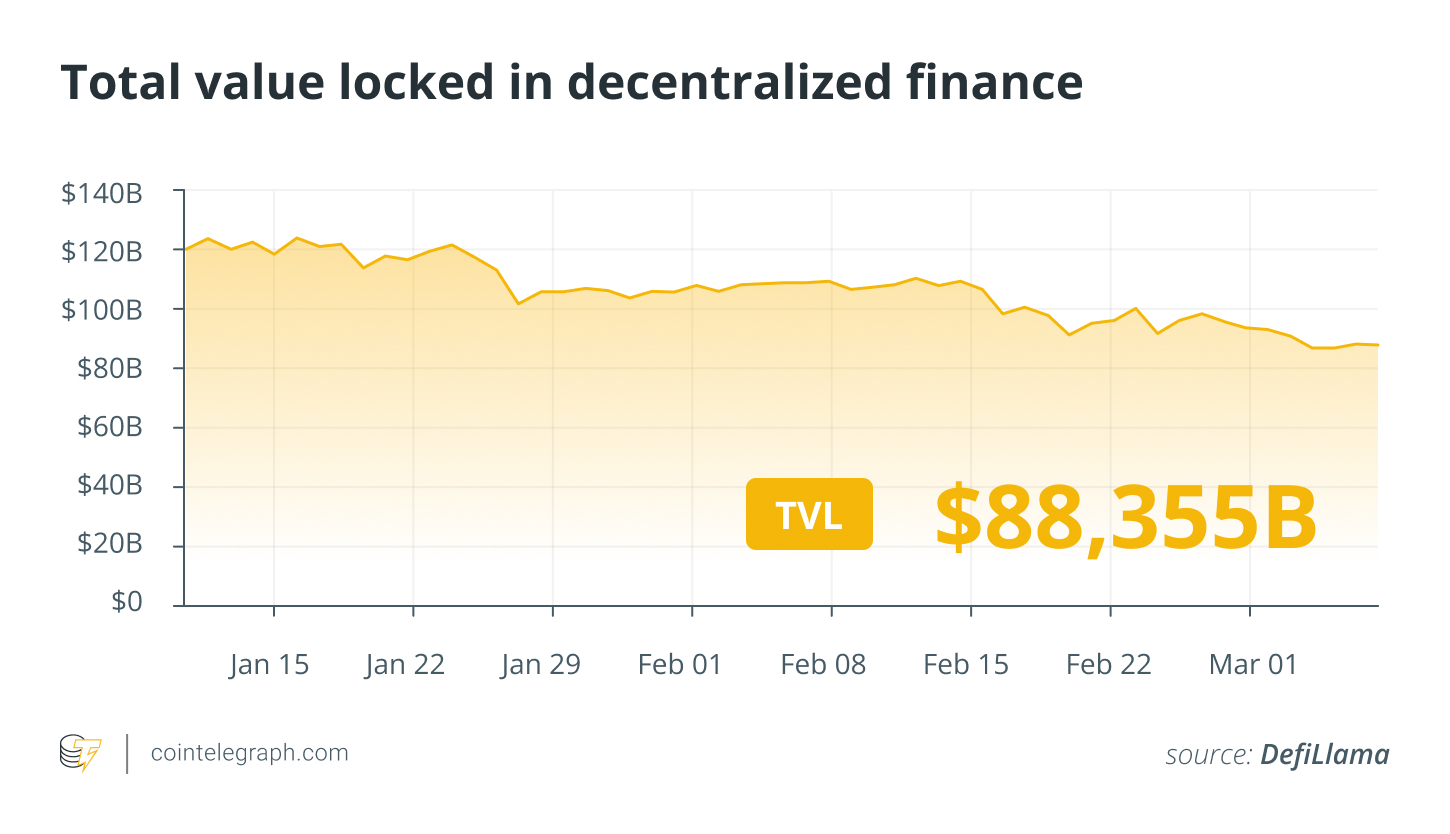
Total value locked in DeFi. Source: DefiLlama

Thanks for reading our summary of this week’s most impactful DeFi developments. Join us next Friday for more stories, insights and education regarding this dynamically advancing space.


Read more at cointelegraph.com

US House kills IRS DeFi broker rule, Solana won’t cut 80% inflation rate: Finance Redefined

In a significant regulatory development for the crypto industry, the United States House of Representatives voted to nullify a bill that threatened the privacy-preserving properties of decentralized finance (DeFi) protocols.

In the wider crypto space, one of the Solana network’s most significant governance proposals was rejected; it sought to implement a mechanism to reduce Solana’s inflation rate by about 80%.

US House follows Senate in passing resolution to kill IRS DeFi broker rule

The US House of Representatives voted to nullify a rule requiring decentralized finance (DeFi) protocols to report to the Internal Revenue Service.

On March 11, the House of Representatives voted 292 for and 132 against a motion to repeal the so-called IRS DeFi broker rule that aimed to expand existing IRS reporting requirements to crypto.

All 132 votes to keep the rule were Democrats. However, 76 Democrats joined with the Republicans to repeal it. 

This followed the Senate’s March 4 vote on the motion, which saw it pass 70 to 27.

The rule would have forced DeFi platforms, such as decentralized exchanges, to disclose gross proceeds from crypto sales, including information regarding taxpayers involved in the transactions.

After the vote, Republican Representative Mike Carey, who submitted the repeal motion, said, “The DeFi broker rule invades the privacy of tens of millions of Americans, hinders the development of an important new industry in the United States and would overwhelm the IRS.”

US House kills IRS DeFi broker rule, Solana won’t cut 80% inflation rate: Finance Redefined

Congressman Mike Carey speaking after the vote. Source: Mike Carey

Continue reading

Solana proposal to cut inflation rate by up to 80% fails

A proposal to dramatically change Solana’s inflation system was rejected by stakeholders but is being hailed as a victory for the network’s governance process.

“Even though our proposal was technically defeated by the vote, this was a major victory for the Solana ecosystem and its governance process,” commented Multicoin Capital co-founder Tushar Jain on March 14.

Around 74% of the staked supply voted on proposal SIMD-228 across 910 validators, but just 43.6% voted in favor of it, with 27.4% voting against it and 3.3% abstaining, according to Dune Analytics. It needed 66.67% approval from participating votes to pass and only received 61.4%.

Jain added that this was the biggest crypto governance vote ever, by the number of participants and the participating market cap, of any ecosystem, chain or network.

“This was a meaningful scaling stress test — a social, rather than technical, stress test — and the network passed despite a wide stratification of diverging opinions and interests.”

Continue reading

Bitcoin $70,000 retracement part of “macro correction” in bull market — Analysts

Bitcoin’s potential retracement to $70,000 may be an organic part of the current bull market, despite crypto investor fears of an early arrival of a bear market cycle.

Bitcoin (BTC) fell more than 14% during the past week to close at around $80,708 after investors were disappointed with the lack of direct federal Bitcoin investments in President Donald Trump’s March 7 executive order. It outlined a plan to create a Bitcoin reserve using cryptocurrency forfeited in government criminal cases.

Despite the drop in investor sentiment, cryptocurrencies and global markets remain in a “macro correction” as part of the bull market, according to Aurelie Barthere, principal research analyst at the Nansen crypto intelligence platform.

US House kills IRS DeFi broker rule, Solana won’t cut 80% inflation rate: Finance Redefined

BTC/USD, 1-month chart. Source: Cointelegraph

Most cryptocurrencies have broken key support levels, making it hard to estimate the next key price levels, the analyst told Cointelegraph, adding:

“This is a macro correction (US tech will be down by 3% in the future, as discussed), so we have to monitor BTC. Next level will be $71,000 – $72,000, top of the pre-election trading range.”

The analyst added: “We are still in a correction within a bull market: Stocks and crypto have realized and are pricing; a period of tariff uncertainty and fiscal cuts, no Fed put. Recession fears are popping up.”

Continue reading

Calls for stricter rules on political memecoins after $4 billion Libra collapse

Industry voices warned that politically endorsed cryptocurrencies must adopt stronger investor protections and liquidity safeguards to prevent another significant market collapse.

Investor sentiment remains shaken after the Libra (LIBRA) token, which was endorsed by Argentine President Javier Milei, suffered a $4 billion market cap wipeout due to insider cash-outs.

According to blockchain analytics firm DWF Labs, at least eight insider wallets withdrew $107 million in liquidity, triggering the massive collapse.

US House kills IRS DeFi broker rule, Solana won’t cut 80% inflation rate: Finance Redefined

Source: Kobeissi Letter

To avoid a similar meltdown, tokens with presidential endorsements will need more robust safety and economic mechanisms, such as liquidity locking or making the tokens in the liquidity pool non-sellable for a predetermined period, DWF Labs wrote in a report shared with Cointelegraph.

The report stated that tokens from high-profile leaders also need launch restrictions to limit participation from crypto-sniping bots and large holders or whales.

“Limiting bot and whale activity is essential in limiting the impact of individuals acting on insider information to corner a large percentage of the token supply,” according to Andrei Grachev, managing partner at DWF Labs.

Continue reading

Hyperliquid ups margin requirements after $4 million liquidation loss

Hyperliquid, a blockchain network specializing in trading, increased margin requirements for traders after its liquidity pool lost millions of dollars during a massive Ether (ETH) liquidation, the network said.

On March 12, a trader intentionally liquidated a roughly $200 million Ether long position, causing Hyperliquid’s liquidity pool, HLP, to lose $4 million, unwinding the trade.

Starting March 15, Hyperliquid will require traders to maintain a collateral margin of at least 20% on certain open positions to “reduce the systemic impact of large positions with hypothetical market impact upon closing,” Hyperliquid said in a March 13 X post.

The incident highlights the growing pains confronting Hyperliquid, which has emerged as Web3’s most popular platform for leveraged perpetual trading. 

US House kills IRS DeFi broker rule, Solana won’t cut 80% inflation rate: Finance Redefined

Hyperliquid has adjusted margin requirements for traders. Source: Hyperliquid

Hyperliquid said the $4 million loss was not from an exploit but rather a predictable consequence of the mechanics of its trading platform under extreme conditions. 

Continue reading

DeFi market overview

According to data from Cointelegraph Markets Pro and TradingView, most of the 100 largest cryptocurrencies by market capitalization ended the week in the red.

Of the top 100, the Hedera (HBAR) token fell over 24%, marking the biggest weekly decrease, followed by JasmyCoin (JASMY) down over 21% over the past week.

US House kills IRS DeFi broker rule, Solana won’t cut 80% inflation rate: Finance Redefined

Total value locked in DeFi. Source: DefiLlama

Thanks for reading our summary of this week’s most impactful DeFi developments. Join us next Friday for more stories, insights and education regarding this dynamically advancing space.

Read more at cointelegraph.com

US House kills IRS DeFi broker rule, Solana won’t cut 80% inflation rate: Finance Redefined

In a significant regulatory development for the crypto industry, the United States House of Representatives voted to nullify a bill that threatened the privacy-preserving properties of decentralized finance (DeFi) protocols.

In the wider crypto space, one of the Solana network’s most significant governance proposals was rejected; it sought to implement a mechanism to reduce Solana’s inflation rate by about 80%.

US House follows Senate in passing resolution to kill IRS DeFi broker rule

The US House of Representatives voted to nullify a rule requiring decentralized finance (DeFi) protocols to report to the Internal Revenue Service.

On March 11, the House of Representatives voted 292 for and 132 against a motion to repeal the so-called IRS DeFi broker rule that aimed to expand existing IRS reporting requirements to crypto.

All 132 votes to keep the rule were Democrats. However, 76 Democrats joined with the Republicans to repeal it. 

This followed the Senate’s March 4 vote on the motion, which saw it pass 70 to 27.

The rule would have forced DeFi platforms, such as decentralized exchanges, to disclose gross proceeds from crypto sales, including information regarding taxpayers involved in the transactions.

After the vote, Republican Representative Mike Carey, who submitted the repeal motion, said, “The DeFi broker rule invades the privacy of tens of millions of Americans, hinders the development of an important new industry in the United States and would overwhelm the IRS.”

US House kills IRS DeFi broker rule, Solana won’t cut 80% inflation rate: Finance Redefined

Congressman Mike Carey speaking after the vote. Source: Mike Carey

Continue reading

Solana proposal to cut inflation rate by up to 80% fails

A proposal to dramatically change Solana’s inflation system was rejected by stakeholders but is being hailed as a victory for the network’s governance process.

“Even though our proposal was technically defeated by the vote, this was a major victory for the Solana ecosystem and its governance process,” commented Multicoin Capital co-founder Tushar Jain on March 14.

Around 74% of the staked supply voted on proposal SIMD-228 across 910 validators, but just 43.6% voted in favor of it, with 27.4% voting against it and 3.3% abstaining, according to Dune Analytics. It needed 66.67% approval from participating votes to pass and only received 61.4%.

Jain added that this was the biggest crypto governance vote ever, by the number of participants and the participating market cap, of any ecosystem, chain or network.

“This was a meaningful scaling stress test — a social, rather than technical, stress test — and the network passed despite a wide stratification of diverging opinions and interests.”

Continue reading

Bitcoin $70,000 retracement part of “macro correction” in bull market — Analysts

Bitcoin’s potential retracement to $70,000 may be an organic part of the current bull market, despite crypto investor fears of an early arrival of a bear market cycle.

Bitcoin (BTC) fell more than 14% during the past week to close at around $80,708 after investors were disappointed with the lack of direct federal Bitcoin investments in President Donald Trump’s March 7 executive order. It outlined a plan to create a Bitcoin reserve using cryptocurrency forfeited in government criminal cases.

Despite the drop in investor sentiment, cryptocurrencies and global markets remain in a “macro correction” as part of the bull market, according to Aurelie Barthere, principal research analyst at the Nansen crypto intelligence platform.

US House kills IRS DeFi broker rule, Solana won’t cut 80% inflation rate: Finance Redefined

BTC/USD, 1-month chart. Source: Cointelegraph

Most cryptocurrencies have broken key support levels, making it hard to estimate the next key price levels, the analyst told Cointelegraph, adding:

“This is a macro correction (US tech will be down by 3% in the future, as discussed), so we have to monitor BTC. Next level will be $71,000 – $72,000, top of the pre-election trading range.”

The analyst added: “We are still in a correction within a bull market: Stocks and crypto have realized and are pricing; a period of tariff uncertainty and fiscal cuts, no Fed put. Recession fears are popping up.”

Continue reading

Calls for stricter rules on political memecoins after $4 billion Libra collapse

Industry voices warned that politically endorsed cryptocurrencies must adopt stronger investor protections and liquidity safeguards to prevent another significant market collapse.

Investor sentiment remains shaken after the Libra (LIBRA) token, which was endorsed by Argentine President Javier Milei, suffered a $4 billion market cap wipeout due to insider cash-outs.

According to blockchain analytics firm DWF Labs, at least eight insider wallets withdrew $107 million in liquidity, triggering the massive collapse.

US House kills IRS DeFi broker rule, Solana won’t cut 80% inflation rate: Finance Redefined

Source: Kobeissi Letter

To avoid a similar meltdown, tokens with presidential endorsements will need more robust safety and economic mechanisms, such as liquidity locking or making the tokens in the liquidity pool non-sellable for a predetermined period, DWF Labs wrote in a report shared with Cointelegraph.

The report stated that tokens from high-profile leaders also need launch restrictions to limit participation from crypto-sniping bots and large holders or whales.

“Limiting bot and whale activity is essential in limiting the impact of individuals acting on insider information to corner a large percentage of the token supply,” according to Andrei Grachev, managing partner at DWF Labs.

Continue reading

Hyperliquid ups margin requirements after $4 million liquidation loss

Hyperliquid, a blockchain network specializing in trading, increased margin requirements for traders after its liquidity pool lost millions of dollars during a massive Ether (ETH) liquidation, the network said.

On March 12, a trader intentionally liquidated a roughly $200 million Ether long position, causing Hyperliquid’s liquidity pool, HLP, to lose $4 million, unwinding the trade.

Starting March 15, Hyperliquid will require traders to maintain a collateral margin of at least 20% on certain open positions to “reduce the systemic impact of large positions with hypothetical market impact upon closing,” Hyperliquid said in a March 13 X post.

The incident highlights the growing pains confronting Hyperliquid, which has emerged as Web3’s most popular platform for leveraged perpetual trading. 

US House kills IRS DeFi broker rule, Solana won’t cut 80% inflation rate: Finance Redefined

Hyperliquid has adjusted margin requirements for traders. Source: Hyperliquid

Hyperliquid said the $4 million loss was not from an exploit but rather a predictable consequence of the mechanics of its trading platform under extreme conditions. 

Continue reading

DeFi market overview

According to data from Cointelegraph Markets Pro and TradingView, most of the 100 largest cryptocurrencies by market capitalization ended the week in the red.

Of the top 100, the Hedera (HBAR) token fell over 24%, marking the biggest weekly decrease, followed by JasmyCoin (JASMY) down over 21% over the past week.

US House kills IRS DeFi broker rule, Solana won’t cut 80% inflation rate: Finance Redefined

Total value locked in DeFi. Source: DefiLlama

Thanks for reading our summary of this week’s most impactful DeFi developments. Join us next Friday for more stories, insights and education regarding this dynamically advancing space.

Read more at cointelegraph.com

US House kills IRS DeFi broker rule, Solana won’t cut 80% inflation rate: Finance Redefined

In a significant regulatory development for the crypto industry, the United States House of Representatives voted to nullify a bill that threatened the privacy-preserving properties of decentralized finance (DeFi) protocols.

In the wider crypto space, one of the Solana network’s most significant governance proposals was rejected; it sought to implement a mechanism to reduce Solana’s inflation rate by about 80%.

US House follows Senate in passing resolution to kill IRS DeFi broker rule

The US House of Representatives voted to nullify a rule requiring decentralized finance (DeFi) protocols to report to the Internal Revenue Service.

On March 11, the House of Representatives voted 292 for and 132 against a motion to repeal the so-called IRS DeFi broker rule that aimed to expand existing IRS reporting requirements to crypto.

All 132 votes to keep the rule were Democrats. However, 76 Democrats joined with the Republicans to repeal it. 

This followed the Senate’s March 4 vote on the motion, which saw it pass 70 to 27.

The rule would have forced DeFi platforms, such as decentralized exchanges, to disclose gross proceeds from crypto sales, including information regarding taxpayers involved in the transactions.

After the vote, Republican Representative Mike Carey, who submitted the repeal motion, said, “The DeFi broker rule invades the privacy of tens of millions of Americans, hinders the development of an important new industry in the United States and would overwhelm the IRS.”

US House kills IRS DeFi broker rule, Solana won’t cut 80% inflation rate: Finance Redefined

Congressman Mike Carey speaking after the vote. Source: Mike Carey

Continue reading

Solana proposal to cut inflation rate by up to 80% fails

A proposal to dramatically change Solana’s inflation system was rejected by stakeholders but is being hailed as a victory for the network’s governance process.

“Even though our proposal was technically defeated by the vote, this was a major victory for the Solana ecosystem and its governance process,” commented Multicoin Capital co-founder Tushar Jain on March 14.

Around 74% of the staked supply voted on proposal SIMD-228 across 910 validators, but just 43.6% voted in favor of it, with 27.4% voting against it and 3.3% abstaining, according to Dune Analytics. It needed 66.67% approval from participating votes to pass and only received 61.4%.

Jain added that this was the biggest crypto governance vote ever, by the number of participants and the participating market cap, of any ecosystem, chain or network.

“This was a meaningful scaling stress test — a social, rather than technical, stress test — and the network passed despite a wide stratification of diverging opinions and interests.”

Continue reading

Bitcoin $70,000 retracement part of “macro correction” in bull market — Analysts

Bitcoin’s potential retracement to $70,000 may be an organic part of the current bull market, despite crypto investor fears of an early arrival of a bear market cycle.

Bitcoin (BTC) fell more than 14% during the past week to close at around $80,708 after investors were disappointed with the lack of direct federal Bitcoin investments in President Donald Trump’s March 7 executive order. It outlined a plan to create a Bitcoin reserve using cryptocurrency forfeited in government criminal cases.

Despite the drop in investor sentiment, cryptocurrencies and global markets remain in a “macro correction” as part of the bull market, according to Aurelie Barthere, principal research analyst at the Nansen crypto intelligence platform.

US House kills IRS DeFi broker rule, Solana won’t cut 80% inflation rate: Finance Redefined

BTC/USD, 1-month chart. Source: Cointelegraph

Most cryptocurrencies have broken key support levels, making it hard to estimate the next key price levels, the analyst told Cointelegraph, adding:

“This is a macro correction (US tech will be down by 3% in the future, as discussed), so we have to monitor BTC. Next level will be $71,000 – $72,000, top of the pre-election trading range.”

The analyst added: “We are still in a correction within a bull market: Stocks and crypto have realized and are pricing; a period of tariff uncertainty and fiscal cuts, no Fed put. Recession fears are popping up.”

Continue reading

Calls for stricter rules on political memecoins after $4 billion Libra collapse

Industry voices warned that politically endorsed cryptocurrencies must adopt stronger investor protections and liquidity safeguards to prevent another significant market collapse.

Investor sentiment remains shaken after the Libra (LIBRA) token, which was endorsed by Argentine President Javier Milei, suffered a $4 billion market cap wipeout due to insider cash-outs.

According to blockchain analytics firm DWF Labs, at least eight insider wallets withdrew $107 million in liquidity, triggering the massive collapse.

US House kills IRS DeFi broker rule, Solana won’t cut 80% inflation rate: Finance Redefined

Source: Kobeissi Letter

To avoid a similar meltdown, tokens with presidential endorsements will need more robust safety and economic mechanisms, such as liquidity locking or making the tokens in the liquidity pool non-sellable for a predetermined period, DWF Labs wrote in a report shared with Cointelegraph.

The report stated that tokens from high-profile leaders also need launch restrictions to limit participation from crypto-sniping bots and large holders or whales.

“Limiting bot and whale activity is essential in limiting the impact of individuals acting on insider information to corner a large percentage of the token supply,” according to Andrei Grachev, managing partner at DWF Labs.

Continue reading

Hyperliquid ups margin requirements after $4 million liquidation loss

Hyperliquid, a blockchain network specializing in trading, increased margin requirements for traders after its liquidity pool lost millions of dollars during a massive Ether (ETH) liquidation, the network said.

On March 12, a trader intentionally liquidated a roughly $200 million Ether long position, causing Hyperliquid’s liquidity pool, HLP, to lose $4 million, unwinding the trade.

Starting March 15, Hyperliquid will require traders to maintain a collateral margin of at least 20% on certain open positions to “reduce the systemic impact of large positions with hypothetical market impact upon closing,” Hyperliquid said in a March 13 X post.

The incident highlights the growing pains confronting Hyperliquid, which has emerged as Web3’s most popular platform for leveraged perpetual trading. 

US House kills IRS DeFi broker rule, Solana won’t cut 80% inflation rate: Finance Redefined

Hyperliquid has adjusted margin requirements for traders. Source: Hyperliquid

Hyperliquid said the $4 million loss was not from an exploit but rather a predictable consequence of the mechanics of its trading platform under extreme conditions. 

Continue reading

DeFi market overview

According to data from Cointelegraph Markets Pro and TradingView, most of the 100 largest cryptocurrencies by market capitalization ended the week in the red.

Of the top 100, the Hedera (HBAR) token fell over 24%, marking the biggest weekly decrease, followed by JasmyCoin (JASMY) down over 21% over the past week.

US House kills IRS DeFi broker rule, Solana won’t cut 80% inflation rate: Finance Redefined

Total value locked in DeFi. Source: DefiLlama

Thanks for reading our summary of this week’s most impactful DeFi developments. Join us next Friday for more stories, insights and education regarding this dynamically advancing space.

Read more at cointelegraph.com

BlackRock now holds over 567,000 BTC, valued at over $47 billion

BlackRock, the world’s largest asset manager with approximately $11.6 trillion in assets under management, currently holds over 567,000 Bitcoin (BTC), valued at over $47.8 billion — making the asset manager one of the largest holders of BTC in the world.

According to Arkham Intelligence, the asset manager’s most recent BTC acquisition occurred on March 14 when a Coinbase Prime wallet transferred 268 BTC, valued at over $22 million, to the asset manager’s iShares Bitcoin ETF (IBIT) wallet.

Bitcoin ETF, BlackRock, ETF

Tracking onchain funds to and from BlackRock. Source: Arkham Intelligence

Data from Arkham also shows that the asset manager holds over 1.2 million Ether (ETH), valued at over $2.3 billion, roughly 70 million of the USDC (USDC) stablecoin and a long list of altcoins.

The Bitcoin exchange-traded funds (ETFs) are widely cited as the most successful ETF launch in history, as asset managers like BlackRock drive tens of billions in liquidity to the crypto markets and disrupt the cyclical capital rotation that characterizes crypto investment.

Bitcoin ETF, BlackRock, ETF

BlackRock’s crypto holdings. Source: Arkham Intelligence

Related: BlackRock Bitcoin fund sheds $420M as ETF losing streak hits day 7

Crypto ETFs experience four weeks of outflows

Crypto ETFs experienced four consecutive weeks of outflows in February 2025 and early March due to macroeconomic uncertainty and fears over a prolonged trade war.

According to CoinShares, outflows from the recent market downturn totaled $4.75 billion, with the week of March 9 recording a total of $876 million in outflows.

BlackRock’s iShares Bitcoin fund experienced $193 million in outflows for the week of March 9, with all BTC ETFs recording $756 million in month-to-date outflows.

Bitcoin ETF, BlackRock, ETF

Weekly crypto fund flows show a recent downturn featuring four weeks of consecutive outflows. Source: CoinShares

Despite the heightened volatility and macroeconomic uncertainty, BlackRock added IBIT to its model portfolio in February 2025.

BlackRock’s model portfolios are preset investment plans that feature a range of diversified financial instruments and different risk profiles. The portfolios are promoted to asset managers, who pitch the preset investment plans to investors.

The inclusion of an ETF or an asset in the model portfolio can significantly boost inflows into the asset by attracting fresh capital.

In the case of IBIT, including the ETF in a preset investment portfolio will expose investors, who may take a more passive approach, to Bitcoin without those investors having to self-custody the digital asset or make any onchain transactions.

Magazine: Bitcoin ETFs make Coinbase a ‘honeypot’ for hackers and governments: Trezor CEO

Read more at cointelegraph.com

BlackRock now holds over 567,000 BTC, valued at over $47 billion

BlackRock, the world’s largest asset manager with approximately $11.6 trillion in assets under management, currently holds over 567,000 Bitcoin (BTC), valued at over $47.8 billion — making the asset manager one of the largest holders of BTC in the world.

According to Arkham Intelligence, the asset manager’s most recent BTC acquisition occurred on March 14 when a Coinbase Prime wallet transferred 268 BTC, valued at over $22 million, to the asset manager’s iShares Bitcoin ETF (IBIT) wallet.

Bitcoin ETF, BlackRock, ETF

Tracking onchain funds to and from BlackRock. Source: Arkham Intelligence

Data from Arkham also shows that the asset manager holds over 1.2 million Ether (ETH), valued at over $2.3 billion, roughly 70 million of the USDC (USDC) stablecoin and a long list of altcoins.

The Bitcoin exchange-traded funds (ETFs) are widely cited as the most successful ETF launch in history, as asset managers like BlackRock drive tens of billions in liquidity to the crypto markets and disrupt the cyclical capital rotation that characterizes crypto investment.

Bitcoin ETF, BlackRock, ETF

BlackRock’s crypto holdings. Source: Arkham Intelligence

Related: BlackRock Bitcoin fund sheds $420M as ETF losing streak hits day 7

Crypto ETFs experience four weeks of outflows

Crypto ETFs experienced four consecutive weeks of outflows in February 2025 and early March due to macroeconomic uncertainty and fears over a prolonged trade war.

According to CoinShares, outflows from the recent market downturn totaled $4.75 billion, with the week of March 9 recording a total of $876 million in outflows.

BlackRock’s iShares Bitcoin fund experienced $193 million in outflows for the week of March 9, with all BTC ETFs recording $756 million in month-to-date outflows.

Bitcoin ETF, BlackRock, ETF

Weekly crypto fund flows show a recent downturn featuring four weeks of consecutive outflows. Source: CoinShares

Despite the heightened volatility and macroeconomic uncertainty, BlackRock added IBIT to its model portfolio in February 2025.

BlackRock’s model portfolios are preset investment plans that feature a range of diversified financial instruments and different risk profiles. The portfolios are promoted to asset managers, who pitch the preset investment plans to investors.

The inclusion of an ETF or an asset in the model portfolio can significantly boost inflows into the asset by attracting fresh capital.

In the case of IBIT, including the ETF in a preset investment portfolio will expose investors, who may take a more passive approach, to Bitcoin without those investors having to self-custody the digital asset or make any onchain transactions.

Magazine: Bitcoin ETFs make Coinbase a ‘honeypot’ for hackers and governments: Trezor CEO

Read more at cointelegraph.com