
cointelegraph.com

Trump to speak at Digital Asset Summit: Report

United States President Donald Trump will reportedly speak at Blockworks’ Digital Asset Summit in New York on March 20, Blockworks said. 

His speech will mark the first time a sitting US president has ever spoken at a cryptocurrency conference, Blockworks said in a March 19 announcement.

Trump’s presence at the event underscores his embrace of an industry that, under former US president Joe Biden, was the target of more than 100 enforcement actions by federal regulators.

“When we started Blockworks, we could barely get someone from a bank to attend an event,” Jason Yanowitz, one of Blockworks co-founders, said in a March 19 post on the X platform.

“Now we have a sitting US President addressing […] 2,500 institutional participants. It is incredible how far this industry has come,” Yanowitz said.

Blockworks reportedly confirmed Trump will address attendees via a video recording at 10:40 am, Fox Business reporter Eleanor Terrett said in an X post.

Conference, Donald Trump

Source: Jason Yanowitz

Related: SEC will drop its appeal against Ripple, CEO Garlinghouse says

Changing political fortunes

During his 2024 presidential campaign, Trump spoke at the Bitcoin 2024 conference in Nashville, Tennessee, where he promised to make America the “world’s crypto capital” and hinted at plans to form a national Bitcoin (BTC) reserve. 

Since starting his presidential term on Jan. 20, Trump has signed executive orders instructing regulatory bodies to accommodate digital assets, forming a White House crypto advisory team, and creating a US Strategic Bitcoin Reserve and Digital Asset Stockpile. 

He has also nominated pro-industry leadership to key regulatory posts, including at the US Securities and Exchange Commission (SEC) and Treasury Department. 

Bo Hines, executive director of the President’s Council of Advisers on Digital Assets, spoke at the Digital Asset Summit earlier this week. 

On March 19, Brad Garlinghouse, CEO of Ripple Labs, announced the SEC was dropping its years-long enforcement action against the blockchain developer while at the Summit. 

Since Trump took office, the agency has also dropped charges against other crypto firms — including Coinbase, Kraken and Uniswap — for allegedly violating securities laws. 

Blockworks did not specify the topics Trump planned to cover during his speech, which it said would take place Thursday morning. 

Representatives of the White House and Hines did not immediately reply to Cointelegraph’s request for comment. 

Crypto industry executives told Cointelegraph in March they are hoping Trump will provide more detailed regulatory clarity on topics such as stablecoin regulation and taxes. 

Magazine: Unstablecoins: Depegging, bank runs and other risks loom

Read more at cointelegraph.com

70% of EU crypto payments go to retail, food and beverages — Oobit

70% of crypto payments in the European Union go toward retail, food and beverage purchases, according to a report from Oobit, a cryptocurrency payments platform that surveyed its users’ spending habits.

The report, which denominated all transactions in US dollars, showed that the average payment size using the Oobit app was $8.36, while the average deposit into the app was around $85. After retail and food and beverage purchases, 26% of payments went to tourism-related activities such as lodging, travel and aviation. 1.5% went to government services and digital payments, while an additional 1.5% went to miscellaneous purchases like healthcare and entertainment.

Related: Transak, Uranium.io partnership lets users buy tokenized uranium with crypto

The report notes that the increased adoption of crypto payments is likely due to the growing acceptance of digital assets in the EU, with increased credibility coming from governments passing crypto legislation. However, 92% of payments came by using the USDt (USDT) stablecoin, which has run afoul of the MiCA regulation, which went into full effect on Dec. 30, 2024.

Oobit’s report supplements data from Chainalysis, which showed that adoption of cryptocurrency in Central, Northern, and West Europe (CNWE) has grown 44% year-over-year. For transactions under $1 million, the stablecoin market in that region has grown at a rate 2.5 times faster than that in North America.

Related: Conflux Foundation commits $500M to fuel PayFi Web3 payments solution

Micropayments, stablecoins growing crypto use cases

Micropayments, which sometimes use stablecoins, have been a growing use case for crypto. Advances in technology like the Lightning Network, which has permitted quick micropayments in Bitcoin (BTC), and crypto debit cards, which offer spending in crypto with “crypto-back,” have spurred this adoption. As Oobit notes in the title of its report, crypto is moving from memes to a means of exchange.

These changes have begun to spur worldwide adoption. In June 2024, Nubank brought the Lightning Network to 100 million Latin American customers.

In June 2023, IBEX partnered with Grupo Salinas to allow millions of Mexicans to pay for their internet bills with Bitcoin. On March 13, 2025, Ripple secured a Dubai license to offer crypto payments in the United Arab Emirates.

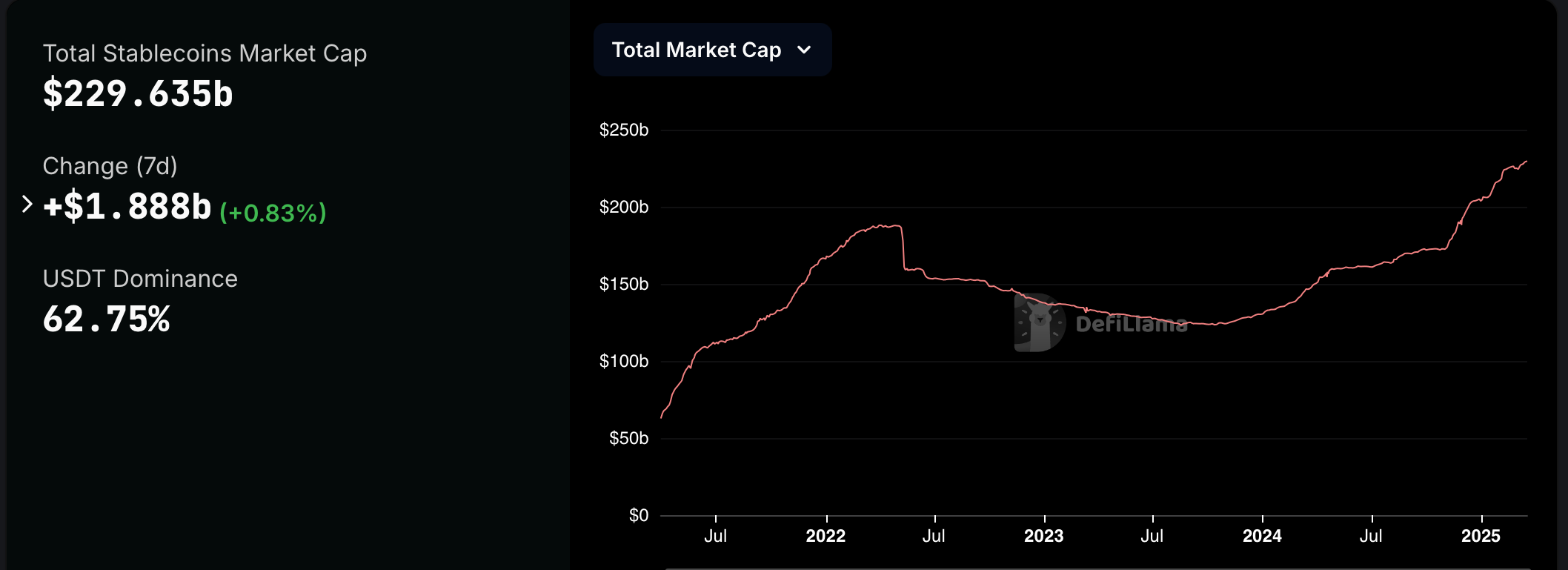
Then there are the stablecoins themselves like USDt and Circle’s USDC (USDC). According to DefiLlama, the stablecoin market cap has grown from $62.8 billion on April 1, 2021, to $229.6 billion on March 18, 2025, a percentage rise of 266%.

70% of EU crypto payments go to retail, food and beverages — Oobit

Stablecoin market cap from April 1, 2021, to March 18, 2025. Source: DefiLlama

These fiat-pegged cryptocurrencies are frequently used in developing countries where the local currencies are being devalued.

As Arthur Azizov, CEO of B2BINPAY, wrote in a February 2025 opinion piece for Cointelegraph, crypto payments may experience an evolution from 2025 onwards. Some key factors to watch out for are the debut of central bank digital currencies, which could push citizens to more decentralized options, and the mesh between crypto payment providers and traditional finance companies.

Magazine: Bitcoin payments are being undermined by centralized stablecoins

Read more at cointelegraph.com

70% of EU crypto payments go to retail, food and beverages — Oobit

70% of crypto payments in the European Union go toward retail, food and beverage purchases, according to a report from Oobit, a cryptocurrency payments platform that surveyed its users’ spending habits.

The report, which denominated all transactions in US dollars, showed that the average payment size using the Oobit app was $8.36, while the average deposit into the app was around $85. After retail and food and beverage purchases, 26% of payments went to tourism-related activities such as lodging, travel and aviation. 1.5% went to government services and digital payments, while an additional 1.5% went to miscellaneous purchases like healthcare and entertainment.

Related: Transak, Uranium.io partnership lets users buy tokenized uranium with crypto

The report notes that the increased adoption of crypto payments is likely due to the growing acceptance of digital assets in the EU, with increased credibility coming from governments passing crypto legislation. However, 92% of payments came by using the USDt (USDT) stablecoin, which has run afoul of the MiCA regulation which went into full effect on Dec. 30, 2024.

Oobit’s report supplements data from Chainalysis, which showed that adoption of cryptocurrency in Central, Northern, and West Europe (CNWE) has grown 44% year-over-year. For transactions under $1 million, the stablecoin market in that region has grown at a rate 2.5 times faster than that in North America.

Related: Conflux Foundation commits $500M to fuel PayFi Web3 payments solution

Micropayments, stablecoins growing crypto use cases

Micropayments, which sometimes use stablecoins, have been a growing use case for crypto. Advances in technology like the Lightning Network, which has permitted quick micropayments in Bitcoin (BTC), and crypto debit cards which offer spending in crypto with “crypto-back,” have spurred this adoption. As Oobit notes in the title of its report, crypto is moving from memes to a means of exchange.

These changes have begun to spur worldwide adoption. In June 2024, Nubank brought the Lightning Network to 100 million Latin American customers.

In June 2023, IBEX partnered with Grupo Salinas to allow millions of Mexicans to pay for their internet bills with Bitcoin. On March 13, 2025, Ripple secured a Dubai license to offer crypto payments in the United Arab Emirates.

Then there are the stablecoins themselves like USDt and Circle’s USDC (USDC). According to DefiLlama, the stablecoin market cap has grown from $62.8 billion on April 1, 2021, to $229.6 billion on March 18, 2025, a percentage rise of 266%.

70% of EU crypto payments go to retail, food and beverages — Oobit

Stablecoin market cap from April 1, 2021, to March 18, 2025. Source: DefiLlama

These fiat-pegged cryptocurrencies are frequently used in developing countries where the local currencies are being devalued.

As Arthur Azizov, CEO of B2BINPAY, wrote in a February 2025 opinion piece for Cointelegraph, crypto payments may experience an evolution from 2025 onwards. Some key factors to watch out for are the debut of central bank digital currencies, which could push citizens to more decentralized options, and the mesh between crypto payment providers and traditional finance companies.

Magazine: Bitcoin payments are being undermined by centralized stablecoins

Read more at cointelegraph.com

Volatility Shares launching Solana futures ETFs March 20

Volatility Shares is launching two Solana (SOL) futures exchange-traded funds (ETFs), the Volatility Shares Solana ETF (SOLZ) and the Volatility Shares 2X Solana ETF (SOLT), on March 20.

According to the Securities and Exchange Commission filing, SOLZ will feature a management fee of 0.95% until June 30, 2026, when the management fee will increase to 1.15%.

Volatility Shares’ 2X Solana ETF gives investors twice the leverage and will feature a 1.85% management fee.

Futures, Solana, ETF

Volatility Shares Solana ETF SEC filing. Source: SEC

The filings represent the first Solana-based ETFs in the US and follow the Chicago Mercantile Exchange (CME) Group’s debut of SOL futures contracts.

Following a leadership change at the SEC and the reelection of Donald Trump as president of the United States, asset managers and ETF firms have submitted a torrent of ETF applications to the SEC for approval.

Related: Solana’s 5th birthday: From pandemic origins to US crypto stockpile

CME Group debuts SOL futures

SOL futures went live on March 17 with a trading volume of approximately $12.1 million on the first day.

For context, Bitcoin (BTC) futures debuted at over $102 million in volume on the first day of trading, and Ether (ETH) futures garnered over $30 million the day they launched.

Despite the relatively low volume, SOL futures contracts could help boost demand for the cryptocurrency from institutional investors and encourage price discovery.

Futures, Solana, ETF

SOL futures volume and open interest. Source: Chicago Mercantile Exchange

The launch of SOL futures signaled the approval of SOL ETFs in the United States as financial regulators embrace digital assets amid a policy pivot.

According to Chris Chung, founder of Titan — a Solana-based swap platform — the CME’s futures indicate that SOL is now a mature asset capable of attracting institutional interest.

Chung added that the launch of SOL futures and ETFs position Solana as a blockchain network poised for real-world use cases such as payments, not just a memecoin casino.

ETFs could also allow investor capital to flow into SOL, creating a sustained rally in the altcoin that competitors lacking an ETF might miss out on.

The launch of Bitcoin ETFs in 2024 is widely believed to have siloed institutional capital away from the rest of the crypto market, preventing capital rotation from BTC into altcoins and upending altseason.

Magazine: Memecoins are ded — But Solana ‘100x better’ despite revenue plunge

Read more at cointelegraph.com

Bitcoin runs toward $86K after Fed maintains course, projecting two rate cuts in 2025

Bitcoin (BTC) price action turned bullish on March 19 as markets grew anxious for the release of the Federal Open Market Committee (FOMC) minutes and a press conference from Federal Reserve Chair Jerome Powell. Cryptocurrencies, Federal Reserve, Central Bank, Bitcoin Price, Markets, Inflation, White House, Donald Trump, Interest Rate

BTC/USDT 1-day chart. Source: TradingView

Generally, traders keep a close eye on FOMC minutes, along with Powell’s comments, to obtain direct insights into the Fed’s take on US economic health, along with their plans for monetary policy and interest rates. 

In the presser, Powell confirmed that the Fed intends to leave interest rates unchanged, in its target range between 4.25% to 4.5%, where they have been since December 2024. 

Although the Fed downgraded its outlook for economic growth and emphasized that tamping inflation remains a sticking point, the Fed’s statements largely aligned with market participants’ expectations. 

Crypto and equities traders have also been forecasting the reduction of the Fed’s policy of quantitative tightening (QT), and the FOMC minutes confirmed that the central bank will reduce “the monthly redemption cap on Treasury securities from $25 billion to $5 billion.”    

Cryptocurrencies, Federal Reserve, Central Bank, Bitcoin Price, Markets, Inflation, White House, Donald Trump, Interest Rate

Changes to FOMC statement (in red). Source: FederalReserve.gov

Related: Bitcoin price volatility ramps up around FOMC days — Will this time be different? 

In response to Fed statements, Bitcoin price added to its daily gains, rallying to an intraday high at $85,950 at the time of writing. 

The DOW also added 400 points, while the S&P 500 index gained 77. Powell and Fed policymakers’ verbal commitment to two additional rate cuts in 2025 also line up with crypto traders’ expectations and could further buoy the current recovery in Bitcoin price.

This article does not contain investment advice or recommendations. Every investment and trading move involves risk, and readers should conduct their own research when making a decision.

Read more at cointelegraph.com

Congress on track for stablecoin, market structure bills by August: Blockchain Association

United States lawmakers are on track to pass legislation setting rules for stablecoins and cryptocurrency market structure by as soon as August, Kristin Smith, CEO of industry advocacy group the Blockchain Association, said during Blockworks’ 2025 Digital Asset Summit in New York.

Smith’s timeline echoes a similar forecast by Bo Hines, the executive director of the President’s Council of Advisers on Digital Assets, who said on March 18 that he expects to see comprehensive stablecoin legislation in the coming months

“I think we’re close to being able to get those done for August […] they’re doing a lot of work on that behind the scenes right now,” Smith said on March 19 at the Summit, which was attended by Cointelegraph. 

“I’m optimistic when you have the chairs of the relevant committees in the House and the Senate and the White House that want to do something and you’ve got bipartisan votes in Congress to get it there,” she added.

Congress on track for stablecoin, market structure bills by August: Blockchain Association

US President Donald Trump sits beside Treasury Secretary Scott Bessent at the March 7 White House Crypto Summit. Source: The Associated Press

Bipartisan support

At the Digital Assets Summit on March 18, Democratic Congressman Ro Khanna said he believes Congress “should be able to get” both the stablecoin and crypto market structure bills passed in 2025.

According to Khanna, approximately 70 to 80 Democrats see stablecoin legislation as important for promoting US influence by expanding access to dollars globally.

“For the first time, those are actually like something we’re able to get done, but to do that, you need to have at least 7 Democratic votes in the Senate,” Smith said, adding that “we already have 5 votes at the committee level.”

Last week, the Senate Banking Committee approved the GENIUS Act, which is an acronym for Guiding and Establishing National Innovation for US Stablecoins. 

The proposed bill sets collateralization guidelines for stablecoin issuers and mandates compliance with Anti-Money Laundering (AML) laws.

In 2024, the House of Representatives passed the Financial Innovation and Technology for the 21st Century Act, also known as FIT21, which sets ground rules for crypto market structure.

The bill still needs to pass in the Senate to become law. 

Executives in crypto have said that the industry will benefit more from US regulatory clarity than even the strategic Bitcoin reserve.

On March 6, US President Donald Trump signed an executive order creating a US Strategic Bitcoin Reserve and Digital Asset Stockpile, fulfilling a campaign promise he made in 2024.

“Markets expect a roadmap for innovation and clear guidelines on stablecoins, institutional adoption and taxation,” Max Giammario, CEO of Web3 artificial intelligence startup Kindred, told Cointelegraph in March.

Magazine: Unstablecoins: Depegging, bank runs and other risks loom
Read more at cointelegraph.com

Cardano (ADA) on verge of 20% breakout as social sentiment indicator hits 4 month high

Cardano’s (ADA) price has managed a steady 13.5% in March after experiencing a 32% dip in February. The altcoin is still down 15% in Q1, but technical data is beginning to point to the continuation of the recent positive price action.Cardano (ADA) on verge of 20% breakout as social sentiment indicator hits 4 month high

Cardano 1-day chart. Source: Cointelegraph/TradingView

Despite ADA price moving sideways between $0.78 and $0.70 over the past 10 days, social sentiment related to the altcoin has hit a new year-to-date high.

Cardano’s “bullish” sentiment soars to 4-month high

According to Santiment, an onchain intelligence platform, Cardano’s social sentiment exhibited its highest positive measurement in four months.

ADA investors received a boost from the US Securities and Exchange Commission’s (SEC) recent comments, which classified Cardano’s use case as “smart contracts for government services.” The SEC statement was followed by ADA’s highest ratio of positive comments since the first week of November 2024.

Cardano (ADA) on verge of 20% breakout as social sentiment indicator hits 4 month high

Cardano’s crowd sentiment score by Santiment. Source: X.com

A rise in social sentiment is often aligned with increased trading activity and, at times, higher prices. In Q4 2024, a rise in positive social sentiment and active transactions went hand in hand for ADA. However, the environment is slightly different right now.

Data from Cardanoscan.io showed a stark difference between the number of active transaction counts from early November 2024 and now. In Q4, the average transaction count remained above 100,000 for most of November and December, but currently, it is roughly down 70%, with the number of transactions coming in at 26,437 on March 18.

Cardano (ADA) on verge of 20% breakout as social sentiment indicator hits 4 month high

Daily transaction count and fees chart. Source: cardanoscan.io

Regardless of the weak onchain activity, Michael Heinrich, CEO of 0G Labs, told Cointelegraph that Cardano’s strength lies in “lobbying” its community. Speaking on ADA and XRP’s inclusion in a US Digital Asset Stockpile, Heinrich said,

“They have time in the game: these tokens have been around for a while, they’re liquid, and they’re unlikely to spring any sudden surprises.”

Related: Cardano’s ADA lands spot in US Digital Asset Stockpile — Will it generate value?

ADA to rally 20% before the end of March?

Irrespective of the underwhelming onchain data, ADA price has been receptive to positive news in the past.

The altcoin has maintained a position above the 0.50 Fibonacci retracement line despite ADA being in a downtrend since its 2024 high of $1.32. This indicates that ADA’s high-time frame (HTF) chart remains on a technical uptrend.

Markets, Cardano

ADA/USDT 1-day chart. Source: TradingView

Cardano retained support from the ascending trendline (black line) while oscillating between its parallel channel. Currently, the immediate resistance lies at the upper range of the channel at $0.78, which is supported by the 200-day exponential moving average (200-DEMA, orange line). A positive candle close above the 200-DEMA on the daily chart indicates a bullish shift, potentially triggering a move above $0.78.

The immediate target above $0.78 lies between 0.84 and $0.88, where a daily fair value gap (FVG) is present. A retest of $0.88 marks a 20% return from its current price.

However, historically, Cardano has exhibited prolonged sideways movement, which could limit immediate gains. A break above $0.78 validates further confirmation for a rally, but until then, the altcoin may continue to range between $0.78 and $0.70.

Related: Bitcoin is just seeing a ‘normal correction,’ cycle peak is yet to come: Analysts

This article does not contain investment advice or recommendations. Every investment and trading move involves risk, and readers should conduct their own research when making a decision.

Read more at cointelegraph.com

SEC’s XRP reversal a ‘victory for the industry’: Ripple CEO

The US Securities and Exchange Commission’s dismissal of its years-long lawsuit against Ripple Labs, the developer of the XRP Ledger blockchain network, is a “victory for the industry,” Ripple CEO Brad Garlinghouse said at Blockworks’ 2025 Digital Asset Summit in New York.

Earlier on March 19, Garlinghouse revealed that the SEC would dismiss its legal action against Ripple, ending four years of litigation against the blockchain developer for an alleged $1.3-billion unregistered securities offering in 2020.

“It feels like a victory for the industry and the beginning of a new chapter,” Garlinghouse said on March 19 at the Summit, which was attended by Cointelegraph. 

SEC’s XRP reversal a ‘victory for the industry’: Ripple CEO

Ripple’s CEO said the SEC is dropping its case against the blockchain developer. Source: Brad Garlinghouse

Related: SEC will drop its appeal against Ripple, CEO Garlinghouse says

Major reversal

The dismissal is the latest — and arguably most significant — reversal by the SEC under US President Donald Trump.

The agency previously dropped charges against other crypto firms, including Coinbase, Kraken and Uniswap, for similar alleged securities law violations. 

Under former President Joe Biden, the SEC brought upward of 100 enforcement actions against crypto firms, typically alleging failure to properly register products that former SEC Chair Gary Gensler said fell under the securities regulators’ jurisdiction. 

Trump has taken a friendlier stance toward the burgeoning industry, promising to make America the “world’s crypto capital” and appointing industry-friendly leaders to key regulatory posts. 

“The new chapter started with the reset at both the Congress and the executive branch […] when Trump came in and nominated Paul Atkins, Scott Bessent, [and] brought on David Sacks,” Garlinghouse said. 

Trump nominated Atkins and Bessent to head the SEC and Treasury Department, respectively. Sacks is Trump’s artificial intelligence and “crypto czar,” a newly created White House advisory role. 

“I really deeply believed that we were going to be on the right side of the law and on the right side of history,” Garlinghouse said of his company’s protracted legal fight with US regulators, adding that, in his view, the SEC was “just […] trying to bully” the crypto industry. 

Now that regulatory headwinds have subsided, Ripple is focusing on expansion, Garlinghouse added. 

“Ripple has invested over $2 billion in investments and acquisitions across the crypto landscape, and some of those have nothing to do with XRP because if crypto does well, I fundamentally believe Ripple will do well,” he said. 

Magazine: Classic Sega, Atari and Nintendo games get crypto makeovers: Web3 Gamer

Read more at cointelegraph.com

SEC dropping Ripple case is ‘final exclamation mark’ that XRP is not a security — John Deaton

The US Securities and Exchange Commission dropping its appeal against Ripple is the “final exclamation point that these [XRP] tokens are considered digital commodities, not securities,” crypto lawyer John Deaton told Cointelegraph.

Deaton added that there is still a $125-million judgment against Ripple over the improper selling of the XRP (XRP) cryptocurrency, which perhaps the company can negotiate down now that the SEC has dropped its appeal.

Deaton is a well-known lawyer who represented XRP holders, arguing that their interests were not being represented in the SEC’s case against Ripple. He’d later run against Elizabeth Warren, a vocal crypto critic, for a senate seat to represent Massachusetts in Washington, DC.

Related: Why is the Ripple SEC case still ongoing amid a sea of resolutions?

Will Ripple drop its cross-appeal?

One factor that will play out going forward is Ripple’s cross-appeal, which was filed in October 2024. Deaton believes the SEC doesn’t want Ripple to proceed with the cross-appeal because a ruling could hurt the commission’s jurisdiction and affect other cases.

That gives Ripple some leverage in negotiating the settlement. “Everything’s turned,” Deaton said. “The election’s turned, the industry turned, the SEC [has] completely done a 180 as it relates to the industry. Why should we pay $125 million?”

However, there still is the issue of the injunction issued by Judge Analisa Torres, which prevents Ripple from selling XRP to institutional investors to prevent violation of securities laws.

“If Ripple obviously wants to be able to issue XRP to banks in America directly, I think the hang-up is that injunction. How do you get past that injunction?” Deaton said.

Related: XRP’s role in US Digital Asset Stockpile raises questions on token utility — Does it belong?

Ripple case was an attack on the industry

“I remember when this case was first filed,” Deaton told Cointelegraph, adding:

“I thought it was an assault on the industry, like the boot on the neck of the industry, and I was confident that it wasn’t going to be just a one-off, that it wouldn’t just be Ripple, that it was more of a message that the traditional finance, the banking system, the Elizabeth Warrens and the Gary Genslers of the world, had it in for the industry.”

He added that Ripple can appeal to the fact that it never left the US even after the SEC brought the case and that it is an American-made company.

“I think it’s to do with Brad Garlinghouse being able to say, ‘Well, look, we got sued by the US government and the Biden administration; we’re an American-made company, you know, [and] we never left.’ And I think that bodes well.”

Magazine: Hall of Flame: Crypto Banter’s Ran Neuner says Ripple is ‘despicable,’ tips hat to ZachXBT

Read more at cointelegraph.com

US needs competitive moat around tokenized RWA — Sergey Nazarov

The United States needs to establish a competitive moat around highly secure tokenized real-world assets (RWAs) to remain competitive in the age of borderless, permissionless finance, according to Chainlink co-founder Sergey Nazarov.

In an interview with Cointelegraph’s Turner Wright at the Digital Asset Summit in New York, Nazarov said that blockchain is a global phenomenon that relies on open-source software and distributed technology, unlike previous technological shifts.

The executive added that the shift to online commerce, which gave the US a competitive advantage due to a five- to 10-year head start on the development of internet infrastructure, is not applicable in the age of digital finance. The executive told Cointelegraph:

“The US really has to push its other two advantages of a very strong domestic market and the ability for it to create these highly reliable financial assets. And this is what I think the administration and the people in the legislature are now starting to understand.”

Real-world tokenized assets could become a $100-trillion market in the coming years, as the world’s assets come onchain, the Chainlink executive predicted.

United States, RWA, RWA Tokenization

Sergey Nazarov takes part in a panel at the 2025 Digital Asset Summit. Source: Turner Wright/Cointelegraph

Related: Ethena Labs, Securitize launch blockchain for DeFi and tokenized assets

Tokenized RWAs reach all-time highs

According to RWA.xyz, real-world tokenized assets, excluding stablecoins, hit an all-time high in 2025, topping $18.8 billion.

Private credit dominated the total RWA market capitalization, with over $12.2 billion in tokenized private credit instruments circulating in the market at the time of writing.

United States, RWA, RWA Tokenization

Total tokenized real-world assets, excluding stablecoins. Source: RWA.xyz

Asset tokenization can make previously illiquid asset classes, such as real estate, more liquid, eliminating the illiquidity discount inherent in physical properties.

In February, Polygon CEO Marc Boiron told Cointelegraph that tokenizing real estate could fractionalize ownership, eliminate intermediaries, and lower settlement costs —transforming the slow-moving sector.

This real estate overhaul can be seen in Turkey, with projects such as Lumia Towers, a 300-unit mixed-use commercial real estate development that was tokenized using Polygon’s technology.

It’s also taking place in the United Arab Emirates, which is considered one of the hottest property markets in the world. Proactive digital asset regulations are driving a tokenized RWA boom in the Gulf state as institutional investors and developers flock to tokenization as an alternative method of capital formation.

Magazine: Real life yield farming: How tokenization is transforming lives in Africa

Read more at cointelegraph.com